Nick's Flick Picks: The Blog

A Sit-Down with Saint Joan
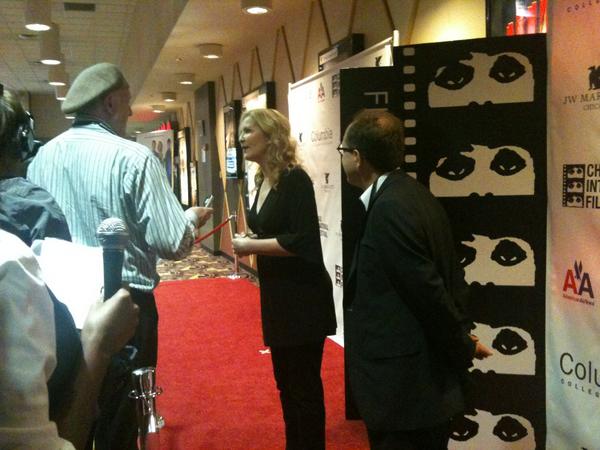 Tonight the 48th Chicago International Film Festival bestowed a Silver Hugo for Career Achievement on the actress Joan Allen, an Illinois native, Tony winner, co-founder of the Steppenwolf Theatre Company, and three-time Oscar nominee. With candor falling just shy of tact, CIFF executive director Michael Kutza conveyed how long he has wanted to give Allen this award. Appearing at the end of a 90-minute career retrospective, he recalled a Steppenwolf anniversary celebration from years ago where he first seized on the idea of the film festival honoring one of that company's crossover stars. "But Gary Sinise is mostly a TV personality by now, and so definitely not for us," Kutza publicly confided, before classifying John Mahoney as even more of a small-screen name and admitting, "Frankly, Malkovich scares me."
While staying all smiles, Allen manifested her signature knack for projecting multiple things at once—in this case, a sincere gratitude at being so warmly recognized and an element of perplexity at this abrupt if comically intended rundown of her close colleagues. At least no one sitting in Screen 20 of the AMC River East could doubt Kutza's admiration for this consummate performer, or take issue with the formal language that came with the trophy: "For dazzling audiences with your radiant performances on stage and screen, whatever the character, genre, or budget." Had this actually been engraved on the silver plating, I would have been able to read it. Showing up early to the ticketholders' line meant I snagged a first-row seat, from which I could literally spot the holes in the buckled straps on Allen's boots.
"Dazzling" and "radiant" indeed in all black, Allen came across as open and easygoing, while still giving something of a performance. She happily offered production-side memories of every movie that the Chicago Tribune's Michael Phillips asked her about, while choosing adjectives carefully for subjects that might have required some diplomacy, especially before a large audience. Most of all, she gave the impression of a cheerful and thoughtful Midwesterner, eager to chat but vigilant against oversharing or impoliteness, fond of her work and touched at the room-filling show of public affection, but rarely inclined to linger over past triumphs. She admitted, for example, to not having seen Nixon (a Nick's Flick Picks favorite) since it premiered in theaters, and a wordless reaction to one of Phillips's questions suggests she hasn't screened The Ice Storm in a while, either. Devotees like myself who have read a lot of Allen interviews may not have left with an embarrassment of new stories, and I don't know why the planners didn't schedule any time for an audience Q&A. Still, the anecdotes ranged far and wide, even when they demurred from going too deep. And as loyal readers knew I would, I managed to get my question in anyway.
The funny, avuncular Phillips was, as ever, an ideal choice to moderate. He has worked as both a theater critic and film reviewer, making him knowledgeable and enthusiastic about both of the arenas where Allen has achieved greatest distinction (though she has made memorable impressions on television as well, in projects like Michael Mann's truncated HBO series Luck and the 2009 Lifetime movie Georgia O'Keeffe, for which she was executive producer). In fact, Phillips recalled visiting Chicago from the University of Minnesota in the early 1980s to see Allen and her Steppenwolf cohort in And a Nightingale Sang..., the play that eventually brought the actress to New York. Meeting her after this performance "turned me into Don Knotts," Phillips confided, before charmingly if unintentionally failing to find the right adjective to capture her flexible, charismatic incisiveness on screen: "She's what I call an excellent working actor," he offered by way of introduction, "who's so... so...," and we all knew just what he meant. The clip-reel that played before Allen's entrance evoked the longevity of her career across bigger and smaller parts, while still hewing closely to the best-known titles on her résumé—a greatest-hits framing to which the conversation mostly adhered.
 Early topics included Allen's admission that it took about five years after her first film role (a small part in 1985's Compromising Positions) to feel that "the penny really dropped" in terms of comfort before a camera. She described the boons of being a student at Eastern Illinois University, where the small size of the program allowed her to tackle during her early college years meaty parts like Nurse Ratched, Laura Wingfield, and even Linda Loman, however "ludicrously" age-inappropriate some of these were. She also got rich educations in lighting, costuming, and scenic design, since the program was geared toward producing jack-of-all-trades theater professors to teach at other schools, and thus forced actors to know their vocation from many sides. Phillips inquired, too, about the ethos and conversations in the early years of Steppenwolf, especially after Malkovich's breakout success in films opened a new route for Chicago actors into national acclaim. Allen described this period as exciting but difficult for the company, with ambitious troupe members somewhat at odds with those who felt protective of the specific identity and talent base of Windy City dramatics. She remembers her own position as somewhere in the middle, glad for New York opportunities and (she wasn't too proud to add) New York paychecks, but more than contented with her lot as a member of a thriving Second City ensemble.
From here, Phillips advanced to questions about the first proper auteurs she worked with, Michael Mann on Manhunter and Francis Ford Coppola on Peggy Sue Got Married (both 1986). Using gingerly euphemisms about the former, which she remembers as "quite a shoot," Allen recalled Mann as a "very, very... driven" filmmaker who would make every day a 20-hour call if he could. Still, she sounded fully sincere in praising his work with actors and his visual eye, even if "we'd make jokes when he'd switch a man's necktie for the twelfth time before a shot." Going from Mann, who barely held rehearsals, to Coppola, who relished and even videotaped them, involved quite a leap. A bigger jump involved getting used to an invisible director: "I remember Francis as one of the pioneers of watching on a monitor, not from behind a camera or near the actors. So someone would yell 'Action,' and we'd be going, 'But where is he?'"
 Around that time, Allen entered a period where her second- or third-tier parts on film and television suited her relative comfort in these media, even as she was headlining and winning major prizes for plays like Lanford Wilson's Burn This, which she played for almost two years, and Wendy Wasserstein's Tony and Pulitzer winner The Heidi Chronicles, where she anchored every scene. Phillips skipped a lot of this supporting-actress journeywoman work in films like Tucker: The Man and His Dream (1988, again for Coppola) or Searching for Bobby Fischer (1993) and moved to that mid-90s trifecta that marked many filmgoers' whiplash introduction to this quiet powerhouse: Nixon (1995), The Crucible (1996), and The Ice Storm (1997). The audience saw short clips of the memorable scenes, respectively, where Pat first threatens to walk out on her petulant husband; where Elizabeth Procter is being hauled off to jail; and where Elena Hood charges her husband, in a rain-battered car, with knowingly taking them to a key party. Among this group, Phillips actually started with the last in the sequence, naming Ice Storm one of his favorite films of the 1990s and "one of the most tonally complex pictures of that decade," a feeling Ang Lee apparently facilitated by keeping his actors off-guard. Enlisting more euphemisms, or else just combing her mind for the mot juste, Allen remembers Lee as "gentle, yes," to use Phillips's word, "but... very... specific, also." Adding, "I think he's maybe a little tougher than people think," Allen recalls him banning actors absolutely from seeing dailies of their performances. "'You don't know what you're doing, but I do,'" he'd insist.
Many readers, I imagine, would have longed as I did for more probing of Allen's less touted projects. She was clearly thrilled when Phillips cued up a clip from Sally Potter's Yes (2004), calling that stylistically eclectic drama, written wholly in iambic-pentameter, "a movie that about 50 people saw," but one that she loved as both a working experience and a final product. Clearly the film was new even for this savvy audience of festival-goers, who might have enjoyed seeing more Alleniana they didn't already know.
That said, Allen's recollections about her Academy-nominated turns in Nixon and The Crucible were among her most detailed and revealing. In the first case, responding to Phillips's query about whether it was difficult to empathize with Plastic Pat, Allen avowed quite the opposite. Reprising biographical details as though she had just researched the role yesterday, she feelingly reported that Pat Nixon lost her mother around age 13 and then nursed her father through the last stages of cancer at 17 or 18, pooling tuition money with her two brothers so that one of them maintained the household while the other two attended college at any given time. They rotated this arrangement until all of them finished. Even so, Pat's acquaintances from youth universally described her as outgoing and "happy-go-lucky"; clearly she was both prepared for marriage to a man who would require lots of careful tending and yet emotionally transformed by that union. Allen described as a cornerstone of her performance a story she heard from a White House consultant who spotted Pat one evening left alone by her husband, dancing by herself with arms outstretched to music that was still emanating from a just-finished state dinner downstairs. In the actress's words, "This was not a president like Mr. Obama, who has dinner with his family every night. Or so we've been told."
 As for crossing paths with Elizabeth Procter, Allen confessed it was a genuine first for her: "I kind of couldn't believe I was as old as I was, having worked so long in theater, and I had never seen or read The Crucible." Forced to audition for the part (indeed, to read many times for director Nicholas Hytner), Allen felt freed by her lack of pre-conceptions about a role that fellow actors kept describing as a trap: "I guess they felt she easily became kind of holier-than-thou, or too pious or something." Unaware of choices prior interpreters had made, Allen simply made the choices that felt right for the script and found out later whether these were familiar ones—resulting in what I still consider a peak performance in a stellar career. I would say the same of Daniel Day-Lewis's lead work in the same film, which may be no coincidence. "People often ask, 'Hey, aren't you intimidated to work with actors like Anthony Hopkins?' or whomever, but I always feel like, 'No, they'll probably make me better!'" This prospect, of course, works both ways, though as Phillips facetiously chirped, "It's a shame you've had to work with so many hacks! I mean, Kevin Kline? Day-Lewis?"
Allen side-stepped a can't-win question about seeking good women's roles in Hollywood, holding to specific comments on particular roles and projects. These ranged from humorous confessions (The Bourne Supremacy was rewritten so constantly throughout production that she didn't even bother bringing her script to the set) to more nervous admissions (she held out against taking Pleasantville, a movie she's now very proud of, because "if there was any typecasting in my work at that point, it was a little bit like, 'The Wronged Wife'"). She probably got her biggest laugh when answering honestly Phillips's probe about whether her 18-year-old daughter has a favorite among Mom's movies. "Oh, I don't know. She hasn't seen a lot of my work. Probably Death Race?" The event's peremptory wrap-up began here, with Kutza replacing Phillips onstage, Allen receiving her as-yet unengraved Hugo, and the audience realizing there would be no questions from the floor.
 I, of course, take the view that God did not give me a larynx so that I could sit in Joan Allen's presence and not engage her in conversation. Close friends will already know the pet question I was eager to pose after sidling up to her, while she amiably signed Upside of Anger posters and posed for iPhone snaps with beaming, seemingly speechless admirers. Struck at close range by her uncanny luminescence (fawning to admit, but completely true), I thanked her for all her tremendous work, and I told her about the great response Bobby Fischer got from my college freshmen last year. I also introduced her to the two new friends I had made while waiting in line, united by our adoration for Campbell Scott's Off the Map, a tender Southwestern memory piece with a never-earthier Allen, a heartbreaking Sam Elliott, and a Nick's Flick Picks favorite, The Wire's Jim True-Frost. "Ohhh, Off the Map!" Allen cooed, hand going to her throat, with (to me) thrilling affection for a quiet little movie I really love, and which waited two years for its minuscule release. "Is there another movie that you're especially fond or proud of that isn't in the group you normally get asked about," I asked, "or that maybe didn't get the commercial shake you feel it deserved?" She laughed and aimed those incredible almond eyes toward the ceiling for a moment. "Well, Searching for Bobby Fischer is certainly one of them. And Off the Map is definitely, definitely another. And the Sally Potter movie, which I was so glad he included," referring to the earlier exchange about Yes. "That's probably the group."
What's wonderful about Allen is that "the group" is in fact so large. She's appeared in so many movies that make striking first impressions and pay such rich dividends on return visits that even 90 minutes is not enough to scratch the surface. Face/Off (1997) and Upside slid under the radar, as did When the Sky Falls (2000), her barely-veiled Veronica Guerin biopic that went straight to video in the U.S., despite her tough, involving performance. We heard nothing about A Good Marriage, the Stephen King vehicle that will soon restore her to leading-lady stature, even if she doesn't necessarily aspire to that. "The thing with The Contender," she stated near the end of her confab with Phillips, "is that even though I was recognized as a leading actress for that role, that's a very 'ensemble' film, which is one of the things I love about it." One of the things I love about Allen is that she still perceives herself as a team player, even as evidence constantly reveals her as a cut above even her most distinguished company.
Labels: Ang Lee, Chicago, Festivals, Francis Coppola, Joan Allen, Michael Mann, Nixon, Oliver Stone
posted by NicksFlickPicks at 3:00 AM
10 comments


 Ang Lee's