Sunday, January 03, 2010

Remembering the 00s: Index

Blogger, as is its wont, is throwing profoundly irritating curveballs, the latest of which is that the archive pages, whether chronological or topic-based, have been so down-scaled that you can't retrieve all the relevant entries. To make sure you still have full access to the gratifyingly popular "Remembering the 00s" series, I am providing my own digest to all of the entries:

2000: Boys Don't Cry, The Cell, Aguirre: The Wrath of God, El Sol del membrillo, Bamboozled, Bring It On, and more...

2001: In the Mood for Love, Shoah, Moulin Rouge!, A.I. Artificial Intelligence, Raging Bull, Riddles of the Sphinx, The Green Ray, The Lord of the Rings: The Fellowship of the Ring, and more...

2002: Kandahar, Xala, The Scarlet Empress, Fat Girl, E.T., FearDotCom, Morvern Callar, Russian Ark, Chicago, and more...

2003: Jackass, The Matrix Reloaded, Dorothy Arzner, 11'09"01, Holiday, The Company, and more...

2004: Monster, The Passion of the Christ, the Cremaster Cycle, Eternal Sunshine of the Spotless Mind, Dawn of the Dead, Dogville, Control Room, Birth + Saw, and more...

2005: Blissfully Yours, Fanny & Alexander, The Gang's All Here + Cobra Woman, Giant, 2046, Grizzly Man, Junebug, Brokeback Mountain, and more...

2006: The New World, Days of Heaven, Lady in the Water, Vinyl, Crank, Jesus Camp, Shortbus, Mary Poppins, Apocalypto, The Good German, and more...

2007: INLAND EMPIRE, Zoo, La Vie en rose, Killer of Sheep, Superbad, Into the Wild, We Own the Night, Lonesome Cowboys, The Mist, and more...

2008: WALL•E, The Dark Knight, Astaire & Rogers, Trouble the Water, Julia, London, The Trespasser, Slumdog Millionaire, Synecdoche, New York, and more...

2009: Notorious, Kenneth Anger, Prodigal Sons, Bright Star, Paranormal Activity, The Muppet Movie, Sherlock Holmes, and more...

Labels: ,

Saturday, January 02, 2010

Remembering: 2009


Encore, encore! Now that 2009 has officially ended and we've spent a day... recuperating, I have to finish off all those series I started that necessarily paused after 2008. I hate to say it'll be a dog's age before I'm posting with the same frequency I did in December, but here's dessert.

Jan 12, AMC 600 Michigan Ave, Chicago, IL
If we don't count W., given its very different agenda, I am pretty sure that Notorious represented my first chance to see a biopic made about someone about whom I had immediate, regular impressions from the moment he first rose to prominence. Much more than that, B.I.G. was someone I admired hugely as an artist, a wordsmith, and, you know, as an indispensable party starter in college. When "Hypnotize" blasted anywhere near a dance floor or a dorm room, I was instantly right in the middle of that, and "Juicy" was a pretty regular playlist jam in grad school. So, I was a hugely excited opening-day audience member for this movie, which unfortunately turned out to be unnecessarily pedestrian, though I completely loved how the movie handled the Lil' Kim arc (that "Get Money" scene is a scorcher), and the chance to hear all those songs pounding through a cinema sound-system was not to be missed. I believe I have made mention before of the AMC 600 Michigan Ave implicitly targeting an audience of black Chicagoans, for which you could read, how AMC600 attempts a kind of de facto segregation of the nearby (and, you'll never guess this, nicer, bigger, and better-maintained) AMC River East. So here's me, a white patron, having a whole conversation with the black ticket-taker where we air our shared impressions of how AMC orchestrates this racial cordoning of their imagined audience. He was telling me about all the black folks who'd been buying advance tickets for opening day for almost a week, once it became clear that the River East wasn't even booking Notorious on any of its 21 screens, despite its emergence, to no one's surprise, as by far the hugest-grossing movie of that weekend. This guy and I were getting along so well. At the end of this chat, he goes, "So, anyway, what are you here to see?" I thought this had been the premise of our whole conversation. I said, "Notorious!" He gave me a quizzical look, and said, "Really?" And I achieved what alcoholics and Jheri-curled contract killers sometimes refer to as a Moment of Clarity, and reckoned with how deeply, deeply uncool I obviously look.

Jan 21, AMC River East 21, Chicago, IL
Maybe I am deeply uncool, because I loved Last Chance Harvey, which was all but thrown away by the admittedly cash-strapped Overture Films, and was never even marketed to anyone who doesn't have personal memories of the LBJ administration, if not Eisenhower's. Mike and I sat in the front row of the main bank of seats; not the ones where you have to look up at such a precipitous angle that it feels like you're blasting off in a rocket, but further back, where you can put your feet on the rail. We loved Harvey, all the more so for the fact that neither of us had expected anything of it. Mike wrote this dear blog entry about the focus-pulling. The focus-pulling! For my part, if you performed a chemical breakdown of my brain, you'd find that at least 25% of it is made up of Middle-Aged Woman, but even without that particular disposition, and even if I hadn't learned an awful lot about divorce and middle-aged regrets from only one degree of separation in recent years, I still think I would have admired the acting of Thompson, of Hoffman, and of Liane Balaban as Hoffman's daughter, as well as the simple but truthful storytelling. This is why I go to ten or fifteen movies a year that have little on the surface to recommend them except someone or other is trying to push them as awards contenders. Most of them are as bad as you're guessing or worse. But then you hit a gem.

Jan 23, Block Cinema, Northwestern University, Evanston, IL
Kenneth Anger's complete Magick Lantern Cycle, starting with Fireworks, on the big screen? Yes, please! You don't pass up an opportunity like that, especially if it means watching a room that is mostly full of college students getting their first look at a legendary short film from 1947 that is candidly about the bloody, sadomasochistic, homoerotic fantasies of a bunch of hunky sailors. Unless the oneiric signals are red herrings and most of this is "actually" happening to the character, give or take having the pulpy cavity around his heart get cut open and probed by an especially avid seducer-tormenter, only to discover that inside his ticker is an actual timepiece. You can see the whole, lurid, vivid piece here and here, but not on projected 16mm, and not with all of Anger's other shorts immediately following, though I unfortunately had to duck out after the third one. Still, a delirious night at the campus rep house.


Feb 12, Bank of America Cinema, Chicago, IL
More virtues of Mike's repertory theater: access to The Goddess, which would otherwise be very hard to come by. All the "Female Brando" hype around Kim Stanley is impossible not to want to know more about, but she only made five movies, and I'm saving Séance on a Wet Afternoon for very near the end of my Best Actress Project. The Goddess was her first movie, and you'll be able to knock me over with a feather if it isn't also her strangest. I took pages of notes watching it from Mike's projection booth, none of which I have done anything with, and there's always the question of how much I'll even be able to decipher from them at this point. But it's a compellingly strange story, another nail in the coffin of the 1950s' ballyhooed "innocence" and "return to normalcy," and, if not quite what I would call a good movie, a completely interesting misfire. I'll be back at Mike's tonight for Pandora's Box with live organ, and hopefully for more of his stellar lineup for early 2010.

Apr 20, Regal Green Hills Cinema, Nashville, TN
As I've already suggested twice, I would probably have flipped for Kimberly Reed's Prodigal Sons in any context, but experiencing her transfixingly honest and incredibly assured documentary with a chance to hear from her and her producer directly afterward at the Nashville Film Festival was especially extraordinary. The audience had just as many questions about gender and sexual identity as about mental illness and relationship maintenance, and just as much for the future of Kim's film as for the stamina of her family. You'll know why when you see the movie, but she was funny, candid, and charismatic in all of her answers. Though I'd never done anything like this before, I approached her immediately after about coming to Northwestern for a presentation of Prodigal Sons to my Queer Cinema class and the Gender Studies Program, and I'm happy to say that in less than a month she and her movie will be here in Evanston. Already one of the looming highlights of my new year... though my own enthusiasm can't have mattered a whit compared to that of Nicole Kidman, who saw either the screening before or the one after the one I attended with an equally impressed Nathaniel R., but whichever one it was, Nicole apparently spotted Kim after, while on her way to the bathroom, and gave her a big, admiring hug.

May 23, AMC Pipers Alley 4, Chicago, IL
When you're lucky, great filmgoing experiences bloom out of movies you're pretty sure you don't even want to see. Admitting the sizable handicap enforced by the fact that I've skipped all of his 1980s career-makers, I just don't get on that often with Jim Jarmusch. And I don't know if there's a single English-language director whose way of talking about his or her films does more harm to my interest in actually seeing them. If it weren't for Ghost Dog (more here), I'd have quit long ago, Tilda or no Tilda. But I had friends who wanted to see The Limits of Control, plus I had read that as a barely-narrative experience of image and sound it rather packed a punch, and I'm always intrigued when a movie I expect to fly in and out of Chicago in a week or two manages to hold on for three or four. So, I went in a group of three, feeling a bit abashed throughout that I was absolutely loving a movie that is so obviously not outfitted to be anybody's cup of tea. Turned out all three of us were feeling the same, mostly concealed enthusiasm: those circles and diagonals! Those colors and angles! The dry, dry humor! I know a lot of folks who are in profound sympathy with the Cannes board's decision to decline Limits of Control a spot anywhere in the festival. I'll want to write about the movie later when I've been through it a second time, but if you're a fan looking for a band of sympathetic comrades, head over to Tim Brayton's great write-up.


Jul 20, Gene Siskel Film Center, Chicago, IL
Communicating volume and vehemence can be tough in print without just getting typographically annoying. But WHY isn't Steven Soderbergh's King of the Hill on DVD yet? And why did barely anyone notice it in 1993, even though everyone I know who has seen it thinks it's a perfectly scaled, deeply felt, refreshingly unprecious film about childhood? As in, not that far from 400 Blows terrain, if you ask me. Why didn't the subsequent explosion of Soderbergh's career, the future "arrivals" of Jesse Bradford, Adrien Brody, and Katherine Heigl, or the curio value of Lauryn Hill as an elevator operator ever convince someone to at least clean the print? Why is Criterion about to drop a deluxe version of Che instead of this? Some questions cannot be answered, but after hauling two dear friends to the Siskel to see this in an extremely rare theatrical exhibition, I at least hoped the movie was as strong as I had described it while selling them on the outing. The verdict: just as good, if not better. Two instant converts and one reconfirmed devotee.

Sep 3, Facets Cinemathèque, Chicago, IL
I'm probably not doing myself any favors by admitting what a harpy and a hypocrite I can be, but I often lay guilt onto local Chicagoan film fans and students who tell me they've never been to Facets Cinemathèque, and yet I've only attended about a half-dozen screenings there in three and a half years, despite having a resounding success on every occasion I recall. This was never truer than with Roy Andersson's You, the Living. It is quite possible that Songs from the Second Floor, Andersson's debut, is just as puckish, innovative, and haunting, but I have to admit, despite liking the film when it belatedly arrived to the States in 2002, no more than one or two images have survived with me. You, the Living was instantly more indelible, and even if that comes down to my being more receptive at 32 than at 25 to this kind of wry, meticulous, bleak, but weirdly jovial static-humor minimalism, I knew I was having one of the most special experiences I'd have all year in a cinema. Hopefully Andersson's next film is coming along nicely, and it won't have to withstand the same two-year hold in the imaginary customs-house of U.S. distribution that slowed this one and Songs so irritatingly after they made such splashes at major world festivals. (I saw this one with Mike, too, so after Harvey, Goddess, and this, he really starts to look like the Angel of Good Fortune in terms of my last year of ticket-buying. Anything he suggests in the near future, I'm going.)


Sep 25, CinéArts 18, Evanston, IL
My Jane! Just seeing the credit "A Film by Jane Campion" shimmering up there on a huge silver screen was like making contact with a long-lost relation or a deeply missed friend. Bright Star very quickly showed itself to be gorgeous, and with the accumulation of chuckly throwaways, precocious yet watchful performances from children, hilarious cameos by our four-legged friends, and the very first triple-pleated mushroom collar that anyone had rocked in Fanny's hometown, I knew I was back on home turf. Such a lovely experience. Too many scenes, maybe, of Schneider's character serving a rather broad structural purpose in the narrative. Lots of scenes of "Is Mister Keats in? No?" and maybe a bit more self-consciously picturesque than is always beneficial, but I still treasure the film. I went with a new friend who happens to be a scholar of Romantic literature, and though she was watching from a very different perspective, snagging on details like Ben Whishaw reciting the words "for ever" as though what Keats wrote was the adverb "forever," she enjoyed it, too, despite some blanket departures from fact. A bonus point since this screening, despite so obviously catering to a crowd of 19th-century period-film enthusiasts, is where I made first contact with the uproarious moment in the Young Victoria trailer where the voiceover narrator helpfully intones, "Based on the true story..." As auditors of Nathaniel's podcast already know, I did not then and have not afterward been able to hear or even remember that line without busting a gut. It's just too funny! I hope Spielberg's Abraham Lincoln movie is also eventually advertised as "Based on a true story."

Oct 3, AMC River East 21, Chicago, IL
At risk of repeating myself, I'll refer you back to my morning-after report about seeing Paranormal Activity in one of its extremely limited-release, guerrilla-marketed midnight screenings on its way to a national release and a hugely laudable $100 million gross. I'm so happy that I saw it when I knew nothing about it, when its considerable scares hadn't remotely been spoiled for me, and when I could root for it as a commercial underdog, once I was finally over the problem of getting scared even while writing about the movie. Probably the single moment in 2009 when I felt most excited to be in a jam-packed cinema—which, given my incorrigible affinity for afternoon matinées, is a pretty rare occurrence for me anyway—and to be in the hands of a filmmaker, a marketing team, and a distributing studio who had clearly thought about how to exploit the environmental and epistemic experience of a movie theater to their fullest extent, and to the clear advantage of the movie. Also, this remains the only movie of last year that terrorized me so thoroughly that I shrieked in the face of the first person I encountered afterward. I know you'd think expect that The Blind Side might have prompted some kind of repeat, but it didn't.


Oct 10, AMC River East 21, Chicago, IL
You know when you're watching a legitimately strange movie when you're thinking as early as the first ten minutes, "Who would even make this?" That's where Raging Sun, Raging Sky got me, though in a transfixed and giddily sympathetic way, as some kind of semi-real, Mestizo-looking gal shuffled around the highways, medians, bus stops, and grassy knolls of Mexico City, tormented by overhearing the thoughts and mutterings of every other person around her. And then it started raining voluminously, and then she met a teenage boy, and then she followed him home and boinked him, and then she evaporated into thin air, and then a whole bunch of steel-gazed, hard-bodied, male cinema patrons and security guards started circling each other in a range of alternately mundane, sweet, and debased situations, having or trying to have or telepathically promising to have a whole lot of sex. I've gotten you about thirty or forty minutes into the scenario of this three-hour movie. We're nowhere close to the sudden blackout, the sudden dessication of all the water in the world, and the sudden coming-to-consciousness of the same characters, or maybe different characters played by different actors, in extreme long-shots of some kind of sun-bleached, granite-heavy prehistory of the world as we know it, visited by Aztec priestesses as well as scaly, half-human captors as well as a buff, nude Perseus of Central America. I totally went for it, as its inclusion on my Best 100 Films of the 00s list will indicate... either because of or despite the fact that a good two-thirds of the sold-out audience walked out, most of them well past the midpoint of the film. Maybe, if Raging Sun, Raging Sky ever becomes possible to see again, I'll conclude that Hernández has made a softcore gay adaptation of an Earth, Wind, and Fire album cover, but his audacity was absolutely thrilling and, to me, buttressed by considerable formal control and persistence of purpose. As the credits rolled, I gave a caustic evil-eye to the old couple down the row, who had loudly lampooned the movie through its last 90 minutes and then wanted to talk to me afterward about all the notes I was scribbling down. But I left it at the hard, disapproving stare. I did not call them out as nasty cynical crows!, cheeching lemurs of near-deafness!, chattering vultures of the apocalypse! So I thought I behaved rather well.

Oct 17, AMC River East 21, Chicago, IL
Another lovely way to experience a film festival is to lap up a strong piece of work as it plays to its most appreciative, studio-starved crowd, and to do so before an unexpected haul of festival awards suddenly makes the movie interesting to everyone else. This was my experience with Tina Mabry's Mississippi Damned, which tries and mostly succeeds as a multi-character, lump-in-her-throat fictionalization of the filmmaker's own past, spent amidst her large family of low-income African Americans, all of them trying just as hard to clear their psychological hang-ups and hurdles as the material obstacles and social contexts that are clearly aligned against them. The film is not the most stylistically innovative you will ever see, and the sort of viewer who sometimes complains, "How could all of this happen to one family?" might push back at Mississippi Damned, notwithstanding Mabry's assurance that she is barely embellishing the details of her own domestic record. The script, especially as buoyed by some excellent ensemble performances, extends an illuminating sympathy to some wrenching betrayals of self and of others that transpire over the film. Mabry's own appealing, low-key cheerfulness and her belief in her work made for a wonderful tonic after such a rueful picture, and I was so glad to watch it in the row just in front of her invited family, co-workers, and friends, who were beaming with tangible pride throughout, no matter how many closets the film rustles through in search of barely-concealed skeletons. Please keep an eye out for theatrical distribution; it won three prizes from the festival jury, including the Golden Hugo for the best narrative feature.


Oct 21, AMC River East 21, Chicago, IL
The Silver Hugo, i.e., the runner-up choice for Best Picture out of 145 films, went to Andrea Arnold's Fish Tank, which also scored the Best Director and Best Supporting Actor citations. I'll have more to say about Fish Tank in the coming year, and if Michael Fassbender can't fight his way to a Best Supporting Actor nomination at the 2010 Oscars, then the system is even more broken than we already know it is. Still, I should admit that part of my lingering affection for the memory of this screening has to do with a rare moment of theological frisson. I forsook my already-purchased ticket to the one scheduled screening of Fish Tank I could attend, because I felt bad about all the work I wasn't getting done during the Festival, but then I was glum for almost a week, regretting having taken the professional high road. "Are you there, God? It's me, Margaret!" I prayed. "Please let Fish Tank win one of the top prizes, so that I can attend some kind of Encore screening!" Does the fact that this in fact transpired, to an absolute tee, mean that I have to start wavering even further in my agnosticism?

Nov 22, Gene Siskel Film Center, Chicago, IL
Derek and I flew my mother out from Washington, DC, to Chicago for an entire week at Thanksgiving, during which we enjoyed making a huge deal of her, introducing her to friends, touring her around our workplaces, and cooking her a big dinner. A much earlier riser than either of us, Mom caught me absolutely unawares with her previously latent actressexuality. She was sleeping in the room with the DVDs and the television, and spent some sunrise hours watching Away from Her, La Vie en rose, Rachel Getting Married, The Talk of the Town, The Double Life of Véronique, The Savages, The Diving Bell and the Butterfly, and, twice, Russian Ark. Not a lot of happy pills in there, though she reports that Rachel was the saddest, because "most of the others were about problems that can't be prevented, but if parents are so screwed-up and self-absorbed that they kind of doom their kids to having that many complexes, then that's even worse. Though I still would have boxed Kym's ears. Many times." So, there's a little piece of Mom. The needed counter-balance of levity came with my surprising her with tickets to a Siskel screening of The Muppet Movie, almost exactly thirty years after she first took me. Expecting a room full of garrulous pups, we discovered that almost everyone in the crowded theater was between her age and mine, and all of us were acting like we were in heaven. If George Clooney or Woody Harrelson or one of their characters ever had to deliver some heart-splitting piece of news to me, I would recommend in advance that they follow it up quickly with a snapshot of Kermit the Frog riding his bicycle, or strumming his banjo on his lily pad, and against all odds, I expect that some part of me would feel a little bit better right away.


Nov 28, Landmark Century City Cinemas, Chicago, IL
As we know, and as I've recently and loudly complained, November and December often prompt a kind of forced march through a series of movies that you half want to see, don't want to see, are disappointed at disliking, or expect to dislike from the get-go, but you're drawn in by the promise of some standout element that other folks have praised. Scheduling can become a bear, if you don't get invitations to pre-coordinated press screenings, so I often wind up piling on the double- and triple-features, even when it means the entire rest of the week or weekend is spent on work, in order to compensate for such dubious gluttony. The day I went to Landmark and watched Fantastic Mr. Fox, Coco Before Chanel, and The Bad Lieutenant: Port of Call: New Orleans back to back to back was emblematic of how at least a couple of days wind up going at this time every year. I wish I had more to show for it than the admittedly great confrontation where Mrs. Fox tells her husband that she loves him but never should have married him, the strong Benoît Poelvoorde performance in Coco and a better-than-expected outing from Audrey Tautou, and the choice but concentrated moments when Bad Lieutenant is as derangedly inspired as I had wanted the whole movie to feel: the breakdance, the iguanas, the line about a "shit-turd" (?), the two accostings outside the same dance club, and a couple of the scenes with Coolidge. Otherwise, the sheer fact of breathing in such a cacophonous triple-feature turned out to be a bit more fun than any of the movies achieved on their own terms. I do love a solidly schizophrenic line-up.

Dec 29, Showplace Icon Theatre, Chicago, IL
And we end with Sherlock Holmes, not, as you know, because I have anything nice to say about that aggressively flippant, poorly executed, and insensible cash-grab but because it at least meant ending the year in a whole new kind of cinema experience. The Kerasotes chain, which I think is Chicago's second-largest after AMC, recently cut the ribbon on a new complex called the Showplace Icon, where for five extra dollars, you get seated in a balcony with a superior sight line, where no one under 21 is allowed to sit, and no one is permitted to enter after the film has started. You also have convenient access to a full cocktail bar and a menu of paninis, gourmet pizzas, meat-and-chase plates, and fresh bits of cooked bacon for your stovetop-roasted popcorn. This all had a rather spurious air of sitting in a Rose DeWitt Bukater cabin of the Titanic, even as the economy of commercial film exhibition, not to mention every other economy, continues to sink. But even if you pay the Jack Dawson price and sit in the main section, you're guaranteed an all-digital projection (which I have to admit, I don't think I want) and absolutely no ads except the trailers for other movies. Since Derek and I didn't really do anything for Christmas, having already gone whole-hog at Thanksgiving, we had the cash to attempt this indulgence. I don't know whether it signals a new horizon for how studios and theater chains will try to recuperate the dwindling experience of in-cinema projection or if it's just a gross emblem of the mass public fetishizing ludicrous amenities at a time when we should all be saving nickels and worrying about any and all infractions of a sustainable economy of scale. Either way, it felt to me like more of a paradigm-shift than being able to see all the way to the back of a passenger shuttle in Avatar. Now we all hang in there to see what comes next, on the screen as well as around the screen, or (gulp) instead of the screen.


Key VHS/DVD Encounters from 2009 (Chronological):
The Mourning Forest, The Flame of New Orleans, Here Comes Mr. Jordan, Flaming Creatures, Band of Outsiders, The Shanghai Gesture, Meet John Doe, The Battle of Midway, Bambi, This Gun for Hire, Holiday Inn, Saboteur, Silverlake Life: The View from Here, The Life and Death of 9413, a Hollywood Extra, I Am So Proud of You, Love You More, Next Floor, In the Year of the Pig, Daughter from Danang, La Ciénaga, The Times of Harvey Milk, Werckmeister Harmonies, A Time for Drunken Horses, Stereo, Eureka, Corner in Wheat, Slacker, Raise the Red Lantern, Duplicity, My Neighbor, My Killer, The Maid, Open Water 2: Adrift, The Sun, Anvil! The Story of Anvil, and A Prophet

Labels:

Thursday, December 10, 2009

Remembering: 2008


The near-end of the decade proves not too late for a series of auspicious firsts: my first festival jurying gig, my first film festival abroad, prompting my first trip to London. These all lead to vibrant in-cinema experiences in addition to the contextual reasons for which they are exciting life-moments for me. It's probably not a coincidence, then, that I feel a bit morose and self-critical about seeing some key late-year releases on official DVD sceeners, which make me feel very prestigious and elite, but I wished almost immediately afterward that I had waited to see what these films would have felt like with an audience. For one, this whole series and the kinds of memories on which it relies would be totally effaced: I remember very clearly how I reacted to The Wrestler and The Class, but I couldn't possibly tell you anything about where or in what mood or in what proximity to other movies I popped them into my DVD player. I hope all the more that the in-cinema experience never goes away, and though I won't deny the exciting kick of an early peek, or the occasional need to see something quickly, or for free, or as a belated catch-up, I'm all the more committed after writing these posts to subsisting on movie tickets, public audiences, enveloping sounds, and big screens.

Jan 27, Kerasotes City North 14, Chicago, IL
I catch a city bus up to where I catch another city bus, riding for a total of about 45 minutes, to a pretty shifty complex, so that I can go see The Golden Compass, which I'd avoided for the better part of two months. Why? It got nominated for the Art Direction Oscar, and I wanted to have an opinion. My commitment papers are probably in the mail.

Apr 25, Landmark Keystone Cinemas, Indianapolis, IN
In Indianapolis as a member of the narrative-feature jury. Because jury decisions for this size of festival are often made partway through the event, so that press releases can go out and extra showings can get scheduled for the winners, I wind up having to see most of the contenders on screener DVDs ahead of time. So my most potent in-cinema experience from the fest is the out-of-competition centerpiece screening of Chris Eigeman's Turn the River, a taut and well-acted character drama that augurs well for what he might do with an even bigger budget and a second opportunity. Certainly the movie implies that Famke Janssen has been under-challenged by almost all of her other roles, though the supporting cast is also very good. Full admission: I had assumed Turn the River earned its slot in the program by having the most recognizable names on the marquee, so it's a particular pleasure to be so taken with the actual film. I learn what it feels like to be on the ground of a new American feature's debut, and though Turn the River didn't get the attention it was due in theaters, it serves notice of the unpredicted potentials lurking in a festival slate.

Jun 16, Landmark Century Centre Cinemas, Chicago, IL
A high point in impromptu double-features, and not only because it's already June and I haven't gotten excited about all that much. Nor should I ignore that the long distribution delays between first reading about these movies and finally seeing them makes it all the more exciting that they both beat the usual rap of postponed releases and all-over-the-map reviews. Savage Grace, for reasons I've described before, is the kind of keyed-up piece of filmmaking, exploring a lurid real-life scenario without really delving into conventional movie psychology, that must have been destined all along for an uneven audience response. But Mike and I both found it pretty formidable, and though he couldn't stick around for The Fall, that one also makes a strong impression with music, sound, and structure. Several passages have trouble summoning an internal momentum commensurate with the colorful reaches of Tarsem's imagination. Both times he's tried, he has put himself at risk of making slightly stuttery, compartmentalized series of tableaus, but I'm more than prepared to keep going with that as an aesthetic, so long as he comes up with spectacles this grand. And the sad but ecstatic finale does ultimately bind the whole movie together as a complex song sung back to a whole history of Hollywood, storytelling, desperation, and stuntsmanship of many kinds, including that of bold imagination.


Jun 28, AMC River East 21, Chicago, IL
It's funny how almost regardless of one's personal passion for the films, WALL•E and The Dark Knight persisted through the year as litmus tests for gauging aesthetic tastes, investments in the Oscars, even national politics. I do remember my viewing experiences of both films pretty vividly. With WALL•E, the immediate, in medias res splash of "Put on Your Sunday Clothes" from Hello, Dolly! was certainly not what I expected, and it certainly landed me and the whole adult audience right in the movie's flat-paneled, mechanical palm. I was as seduced as anyone by the entire phase of the film where WALL•E is alone on the windswept earth, and voluptuously enjoyed the easy but surefire manipulation of the robot running over the cockroach (Oh no!) and the same roach pinging back to life (Isn't this all so adorable!). I had a few problems with Eve: must she have been named Eve, and look like an ovum and an Apple product? Still, I was jubilantly in WALL•E's camp up through the infiltration into the spaceship, where the bizarre but recurring Pixar narrative dispersal into chases, fracas, and hullabaloo kind of pushed me out of the movie a bit. For me, WALL•E represented the steepest, most sudden decline yet in a Pixar movie from an experience I was treasuring to a film I was more than averagely enthusiastic about. Too bad about the increasingly addled and rather desperately optimistic final acts, although blog friend Colin has written quite compellingly about some inherent problems or compromises in WALL•E well before that point. I still went back to see it twice, with basically the same results the second time. I am aching at this point for a Pixar movie that ends even half as well as it starts, which I don't think has happened since The Incredibles, and even that one didn't quite nail the dismount. Still, I can't think of another megapopular corporation, creative or otherwise, that has made such money prodding the American public into such lively but many-sided critiques of capitalist, bureaucratic, and mas-consumerist practices, and it's heartening to see a generation of kids raised with a suspicion of this particular cast of heavies. Even if the young kids at WALL•E didn't seem quite as engrossed as I was.

Jul 18, CinéArts 18, Evanston, IL
I wasn't one of those people who had been keeping myself alive so as to see The Dark Knight, though I did wind up at an opening-day matinée, early enough that I had a seat in the dead-center of a middle row. I had not read a single review and was not expecting such a long film, but much more importantly, I'd had no expectation of being so troubled by the whole experience. I was more upset by The Dark Knight than by any movie I'd seen in a theater since INLAND EMPIRE a year and a half before, and it had nothing to do with the rabid fans or the slightly creepy forms that the posthumous idolatry of Heath Ledger was starting to take. Nolan's ability to make color, framing, lighting, blank faces, and especially urban architecture look unnervingly sinister without most of the obvious tricks really got under my skin with this one, probably because The Dark Knight amplifies these bents within his usual style while also incorporating more sadistic behavior and corporeal blighting than probably all his previous films combined. But worse than that, for me, was the profound charge of the urban mayhem itself: the Joker really did love watching the city burn, and I live in the city that slides so convincingly and pyrotechnically in The Dark Knight into a flaming pit of terrorizing nihilism. I live about five blocks away from where that huge semi-trailer gets upended by the tripwire, and I pass most of the film's key landmarks on LaSalle Street (i.e., the assassination attempt on the mayor) and along the Chicago River close to every day. I have certainly seen many more graphic movies than this, but I'm not going to lie: I was spooked and shaken, and I suddenly didn't like being surrounded by all those people, feeling trapped in my seat. Part of the troubling, rather self-aggrandizing power of The Dark Knight has to do with its potent simulation of the modern city past the brink of outright lawlessness. Though I had lived in Chicago for barely two years by the time I saw this film, I experienced a hectic oscillation between sick, numb shock and panicky fright at seeing Chicago so recognizable, and so aggressively assaulted. Only later, with some distance from the movie, could I reflect on how surprised I was to feel quite that attached to my new home, and so viscerally defensive of it.


Jul 22, AMC River East 21, Chicago, IL
More local color: our previous neighborhood before moving down here to Batman territory, and still an easy walk away, contains the national flagship store for the "American Girl" products, including an American Girl theater and an American Girl museum. This franchise has shown an odd stamina in my life; I used to teach at Wells College in Aurora, New York, the alma mater and pet cause of Pleasant Rowland, founder of the American Girl megafranchise. These days, part of my daily commute involves wending my way through the phalanxes of daughters, granddaughters, grandmothers, mothers, nieces, cousins, and pig-tailed companions, shuffling slowly along the pavements and clutching their dolls, who often look just like them. It's a Big Thing. But that's not why I saw Kit Kittredge: An American Girl, the corporation's first attempt to breach the cinema market. Anything that gets reviews this good, I'm happy to check out, and given that Hollywood seems utterly recalcitrant about making films of lasting value for young girls, I felt good about supporting this one. The movie wasn't absolutely everything I had hoped. Julia Ormond's exquisite performance aside, I didn't see anything here that wasn't roundly outpaced by Steven Soderbergh's admittedly boy-centered but criminally underseen King of the Hill. The one powerful lesson I did take away from the screening, though, is that a 30-year-old man walking alone into Kit Kittredge, in a relatively packed theater with not a single other male of any age inside, is bound to create a discomfiting stir. Hard, glacial stares abounded. No one, not even the kids, seemed comfortable with my being there. I felt like Jackie Earle Haley. Devilishly, it occurred to me to say very loudly, "I want to see this because I support lesbian directors," which was also true, but I just wanted to witness all those frosty, quick-to-judge Moms having to explain that to their little charges.

Jul 24, Gene Siskel Film Center, Chicago, IL
Heaven, I'm in heaven... All of Fred and Ginger's movies were revived all through the summer at the Gene Siskel Film Center, a much-beloved screening space that I'm amazed has not yet made an appearance in these pages. Thinking backward, I guess it's true that the movies I've seen here have rarely been as delectable as the facility itself, or as wondrous as the simple chance to see them: old classics, local and experimental work, penguin-less documentaries, international releases struggling to find a berth anywhere else in the city, and a regular roundelay of mini-festivals, including whole months devoted each year to contemporary Iranian work, African American film, and a European Union Film Festival. Even amid that esteemed company, the Astaire-Rogers series was an absolute high-point of my relationship thus far with the Siskel. For me, the discovery in the series was the deftly choreographed, snazzy, dapper, and wonderfully light on its feet Follow the Fleet. The other discovery in the series: Astaire is a phenomenal dancer, and often fine as an actor, but I can almost never stand his characters, who are always getting Ginger's characters fired, or screwing up their plans or their accommodations, or whining about his own bad luck (re: his off-putting behavior). It hasn't soured me on their partnership, but when I see him walking toward Ginger for the first time in each movie, it's hard not to scream, "Run, girl, run!" But then they start dancing. And then, you know...


Sep 24, Landmark Century Centre Cinemas, Chicago, IL
Trouble the Water is exactly the sort of documentary Chicagoans would normally have to rely on the Siskel to program, but the Landmark came through this time, and it was one of my seminal experiences of the year, from the standpoint of admiring the filmmakers' art and the subjects' profound resilience and resourcefulness, but also because I'm one of those people who was much more deeply distressed by Katrina and its aftermath than I was by 9/11. I was miffed throughout the presidential campaign that year that it remained a Great Unmentionable in so many debates and touring speeches, even though I understand there's little either candidate could have said that wouldn't have been immediately co-opted and distorted by the egregious ways in which Americans and our media talk about race, which are almost as bad as the ways in which we don't talk about race. Poverty and regional prejudice—for example, as in the Northeast's often unconfessed disdain for the South, and vice versa—are also key contexts if not always direct subjects of Trouble the Water, and those aren't really discussable subjects in American public life, either. So what made me furious and despondent during the events of late August in 2005, and for weeks, months, and years afterward, and what makes me continually frustrated about the stunted or flat-out refused acknowledgments of the lessons of New Orleans (and I say this having never even been to New Orleans), also made me profoundly admiring of the movie. I felt gratitude and awe, in the face of Trouble the Water's sure-footedness, its frankness, its grasp that the storm and the flood were the catalysts but not the core of what is devastating in this story, and its non-exploitative immersion in the lives of Kimberly and Scott and the other protagonists.

Sep 26, AMC River East 21 and AMC 600 Michigan Ave, Chicago, IL
It wasn't until I was walking home from my third film in a luxurious day that I realized how profoundly unusual it was that I had just seen three commercial pictures in different genres, all directed by African-Americans. Granted, I found Miracle at St. Anna embarrassingly diffuse even by the standards of medium-grade Spike Lee, and there's not much to be said for Nights in Rodanthe, but it does matter to me that pictures like Miracle still get made and that directors like Lee and Wolfe still have their pick of material, even if I sometimes balk at their choices. Tyler Perry's The Family That Preys, only my second Perry movie after Meet the Browns, which I disliked, emerged as the champ among this bunch, and not just because the other two were, respectively, disastrously over-fussy and hilariously half-baked. I've probably said it enough already, but whatever its limits and its crude constructions of narrative, Family That Preys is quite moving thanks to its cast. I include Perry himself, who gives a tantalizing glimpse of what a solid, affecting actor he can be when this inveterate over-doer suddenly hears the koan that Less Is More. You've probably already gleaned as much from this series, but I just adore it when a film surmounts the expectations, mine or other people's, of its makers or its genre. This one definitely did.

Oct 17, AMC 600 Michigan Ave, Chicago, IL
I don't remember exactly when all the chips of good fortune fell into place to get me to London last fall, or when I knew beyond a doubt that I was going, or when I realized that it would mean missing all but the opening days of the Chicago Film Festival. Global travel, of which I had had none in almost ten years, was one of the few reasons I could think of for missing so much of the CIFF, and I surely wasn't complaining. Making it even easier not to complain, the two screenings I was able to catch were both total home-runs; as it turned out, they both handily eclipsed any of the actual movies I saw later in the month in Leicester Square. I don't know much I could possibly add about my passion for Julia, especially since I'll need to save up some vocab for my Best of 2009 projects. It's been certain for almost 14 months now to feature prominently in those lists, but I'm thrilled that the movie has lost none of its charge. Even the jarring impression of Tilda lurching so blowzily around a dance club, all purple and sozzle and sequin and jade, has remained just as bracing now, on umpteenth replay, as it was the first time I saw it. That means she's not just pulverizing her usual typecasting (and, apparently, her prior preconceptions about her own acting), but that she's truly and durably extraordinary in the part. And the movie gives as good as it gets, to her and to us. I'm so thrilled to have seen this with a sold-out audience. When else would that ever happen except at a festival? I would have been just as happy to see it in its eventual release at Facets, madly and self-righteously speculating about how much people miss by not seeking out movies like this. Instead, I got to experience first-hand all the gasping, tension, and shocked laughter, which confirmed for me not just the electric grip of Julia but the fact that there really is a large audience for "small" movies, if only we can figure out how to bring them together more often.


Oct 18, AMC River East 21, Chicago, IL
Same thought I had at the otherwise extremely different Ballast, which I reviewed here. I'm so glad it has finally arrived on DVD, care of Kino, because I've been itching to have a second experience of this one. Still, that first viewing, with writer-director Lance Hammer and broadly grinning Tarra Riggs in attendance, was a lovely moment of being so moved by a new and modestly scaled piece of work and then getting to say so to the people who made it happen. I sure have my eye on those two. Riggs had a throwaway role as a hairdresser in this year's mini-release American Violet, and though she's very charismatic in her all-but-momentary appearances, with something like 20th billing, you would never know there's a strong, graceful, powerhouse thesp hiding inside that part.

Oct 21, Cineplex Odeon West End, London, UK
London! Hurrah! I arrive at Heathrow and bump almost immediately into Mike Leigh. Clearly a sign from the gods of cinema. We exchange a bemused look, slightly crustier on his side than mine, about the driver holding Leigh's name on a posterboard, who clearly has no idea who he's looking for and is gazing right past him. Get with it, liveryman, this is Mike Leigh. Tim picks me up, takes me to his apartment, gives me my first partial walking tour of the city, during which I try not to look too overwhelmed or too exhausted. We wind up at our first screening, for James Gray's Two Lovers, and though he is more taken than I was, we're so gratified to get to experience the new Gray film together, since The Yards and We Own the Night had been objects of such avid discourse and critical sympathy between us. Two Lovers is followed immediately at the festival by some howlers and then a string of sturdy achievements, but did I mention that I'm in London??


Oct 28, The Screen on Baker Street, London, UK
Perhaps you know the story about how Gomorrah revealed to me that ducking out of a film for an emergency bathroom break is not only something I hate to do, but something that God is more than prepared to punish me for. You better believe I haven't done it again since.

Oct 30, British Film Institute, London, UK
Tim would almost certainly opine, and many would agree with him, that the high-water mark of our filmgoing that festival were the consecutive screenings of Johnny Mad Dog and Wendy and Lucy that we took in at the Ritzy in Brixton. Perfectly sound reasoning, but of course the soft spot in my heart is for Eastman Kodak's restoration, swiped from the maw of total oblivion, of Edmund Goulding's The Trespasser. After Mike Leigh and the doomed pee-break, this is the third and most prodigious proof of divine intervention into my English sojourn. How does it happen that during the two weeks I happen to be across the Atlantic, the BFI hosts the first-ever British screening of this early-era Best Actress nominee, long thought lost to the ravages of depleted celluloid? How did that happen? Swanson is inimitably Swanson through this absurd sudser, which I wish I'd written up at the time. Now I remember it mostly as the vehicle in which she shouts "Beasts! Beasts! Beasts!!" at a horde of paparazzi who have invaded her house. Who hasn't wanted to shout this at someone in their lives? I could not have been more delighted, nor could Tim have been more gently indulgent. As an added bonus, a dear soul called Guy Lodge crosses a hall to introduce himself to me on my way to go see this movie. Someday, Guy, we'll get to see a movie together... and though you'll have divined from previous entries, based on past experience with so many blog buddies, that it's almost certain to be a dreadful film, I'm still looking forward to it!


Oct 31, Cineplex Odeon Leicester Square, London, UK
Dog me, argue with me, fire your slings and arrows, say all kinds of unconscionably profane things about how wrong I regularly am on this site. I've heard worse. Just don't tell me I was part of a "backlash" against Slumdog Millionaire, which I saw a full month out from its U.S. debut. Tim and I had gotten some wires crossed and missed each other at the start of the show, so I ducked in without him. I wasn't even sure he was anywhere in the house, but I was worrying in my upper-balcony seat (it's that kind of cinema), what if he is loving this thing? How will we speak about this? The other critics at the press screening, who surprisingly numbered somewhere in the hundreds, appeared in general to be lapping it up. Total hometown leniency for the British Movie That Could, I'm guessing. As you already know, I was despising it pretty much through and through, from the utterly implausible and logically torqued premise to the grotesquely danced and haplessly edited "Bollywood" finale. I hop downstairs and locate Mr. Robey. We walk for a few minutes in silence, and at last he says, "Wasn't that just... horrid?" Bless.

Nov 2, The Barbican, London, UK
My last screening in England before returning home, and not only am I thrilled to see it in its home country, it's the kind of gobsmacker that the actual festival never quite yielded—though my mood was so good through the whole trip, it had hardly bothered me. The movie was Hunger, and even if Tim hadn't already raved about it, I would have been compelled by the staggering, minimalist posters that had been limning the Tube stations the whole two weeks I'd been in town. One would be forgiven for confusing these ads with sheets of brown butcher-paper. You had to pay attention to see "Hunger" in blocked white font in a bottom corner. Austere, to say the least, but viewers of the film will find the spare but oddly beautiful aesthetic hard to second-guess. I admit I'm delighted to fly back home with a new near-masterwork tucked away in my brain. I land in the U.S., and less than 24 hours later, we've elected a grand new president. Everything is right and wonderful. Every single thing is fantastic.

Nov 10, CinéArts 18, Evanston, IL
One last trip before the year is out, this one to Synecdoche, New York, a destination that few people will want to entertain. I had actually meant to see it in London, but so many regular ticket-buyers had paid to see it that our press badges proved useless. No room at the inn, and in retrospect, thank goodness. Who would want to squeeze this in between four hours of Che and 90 minutes of Gloria Swanson? (And Guy, I would have missed you. That's divine intervention #4!) I frankly wasn't inspired by the stills I'd been seeing or the précis I'd been reading, so as the first reel unspooled back on my home turf, and the grey, constipated miseries of Caden Cotard started accreting, I couldn't have been more surprised at how strongly the movie was hailing me into this strange, drab, lugubrious, but peripherally magical world. It's awfully hard to argue with anyone who finds Synecdoche entirely too dour, and much too repetitive of Kaufman's prior conceits and Hoffman's seemingly endless train of sad-sacks. But there's a smallish camp of us who can hardly bear the weight of Caden's sadness, or the heaviness of his protean but impossible stage-show (which is also his life), or the dolor of all his lovers and friends, or the grim possibility that Caden might not even exist, except as the furrowed and flailing alter ego of somebody else, harboring equal reserves of disappointment and grief. When I say, we can hardly bear the weight, that's an unexpectedly good thing. I marvel at what a potent emotional experience Synecdoche, New York is for me, and though I fully sympathize with other viewers who yearn for a more supple directorial style, I realize how tremendously in awe I am of a picture that can conjure such a crashing wave of affect despite looking and feeling, from shot to shot and scene to scene, so careworn and undistinguished. That's not to impugn the exemplary craft of Mark Friedberg's sets, or any of the other off-center, frayed-looking, or self-effacing proofs of savvy craftsmanship. Synecdoche is unquestionably elaborate, but it's almost impossible to extract any single image that doesn't look embarrassingly prosaic. To me it's a kind of sad miracle: the magic of this film, unrelieved and overcast though that magic is, comes not from the images, the cuts, the exacting and intricate script, or the precise performances, but from the heaving, groaning, pining spaces in between all of those things.


Key VHS/DVD Encounters from 2008 (Chronological):
A Star Is Born ('37), The Lost Moment, Petulia, 7 Women, Imitation of Life ('34), The Champ ('31), Smart Money, I Am a Fugitive from a Chain Gang, The Bitter Tea of General Yen, The Miracle Woman, Little Women ('33), Once Upon a Time in the West, The Thomas Crown Affair ('68), Mandabi, Unrelated, Secret Ceremony, Arise, My Love, The Misfits, The Hurricane ('37), The Wrestler, Chicago 10, and The Class

Now, with any luck, I still have screenings and rentals worthy of this series awaiting me in the next three weeks... so stay tuned till the very end of the year, when it makes the most sense to be Remembering 2009.

Labels:

Wednesday, December 09, 2009

Remembering: 2007


Not my richest year of revival- or repertory-house screenings, which means that even more so than usual, almost all of my most resonant memories arose from first-run releases. Many people look on 2007 as an exemplary year for film releases in the U.S., and I'm inclined to agree, though I seem to have gotten excited about a different slate of movies than most. Still, this is also the rare year when the new stuff I was experiencing in cinemas could go proudly toe-to-toe with the best of what I rented from the world's back catalogue. In truth, though, I just wasn't renting much, since 2007 significantly outpaced any previous year of my life in terms of just how many times I bought a movie ticket. I apparently wanted my 30th year of life to be one big celluloid dream. And why not?

Jan 26, The Music Box, Chicago, IL
There aren't many filmmakers whose equivalents of INLAND EMPIRE I would want to see. Frankly I was amazed how receptive I was to Charlie Kaufman's, which I never imagined he had in him to give, but that's a tale for next time. Anyway, hot-wiring a film from the most raggedy, morbid, undecidable, scarifying transmissions from one's own artistic id is virtually the definition of self-indulgence, but if Lynch were only making movies for himself, then why would I be so alarmed and shaken by them that I left the theater, hopped on the city bus, and cried all the way home? I'm not giving up my diegetic theory about the "story" behind this movie, because I have to have something left over for my academic publishing ambitions, but despite that coy (non-)admission, I think INLAND EMPIRE is even more resistant than Mulholland Drive is to "sense," and I doubt I'd want the film any other way. Maybe the Polish bits could be a tad less opaque. That I'd live with. But as rusted, sharp-edged, and fearsome as INLAND EMPIRE appears during its most confrontational moments, and as hearty as you'd have to be to even film this, assemble it so, and promote it in such unusual ways, it also has a definite house-of-cards quality. With just one less scene, or one altered rhythm, even among the least legible parts of the movie, who knows whether the furious affectation of Grace Zabriskie or those abject hotdog parties in the backyard or The Locomotion or The Face or the sidewalk monologue or "Sinnerman" would explode as forcefully as they do? What if everything's a trigger for everything else? I came back three times, and I harbor a fantasy of reserving a whole night this winter for all the extra footage on the DVD. But I'll have to do it when I've built up some reserves of stabilizing emotion, since INLAND EMPIRE eats that stuff up and spits it out.

Mar 2 and Apr 6, CinéArts 18, Evanston, IL
Who knew that the ship-shape Evanston moviehouse would start feeling like such a flea-hole, if only because two such proudly disreputable pageant-provocations threw down stakes within a month of each other and dared everybody not to look? Granted, a lot of people didn't look, but I can't figure why not. Black Snake Moan was an absolute corker of not-quite-sleaze, and if I didn't go as far as some in seeing an apotheosis of moral inquiry, I still had the biggest whale of an unexpected good time that I'd had since Crank. As for
Grindhouse, a slip-up on Moviefone had reported it as a three-hour affair, rather than four, so I made myself pretty dangerously late for an evening appointment by refusing to budge from my seat. Ironically, this involved a self-sabotaging show of loyalty to the Tarantino component, Death Proof, which is the part I didn't like; to me it signaled his increasing slide into the kind of self-flattering virtuosity and barely recuperated sadism that came to fuller, evil flower in Inglourious Basterds. I was pretty thrown by just how much and just how long he wanted to immerse us in the terror of those women, notwithstanding the fact that Zoë Bell comes across as the final word in Gals Who Can Take Care of Themselves. And even this was much preferable to all the talking talking talking talking to no discernible purpose in the first, draggy hour of Death Proof. But Planet Terror was a squishy, pulpy, frenzied, and funny bit of merriment, the interpolated fake trailers were a reason in themselves to see the movie, and I was generally amazed at how much stylistic work and jovial wit had gone into making this seem like four hours in a dank dive. Absolute entertainment, and I'm sorry more people didn't catch the wave.


Mar 17, Landmark Century Centre Cinemas, Chicago IL
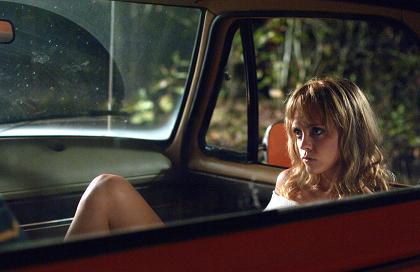
The title of Zoo turns out to be pulling duty as an adjective, not a noun. People who are "zoo" obtain erotic pleasure from contact with animals. One can scarcely imagine how the four-legged partners feel about this; from the humans' point of view, it can go extremely well to extremely poorly, as in the case that kick-starts and structures the documentary, wherein a man was dropped off at a Pacific Northwest hospital, bleeding to death on the inside, after his intestines were perforated by a horse. I'm sure you can figure out how that happened, though you may or may not want to. Robinson Devor, working different sides of his unusual imagination than I had observed the previous fall in Police Beat, had constructed the most boundary-pushing documentary I had seen in years, less because of the subject matter than because of the oblique, abstract, willfully shrouded way in which he chose and/or was forced to communicate the essentials of this story, and to suggest the extremely perplexing desires that set the agenda for all of these adumbrated interviews, on-screen aliases, confounding testimonies, and darkly lyrical images. I saw it in the theater with about ten people, of whom I seemed to be the only one who had wandered in from Away from Her, still packing 'em in down the hall. Very subdued and furtive mood in the cinema before the lights went down. I expect this is the closest I will ever come to feeling like one of the enthusiasts who congregate like phantoms in Cronenberg's Crash to see something they know they "shouldn't" be looking at, but they can't help being fascinated.

May 25, AMC Empire 25, New York, NY
High time for some lighter fare, though, so after Derek and I jaunt to New York City for the wedding of two dear friends, Nathaniel and I make an evening date to catch Once in the AMC Empire. The movie is so soothing, seductive, charming, and rueful that we're completely in its hands, even as two audience members on the other side of the cinema get into a verbal spat that intensifies until the theater managers and someone with a badge eventually intercede. Still, the Broken-Hearted Hoover Fixer Sucker Guy is absolutely more compelling than the midtown nutjob who is losing his mind on the other side of the row. Once stayed put from this point forward as my favorite movie of the year, and I was so ecstatic that my one, very rare bit of immediately post-screening awards prognostication came true. "I can't wait to see them sing that song on the Oscars!" I gushed, and though Nathaniel looked at me like I was crazy, and it must be admitted, I've grown so errant as an Academy forecaster that he had every reason to doubt me, I felt in my bones that this one was too good to pass up. However it happened, I can hardly evoke the pleasure of watching Glen and Markéta actually win nine months later, as though our evening at the Empire was the moment of film-loving conception that eventually, right on time, produced a tiny, naked, gold-plated baby.


Jul 4, AMC River East 21, Chicago, IL
Derek and I are forced to move, again, because our first landlord in Chicago decides he likes our unit so much he wants to move back in himself. It's a blessing in disguise, though, because we find an affordable rental in the Streeterville neighborhood, which in Chicago terms is a little like finding a golden ticket in your Wonka bar. It turns out, of course, that the building had things to hide, and a year later, we were moving again, after the property group announced the sale of our entire building to a boutique hotel chain. But that year, albeit a kind of evanescent mirage, was a grand ol' time of living down the street from the Hancock Building, the old water tower, and Oprah's pad. Also, it was the only time I had ever lived within normal-person walking distance of a major multiplex, and also the first time I had lived less than 100 yards from a beach. (Yes, in the summers, Chicago is a beach town. Seriously.) Right after we moved, before the phone or the internet were even working, Derek had to ship off to visit a friend in New Orleans, and I enjoyed this blissful week of being totally cut off from everything while relishing the comforts of my own home. The apotheosis of that week involved reading The Ambassadors for three hours in the sun in between dips into Lake Michigan (not, to all minds, the most health-conscious choice), and then shaking the sand out of my clothes and padding over in my flip-flops to see A Mighty Heart. As you already know, I love me some Winterbottom, and this one's as good as most of his best. The other effect of living this close to the huge AMC hub is that the bar for what I'll pay to see in a theater gets lowered even further. I quickly learn this the hard way, after taking a chance on the mothy-looking Evening. Very close to a pure waste of money, which is shocking considering the assembled talent, but at least I was home inside of a quarter-hour, contentedly popping something else into the DVD player to wipe all the syrup from my brain.

Jul 21, AMC Pipers Alley 4, Chicago, IL
I leaned over to Derek as the flashbacks and flash-forwards in La Vie en rose started getting totally entropic, and the years became harder and harder to follow. "1492!" I whispered. "1066," he said. "2046," I said. I wanted Edith to keep suffering in the far future, and maybe even the prehistoric past. Barely less funny to me was the way in which the English subtitlers had refrained from translating almost any of the song lyrics, but had helpfully let us know that the captions that said "septembre" or "décembre" referred to September and December. Still, what neither of us understood was that despite our shared bemusement at this rapidly era-hopping film was that we were otherwise reacting in totally different ways. He couldn't believe I had liked it when it was over, and assumed I was kidding. I was just barely less surprised that he'd hated it so much. I've made clear in the past that I think Cotillard is astonishingly vivid, detailed, and emotionally acute at etching Piaf's oscillating levels and contexts of distress, but I even think the film itself works adeptly as a kind of centrifugal storm evoking all of her demons. The movie and the woman are dizzying and relentless and more than a bit histrionic, in a way that reverberates in her astonishing vocal deliveries and her vast portmanteau of stentorian laments. I also think the handheld camerawork and the potentially clichéd color palette of blacks, golds, ombres, and deathly whites come across magnificently. Derek, on the other hand, couldn't take the kitsch, the length, the emotional garishness, the restless frames, and the overall self-seriousness. And he's never let me forget my admission that by the time she's hunched over and talking to that beach reporter about love, she looks kind of like a Fraggle. A notably huge divergence of response, but given how transparent your friends' reactions usually are while watching a film, much less how transparent the larger crowd usually is, I tend to get excited when my viewing partner turns out to have had a decisively different experience than I did of the same movie at the same time, without me so much as noticing. Those are always good conversations.

Aug 15, The Music Box, Chicago, IL
Myth come to life: Milestone Films, God bless, brings out Killer of Sheep for its first-ever theatrical run, and it's as stunning as everybody has always said while the film was notoriously out of circulation. It took me two visits to really absorb how poignant and finely drawn the picture is, because the combo of shoestring realism, narrative elision, and heightened poetic sensibility was not quite what I was expecting. I adore a film that, beyond furnishing a gripping emotional experience, actually teaches me a new way to watch movies, or an entirely new paradigm for how movies can take shape. Killer of Sheep is like Rossellini or De Sica rendered in a blues key and roughed up a little around the edges. Roughed up at its heart, too, as we detect in that long, slow dance to "At Last" that Henry Gayle Sanders and Kaycee Moore share in their living room, even though we sense that they're hearing the music and its message in very different ways.


Aug 25, AMC River East 21, Chicago, IL
While Derek hangs out with a friend of ours who is visiting, I take her 15-year-old son to see Superbad. We are both asked for our IDs, to confirm that we're old enough to see the movie without our parents. For those of you just joining this site, I was two months shy of hitting 30. I am happy to take this as flattering, and certainly more memorable than anything that happens to me for the next two hours, unless you count the photography in Superbad being so cruddy that I still can't fully shake it.

Sep 4, AMC Pipers Alley 4, Chicago, IL
If Zoo was a great experience of seeing the documentary form pushed into new levels of effective abstraction and sensual distillation, No End in Sight was about as workmanlike as possible at presenting crisp, clear, but impassioned facts in the shape of a pristine argument. Probably like a lot of you, I always felt that the Iraq War would be and has been an unmitigated disaster, but No End in Sight brought a completely different and authoritatively textured perspective to the dynamics of government, sociology, employment, and national morale across Iraq that deepened my sense of how war came to pass and why this gruesome boondoggle is so particularly complex, pronounced, and self-reinforcing. You can feel that Charles Ferguson is more of a policy wonk and a researcher than a born filmmaker, but that's barely a blight on the movie's lean, candid cogency, and no blight at all on its power. The question holds, of course, why the national media has, for virtually all of the 00s, fallen so egregiously short of this example of historical seriousness, nuanced dissection, and the value of speaking from verifiable facts rather than rhetorical sentiments.

Sep 8, AMC Pipers Alley 4 and Landmark Century Centre Cinemas, Chicago, IL
Here were two more documentaries that worked in different ways, more narrativized for emotional effect and audience identification than a current-affairs exegesis like No End in Sight, and much less formally or thematically daring than Zoo. Louise Osmond and Jerry Rothwell's Deep Water would also rank extremely high on the list of movies that I've recommended most often this decade, even though it's been barely two years since I saw it. The astonishing true tale of an ill-trained English sailor attempting to circumnavigate the globe at the end of the 1960s, hoping heroically and pitifully to save his family from poverty by winning the cash prize attached to this maritime race, is such a corker that just describing the opening beats of the tale to friend after friend, students and colleagues, has been enough to force their notepads out of their purses and pockets to make a careful memo of the title. What took me aback upon seeing it was that its story translates with such remarkable lucidity and prodigious dramatic force—for me, Donald Crowhurst was the grand tragic figure of a full year in cinema, well out front of Daniel Plainview. I had no trouble reciting the full narrative sequence in order to anyone who asked, even as weeks and months passed. Thank you, Weinstein Company, for burying yet another movie that should have been a surefire hit, at least by the terms of its genre. More visible to audiences and more frequent on year-end best lists was The King of Kong: A Fistful of Quarters, which turns out to cut a few major corners in styling the Billy Mitchell-Steve Wiebe showdown for maximum audience delight. But delightful it is, full of dialogue I wouldn't trust any paid screenwriter to devise, and pushed along by a narrative of the haughty tyrant and the decent, damp-eyed aspirant that satisfies tremendously, despite the bluntness with which the film draws its lines and makes evident its sympathies. I am proud to say I started a round of applause at a key moment in the film, at the eleventh hour of the eleventh hour, that spread through the whole auditorium both times I saw The King of Kong. I basically blurted half the plot of this one, too, to anyone who would listen or even half-listen over the next several months. Often you can gauge the best acts of storytelling by your desire to inherit the tale and pass it along as your own.


Sep 28, AMC River East 21, Chicago, IL, and CinéArts 18, Evanston, IL
Until very recently, the website for my public high school had a link on its webpage to a list of distinguished alumni, and #1 on the list was Chris McCandless, the doomed protagonist of Into the Wild. If you have seen the movie or read the book, you can imagine what a bizarre thing this is for a school to claim about itself, and how much Chris would surely have loathed being so designated, unless he took it as deliciously wicked irony... though "irony" seems not to have ranked strongly on the list of Chris's endowments. I was excited enough about the film to go see it downtown at 10:30am on the Friday it opened. There were about 20 of us in the audience, and we slowly registered varying states of alarm about the man sitting just two rows back from the gigantic screen, who was repeatedly rising from his chair, ambling around, and then re-seating himself, in a manifestly erratic mood. The closer I looked, I could see that he was sticking his hand in the pocket of his sweatpants and then seeming to sniff something out of his palm. A few patrons left, most of whom returned, having obviously notified theater staff. He was taken out by a manager, but then, 10 minutes later, as Chris headed to South Dakota, he returned. Farting loudly, so loudly that even Eddie Vedder couldn't drown him out from full across the room, this guy then turned to face the rest of us, strutting back and forth across the walkway in front of the main bank of seats, and patting himself ostentatiously just above his groin. In movies, this always means that someone is either concealing a firearm or wants you to think he is. By this point, Chris McCandless was working for Vince Vaughn in South Dakota, and I thought, "What would Chris have done in this situation?" I decided he would have stuck around, in the interest of seeing something spontaneous and exciting and "real" unfold. This was as clear a signal as any that the prudent thing to do was to cut bait on the movie. I left, passing some policemen in the hallway, and caught the shuttle up to Evanston. I'm so glad that I go to the movies so often that most of the local ticket-sellers recognize me, so that when I say something crazy like, "I was trying to watch this film downtown, and some guy started snorting drugs out of his hand and play-acting that he was about to shoot us," they respond, "I'm so sorry, baby. Why don't you go in and catch the rest of our show." So I've seen Into the Wild once, except for 15 or 20 minutes in the middle, which I've seen twice, in two different towns.

Oct 6, AMC River East 21, Chicago, IL
My defining film of the 2007 Chicago Film Festival, the first fest I ever hit full-on, was Esteban Sapir's The Aerial (La Antena), which never secured a theatrical release in the U.S. Even the DVD is only obtainable in a PAL pressing from Europe, which is too bad, since whatever people found charming about Jean-Pierre Jeunet's or Guy Maddin's eccentric experiments, and whatever cosmetic allure and Otherworld kick they located in Pan's Labyrinth or Coraline, I feel pretty sure they would derive something similar from Sapir's trippy dystopian fantasia where no one has a voice (literally) and they're being gorged on cookies that are mass-produced by the corporation that, you know, Owns Everything. The styling as a latter-day silent film is witty, but not in a way that leans esoterically on rarefied knowledge; anyone could get it, even kids, and the movie is full of surreal flourishes like characters with TVs for heads and boys with no eyes. I saw it with Goatdog, with whom I have an infinitely higher success-ratio in movie-watching than I have pulled off with most of my other blog buddies (although if it makes you feel better, Tim and Nathaniel, Mike and I have sat through a whole lot of awful dogs in our Oscar-directed DVD rentals). We both left the theater feeling plucky and propped up by such a pure act of unusual, resourceful creativity, and while I hope The Aerial will in some way or other find an audience, I hope just as much that Sapir has a second try at a feature-length film, and that it has more luck penetrating the commercial market. The whole, sizable audience at CIFF was obviously charmed, and I kept hearing people talk about it over the next two weeks of other screenings. Consequently, though I send Sapir best wishes for future success, there's a part of me that feels admittedly jealous and protective of having had such a rare, invigorating peep at something almost no one else has gotten to see, least of all in a cinema. Please don't think I ever forget how lucky I am to live here.


Oct 12, AMC River East 21, Chicago, IL
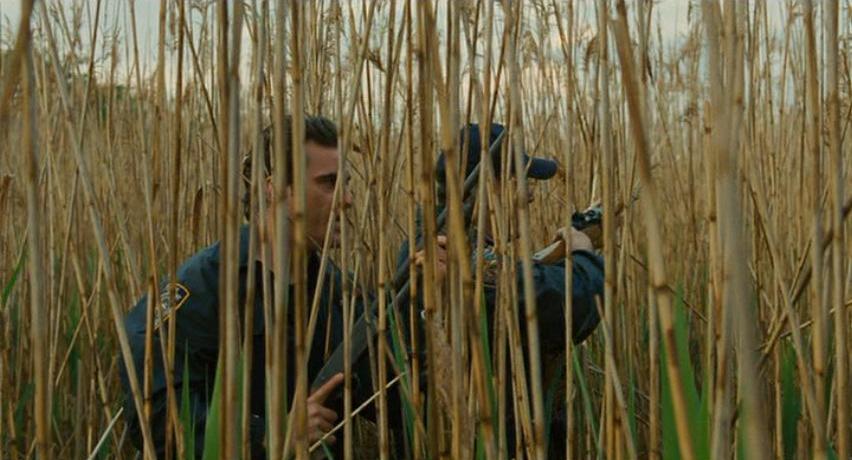
What's strange about film festivals is that you can sit in the audience for a sublime piece of pop-genre filmmaking like James Gray's We Own the Night in its first weekend of release, with only about a dozen other fellow filmgoers, knowing that a Roy Andersson movie or a documentary about marathon runners is playing down the hall to a completely packed house in one of the much larger screening rooms of the same mainstream 'plex. It's like Opposite World, but then, almost every mental association I have with We Own the Night has connotations of Opposite World. Like, why did this movie bomb when it was decently well-sold as an action policier, the kind that usually fares much better even when the reviews are much worse? Then again, why were most of the major American critics so quiet, and why have they only started speaking up on Gray's behalf in the wake of Two Lovers, which strikes me, self-righteously, as a patently thinner work than either We Own the Night or The Yards, which almost all of them brushed off? If there's one mainstream American movie from the last few years that I wish I could convince more people to watch, it's this one. If anyone has recently seen a better-constructed car-chase sequence (okay, it's not quite a "car chase" per se, but it sure feels like one), I'd love to hear about it. And ditto for the ingenious framings, edits, and atmospherics that make so utterly fresh and indelible the entry into the nightclub, the scene of Wahlberg returning with groceries, the scene of Phoenix infiltrating a drug-packing operation, the glimpse of a major character buckling quietly but absolutely under escalating pressure, and the final sequence among the hollow, hay-colored reeds.

Oct 17, Harris Theatre, Chicago, IL
Readers of the past few years will already know the story of my dreamy encounter with Laura Linney at the festival's closing-night premiere of The Savages. I won't reiterate the details here, but I was thrilled for her when her number came up on Oscar-nomination morning, and though I have since seen a staging of Don Giovanni, one of Benjamin Britten's Owen Wingrave, and a Step Afrika concert in the same theater space, for me it'll always be Laura's House.

Nov 17, Facets Cinematheque, Chicago, IL
Lonesome Cowboys was the biggest popular hit that Andy Warhol ever had. It screened in a good number of "regular" theaters in 1968, which serves to indicate just how weird the history of popular narrative film and of American exhibition really is, without having to dig all that far back through the decades. It's unimaginable to me that something like Lonesome Cowboys could advance so far in today's distribution economy, but it's awfully fun to speculate how American cinema might have changed if Cowboys had really augured the kind of major paradigm shift in gender, sexuality, and their iconographic representations that many Warhol enthusiasts clearly hoped for. Viva is total hell on wheels in this one, but like all the Warhol films I've seen (save for Flesh, not officially directed by Warhol), the particulars of the movie are pretty hard to retrieve, even just days after attending the screening. It's more a feeling I hold onto, since almost any time I encounter Warhol's legacy in gallery art, in print, or in film, I wind up having a totally different impression of what he was about, what he might have gone on to do, and what I feel about all of it. Cowboys is largely prankish, but there are sharp edges of permanent loneliness and of misogynist cruelty streaked across it. For a movie that looks so stylistically half-assed and stapled together, for a movie it's hard to even recollect in its specifics, it still serves as quite a think-piece.


Nov 24, AMC River East 21, Chicago, IL
I'm so glad I defied my early instincts as well as most of the reviews I'd been reading and went to see The Mist, and I'm glad I broke my usual rule against Friday- or Saturday-night movies. Howling with a full, gregarious audience at the movie's absurdities and its obviously fake creature effects was an unexpected pleasure, especially since the film seems in on its own joke, or even a bit metacritical about the complex pleasures of camp. But then, sitting silent and stunned in my seat by the movie's concluding movements was an even more impressive experience. I'm not being churlish or purposefully provocative in saying that the conjuration of hopelessness and existential drift at the end of The Mist packed a much bigger punch for me than what the Coens pulled off in No Country for Old Men, a perfect example of a movie for which I couldn't invent a memory if I tried of exactly when or how or in what mood I saw it. Maybe the bleak convictions of The Mist are more bracing because they exist in such inextricable relation to such an overtly synthetic story and mise-en-scène. It's the surprise of opening a toy chest or a styrofoam container and finding a pistol inside, with your name on it.

Nov 26, AMC River East 21, Chicago, IL
I'm Not There: I don't have much to say, except that I was there, attending a Todd Haynes movie on the hugest screen and via the clearest projection I'd ever enjoyed for one of his films. When you love Haynes's work the way I do, you're never going to forget that. I know a lot of people found it a bit too eggheady or coldly intellectualized, but what can I say? It played to me, twice in three days, like it was one from the heart.

Dec 19, AMC River East 21, Chicago, IL
Chicago winters can make you do crazy, almost hormonal things, as if you're a pop-cinema pregnant woman, full of inexplicable urges. There are times when you'll do almost anything to get inside and out of the freezing wind. There are times where you feel so housebound by the same conditions that you just have to get out, all of a sudden, to avoid the strange sense of cabin fever despite living in a densely populated city of almost three million people. Rarely has this climatic problem broken so beautifully to my advantage as when I came home one night from work to find Derek fully dressed, saying, "Let's go see Juno!" On the rare occasions he expresses interest in a first-run movie (though I realize his disproportionate recurrences in this series make this sound like a much more frequent trend than it really is), I know that it usually means waiting much longer than I usually like to, because he doesn't usually care how soon he sees the film, and he doesn't have the kinds of friends I have to whom he's dying to report his specific thoughts on films, or who are likely to poll him for those thoughts. So I was worried about how soon I'd get to see the buzzy burger-phone movie. Half the battle was already won for me by the special Jennifer Garner Exception Rule; because she and Derek were casual friends in college, he's always eager to see what she's up to on screen. Seriously, we almost saw Elektra, and Derek attending Elektra is like, I don't know, Barack Obama sucking down Pabst Blue Ribbon and shooting rabbits on the ranch in Crawford. I'm so glad that December in Chicago got him restless, and I'm even gladder for Juno, one of those phenoms that I guess we're now apparently supposed to hate, or begrudge, or apologize for, as in, "Okay, I admit it, I still like Juno!" The first ten or fifteen minutes make it hard, but once we're past the abortion clinic, all I see as a giddy-colored, adventurously written, cozily scored, emotionally sincere, brilliantly acted, smartly structured movie in which it turns out Juno's biggest question isn't about motherhood but about couplehood: what does it take for two people to stick together? Juno is serious and affecting in the way it poses and builds to this question, and though the past fall has been full of film reviews that take quick, dirty swipes at this character or her vehicle, I think the movie's engaging, artful, and (most of all) earnest portrayal of this often facetious but ultimately uncynical character is a bigger gift than any of the recent stuff for which it's been set up as a relative fall guy. Or fall gal. Whatever. Take your Educations and your Up in the Airs. Please, take them! I'll be on my burger phone, rolling my orange tic-tacs around my tongue, savoring old delights that still, rather wonderfully, taste as salty and sweet as ever.


Key VHS/DVD Encounters from 2007 (Chronological):
The Stunt Man, When the Levees Broke: A Requiem in Four Acts, Life of an American Fireman, The Adventures of Robin Hood, Wise Blood, The Apple, The Wild Party, Married to the Mob, The Big House, Broadway Melody of 1940, Waterloo Bridge, La Jetée, East of Eden, and I Don't Want to Sleep Alone

Labels: