Nick's Flick Picks: The Blog

Just When You Thought It Was Safe...
 ...to go back in the water, M. Night Shyamalan drops a narf into the pool. But before I go on to ridicule and castigate this movie completely, say this for it: after seven long months since King Kong, and after a summer of virtual silence even on this blog (blame the move, and the heat, and the lack of much to see), I finally wrote a full-length review for my once-bubbling website. So, even if the only reason I can only possibly thank Shyamalan for getting me back on the movie-reviewing train is that his movie was so goddamn awful I had to write it out of my system... M. Night, your narf has moved me. Thanks for the inspiration, if not for the memories.
More briefly, for those of you who are still trolling the multiplexes for a hot ticket, here are some dispatches from my other pathbreaking excursions into the New World of Chicago movie theaters. (A sotto voce aside to Goatdog, whose delicious-and-not-just-cuz-we-agree review of Lady in the Water is here: I'll be down at LaSalle Bank soon!)
The Road to Guantánamo B+
 Michael Winterbottom and Mat Whitecross stunned the Berlin Film Festival and copped the Best Director prize with this concise and searing picture, which might rightly be described as a travelogue of the War on Terror. Appearing as themselves in tightly framed, neutrally photographed interviews are Asif Iqbal, Ruhel Ahmed, and Shafiq Rasul, three Pakistani-born English lads who were seized as suspected terrorists in Afghanistan in 2001 and then detained for two torturous years in the U.S.-operated Camp Delta and Camp X-Ray facilities at Guantánamo Bay. Intercut with the on-camera testimonies of the "Tipton Three" are narrative restagings of their story, with nonprofessional actors both re-enacting and rounding out the dizzy, almost impromptu trip from the U.K. to Pakistan and then to a blood-chilling vision of a bomb-struck, chaotic Afghanistan. The conception doesn't work perfectly; the interview subjects gloss or withhold important information, probably to leave room for the fictionalized version to stand on its own, but it doesn't quite. The actors aren't given enough freedom or distance from the persons they are playing to fully emerge as personas in their own right, and somewhere between the "docu" and "drama" planes of the picture, some major questions and specifics get occluded. Still, the film is muscular, persuasive, and necessary without being exploitative. As in all of his recent films, but especially in the seminal In This World, Winterbottom captures the nervous, dust-streaked placelessness of our age as well as the stories and horrors unique to specific locations. Despite the superimposed captions and geographical markers, Pakistan, Afghanistan, and Cuba all appear as interchangeable, dehydrated zones of threat and disquiet, where no one quite seems to know how to get from A to B. Over and over, people hop onto trucks and buses without checking where they're headed, and while such behavior makes sense at each moment, the larger ethical metaphor is suitably sobering. Guantánamo itself is not just an emblem of deliberate martial cruelty—though the movie captures that cruelty more forthrightly and powerfully than any other recent release has had the gumption to do—but an almost inevitable outgrowth of a world where maps, histories, and identities have all been subsumed beneath hasty political fictions.
A Scanner Darkly B–
 The best news about A Scanner Darkly is that is isn't as restive and driftless as Waking Life, Richard Linklater's last foray into rotoscope animation and the Big Questions of Existence. The animation effects here are engaging in their impressionism without smothering the pulse of the film's characters or standing in the way of any trajectory from scene to scene. Speaking of trajectory, Scanner also charts a solid balance between conveying the particulars of its own paranoid, Philip K. Dick-derived story and miming the atomized dispersal of a doomed, drugged-out personality. Motivations, relationships, even the confidence that one is who one thinks one is: they all fray over the course of A Scanner Darkly, and without being quite so distastefully show-offy in its formal devices as Requiem for a Dream—you take the film's look for granted after a while—the film succeeds as a movie about drugs that addicts as well as total non-users will probably recognize and understand. But, the down side? For all of its ambitions and technical complexity, and for all the apt reasoning behind its storytelling decisions, the narrative of A Scanner Darkly is never particularly engrossing. I was never glad I was watching it, or even very appreciative of the fact that it was made. Reeves, Ryder, and Harrelson all bespeak their customary limits as actors, especially in a story as complex as this one, but even the nimble Robert Downey Jr. can't transcend a tale where "dystopian" futures, sinister corporations, and an undercover narc turning into his own target all feel like overly recycled tropes. One admires Dick's prescience in seeing all of this coming, but the world has so deeply corroborated the tones and even the details of his visions that they now feel a tad redundant, and maybe even clichéd.
Two Drifters (aka Odete) B+
 Portuguese provocateur João Pedro Rodrigues joins Shyamalan at the fable-spinning table, but unlike Lady in the Water, Two Drifters is about something, it has a plucky and consistent sense of humor about itself, and both its characters and their secrets are allowed to exceed the grasp of the director-screenwriter. When Pedro (João Carreira) dies, he is grieved extravagantly by three people: his lonely mother Teresa (Teresa Madruga); Rui (Nuno Gil), his boyfriend of one year, though no one in the family appears to know about him; and Odete (Ana Cristina De Oliveira), a young and tempestuous gal who lives downstairs in Pedro's apartment building, and who in fact never knew Pedro while he was alive. Rui, whose bereavement has a powerful basis in adoration as well as guilt, can't summon the energy to do anything. By explicit contrast, Odete, whose link to Pedro is either mystical, insane, or non-existent (or all three), finds it all too easy to sculpt a bold new life in his memory: leaping atop his coffin during his funeral, tending to the gravesite, claiming him as the father of her unborn baby, though she may not even be pregnant. As a piece of Iberian queer cinema, Two Drifters fuses the seductive and disturbing metaphysics of Talk to Her with the frank, tacky energy of Law of Desire; not for nothing is "Pedro" the name of the ghost haunting the movie. And yet, Rodrigues navigates kitsch in very different ways. Unlike what we see in many of Almodóvar's women, there is nothing cozy or romantic about Odete's peccadilloes—she's a bit of a crocodile, like Gael García Bernal or Fele Martínez in Bad Education—and the lighting often has a purposefully garish, almost incriminating look, as in Fassbinder. Despite some imperfect conceptions and story patches that don't work, Two Drifters is an arresting and lucid study of how gay men and straight women often compete for the same objects of lust, the same velvety nostalgias for a certain vision of love.
Images © 2006 Warner Bros. Pictures; © 2006 FilmFour/Revolution Films; © 2006 Warner Independent Pictures; and © 2005, 2006 Rosa Filmes/Strand Releasing.
Labels: Michael Winterbottom, Movies 2006, Queer Cinema
posted by NicksFlickPicks at 8:21 PM
0 comments


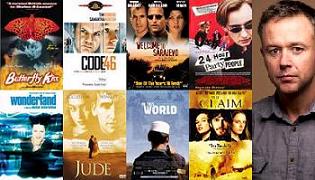 The best English director whom the mainstream still hasn't heard of, and whom the American art-house keeps shrugging off, is the preternaturally prolific