Thursday, January 06, 2011

My Own Medicine: Peel and Gasman


As the first exercise in my reprised course English 386: The Film Review as Genre, I've asked my students to watch two of my absolute favorite short films, Jane Campion's Peel: An Exercise in Discipline (which I've reviewed more extensively elsewhere) and Lynne Ramsay's Gasman, and write a three-sentence review of whichever film they prefer. One sentence should encapsulate the scenario or project of the film, and the other two should concisely encompass a more editorial appraisal. I figure I'll take a stab at my own game, and you can, too, since the films are screenable here and here.

Peel: "Discipline" connotes two meanings in Peel: while a young boy fulfills a comically ridiculous task assigned by his father as punishment, the film itself manages a rounded portrait of family tensions and eccentricities through bold, economical formal choices. While Campion laughs heartily at paternal discipline, which seems all the more absurd after the kid sweetly fulfills his mindless chore, her own discipline with image, sound, structure, and tone are nothing to snigger at. Indeed, with its electric color palette, tautly arranged frames, and inventively odd camera angles inside a very cramped space, Peel discloses a major young talent, all the more charming for emphasizing the humor and vitality of this family's hotheaded perversity.

Gasman: Gasman begins as a Campionesque scrapbook of bright, off-kilter images inside a small Scottish household: patent-leather pumps, toy cars plowing through mounds of sugar, the bony nape of a father's neck, though hardly any glimpses of faces. Then, as Dad takes the kids to a downmarket Christmas party, stopping along the way to pick up another pair of nervous-looking moppets, Gasman becomes looser in sound and image but darker, even heartbreaking in tone. "Get off my Dad's knee" becomes a wee lass's cri de coeur, and though Ramsay typically withholds the details of domestic secrecy, what starts as a memorable but mannered exercise concludes as a remarkably sobering snapshot of how we're sometimes forced, inside a single instant, to grow up.

Labels: , , , ,

Tuesday, December 09, 2008

From Sir with Love

Am I the only one who would love to read or hear a little more often about the day jobs and non-bloggish projects being conducted week-in and -out among our little school of fish. I probably talk about it more than most, partly because my job isn't always such a far cry from what I'm up to on this site, but I still think it's funny sometimes that even among many of the frequent commenters, I know who you think is going to win Best Supporting Actor from the New York Film Critics Circle but I don't really know what you do of a workday. Not that there's anything wrong with that.

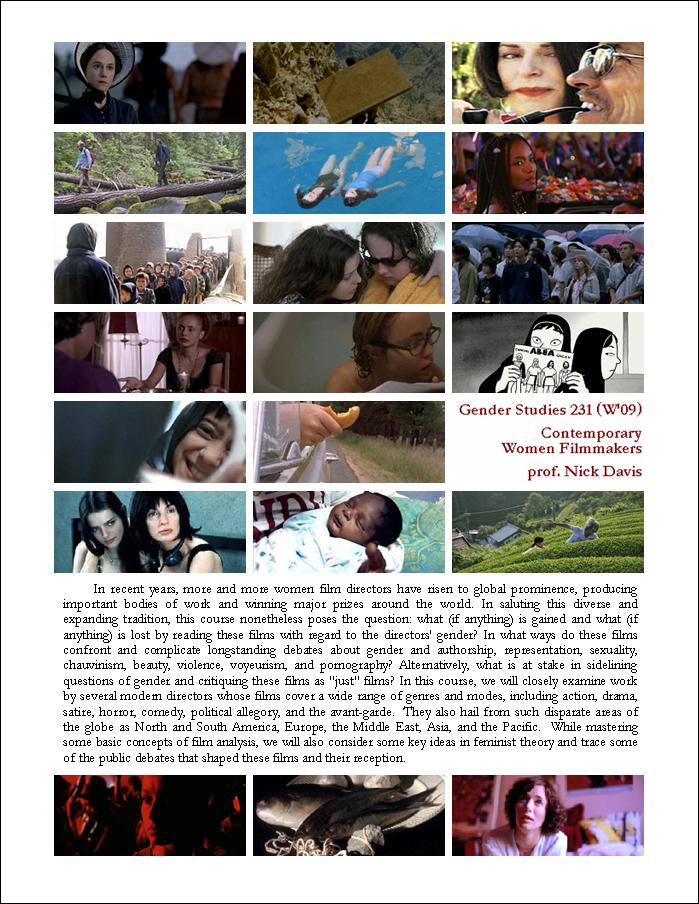
Either way, even if you don't want to show me yours, I'm showing you mine, because I'm so excited to teach this newly expanded Contemporary Women Filmmakers course next quarter (i.e., starting in January). I tried to bring the pretty with this flyer I made, which would be hard not to do, given the luscious and/or otherwise compelling images that my selected directors have so generously furnished in their films. Here's the write-up for the course, in case it's too fuzzy in the jpeg:

In recent years, more and more women film directors have risen to global prominence, producing important bodies of work and winning major prizes around the world. In saluting this diverse and expanding tradition, this course nonetheless poses the question: what (if anything) is gained and what (if anything) is lost by reading these films with regard to the directors' gender? In what ways do these films confront and complicate longstanding debates about gender and authorship, representation, sexuality, chauvinism, beauty, violence, voyeurism, and pornography? Alternatively, what is at stake in sidelining questions of gender and critiquing these films as "just" films? In this course, we will closely examine work by several modern directors whose films cover a wide range of genres and modes, including action, drama, satire, horror, comedy, political allegory, and the avant-garde. They also hail from such disparate areas of the globe as North and South America, Europe, the Middle East, Asia, and the Pacific. While mastering some basic concepts of film analysis, we will also consider some key ideas in feminist theory and trace some of the public debates that shaped these films and their reception.

Huge kudos to anyone who can name all the films or makers based on these snapshots. But my question for you is, who else would you have wanted to see included as part of this class? I can sneak in plenty more stuff in lectures and through on-line clips. You know you want the undergraduates of Northwestern to be seeing all the best stuff. For the purposes of this class, "contemporary" means the last ten or fifteen years (though I'm cheating for Peel).

I already have a list of who I was sad to leave out, but I'll learn more from hearing your suggestions. Let loose! Just, you know, don't suggest Twilight.

Labels: , , ,

Monday, May 29, 2006

Cover Boy

Debuting on newsstands right about now is the new issue of Stop Smiling, the magazine where you'll find my cover-story interview with the phenomenal Scottish film director Lynne Ramsay. Some of my favorite tidbits from the conversation are missing from this transcript—not least the discovery that we love many of the same films, including Safe and A Woman Under the Influence—but I still hope that you'll enjoy the conversation and follow up on her films, including the three dazzling shorts (Gasman, in particular) available on the Ratcatcher DVD. After a week of very high spirits for British cinema, Ramsay's a great rental choice!

Image © 2006 Stop Smiling Magazine, and reproduced from their website.

Labels: , ,

Wednesday, April 12, 2006

A Trip to Mt. Olympus


A few posts ago, I alluded to a project that kept me busy through much of last week. Here's the scoop: I spent an hour and a half of last Thursday morning interviewing Lynne Ramsay, whom I consider the most interesting young filmmaker working in the English language, and whose Morvern Callar is still my favorite film of this decade, give or take Russian Ark. (The Scene Stealer is also on record as a big fan.)

Ramsay was an absolute delight to talk to, remarkably humble and accessible for someone who, at least for me, inspires such total awe. I had a great time asking her about her experiences in film school, her working method with her brilliant cinematographer, her three impeccable short films (all of them available on the Criterion DVD of her first feature, Ratcatcher), and her pair of upcoming projects, both of which sound like bold new choices for a director who seemingly can't put a foot wrong.

All of this was sublime enough for me without the cosmically ordained moment when I asked her about the last occasion when a movie really blew her out of the water, and she described watching Ingmar Bergman's Persona, deep in the Australian bush, in a tent she was sharing with Jane Campion. Most of you will understand immediately why I experienced this confession as pure delirium, verging on phone sex, but if you're confused, click here and take note of #1 and #5.

The interview will appear in the May '06 issue of Stop Smiling Magazine, for whom my next assignment will be a review of the forthcoming 7-disc set of Tennessee Williams adaptations. What I ever did to or for Stop Smiling to prompt all this kindness, I will never know.

Labels: , ,