Nick's Flick Picks: The Blog

Plays of the 00s: The Ride Down Mt. Morgan
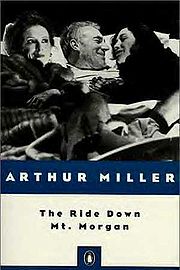 Too often when conversations turn to the seminal greats of American theater, you hear people saying "Oneillwilliamsmiller" as though it's some German compound word and as though it names some indivisible, uncontested trifecta of major artists. I beg to differ, and if The Crucible is pretty stunning and The Price, at least in memory, was a tautly compelling push-pull among family members sifting through their own debris, I often find Miller raging awkwardly against Big Ideas that elude the ambitions of his intellect or the poetry of his words. I appreciate enormously the vitality of his best writing. He's as unashamed as Philip Roth—his partner in self-canonizing, red-blooded literary expostulation—to push angrily lofty speeches into the mouths of his characters, and to limn them with clear allegorical gestures to The Deeper State of Things. But for the same reasons, he can be embarrassingly overwrought, often at the same time he's being astonishingly clichéd, particularly given how complacent he often seems about White American Guyness as an Olympian vantage for diagnosing the ills of the soul and the forces of the world.
The Ride Down Mt. Morgan—like True West, another play that took its sweet time landing on Broadway—does a good deal of spouting about, but also from the vantage of, a bullish, philandering narcissist of a certain age who's landed himself in a full body cast while speeding down a snowy mountain in his Porsche, racing to get home to his wife. In context, a pressing question, though less so than it might be, is, "Which wife?" This is because Lyman Felt has spent the last ten years keeping two conjugal spheres in play, one in New York City and one upstate, one child apiece. You will not be astonished to hear that one wife is an acerbic Protestant who's often self-conscious about her truculence and her deep familiarity to her husband of several decades, and the other is a Jewish sexpot who kept a surprise baby at Lyman's own encouragement and has held things down in Elmira ever since the kid, named after two of Lyman's ancestors, was born. You could say plenty about the stock binarization of these gals, about the hazily sketched dotingness and vituperation of his grown daughter, about the fact that Lyman's intense and recently sustained injuries are the first, immediate tip-off that Mt. Morgan really wants us to worry about his pain as the grand dishonesties of his life come to light (with increasing media attention, though this is reported rather than dramatized). One might well complain about Miller's insistence that Lyman's nurse be a black woman, and that she console him, even kiss him on the forehead when everyone else has stamped off in righteous indignation—this despite his purple fantasies about "white thighs" and vaginas commemorated as "cathedrals," and despite his smarmy quickness to share a likely double-edged compliment he once scored from James Baldwin, back when Lyman used to write. Two flashback scenes involving a man-eating shark and a man-eating lion have to be read to (not) be believed, and even they are less dismaying than lines like, "I am human, I am proud of it!—of the glory and the shit!" or a recurring thread wherein the ghost of Lyman's father passes through his hospital room to smother him or beat him, accompanied by seismic reverberations from beneath the stage, pitched to rattle the whole theater.
The Ride Down Mt. Morgan is a desperate play, knocking around with real fury at its own indulgent conceits, besotted with its lead character both despite and because of his enormous flaws but struggling nonetheless even to glimpse almost any other character. The dialogue often sounds like badly translated Ibsen or Bergman, and the nomination for Best Play in 2000 was likely an inevitability of a thin Broadway season or a chance to honor a key American figure whose work swelled to a remarkable popularity on Midtown stages in the late '90s and early '00s. But it's too easy to shrug the play entirely, whatever its arrogance or its shortcomings. One can imagine a careful, vitriolic actor, maybe a Frank Langella (though not, I would guess, the Patrick Stewart of the '00 production) redeeming Lyman into a fascinating enigma of self-love and self-excoriation. If the right director got deeply interested in the tough problem of Lyman's truth-telling even amidst a life's work of lying—he's a shit, but he's not wrong that every lover will eventually lie to their beloved, or that magnificent happiness is often dependent on subterranean dishonesty, or that the outrage of victims can be just as preening as the convenient self-exoneration of traitors—you might find a stirring night of uneven but unsettling theater inside The Ride Down Mt. Morgan. If you found some ways to give the women more to do with their silences, if you dropped the incongruously macabre dreamscapes, if you cast the nurse as a white man so that Lyman had to seek solace from someone unexpected, you could shave a lot of crust off of Morgan and release a lot of the ferocity and verbal force of the play's best moments, and of what Miller clearly wants to get at and worry over. I don't trust Arthur Miller, and I wish that playwrights twice as subtle and talented didn't have to fight four times as hard for comparable prestige. When it comes to uncomfortable waiting-room dirges, I'll take Albee's All Over over Mt. Morgan any day. Still, even when his premises seem self-serving and his images and his language lack for grace, you can't say that Miller's plays aren't about anything. There's often, as there is in this one, a tough, muscled heart inside that it's worth trying to hear.
Labels: Plays of the 00s, Theater, Tony 00
posted by NicksFlickPicks at 8:00 PM
1 comments


 This always happens in June: I feel glum about the mediocrity of what's spilling out of
  Given all that preface, it's both anomalous and strangely necessary to start with True West, a play first performed in San Francisco in 1980 but invisible on Broadway for 20 years. Starring the then-upwardly mobile Philip Seymour Hoffman and John C. Reilly, who famously alternated the leading roles, this