Wednesday, August 11, 2010

Hit Me With Your Best Shot: Angels in America

I struggle with the HBO adaptation of Angels in America because the play means a lot to me, and especially given all the money that was clearly made available to this project, I wish it were a richer, more thoughtful production. Perestroika in particular brims with missed opportunities, though the heavy re-writing only further proves that Kushner has never quite settled on a design for that half of the play (though chaos is clearly an indispensable element). I can see that Nichols and his designers have played up the "staginess" of several interiors so as to keep the project rooted in a sense of theatricality, but a lot of the cinematic embellishments and CGI effects feel too slick and two-dimensional, when the play clearly benefits from as much tangibility as you can bring to it. I'd love to see what John Greyson or Robert Lepage or somebody might have done with the material. Still, it's hard to imagine a really bad production, and this one certainly isn't, because the core text is just so provocative, ambitious, imaginatively drawn, and beautifully written.


I'm picking this image less as the "best" than as a kind of emblem for my feelings. I'm not sure Angels needed this new scene that Kushner wrote for Perestroika, and it feels like a somewhat desperate opening-out of the physical space. I'm not a huge fan of natural location photography with a project like this anyway, since the whole text is constructed as a series of artificial problems and conceits laid over the very real nightmares of our history and our current reality. The beach here feels so ...domesticated, in a play that thrives on fantasy and fire. At the same time, I do appreciate the dynamic of this scene, not just because you see Joe Pitt getting recklessly invested in a relationship he barely understands—and at the same time you're feeling Louis Ironson starting to pull out of it—but because Angels in America is always telling us that denuding ourselves does not pare us down to essentials but in fact exposes our complexities. That in opening yourself to the world of sexuality you inevitably create a storm of debris, big or small, and that somebody else will have to pick it all up, now or later.

From a visual standpoint, in a miniseries that takes playful but earnest care to consider all the characters' potential relations to the angelic, I like how the foamy line of surf hits Patrick Wilson's body just where a tufted set of wings might go. The story, the dialogue, and the bulk of the shots make this Joe's scene, which is fine with me, since I think Wilson gives the best performance in the cast, in the play's most potentially opaque role. But visually, as Joe begins to strip down, we also recognize that it's really Louis's turn to wrestle, Jacob-like, with the naked angel—whatever an "angel" might mean to Louis, or to us, at this point in the piece. The shot and the scene are like a cold parallel to Emma Thompson's magnificent arrivals to Louis's HIV-infected boyfriend, Prior. Joe looms above with a kind of majesty that Wilson's body, the best one that a court of appeals lawyer ever had, only reinforces. Louis, like Prior, crouches below in a panic. This Louis-as-Prior doubling, despite the annoying fact of how the miniseries rejects a lot of the other doublings that the playscript demands, only intensifies insofar as this gray, cruddy beach with the jagged stumps at the shoreline and the capsized hulk on the horizon is like a downscale, mundane precursor of the chilly, magnificent wreck called Heaven that Prior is soon to visit.

If anything, though, it is Joe who is the hapless, Prior-like innocent in this relationship, and Louis who is the flighty, schizophrenic, Angelic agent/invader who likes to think he is a victim. In fairness, Louis does suffer. But nonetheless, the brief, visual confusion of roles in this shot strongly implies that this relationship won't work out.

So, a lot of resonant stuff going on in this otherwise simple shot, though it still feels like the viewer and the play have to do a lot of their own thinking to keep the image and the movie interesting. HBO's vision of Angels is nothing if not concepty but it barely if ever registers as intellectual, a category that the play fully embraces but which Nichols' movie avoids like a kind of ...virus? That's my reaction in a nutshell to this made-for-TV Angels, which I always feel like I'm either overestimating or underestimating. If Patrick's just taking off his clothes in a last-ditch attempt to convert me to the cause, what can I do about that? Let him try.

P.S. I would like to add a few more runner-up shots. Like Nathaniel, I am totally in love with Jeffrey Wright's physical vocabulary as Belize, whom he plays very differently than he did in his Tony-winning take on the same character for Broadway. I like this shot not only because Belize just cracks me up with all his heavy-lidded, low-volume, but prissily catlike gestures, but because I always wonder how much Wright might have felt like Belize, trapped in a play that pretends to have a lot to say about race (and, like Louis, it occasionally does have something to say) but delivers a lot less than it promises. Does Wright ever wish he could just signal the waitress, grab his check, and get outta there? It'd be Belize's best option for finding a private life or an orgasm, since even Hannah Pitt beats him to both. (Also, love those Ann Roth costumes.)


I'm including these three shots of Emma Thompson—the we-get-it, she's-a-religious-icon halo shot, the worthy showstopper that ends Part One, and the Goth-queen hurricane she whips up in Part Two—because even though I felt while watching Angels that Emma could have been more confident with her character work (outside of her marvelously dykey, warm but gruff take on Nurse Emily), I think the piece ultimately benefits from her balls-to-the-wall spirit of exaggeration and risk. You'd not have imagined Margaret Schlegel doing this, and if you fast-forward through Angels instead of actually watching it, she seems like the biggest incentive for a re-watch. I'll certainly take her any day over Mary-Louise Parker, who can always find new opportunities for empty, adenoidal "irony" in virtually any part. The entire HBO version misses Harper so badly, from script to performance, that it's too sad to dwell on.


And lastly, since it's one of the few shots that suggests what Angels might look like with a Tarkovskian sense of cold, stately, unreassuring divinity blowing through it, I'll admit that this shot triggers fantasies of what a totally different film might have looked like. I'm more reconciled to this version than I'm sounding in this post, but I like it best when it prompts celestial visions of other, more persuasively millennial approaches.

Labels: , , , , , ,

Wednesday, June 09, 2010

Actress Files: Grace Kelly

Grace Kelly, The Country Girl
★ ★ ★ ★ ★
(won the 1954 Best Actress Oscar)

Why I Waited: Kelly's trophy-copping performance has always intrigued me more in relation to her enduring cultural cachet and to the famous nominees she trumped than on its own terms. But she surpassed my expectations in Rear Window and Mogambo, so it was worth hoping she might do it again.

The Performance: It's entirely possible that at the tail end of 60 days and 44 performances, my head is starting to swim from so much actressing. But I hope there are more case-specific reasons why I find Grace Kelly's Oscar-snagging performance in The Country Girl so tricky to write about, or even to form a stable opinion about. It's one thing to be of two minds about a performance, even for the full length of a film. In Kelly's case, though, I was of different minds for different reasons depending on which sequence I was watching, and in shifting relations to a problematic film which itself deserves credit in lots of respects and yet feels over-strained and over-confident in lots of others.

I find this much solid ground to stand on vis-à-vis The Country Girl: Bing Crosby gives an exemplary turn as worn-out and drink-ridden stage actor Frank Elgin. The first half of his performance highlights Frank's broken self-confidence, his fear of failing in a performance that's meant to resuscitate his career and his spirit, and which he can't afford to say No to. We hear rumors of pronounced alcoholism in the past, and both Broadway and Hollywood have generically prompted us to expect some vivid backsliding, but the performance doesn't feel immediately centered on those questions. The second half of the film, though, does feature many more scenes where Frank's sharp, sweaty need for a drink is front and center, taking on a focalized life of its own, in some ways superseding the questions of professional ability and confidence. One of many rare feats that Crosby achieves is that his incarnations of the pitiable, aging veteran and the soaked, volatile lush are equally powerful and specific, and they persuasively add up to the same person. Many a performer would struggle through one of these facets of Frank while thriving with the other, but Crosby offers a detailed, integrated, poignant articulation of both. Moreover, as The Country Girl makes its climactic moves to wrestle specifically with the chicken-egg question of whether Frank drinks because he fails or fails because he drinks—framing these riddles in the dueling contexts of an unsilenceable grief (the heavy past) and of Frank's potential "comeback" show, lumbering toward its Broadway opening (the portentous future)—Crosby pulls all these threads of Frank's suffering into a sad, eloquent synthesis. Through him, The Country Girl puts forward a haunting essay, a kind of didactic parable but also very lived-in, about the problems of success and failure. Why does success in one part of life seem to engender so much resistance from other people or invite bitter cosmic setbacks in other arenas? And why does failure, by contrast, seem to have such an easier time of spreading virally from one realm of experience until it infectiously grips all the others? Once you're living in that grip, how and with whose help can you ever get out?

I don't mean to build up Crosby just to say that Kelly acts less convincingly than he does, but to suggest some of the themes and stakes that become important in The Country Girl through the clarity and force of his performance, and as another way of indicating that success in their two roles involves the agile negotiating of major balancing acts. The characters are highly ambivalent, the script underscores different dimensions of the drama at different times, and it has that heightened, even awkward transparency of theme and language that are typical of Clifford Odets's writing—all while nonetheless requiring that the actors sell that language as "real" in order for the film to work. Plus, the way Kelly's Georgie is structured into the story, she is both a co-lead alongside Crosby and William Holden (in the somewhat simpler role of the writer-director who hires Frank for his play), and a reactor/enabler of Crosby's Frank, to a degree unusual even by the standards of screen wives. When he's in a play, she has to get him through it, as agent, dresser, and morale booster, though the last bit is the hardest. When he wants a drink, she has to try to get him over it. When he inevitably does drink, she has to pull him out of trouble. And all of this upkeep doubles as triage on their marriage, additionally beset as it is by an age difference that has never become easy and a catastrophe in their past to which they will never stop responding. I said before that this battle with grief aligns with the production of Holden's play as two arenas in which Frank's capacity for success—for survival, really—will finally be measured. I add now that the sustainability of the marriage is a third, parallel framework in which Frank and Georgie stand to rise and fall, which is not made any easier when Bernie Dodd, the Holden character, draws the quick, hard conclusion that it's Georgie who most undermines Frank's competence and self-belief, and that she must be exported at all costs.

That's an incredible lot to manage in one part, particularly for such an inexperienced actress. And notwithstanding a few key speeches, Georgie doesn't get the kinds of big, blustery, emotional climaxes that are the frequent payoff of having so much to handle. There's barely even anything in the script that encourages the audience to relate to Georgie. We suspect that Bernie is wrong in his estimation of her, if only because his misogyny is so astonishing and unrelenting ("Did it ever occur to you that you and your strength might be the reason he IS weak?... To be frank, I find you slightly grotesque, Mrs. Elgin"), but the point of The Country Girl is never to bring us around to Georgie's side. Maybe the most admirable commitment made manifest in Kelly's performance is that she respects this vinegary dynamic and never asks the audience to applaud her, feel sorry for her, or even get very close to her. That's not to say that I don't wish Kelly were a bit more permeable and much more flexible in the part. But she takes the role and the script seriously, very much the young actress who expects to improve by working on "good material" written by and starring more estimable talents, even if it means jumping in way over the head of her nascent sense of technique.

I'll say this for Kelly, too: the factors I most expected to interfere with her performance, the dowdying of her physical appearance and the improbability of being married to twice-as-old Bing Crosby, don't cause her any trouble. I almost wish Odets didn't include the line about young women trying to conceal themselves by looking like old ladies because, not unusually in his writing, it saps a visual and a behavioral signal into a coarsely literal assertion. The guarded way Kelly moves and wears her bulky sweaters and large spectacles all feel persuasively like the turtle-shell habits of several years, not like desperate lunges at "acting" through accessorizing. Her merry adoration of her husband in the flashback scene, where a younger, beautiful Georgie beams at a younger, golden-voiced Frank in a recording studio—even as it feels like a predictable producer's gambit to make sure we aren't hiding Grace under so much woolly cotton for the whole movie—handily communicates a real attraction to and enjoyment of each other. I suppose I was most impressed by how Kelly and Der Bingle communicate a long marriage of impatience, discontent, tiny budgets, and echoing tragedy without opting for the cliché of love that has curdled into hate, or even dislike. Kelly manages to seem ornery at almost all times with Frank's shortcomings and prevarications and she is sometimes very hard on him, but without suggesting she has foreclosed on some fundamental sympathy. I never asked myself, "Why are they still married?" and I had expected to ask that soon and often. Just the way Georgie surprises Bernie later in the film with the blunt admission that she has "twice left, twice returned" conveys a sense of beleaguered but genuine attachment. It's also the moment when we hear that Georgie, though less of a chronic or destructive self-berater than her husband, nonetheless has some aptitudes of her own in this area. When Bernie initially can't work out whether or not Georgie is encouraging Frank to take the role in Bernie's play, and he asks, "Are you for him or against him?" I admired the bullish, crabby way in which Kelly's Georgie responds, "I'm his wife," not quite clarifying whether it's to be assumed that she's "for" her spouse or whether wifedom, for her, has been accretively naturalized as a life-sentence of stalemate between being "for" and being "against."

Kelly never orchestrates anywhere near the same kind of "take" on her scenes with Holden, and unfortunately for her, these are lengthy, frequent, important, and prosy scenes. I don't envy her having to embody such an object of withering chauvinist contempt for such a long while, lobbed by an actor who radiates such a flat aggressivity that it's hard not to respond in kind (whereas Crosby's acting seems to engender in Kelly some of the sensitivity and sympathy that are characteristic of his own style). In these scenes with Holden, though not only with Holden, we catch Kelly too often playing not the character so much as some idea she associates with the part, the script, the playwright, the genre of serious drama. She looks off acridly into the distance. She jams her hands into her pockets while she quarrels or mourns. She settles again and again on a kind of hollow, superior-sounding cast to her voice, as though Georgie should be speaking from a perspective of profundity or complex thought, but without implying that Kelly has worked out just what it is that Georgie is thinking. The titular speech, when George describes herself as just "a girl from the country" who thus cannot fathom the foibles, machinations, and vicissitudes of theater people, seems totally opaque to Kelly. Again, the writing is so here rhetorical that I sympathize with its being difficult to play. But it's also a speech you know, as an actor, that the audience will be scrutinizing, and a perfect platform for making one's own decisions about why Georgie is saying this and what else it signifies for other facets of the characterization.

Kelly feels inert about making these sorts of decisions, sailing ahead in that low, etherized register of free-floating disillusion, or of introspection about nothing in particular. She makes the same choice while reciting a related but even more opaque soliloquy about the mysteries of the theater when she surprises Frank and Bernie with an after-hours visit to the rehearsal stage. Later, Georgie makes a morbid allusion to seemingly happy people who startle everyone when they wind up hanging themselves from their chandeliers. When Bernie, nonplussed, asks if she's insinuating something about Frank, Kelly looks off diagonally and says "Yes and no," but so stiffly that neither half of the answer really clarifies anything or leads anywhere. Her Georgie appears to have been doling out a speech, not working through a thought or a specific agenda; she isn't communicating anything through her "Yes and no" response except for Kelly's own seemingly vague sense of the preceding language, as though the overt ambivalence of the line has ratified her own perplexity about Georgie and mercifully absolved her of having to work it all out.

Rhythmically, formally, and narratively, The Country Girl suffers some costly lapses as it nears its conclusion, such that anything that has been frustrating about the film or its performances up to the final 20 minutes or so is only intensified as a question mark or a misgiving. Worst of all, we get a dramatic ellipsis of five weeks just where we wouldn't want one. Again, it's not just down to the actors that the characters' revised ways of relating to each other don't make as much sense, and rarely feel as though they've been plausibly signaled in any of the earlier scenes. But I wouldn't say this leap is insuperable. Particularly in Kelly's case, it seems rather too easy to reframe so much of the performance on so much new ground, under an umbrella alibi that "much has changed" since the preceding fadeout, and losing even the distinguishing marks of Georgie's glum carriage and stalwart physique. Of course, several of the old conflicts keep percolating, but the ways in which Kelly's Georgie relates to them seem superficial or sentimental—not just out of step with her earlier portraits of the character, but a direct antithesis to the woman Georgie is in her first long sequence, where "sentiment" is precisely the curse word she flings at empty praise, impractical assurances, conspicuous avoidances. Kelly and Crosby have to shoulder one pivotal scene of exchanging a long, meaningful look during the recital of a piece of music, and I'd have hoped the director George Seaton could have spatialized the scene in more complex terms than shot/reverse, or guided the performances in ways that had a chance of connecting these close-ups more fully to earlier notes. But here too, Crosby—who has never previously struck me as a born screen actor—looks as though he's trying to hold onto as much tension and emotional prehistory as possible while still managing a fairly direct expression, whereas Kelly looks as though she's favoring the most obvious affect suggested by the scene, and in an almost effusive, shining way that I have trouble squaring with the figure Georgie has elsewhere been cutting, even very recently in the film.

"Don't keep things from me" and "He's shunned any responsibility" are Georgie's two most frequent refrains in complaints to or about her husband. It's tempting, if a bit easy and twitty, to say that she keeps too many things from us that we need to know about Georgie, and she shuns too much responsibility for exploring, coming to grips with the character. Theater training is probably a crucial asset for essaying this character, even in a screen incarnation; I have my beefs with contemporaneous screen performances like Shirley Booth's in Come Back, Little Sheba or Julie Harris's in The Member of the Wedding, which seem too fully, even garishly conceived with only the stage in mind, but Kelly seems paradigmatic of an opposite awkwardness, applying a screen-specific conception of acting and a still nascent one at that to the realization of a very complicated, occasionally thankless part that can only subsist on lots of rehearsal, an ample bag of technical facilities, and lots of spontaneous interactions with co-stars, leading to well-judged and practiced takeaways from those in-the-moment experiences. It's not an all-or-nothing proposition. Kelly is effective and memorable plenty of times: glaring at Frank with empathy and annoyance as he awaits his first reviews, walking into an unwanted broadcast on the radio and dropping into an angry sorrow, catching Frank as he tries to abscond with a bottle of liquor-heavy cough syrup, without even raising her eyes from her knitting.

From moment to moment, the performance is very up and down, and on the whole, it's an unusually potent merging of the compulsively watchable with the plainly inadequate, in a way that has nothing to do with kitsch. Save the occasional jaw-clenching, eyes-widening, Mae Marsh look of furious panic, as in a scene where she has to slap Holden for one of his sexist vituperations, I never thought Kelly was remotely embarrassing herself or embarrassing the film, even though it's hard not to feel that major opportunities were missed by not casting someone with more chops, more life experience. Georgie is younger than her husband, but 25 is awfully young to have already been through all the stages she is reported to have been through, or to know how to express those ordeals and their legacies for a screen audience (even the ones that turn out not to be true). Having now seen all the performances that garnered a Best Actress Oscar, I'd have to categorize Kelly among the 20 or so that just don't make the case to me that they ought to have carried anyone near the Academy podium, even in a weak year or for heavily qualified reasons. But at the same time, of those same 20 performances, hers is the only one that specifically falls short by testing a very new actress against truly highwire dramatic material (perhaps more formidable than even she realized), and where the infelicitous match of performer to vehicle doesn't yield a flat, a dispiriting, or a mockable result but a compelling spectacle of an earnest performer who wins a couple of key rounds with the script. She goes down, ultimately, but never without a good, inspiring fight. If she were ever really electrifying in her peak scenes, as Halle Berry is in Monster's Ball—the only other winning performance that seems to marry palpable ambition, dubious technique, fitful insight, and impressive sincerity in something like the same way—I might be able to privilege the half-full glass in thinking about Kelly's work. That's what's happened over time for me with Berry, and I just saw The Country Girl yesterday. For now, her Georgie Elgin feels like a glass half-empty, but even if it therefore seems seriously undeserving of an Oscar, I do think it warrants our respect.

The Best Actress Project: 1 More Down, 1 to Go

Labels: , , , , , , ,

Sunday, May 02, 2010

Actress Files: Julie Harris

Julie Harris, The Member of the Wedding
★ ★ ★ ★ ★
(lost the 1952 Best Actress Oscar to Shirley Booth for Come Back, Little Sheba)

Why I Waited: The recent arrival on DVD, though I've owned it on high-quality VHS for a while. Mostly, I waited out of high, optimistic investment. Member is a seminal classic of screen tomboyism and a favorite movie of a few lesbian friends and film scholars, which for me are big selling points.

The Performance: Fans of cinematic actressing who don't follow the stage or its history may not realize what a legacy of performers they're missing out on. You could follow Oscar's annals and never come across Uta Hagen, Zoë Caldwell, Diana Rigg, Colleen Dewhurst, or Irene Worth. Occasionally a great dame of the boards manages a single nomination, but barely ever a win: Kim Stanley, Margaret Leighton, Kate Nelligan, Rosemary Harris, Janet McTeer, Viola Davis. Sometimes they swoop in for a trophy and are gone from movies before you know it, as happened with Mercedes Ruehl. A few lucky ones, from Lynn Fontanne to Stockard Channing, have won opportunities to reprise famous stage roles on celluloid and gleaned Academy attention for their troubles, but real crossover stardom or simultaneously thriving careers on both coasts are rare. Outside of theater enthusiasts, Cherry Jones is still known to an awful lot of people, if at all, as the woman who didn't get to reprise her stage triumph in Doubt, although I suppose her ascendancy to the White House on 24 may have changed that. Whether it leads to actual movie parts for her, despite being one of the craftiest and most memorable sculptors of character currently at work in the United States, I'm nervous to even guess.

Julie Harris is a sort of patron saint of the Broadway legend-cum-Hollywood footnote. 30 credits on the big screen are nothing to sniff at, but most of the titles are negligible. She was very moving as James Dean's worried and delicate confidante in East of Eden and reliably fragile as the target of menace in Robert Wise's The Haunting, but almost nothing else made a splash, despite her copping a record-setting five Tony Awards as best leading actress, plus a sixth for Lifetime Achievement. Early in her theatrical career, she was Alice's White Rabbit and one of Macbeth's Weird Sisters in less than a year's time, and she's packed houses and inspired rhapsodies playing everyone from Emily Dickinson to the original, non-singing Sally Bowles. Harris won her first Tony for that last performance, the same year that Stanley Kramer, esteemed producer of noble feelings and stodgy drama, tapped her and costar Ethel Waters to reprise their landmark Broadway success of two years before in The Member of the Wedding. The film did well with critics and patrons, remaining director Fred Zinnemann's lifelong favorite of his own works. Probably the major scandal of the 1952 nomination announcements was that Waters, a prior nominee for the misbegotten Pinky, wasn't cited alongside her costar.

Writing about the performance in this context presents a challenge, because it embodies so many of the standing defenses for as well as the warning-shots against Broadway casts carrying their work into film. Member was divisively received for just those reasons in 1952, so that almost anything you could say about it arrives outflanked by prior comment or larger cliché. Harris's crewcut hair and beanpole androgyny don't quite qualify as a photo-realistic impression of a 12-year-old tomboy, but if you're watching for drama and not for documentary, the proximity more than suffices. She animates the two primary sets of a kitchen and a small yard with the aggressive, slicing movements of a frustrated impetuousness, which no doubt explains why Zinnemann and photographer Hal Mohr, better-known for more innovative and expressionistic lensing, hold to so many proscenium-style wide shots and full shots. By the same token, Harris's wan, freckled face and her soft but frequently anguished eyes capably hold the camera, determining the second major fixture of the film's cinematography: close-ups so intimate that Harris is frequently scalped by the top edge of the frame. She's playing an emotionally ripe, sometimes overripe scenario as a single daughter of a widowed, distant doctor-father. Lacking his company, she kills time more often with the family's black housemaid (Waters) and with the younger, sickly boy next door (Brandon de Wilde, soon to enter the canon in Shane). Repelled by the frivolous femininity of the local girls but devastated at never being invited to join their giggly society, proud of but also tortured by being such a misfit, Frankie Adams is a walking chain reaction of ferocity and woundedness, and her impatience to grow up is expressed via both of those registers. Moreover, and inexplicably to everyone around her, she is obsessed with the impending nuptials of her much older brother Jarvis. Her sentimentality about this occasion, fraught with anger and envy, implies blooming ambivalences of desire and of gender, maybe even of sex: "I couldn't be jealous of them 'less I was jealous of both of them," she admits, without fully knowing or fully not knowing what she means.

Frankie harbors hysterical, unreasonable hopes that Jarvis and his bride Janice—even their names are a parody of hetero pairing and seemingly automatic kinship—will take her with them on their honeymoon and into their conjugal life, though she appears furious that such an oblique contrivance as someone else's romance, bearing nothing in common with what we intuit about her fantasies, represents her only vehicle for escape. She's implacably fixated on something she clearly, at some level, can't stand, though she pours intimidating levels of energy into her plan, emitting eagerness and anxiety through as much through physical aggressivity as through speeches and intense mental focus. Virtually everything Harris finds to do across 90 minutes of barely changing scenery and of blocked, repetitious narrative serves to evoke these desperate double-binds: picking splinters out of her bare feet with a throwing knife, terrorizing the furniture, slumping and gazing morosely out of the frame, sobbing into her hands, raging at Berenice and John Henry, imploring them to absolve her, inviting passersby into her yard and then harrying them out. She's always pushing someone away and pulling someone close, frequently the same person at the same time, and quite often herself.

It's a very emphatic performance, laudable for its sustaining of energy and its refusal to be vised by the unforgivingly stagy filmmaking, but in many ways ill-calibrated for the intimacy of the camera, or the capacity of the audience to be exhausted, if not put off. She handles some of those tight close-ups very well, as when the light behind her eyes clouds over at the news that the clubhouse girls have once again denied her an invitation, before her face darkens subtly but unmistakably into a hard mask of disgust and vituperation. Harris, though, seems to equate the potential for subtlety with the closeness of the camera: when the mise-en-scène reverts to being stagy, so too does much of her acting, and the line between Frankie's histrionics and her interpreter's can be hard to draw. She's inimitable and cosmetically ideal for the role, a much-needed alternative to all the wistful dreamers or sympathy-begging tykes and preteens of the movies. In resisting those traps, though, I wonder if she hasn't opted too purely for violent tantrums over the kind of rolling, pouting, narcissistic loneliness that would agitate the other characters just as plausibly, and make at least as much sense in relation to Frankie's dialogue, but without alienating the viewer or the camera quite so much. The stark physical vocabulary and the impassioned vocalisms can also qualify Harris's eccentric but otherwise plausible impression of being a child herself, turning her Frankie much more into an older person's dilated presentation of adolescent angst—hardly a liability in every sense, but an odd fit with the realistic look of the film, and a tricky counterpoint to Waters's naturalism as Berenice.

I should add, though, that in such bruising scenes as Frankie's last-ditch effort to stowaway in her brother's company, few if any of these caveats matter, and Harris more than overrides the perils in her approach with a body-blow of feeling, scrupulously executed but conveyed with seeming spontaneity. Moreover, screenwriters Edna and Edward Anhalt have restored an ensuing episode from Carson McCullers's autobiographical novel that she excised for logistical reasons in adapting the Broadway play. For reasons I won't reveal, Frankie makes a late-film excursion into the city, where little goes as planned (how could it, with no plan?) and danger rears many heads. Ironically, though story incidents are even more heightened in this passage than in all the weary hours of Frankie being stifled by her home life, and if anything the character's emotions should be even more keyed up than usual during this threatening interval, Harris navigates this late, somewhat sensational sequence with fewer "theatrics": she is scared, restless, and uncomprehending, a fugitive child and an incipient adult in ways that feel well-scaled for cinema and don't insist on a bodily or shouty correlative for every shift and seizure of her inner state.

Was Harris just glad for a departure from a stage-regimen she had reiterated so many times? Was I just so relieved for a change of environment and an opening for narrative unpredictability that my interest revived in a performance I had started to admire in spite of its weaknesses, or maybe even to regret in spite of its strengths? Hard to say. I'd be keen to revisit Member some day, though not soon, to assess more closely what Harris does in this not-quite-finale, and how she has readied the character for this passage all along. In any event, the actress most fully shakes the impression that she's translating work from one platform to another, for better or worse—that is, sometimes with the depth and care that years of familiarity afford, sometimes calcified or reduced by old habits or confusions about the relative scaling required by specific artforms. The balance, I think, ultimately tips in Harris's favor, and I wish more plays were brought to more screens, and more often by their birth parents instead of more bankable Hollywood surrogates.

The Best Actress Project: 1 More Down, 31 to Go

Labels: , , , ,

Friday, January 08, 2010

Friday Reviews: Pandora's Box and Others

I'm trying to get at least a little better about sketching out a few comments on the films I watch, rather than just posting credits and grades without any substantiating commentary. Here, then, are some short notations on the three films I saw on video this week—Nikita Mikhalkov's 12, a 2007 Oscar nominee that premiered last year in American theaters, and two old dramas from 1944, the Eugene O'Neill adaptation The Hairy Ape and the Greer Garson-Walter Pidgeon vehicle Mrs. Parkington. I meant to write something comparably short about G.W. Pabst's Pandora's Box, but with a film that seminal and thrilling, and even more so in 35mm projection with live-organ accompaniment at the Bank of America Cinema, who can hold to just a few words? Not me, surprise, surprise.

A mishmash of titles, to be sure, but hopefully if I can keep up this steady drip instead of the heaving cycles of feast and famine, you'll find things in the mix that interest or appeal to you.

Labels: , , , , , , , , , ,

Friday, October 09, 2009

CIFF 09: The Eclipse

Note: Today's and yesterday's CIFF reviews fall notably short of "rave" territory, but already I have encountered two gems on which to fill you in. Stay tuned!

I regret that my summertime undertaking of a theater-centered blog to complement this one was such a quick casualty of the busy fall, but I will hope to check in over there occasionally. I do love plays, and I'm always eager to see how strong playwrights fare as their work travels to the screen, particularly when they get to test their own hands in this new medium. I was off-consensus last year about Martin McDonagh's feature-length debut In Bruges, which I found to be hectoring and over-worked, and lacking the emotional sincerity that would have driven home its ambitious character arcs and committed central performances. Still, I can see why people who like In Bruges like it. I will be less easy to persuade that my cool response to The Eclipse, a rare cinematic foray for Shining City and Seafarer scribe Conor McPherson, amounts so easily to an issue of personal taste, and I doubt it will prompt nearly as many people to try to bring me around to greater enthusiasm. It works serviceably as a generically spooky mood-piece and has some nice acting moments from Ciarán Hinds and Iben Hjejle, plus it's the only movie that's ever found occasion for the line, "Yes, I was terrified, but at the same time I was so intrigued and fascinated that I actually wound up studying theoretical physics at university." The auditor of this comment offers the only conceivable response, which is "Jesus!"

Now, that's entertainment. Unfortunately, though, The Eclispe lacks the focus or the courage to be as fragile and understated in generating its eerie moods as McPherson's play scripts generally are. There's also one howler of a performance from someone who should really know better. You can read my full reaction here, but as always with festival reviews, I warmly invite you to go check it out for yourself. Hinds did win the Best Actor prize at Tribeca for this turn, and if low-intensity disquiet and a few whiplash jolts are what you're after, this might be just the vehicle.

The Eclipse plays tonight, Friday 10/9, and also on Saturday 10/10 and Friday 10/16.

Labels: , , ,

Friday, June 19, 2009

I Know and You Know...


...that the movie-fiends who constitute the vast majority of this blog's readership aren't necessarily so interested in my takes on ten-, twenty-, thirty-year-old plays, maybe even one-year-old plays. Plus, the plays project is intended as more of a reading journal than anything—they're just dashed-off thoughts after I finish a script and mull for a bit—so without going all Jim Crow, I like the idea of partitioning out those entries more formally. So, I built an addition onto my house. As Mae West famously said, "Why don't ya come up some time and see me?"

Two blogs might be asking for it when I don't always have time for one, but I'm not promising very regular updates over at the Playhouse, and as Mae West also said, "Too much of a good thing can be wonderful." She also said, "It's better to get looked over than overlooked," but to help you know when to look, if you're at all interested, I'll toss a head's up into the sidebar over here.

Soon: back to some cinematic matters at hand.

Labels: ,

Thursday, June 18, 2009

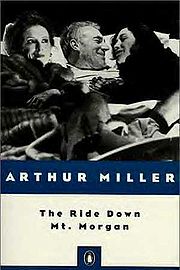
Plays of the 00s: The Ride Down Mt. Morgan

Too often when conversations turn to the seminal greats of American theater, you hear people saying "Oneillwilliamsmiller" as though it's some German compound word and as though it names some indivisible, uncontested trifecta of major artists. I beg to differ, and if The Crucible is pretty stunning and The Price, at least in memory, was a tautly compelling push-pull among family members sifting through their own debris, I often find Miller raging awkwardly against Big Ideas that elude the ambitions of his intellect or the poetry of his words. I appreciate enormously the vitality of his best writing. He's as unashamed as Philip Roth—his partner in self-canonizing, red-blooded literary expostulation—to push angrily lofty speeches into the mouths of his characters, and to limn them with clear allegorical gestures to The Deeper State of Things. But for the same reasons, he can be embarrassingly overwrought, often at the same time he's being astonishingly clichéd, particularly given how complacent he often seems about White American Guyness as an Olympian vantage for diagnosing the ills of the soul and the forces of the world.

The Ride Down Mt. Morgan—like True West, another play that took its sweet time landing on Broadway—does a good deal of spouting about, but also from the vantage of, a bullish, philandering narcissist of a certain age who's landed himself in a full body cast while speeding down a snowy mountain in his Porsche, racing to get home to his wife. In context, a pressing question, though less so than it might be, is, "Which wife?" This is because Lyman Felt has spent the last ten years keeping two conjugal spheres in play, one in New York City and one upstate, one child apiece. You will not be astonished to hear that one wife is an acerbic Protestant who's often self-conscious about her truculence and her deep familiarity to her husband of several decades, and the other is a Jewish sexpot who kept a surprise baby at Lyman's own encouragement and has held things down in Elmira ever since the kid, named after two of Lyman's ancestors, was born. You could say plenty about the stock binarization of these gals, about the hazily sketched dotingness and vituperation of his grown daughter, about the fact that Lyman's intense and recently sustained injuries are the first, immediate tip-off that Mt. Morgan really wants us to worry about his pain as the grand dishonesties of his life come to light (with increasing media attention, though this is reported rather than dramatized). One might well complain about Miller's insistence that Lyman's nurse be a black woman, and that she console him, even kiss him on the forehead when everyone else has stamped off in righteous indignation—this despite his purple fantasies about "white thighs" and vaginas commemorated as "cathedrals," and despite his smarmy quickness to share a likely double-edged compliment he once scored from James Baldwin, back when Lyman used to write. Two flashback scenes involving a man-eating shark and a man-eating lion have to be read to (not) be believed, and even they are less dismaying than lines like, "I am human, I am proud of it!—of the glory and the shit!" or a recurring thread wherein the ghost of Lyman's father passes through his hospital room to smother him or beat him, accompanied by seismic reverberations from beneath the stage, pitched to rattle the whole theater.

The Ride Down Mt. Morgan is a desperate play, knocking around with real fury at its own indulgent conceits, besotted with its lead character both despite and because of his enormous flaws but struggling nonetheless even to glimpse almost any other character. The dialogue often sounds like badly translated Ibsen or Bergman, and the nomination for Best Play in 2000 was likely an inevitability of a thin Broadway season or a chance to honor a key American figure whose work swelled to a remarkable popularity on Midtown stages in the late '90s and early '00s. But it's too easy to shrug the play entirely, whatever its arrogance or its shortcomings. One can imagine a careful, vitriolic actor, maybe a Frank Langella (though not, I would guess, the Patrick Stewart of the '00 production) redeeming Lyman into a fascinating enigma of self-love and self-excoriation. If the right director got deeply interested in the tough problem of Lyman's truth-telling even amidst a life's work of lying—he's a shit, but he's not wrong that every lover will eventually lie to their beloved, or that magnificent happiness is often dependent on subterranean dishonesty, or that the outrage of victims can be just as preening as the convenient self-exoneration of traitors—you might find a stirring night of uneven but unsettling theater inside The Ride Down Mt. Morgan. If you found some ways to give the women more to do with their silences, if you dropped the incongruously macabre dreamscapes, if you cast the nurse as a white man so that Lyman had to seek solace from someone unexpected, you could shave a lot of crust off of Morgan and release a lot of the ferocity and verbal force of the play's best moments, and of what Miller clearly wants to get at and worry over. I don't trust Arthur Miller, and I wish that playwrights twice as subtle and talented didn't have to fight four times as hard for comparable prestige. When it comes to uncomfortable waiting-room dirges, I'll take Albee's All Over over Mt. Morgan any day. Still, even when his premises seem self-serving and his images and his language lack for grace, you can't say that Miller's plays aren't about anything. There's often, as there is in this one, a tough, muscled heart inside that it's worth trying to hear.

Labels: , ,

Wednesday, June 17, 2009

Plays of the 00s: True West

This always happens in June: I feel glum about the mediocrity of what's spilling out of Hollywood, and, post-Tony Awards, I start pining for more theater in my life. Crabby and contrarian to the last, I still prefer reading plays to seeing them: the possibilities seem so much more endless, simultaneously multiple, while you're staging the script in your mind, mouthing and timing different line-readings as you go. They're also incredibly commute-friendly. 45 minutes northbound in the morning, 45 southbound in the evening, and you've absorbed a whole tale, a whole style and imaginative orientation.

As a long lead, then, on the deluge of "Best of the 00s" features that are bound to swell toward the end of the year, I've decided to orient my play-reading by revisiting as many texts as I can that were honored with major critics' prizes and nominations during the past decade: Tonys, Drama Desks, Obies, New York Drama Critics Circle, Outer Critics Circle, and, across the pond, Evening Standard and Olivier Awards. I am also following some inside tracks when I can to overlooked gems from each year, especially well-regarded works that push against the daunting whiteness and conservative theatricality that often prevails on Broadway and (I'm guessing?) the bulk of the West End. I'm always on the hunt for contemporary material to teach, so this spelunking serves a pedagogical purpose, too. Mind you, I'm giving myself plenty of time and not committing to any particular pace—which will, uh, hardly surprise my regular readers.

Given all that preface, it's both anomalous and strangely necessary to start with True West, a play first performed in San Francisco in 1980 but invisible on Broadway for 20 years. Starring the then-upwardly mobile Philip Seymour Hoffman and John C. Reilly, who famously alternated the leading roles, this production, guided by recent Tony magnet Matthew Warchus, earned True West a Best Play nomination in 2000. I'm not as big a Shepard nut as some people; anyone that prolific is bound to swing unpredictably above and below par. But True West is a pretty dazzling experience even on the page. I'm delighted to see a mordant statement about outer-Hollywood desperation that bends into unsettling opacities instead of cheap punchlines or dowdy, careworn pessimism. By the end of the play, Austin and Lee, the aspiring screenwriter and the restless gate-crasher, are wading through an indoor pond made of stolen toasters and smashed typewriters and smushed bread, and Shepard's text has walked a fine line between plausibly psychologized escalation and menacingly heightened theatricality to carry us into these weird tableaus. An Author's Note in the script disavowing exaggeration and insisting on psychological realism stands weirdly at odds with the strange conceits built into the stage directions (an Astroturf floor, a strictly red-and-white costume aesthetic for a key character), and you can imagine the actors having a field day in the best sense, a real calisthenic workout, honoring Shepard's edict for realism while toying with all of the script's suggestions of symbolism, gestalt, and stylization.

It's also a pleasure to see men, rather than women, cast in a scenario about uncanny slippages and overlaps of identity. The convincingly fraught fraternal rivalry between Austin and Lee holds down the "realism" angle while the metaphysical mysteries of the play keep tugging it into allegory and experiment. I didn't quite buy a pivotal monologue about chop suey and false teeth, but you could easily stage the piece such that you don't have to believe this story outright; you also have the option of making Lee's harebrained script ideas truly harebrained or Manny Farber-ishly gripping, and either alternative would excitingly redraw the flexible emotional lines of the script. One thing I wouldn't do is tamper a bit with the surprising, haunting understatement with which a semi-surprising character enters, hovers, and exits in the last scene. I was expecting some fireworks or revelations, maybe even a Guignol tableau à la Buried Child, but the cool, distracted indifference of this character is both funnier and scarier than more obvious dramatics could have been.

True West, like a lot of Shepard I've read, reads as rough-hewn and frontier-friendly Pinter, in structure and theme if not in language, but the play has its own dramatic, plastic, and verbal identity, and its occasionally blunt figures turn out to be more subtle and shiftable than they seem. How much of what's coming can Austin predict from the outset? Is a fourth character's unexpected partiality to Lee a reality or a false rumor, and is it earnest or bullied? Certainly Austin speaks more often in clichés than Lee does, and yet Lee is (or could be) the more familiar archetype of the id-driven lout. Where can we go with those observations? Are these men really "becoming" each other, in reviewer-lingo, by the end of the piece, or are we watching a single evening of recreational dabbling in each other's habits and life-projects? What backstory actually precedes what we see? What will possibly happen after? What does all this have to do with the vanished West, with America, or are those allegorical pressures as highfalutin and hollowly compulsory as the storytelling cheats that Austin and Lee haggle over in their script? True West manages the neat trick of carving out a strange, severe, and specific niche of its own while generously furnishing its interpreters, on the stage or on the page, with a wide and genuinely thought-provoking series of unresolved questions and viable possibilities. Shepard didn't win the Tony, and if it turns out he didn't deserve to, that means at least two great plays were Tony-nominated in 2000.

Labels: , , , ,

Monday, June 08, 2009

Congratulations, Marcia Gay

I missed the Tonys last night, and the academic quarter system reaches so far into June that I've mostly had to abandon my once-customary practice of reading all the nominated plays before the big night, a delicious treat that this guy obviously swiped from me. I'll eventually catch up with the ceremony from someone who taped it—or, what do they say now, DVR'd it? But I do want to congratulate Marcia Gay Harden on her win as Best Lead Actress in a Play. Sometimes I totally get what Marcia Gay is doing with her roles and sometimes I totally don't, but I increasingly like that about her: you can't quite call what you're going to get. And I think she is ingratiatingly patient, thoughtful, generous, candid, and articulate in this interview about God of Carnage and the Tony experience, beautifully sailing through the frequently smug or tactless questions posed by Tom O'Neil (and that's even before his cell phone goes off mid-interview).

I'm not saying I necessarily would have voted for her, having seen none of the nominated performances, and acknowledging the formidable talents of Jane Fonda, Harriet Walter, and the transfixing Janet McTeer—one of the actresses I most often recruit when I mentally recast movies, feeling sure she'd do better than the bigger names who often snag the key roles. (Leaving Hope Davis off this list sounds like more of a dig than I mean it to, but Secret Lives of Dentists aside, she's often on a different performing wavelength than I am.) Meanwhile, speaking of mental casting, I'll look forward to reading God of Carnage and imagining what Marcia Gay might have done with the meaty part. Maybe one day I'll see for myself? More to the point, I appreciate how honest she is about wanting to win but also how sincere and reflective she is about how actors feel about these contests, and how different that often is from what we awards-mongers might project onto them, or what we over-emphasize among ourselves. Chastening and admirable. Well put, Marcia Gay—and, incidentally, way to look like a million bucks on your big night!

P.S. Lovely to hear that, one way or another, Neil Patrick Harris' first, ahem, outing as an awards-show host coincided (or not?) with a major bump upward in the ratings, and that Bret Michaels, bless him, is recovering just fine.

Labels: ,

Wednesday, November 14, 2007

Inspirations and Holy Encounters

Maybe it's the onset of cold or the early darkness of autumn evenings, or maybe it's all the tremors of terrible news coming from the Fed and from Wall Street, or maybe it's every single article in the newspaper: for whatever reason, I keep talking to close friends about seeking inspiration and about how we're all keeping ourselves going amid busy jobs and worries about money and anxieties about how to find the time for the relationships, hobbies, and down time that do inspire us. I'm struggling as much as anyone to keep up with what I need to do and what I want to do, and to do it all without neglecting the people who are important to me. Amidst all of this, I've been lucky to stumble upon some unexpected jolts of pure inspiration lately, and if you'll pardon me, I'd like to write about them so I can hold onto them and also share them—and to invite you to share what inspires you, either lately or perpetually.

It warms my heart that a living genius like playwright Adrienne Kennedy is enjoying a revival in New York City, and that Charles Isherwood reviewed it so lovingly. I don't live close enough to New York anymore to see it, but knowing that it's happening and reading this review inspires me.

It warms my heart that another living genius, Todd Haynes, is rolling out his new film to such a rich and ardent reception by critics and early audiences, the kind of reception that should have greeted his last musical-fantasia masterpiece. This article about Haynes from the New York Sun, written by a good friend of mine from college, enlivens me both because of Haynes' candor and eloquence within the piece and because of the eager support and articulate admiration that the article extends to him. I'm Not There opens in Chicago a week from today, and I simply cannot wait.

In an added and wonderful wrinkle, which began as a frustrating wrinkle, I had to work during the Chicago preview screening that happened last week, where Haynes appeared in person for an audience Q&A. Thankfully, the work itself was invigorating that evening—I am lucky to have a job that gratifies and inspires me—but I was still feeling sorry for myself about missing a one-to-one encounter with a personal hero. So, calling on my inner Eve Harrington, I took a bus after work to the cinema where he was finishing his Q&A, bought a ticket for a movie I wasn't going to see so I could get past the usher, planted myself outside Auditorium #9 as people started filing out, and totally cornered him at the escalator, long enough to tell him that he is a personal hero to me, that I teach queer cinema classes at a university, and that my students invariably love Dottie Gets Spanked and Safe and Velvet Goldmine and Superstar and admire his hard work in creating them. The ensuing handshake was maybe my favorite handshake in my whole life. (And afterward, because I am a cheap rat, I got my unused ticket refunded. Sorry, Michael Clayton.)

A few weeks ago, as the Chicago Film Festival wound down, I had comparable luck (and comparable Eve-ishness) and managed to introduce myself to (The Lovely) Laura Linney at the closing-night screening of The Savages. I was initially so caught-off guard by my good fortune that I couldn't think of anything to say to her, though I did geek out and realized a dream of double-hand waving at her in the same way she does to Mark Ruffalo from inside the restaurant at the beginning of You Can Count on Me. If you've seen the movie, you know what I mean. She was wonderfully cordial and approachable—she even started the conversation, since I was so obviously unable, and she signed my DVD!—but I was even more moved by her response to a question I put to her during the post-screening Q&A. I prefaced to her, so I'll preface to you: I am so touched and gratified by how devotedly this actress commits herself to stories about unique, complicated, reorganized, fractious but tender families that aren't the families we typically see on screen—in You Can Count on Me, in The Squid and the Whale, in Jindabyne, and now in The Savages—and by how adept and precise she is at communicating entire and unbelievably specific histories with her screen siblings and children and relatives. I truly don't understand how she conveys all this depth of information, these lifetimes of mutual knowledge and bonding, so I asked her whether she prefers to spend more rehearsal time than normal with actors to whom she will have to relate persuasively as family, or whether she likes instead to be surprised by these actors (since her screen families do tend to be full of surprises). I also wanted to know whether she likes to collaborate with the actors or the screenwriter or director on forming articulated, comprehensive backstories for these characters or if it's more creatively exciting for her to go only on the evidence of the script, to hold in mind whatever makes sense to her about the characters' histories, and to assume that her fellow actors are doing the same thing. Here's what she said, and I love it:

I do think some actors have a particular process that they prefer to use and that works for them on every project. I don't. I like that each piece of work is different. Sometimes, my process is completely textual, and I can do the exciting job of sitting down with every line and every action and saying, 'Okay, why this? Why does that make sense? How does that fit?' And as you probably know, sometimes the answer is in another line, but it might also be in an action the character takes earlier or later in the script, or it might be somewhere else between the lines. Sometimes the process is textual because it's all you've got; I've been on projects where maybe I haven't liked the actor so much who I have to have a family relationship with, but it's okay, because the writing has enough to go on. [Ed.: !] But at other times, things do happen collaboratively or spontaneously on the set, or you engage in a different back and forth process based on the people you're working with and the mood of what you're doing.

Because you mentioned those movies, I do want to tell you that I am very, very lucky, because my two fictional brothers [Mark Ruffalo and Philip Seymour Hoffman] truly are two of my favorite people in the whole world, and if you knew them you would see why. And now I feel like you do in a family, like you have a sort of invisible string connecting you to that person wherever you are and whatever you're doing. And I love that audiences for those films think of us that way, too. It can actually be dangerous for the acting: I felt like they were my brothers, and you can sort of fall into that easy relationship and just relate with them as people instead of keeping it about who you're playing. So you need to be vigilant.

And really, despite what I said earlier, all of those four movies you named were wonderful experiences for me, and the scripts were so great that I'm sure that's why everyone chose to do those projects, including this one [The Savages]. So – thank you!


Of course I was thrilled to be "talking" with her, even across a stage/house divide and from within a huge public audience, but I was also inspired by the generous length and detail of her answer; by the idea that people I admire really do interact and take care of each other with the kind of sensitivity and mutual joy that I feel when I watch those movies; and, too, by her willingness to take each experience as it comes and bend her own rules rather than sticking to comfort zones or insisting on A Way To Do Things. It's a lesson I've thought about a lot in the weeks since, and I'd love to emulate the flexibility and adventure of her work life as well as her personal grace and the evident blend of seriousness, responsibility, playfulness, and passion that she brings to what she does.

This is as gushy and fanboyish as it gets around Nick's Flick Picks, but like I said, 'tis the season when a little gush won't hurt anybody. In response to another recent conversation, I don't agree with the conventional wisdom that critiquing movies or artworks entails a contempt for them or an air of superiority toward them; I think if you love movies, you take it personally when they're shoddy or misused, and more than being entertained, you are grateful and rejuvenated when they're good, and you want to be able to say why, specifically, this is so. Still, having said that, it's true that I don't always make the time (and do any of us?) to express that feeling of giddiness and awe and eager impressionability that we feel in front of our role models or in front of work that stirs up our spirits.

Setting aside, then, what's been "good" or "bad" in the movies lately, when have you felt encouraged, gratified, enthused, appeased? Who has said something, in print or on air or in person, or stuck with a project, or nailed a role, or challenged themselves in a way that resonated with you and made you glad, gave you energy? Who or what do you read for this kind of inspiration? (For example, the abundance and detail and inclusiveness of the posts at GreenCine are a constant spark to me to learn more, see more, think more carefully, and share more broadly.)

Chime in below: we can all use the tips. And go see The Savages! And be there for I'm Not There, though I expect I'm preaching to the converted on both points.

(Photos © 2007 New York Times/Gerry Goodstein; © 2003 WireImage/Jason Nevader; and personal archive)

Labels: , , , ,

Tuesday, March 28, 2006

Finding 'Never Land'

For the flatmates of D––––– St.

Phyllis Nagy's Never Land is the best play I have read so far this year, or at least the most interesting. I picked it up based on The Webloge's vehement recommendation of Nagy in general; Never Land, as I understand it, is not her favorite among Nagy's works, but it's one of only three that my university library owns, and you've got to start somewhere. If, however, the correct implication is that Nagy's other plays are even more ambitious and unsettling, then I've got a new name to add to my list of favorite modern playwrights.

Never Land takes place in the south of France and concerns itself with the three Jouberts: Henri, a middle-aged Frenchman who works at a perfume distillery, though neither his head nor his heart is much there; Anne, his tart and witty wife, loyal throughout his string of failed enterprises but longing for her own, different life; and Elisabeth, their thirty-something daughter, comfortable bathing in front of her parents in the very first scene but adamant in keeping them from meeting her fiancé. The first scene of the first act is the only one where les Joubert reserve the stage to themselves, all together and unaccompanied. The bulk of Nagy's three-act script showcases the Jouberts' strained relations to four other characters: their married friends the Caton-Smiths, petits-bourgeois from England; Albert Montel, the jocular owner and foreman of the parfumerie where Henri works; and Michael Carver, an African-American employee of a nearby casino, and Elisabeth's lover. The last scene of the last act, in a bitter symmetry, will again focus solely on the Jouberts, though a crucial series of entrances and exits will keep them from sharing the stage all at once, or ever again.

The most obvious theme of Never Land is the pathetic and oddly Sisyphusian way in which Henri dreams of abandoning his homeland for England. This longing so encases the other aspects of his character that Nagy's dramatis personae describes Henri only as "a middle-aged Frenchman who only speaks perfect RP." Henri's Anglophilia elicits both pity and discomfort, from his intimates as well as Nagy's audience, as he reprimands his daughter and his boss for addressing him in French, insists on referring to the wine he drinks as "tea," and even goads his dinner guests through impromptu recitals of skits from Fawlty Towers (where Henri, oddly, plays a Spanish character). It is a hot, passionate thing, Henri's craving for England, even when it courts absurdity and incites plunging melancholia. Doubtless, Nagy's play communicates something different to readers better-versed than I in the particulars of English-French relations, although the elliptical register of her setting and dialogue, all of them strongly redolent of subconscious urges and psychic states, all but neutralize the specificity of France and England within the logic of the play. The Jouberts live on the top of a high, muddy precipice, while the admittedly sheltered Caton-Smiths describe their neighborhood in London as a rare bulwark against the encroaching emptiness and lawlessness of Britain. Uniting all of the characters, though none too chummily, is a desire for geographic distance, mirroring a desire for personal solitude. This is not one of those plays about "alienation" where modernity's castaways hunger for a closer connection. Instead, Nagy's characters, already divorced each from the other, including spouses in lasting marriages, including couples from their friends, including parents from their children, can be roused to trembling aggravation at the slightest hint of companionship.

Working out a heady array of formal inroads to this sad and often angry emotional territory, Nagy fills her script with interesting conceits that are never quite systematic: they permeate the play, but not always in the same way, and not in a way that actors, directors, or audiences will easily put their finger on. Though Nagy subtly quotes at least one O'Neill title in the play and conjures his ghost in many other ways, her characters' curious and almost unpunctuated soliloquies do not separate public behavior from private obsession in quite so clean a way as the monologues in Strange Interlude or Mourning Becomes Electra do. The "(Beat)"s peppered all over the script are not necessarily pauses, and despite surface appearances, the story and the characters in Never Land differ from Pinter's example as much as they invoke them. Pinter often does what Henri does at his job: he distills essences, condensing subtle strains of meaning and feeling into overwhelming atmospheres, as a means of both defining a place and implying where else its inhabitants wish they were. Nagy, though less innovative in her style, is more complex in her tones and admixtures. Never Land sees its characters as discrete, if not altogether incompatible, and the different kinds of disunion that define their psyches and plague their relationships do not boil down into any universal statement. Indeed, it would defy Nagy's point to court any such goal. Rather, by shuttling us amongst comedy, eroticism, and panic, she all but changes the mood and rhythm of the play with every new scene, and she refuses the audience any ironic superiority over her characters' knowledge or self-knowledge. She does not shy from outsized staging effects—a huge vat of boiling fragrance, a thunderous rainstorm—but these are neither so predominating nor so numerous as to disguise her primary interest in her people.

And it is in people, not in any one person, that Never Land maintains its deep, disturbing fascination: in how they flee each other, even in the very midst of seduction; in how they send each other on errands they would rather not commission upon themselves; in how parents sometimes dispatch their own children before moving onto the business of more fully reckoning with each other, or with themselves. These group phenomena seem to me to suit Nagy's style much better than her recent film Mrs. Harris, now playing Stateside on HBO. That script, directed by Nagy's own uncertain hand in a medium she understands much less well than she does the theater, boasts an array of complicated ideas about Jean Harris but shockingly few about her underwritten and dissonantly acted allies and adversaries. Working only on the evidence of these two works, I admire the audacity of her writing: so enviably gifted with elucidating imbalance, estrangement, and disappointment within unexpected life stories, she all but consigns herself to accusations of unevenness—her pitfall as a writer as well as her forte.

Never Land wavers a bit for me whenever the character of Michael shows up, possibly because the script limns his Americanness a bit more rigidly than it does the Frenchness of the Jouberts or the Englishness of the Caton-Smiths, and the rigidity in this case stems not from the characters, but from the play. Nonetheless, Michael comprises the only uncertain note within the utterly persuasive and absorbing discordance of a brave, tricky script, full of speeches and exchanges that are credibly playable in any number of ways. Its portrait of an endangered marriage and an inchoate anxiety with life in toto comes impressively close to the high summit of Albee's A Delicate Balance. The dark, rumbling melodies it both hears and repeats inside words like "menace" and "miscalculation" are equal to the best moments in Mamet, in The Cryptogram or Glengarry Glen Ross. But Nagy is not Albee, or Mamet, or Pinter—or Churchill, or Beckett, or Kane, or Dorfman, or Parks. She aligns herself with the overriding concerns of modern British and American drama but doesn't simply repeat them, and with compelling strokes you don't see coming or don't grasp until much later, she corners her readers into a rich and under-explored terrain of modern introspection.

Labels: ,

Sunday, March 12, 2006

Praisin'

I spent a lovely afternoon at Hartford Stage attending a matinée performance of their terrific revival of A Raisin in the Sun, and giving an invited lecture at the end of the performance. Even before that alarm clock sounds and the action begins amidst deceptive sleepiness, this is a strong production: the set is superb, cheerfully dingy if that makes sense, and deftly detailed. The actors are a strong group, especially Billy Eugene Jones' lucid but empathetic take on Walter Lee, who says some terrible things and is too easy to dislike in the hands of lesser interpreters (and, perhaps, too easy to like in the form of Sidney Poitier). Lynda Gravátt and April Yvette Thompson are also standouts as Lena, the play's dowager empress, and Ruth, Walter's subtly incisive wife. In fact, only Albert Jones, who is much too eager to telegraph the superficial vacuousness of the gentleman caller he plays, sounds a wrong note in this impressive and engaging ensemble.

The real star, though, as it should be, is Hansberry, an utterly underrated playwright and enormously promising intellectual who died at age 34, as her criminally short-shrifted play The Sign in Sidney Brustein's Window was closing its unsuccessful Broadway run. Hansberry was a brilliant writer, an inspired sketch artist and painter, a librettist, a witty correspondent, a real in-the-trenches activist, a proud Marxist (and this in the 1950s, before she had any celebrity to insulate her from attack, and when celebrities themselves weren't insulated anyway), an associate editor of Paul Robeson's radical leftist magazine Freedom, a reputed bisexual and dues-paying member of the Daughters of Bilitis (offering regular columns to their journal, The Ladder), an aspiring novelist, and an articulate grasper of global systems and political complexity. She thought and understood at the same level as James Baldwin or Tony Kushner, and she was able to get her audience to think at that level, too. Raisin is her most conventionally realist work, but it is layered, ambiguous, and fine-tuned as few American dramas are—it's better, I think, than anything by Miller—and hearing its impeccable dialogue and its stunning syntheses of familial, racial, local, sexual, sociological, and international tensions ring through the electrified air of a sold-out theater is a great way to pass a day.

And a lucky day it is, if you live in Hartford, or near it, since the show has been extended an extra week, through March 26. So pony up!

Labels:

Wednesday, January 18, 2006

Theater 1, Film 0

Okay, so I'm officially back in Hartford after a month away. There is nothing in my fridge or pantry, there is next-to-nothing in my checking account, and there are only five days before the next semester gallops apace. How is any of this possible?

I did get to spend a good long weekend in New York City on my way back up here, during which I saw five movies, but none of them were as good as the production of Adrienne Kennedy's Funnyhouse of a Negro that Derek and I saw at the Classical Theatre of Harlem, up on St. Nicholas Ave and 141st. Admittedly, Funnyhouse of a Negro is probably my favorite American play, top five easy, and yet it's so rarely staged that I probably would have been tickled by any production. But director Billie Allen, the star of the original 1964 off-Broadway production, has done exquisite justice to the rich figures, the starkly beautiful language, the brutal historical kaleidoscopes, and the frightening Artaudian cruelties of the piece. How many American plays are this rich in narrative and character but also invite, even require, such stunning attention to movement, voice, sound, masking, and makeup? The full cast of actors—not just the brave lead actress Suzette Azariah Gunn but, even more so, the exemplary artists who embody her historically-derived alter egos—are in stunning control of the text and its ritualistic choreographies. The piece is perfectly suited to the small, dark space of the Harlem School for the Arts, and the play's heavy demands on the lighting and tech crews are fully met across the board. New Yorkers and nearby outliers, you have until Feb. 12 to buy a ticket and better your life.

In the wake of this event, the movies I caught were bound to be also-rans, although Michael Haneke's Caché (which I was lucky to catch with Nathaniel) works very proficiently as a paranoid thriller and a probing character study. Eventually, the thematic implications become a bit cut-and-dry, not as textured as what Haneke achieved in The Piano Teacher or as chilling as his underrated Time of the Wolf. Still, Haneke's images retain their formidable obstinacy, somehow implying that they are staring you down much more forcefully than you are staring at them. Watching the movie at Lincoln Plaza Cinemas is sort of a kick, because the social caste that Caché critiques is basically the same one plunked down in front of it; I was fascinated to sense the moments when the audience's enervated glee paled into a kind of nervous disavowal of the film.

In other news, I found Duncan Tucker's Transamerica to be a rather winning experience, without too much of the mushy sentiment that adheres to adjectives like "winning." The actors are good, even when creaky story-motivations require some surmounting, and the pressure to affirm the heroism of the protagonist or to simplify the perspectives of the people who surround her is much less than this kind of movie often demands. Moving down the ladder of value, Merchant-Ivory's The White Countess boasts a very strong performance by Ralph Fiennes, a bewitching sound mix, a typically good score by Richard Robbins, and a preposterous screenplay that keeps threatening to sink the whole thing. If Ivory had directed the verbal repetitions, stock figures, and clunky social collage so that they felt more purposefully irreal—as in some of screenwriter Kazuo Ishiguro's more dreamlike novels, like The Unconsoled—then things might have hung together. Unhappily, The White Countess starts as a polished film with quaintly banal notions of history, before lowering itself into the truly unpardonable dialogues and contrivances of its finish.

It gets worse from there. Mrs. Henderson Presents sells out its virtues to its inanities in an even more galling way than The White Countess does, because at least what works in The White Countess is unexpected, idiosyncratic. Mrs. Henderson Presents is much more conventionally dispiriting: a period comedy with luscious costumes and make-up and an agreeable song score, all vainly recruited into the kind of movie that espouses nude vaudeville as a soulful protest to the indignities of global war. Judi Dench's protagonist isn't a character so much as a machine for prodding guffaws at her faux-outrageous quips. Jennifer Aniston puts much more effort into her lead turn in Rumor Has It, but without the slightest wisp of anything to play, she can only sell individual lines and moments. There isn't a single thing tying this movie together except its uniform garishness of tone, look, and scenario, all of them bordering on the lewd. You know the kind of "romantic comedy" where you wish the beleaguered boyfriend would file a restraining order against the protagonist instead of reconciling with her? This is that sort of gig.

Tim R. has correctly diagnosed me as an "Oscar completist," which is the only reason I would pay to see a movie like Mrs. Henderson Presents, and why I'll almost certainly squeeze in Memoirs of a Geisha, Casanova, and, God help me, The Producers before the nomination announcements January 31. (Note: "Oscar completism" transcends the high-profile categories and requires seeing anything short of The Polar Express or Bicentennial Man that might swipe even an Art Direction or Original Song nod.) The only major milestone of 2005 still to arrive to my eyes is Terrence Malick's The New World, which finally opens in Hartford this Friday—quite possibly in a re-edited version, given that the film was yanked from all of its metropolitan screens early this month and that rumors have run rampant about Malick and/or the studio tinkering with the tepidly-received epic. As a dyed-in-the-wool Malick devoté, I'm hoping for the best. In any event, my Top 10 list for 2005 will be posted once I've seen it, with the Nick's Flick Picks honorees in all categories soon to follow.

Labels: , ,

Friday, January 13, 2006

Where I'm Blogging From

With apologies to Raymond Carver, and to any of you reading, my wee but loyal party of chums. I am neither a) dead, b) near-dead, c) undead, nor d) trapped under something heavy. I am just finishing my last night of a three-week stay at my mother's house, helping her convalesce from a recent illness. Happily, all signs are looking good for her at present. Meanwhile, through diaphanous spiritual algorithms possibly unique to middle-class suburbia, it seems that a woman's health improves in direct proportion to how many household chores you can do in her stead and how much yard work you can perform at her behest. Helping to prepare meals and outfits, encouraging her through physical therapy workouts, etc., were helpful at the time, but appeared positively minuscule compared to the moment on New Year's Day when two fellows appeared unsolicited at our doorstep and volunteered their services to clean and flush the gutters surrounding the roof. This event was greeted as something akin to a cracking open of the heavens. And nothing apparently says I love you like raking a backyard that has, of necessity, gone untouched throughout a heavily deciduous autumn. Having spent an entire two days filling 68 of those 30-gallon Glaad bags—the ones with the plastic yellow drawstrings that look like police-emergency tape—I finally attained something of The Zone described to me by certain marathon-running acquaintances. Call it a raker's high.

All of this plus a last-minute job interview that went deliciously well (Chicagoans: prepare for a long-in-coming visit!), a bout with a nasty bronchial cough, an 81-year-old grandfather undergoing sudden surgery (he's fine), the delicate choreographies of post-divorce Quality Family Time, a worrisome addiction to my older brother Nathan's PlayStation version of Galaga, and a household where dial-up is the only internet option but the phone-line has to stay clear all day for doctors, well-wishers, and pinch-hitters from the office.... all this and no broadband makes Nick a dull blogger.

You can see on the sidebar that I did at least squeeze in some movies, mostly with Nathan. Syriana, a film which I felt I had no need to re-visit, actually got much more legible and more interesting on a second viewing, and I'm wondering about the degree to which I might have undersold it. I'm considering an upgrade to B+. Werner Herzog's indifferent documentary The White Diamond only throws into further relief the superior qualities of Grizzly Man; Graham Dorrington's tetchy inner conflicts aren't a patch on Timothy Treadwell's flamboyantly embodied contradictions, and The White Diamond is diverting without raising any great questions. Most recently, Woody Allen's Match Point proved to be a weirdly anaesthetized experience, creepily absent of ambient noise, and marred by bovine lead performers who repeat lines and looks quite frequently. Altogether, the film tends to steep almost everything that works or almost works in a thin tea of everything that doesn't. I'm doing my best to extend benefit of the doubt, but I still think Tim R. has nailed it here.

I've also been reading. Ed Bullins' We Righteous Bombers, a pseudonymously written adaptation of Camus' The Just Assassins into the militant idioms and cultural contexts of late-60s Black Power politics, is a sprawling and complicated play, fertile with a kind of theatrical imagination that excites even on the page, though its multiple characters, layered realities, projected images, and Genetian betrayals would be most absorbing in performance. Look for it in Bullins' own anthology New Plays from the Black Theatre. I'd love to say the same for August Wilson's Radio Golf, the last play in his famed 10-part cycle devoted to the 20th-century social history of African-Americans, especially in Pittsburgh. Read it for yourself in the November '05 issue of American Theatre magazine, but—as much as one hates to speak ill of the recently deceased—it's a sadly disappointing piece, limned within very proscribed arguments about ownership, political viability, and preservation of traditions within an upwardly mobile segment of the black middle class. The characters, unfortunately, just don't convince, the scenario pales beside the messier but more confident yarns of the other plays (Jitney is the only other clunker), and one can't help feeling, or at least I couldn't, that the ailing Wilson had to finish this play too fast if he was to finish it at all. If the play gets you down, hop back into Ma Rainey's Black Bottom or Joe Turner's Come and Gone or Seven Guitars and feel better.

Finally, I'm a little over 100 pages into Zadie Smith's On Beauty, and on balance, I'm really enjoying it. I am not much buying the dialogue that issues forth from any of the younger characters, and the Howards End parallels often feel too forced; the transliteration of Leonard Bast's unintentionally nicked umbrella into a brief wrangle over swapped Discmans creaks like a poor transmission. But there's wonderful and quite funny narration throughout, the unfolding of extra- and intra-marital intrigue is succulently paced, and as much as it irks me that novels about academia are almost inevitably satires (does no one really believe in it anymore?), Smith's comic observations are trenchant and specific instead of just twee. She's particularly good at the absurd frictions between intellectual solipsism and the worlds outside that tower: "The flight from the rational, which was everywhere in evidence in the new century, none of it had surprised Howard as it had surprised others, but each new example he came across—on the television, in the street, and now in this young man—weakened him somehow. His desire to be involved in the argument, in the culture, fell off. The energy to fight the philistines, this is what fades."

I admit, though, that these later sentences froze my blood a little: "Christian, under [the wine's] influence, looked properly young for once. You could see him permitting himself some partial release from the brittle persona that a visiting lecturer of only twenty-eight must assume if he has ambitions of becoming an assistant professor." Now, technically, I am a visiting assistant professor of only twenty-eight, but still, I am now going to be so on-guard against brittle party behavior that I am probably doomed to exhibit it. Thanks, Zadie.

More to come from that book on the train tomorrow morning. Meanwhile, in a few days' time, I'll be back at my normal station, ensconced in Hartford and glued to my laptop. More to follow then—just in time for this blog's one-year anniversary on Wednesday. À bientot!

Labels: , ,

Thursday, December 22, 2005

Play with Me!

I love reading plays. Truth be told, I love reading them even more than I love seeing them. Don't get me wrong, I love a great production, but following a great script, reading it, re-reading it, reading as different characters in my kitchen or in bed or in the tub, poking around all the possible production choices, whipping up entire revivals in my proscenium imagination.... can't get enough.

Y'all know about the New Year's resolutions I make every year to see 24 Anglo-American movies and 24 international ones that had previously eluded me. I never come close to reaching them all, although in better years than this one, I manage about half. Anyway, I do the same thing with 24 plays, no more than one by the same author. (Also with 24 novels, but we won't get to that till another post.) I've only scratched six from my list this year—again, blame my dissertation, the new job, etc.—but I read many more than that. My favorites, in no particular order, were:
  • Jean Genet's The Screens, which was timely as all get-out as well as being astonishing in every other way

  • John Guare's Landscape of the Body, which I read well before I knew about the upcoming Signature production

  • Tug Yourgrau's The Song of Jacob Zulu, which so bravely avoided easier ways out of its story

  • Martin McDonagh's The Pillowman, whose thrilling Broadway production was almost exactly what I'd envisioned from the script, except the wobbly Goldblum and Ivanek perfs

  • John Patrick Shanley's Doubt, a deserving Tony winner in any other year, whose Broadway production was notably unlike what I'd envisioned

  • Will Eno's Thom Pain (based on nothing), which was a hoot and a holler to perform, twice, while I baked

  • August Wilson's King Hedley II, which at long last debuted in print from TCG

  • Bertolt Brecht's Edward II, which I thoroughly enjoyed even before seeing Creative Mechanics' delicious Off-Broadway production this past September.
Anyway, what I need now are recommendations for what else I should be reading. With plenty of readers who love the thea-tah and know it 1000x better than I ever will—I'm looking atchoo, ModFab, those are your ears burning, Webloge—I'm looking to have my mind blown by new stuff, provided it's in print. What are your favorite plays? What tickled your fancy recently? What are you reading now? Come one, come all, classics and newbies.

Making it harder: I've still got all the 2005 plays I didn't get to moving onto the 2006 list, so these authors are already spoken for: Bullins, Calderón, Chekhov, Churchill, Congreve, Fornès, Ibsen, Kane, Kramer, Lorca, O'Neill, Orton, Racine, Shakespeare, Shaw, Wilde, Wilder, and Yew.

Now, I know y'all are still up to it. Throw down some titles and make your case. Get everyone talking drama, no matter what Mary J. say. Here are some hints—I'm definitely on the market for a good Soyinka or Fugard, or a Pinter that will challenge the impressions I've formed from The Caretaker, The Homecoming, and The Room. Extra points for any good African-American drama, since it'll come in handy for my Spring 2006 seminar. My absolute favorite playwrights are Adrienne Kennedy, Tennessee Williams, Caryl Churchill, and Bertolt Brecht, if you need some guidance on taste.

Now: ready, steady.... go!

Labels: ,