Wednesday, October 10, 2012

The Fifties for 2012: Best Actress

My perennially favorite category, saved for second-to-last...


Best Actress
Greta Gerwig for Damsels in Distress, for gently suggesting that her archly chipper co-ed might be playing a role or just being herself, and making her deluded epiphanies matter;

Léa Seydoux for Farewell, My Queen, for maintaining the sly, neurotic reserve of a cat in a court painting, but coming to life when it counts, as in her last-act twists of fate;

Meryl Streep for Hope Springs, for refusing to flatter the wife as an exceptional diamond in the rough, playing a timid, unremarkable gal who deserves love, as do we all;

Quvenzhané Wallis for Beasts of the Southern Wild, for passing so fluidly among precious, pugnacious, and contemplative, entering fully into the youthful but old-souled métier of this movie; and

Deanie Yip for A Simple Life, for giving such an understated, transparent performance despite the field-day elements of this role, from gradual dementia to beatific dying.

Honorable mentions skip past critical favorites Rachel Weisz in The Deep Blue Sea, from whom I just didn't get much, and Michelle Williams in Take This Waltz, who makes a dubiously written character actively more irritating before pulling things together in more interesting ways toward the end. My runners-up are Ann Dowd in Compliance, who's never better than in her first 15 minutes or her last five, and does what anyone could with a jerry-rigged script; and Ariane Labed in Attenberg, for taking the character and her situations so seriously and soberly despite (and without shying away from) the bizarre mannerisms of the writing and directing. I got a lot of joy from Julia Roberts in Mirror Mirror and Jennifer Westfeldt in Friends with Kids and was impressed with what Linda Cardellini augurs for her potentials in Return, but none are quite Honorable Mentions.

Labels: , , ,

Sunday, January 29, 2012

Live-Blogging the 2011 SAG Awards

I wasn't planning on watching these, as I don't have cable, but I stumbled onto some kind of Filipino livestream and tweeted up a storm. I didn't move to the blog because I hadn't advertised and wasn't sure the feed would hold out. But as Kate Winslet's come-from-behind, dark-horse trophy for Mildred Pierce shows us, miracles do happen! For anyone who was sleeping, or was only belatedly interested, or is dying to re-live the magic, I'm moving all the tweets over here. I'll add times once Twitter designates them more specifically than "1 hour ago."

7:06 PM, CST BEST SUPPORTING ACTOR No, SAG. Do NOT invite the co-stars of nominees to present their awards. Especially when they absolutely won't win. #SAG #Tackiness

7:08 Christopher Plummer is seated next to Meryl. He looks all but indifferent to her praise on his way up. But it must be an out-of-body thing.

7:09 Christopher Plummer is honored to be nominated in the same company as Jonah Hill and Armie Hammer. Thanks Cosmo. Thanks Amanda! Loves wife.

7:12 BEST SUPPORTING ACTRESS Jessica Chastain has worked out the whole hair-dress situation beautifully. Stop worrying, everybody. #SAG

7:14 Octavia Spencer. First-ever name-drop of Medgar Evers at an awards show.

7:16 TV producers everywhere: there's no rule that you can ONLY cut to black people after actors from The Help win a prize. It's all freed up!

7:19 The unsung hero of this award season so far is the genial, dapper handsomeness of Kenneth Branagh. So pulled together. All smiles, always.

7:21 These ladies from The Help have mastered how to use their speeches to push back at people's condescension toward and gripes with the movie.

7:22 (I'm not saying all the gripes are undeserved. But they sure do have to hit the ball back at a lot of arrogant questions.)

7:23 TV BEST ACTOR (COMEDY) Subtle signals that even 30 Rock table thinks six, consecutively, is Enough for Alec. Similar signals from other attendees, but less subtle.

7:24 See? Jon Cryer only needs four minutes to assume his Happy For You game face. That's a professional. He's won an Emmy, people.

7:28 TV BEST ACTRESS (COMEDY) You guys. The Betty White thing. How much is enough? At some level, I realize nothing is enough. But at the prize-giving level...

7:29 Julie Bowen took what can only be called a gulp of wine after Betty bested her. She smooched Ty Burrell, in his little checkered shirt.

7:31 Jessica Chastain is here to insist serenely that there really are actors in cities besides NYC and LA. We also have doctors here! And food!

7:33 TV BEST ENSEMBLE (COMEDY) Kevin and Kyra are here to salute "the hits of a new generation." I'm not sure if this is to make the nominees seem fresh or K&K seem old. [Winner: Modern Family]

7:34 Can somebody fill me in on Jim Parsons' relationship to outness?

7:36 So will Sofia Vergara never win a solo prize, and people will go, "Lame!" Or will she win past her sell-date, and people will go, "So lame!"

7:39 Lili Taylor is doing voice-over for car ads. Am I more sad for her, or for the not-famous actor who once would have gotten that gig?

7:42 TV BEST ACTRESS (TV MOVIE) Glenn Close and Kenneth Branagh, presenting together! I can smell 1989 from here...

7:43 At what point do you vote for Diane Lane, just to thank her for sitting patiently and gorgeously through all those Winslet wins? #SAG

7:44 Kate Wins(let). She's not here, because everyone told her she had NO chance of winning. Not for this role.

7:47 The Help is about "women who would not let themselves be defined their jobs." That's their lead. (And Skeeter? Who's kinda aiming for that?)

7:47 TV BEST ACTOR (TV MOVIE) Zoe Saldana and Armie Hammer read a list of the real people these guys are nominated for playing. Don't fret, guys! We have biopics in here! [Winner: Paul Giamatti]

7:50 I would describe the mood in the room as... 60% seasonal fatigue, 10% desire to win, 30% annoyance with clapping for the same people, AGAIN.

7:53 Upon announcing the historic merger of SAG and AFTRA, which IS a big deal, the only sensible choice is to cut to Shailene Woodley. #SAG

7:55 My favorite reply to the Parsons question is @dylchap's: "Adjacent." Y'all apparently have your fingers on the pulse! I know nothing.

7:58 Shailene's spending the commercial break on her Blackberry, helping me get better residuals and a good back-end on this Twitter. #SAG

7:59 What does Rose Byrne have to do to get in on this intro?

8:01 Every time Bridesmaids is described as anything besides "the female Hangover," an angel gets its wings. And a hideous dress loses its tulle.

8:01 LIFETIME ACHIEVEMENT AWARD: MARY TYLER MOORE Standing ovation for Dick Van Dyke, presenting! "Hi, everybody. I'm what's left of Dick Van Dyke." Gretchen Mol ponders him, studiously.

8:02 Dick Van Dyke sounds exactly like Liza Minnelli after two cigars.

8:05 Mary Tyler Moore invented capri pants, but it was TOO MUCH for everybody. They had to mete out the capris. There were meetings about this.

8:09 Not to pull focus from MTM, but TNT just showed a double-profile shot of Tilda and Angelina, clapping, and it was like being on Mt Olympus.

8:13 Whoa. Difficult moment. Mary Tyler Moore deserves that prize 100% but it looks like it took a toll on her to be up there. Uneasy television.

8:16 The Mentalist ads have tried to pitch it as every possible genre: screwball, action, mystery, character drama. The next will be all-sung.

8:18 TV BEST ACTRESS (DRAMA) This was the Year of the Woman on television. Actresses were finally hired to be lawyers, as well as DAs. And one's a nosy neighbor!

8:19 Jessica Lange drops a pause in the middle of the phrase "upper-body ...strength" just because she can, and she got bored.

8:20 Lange: "Thanks to all the crazy... imaginative... people... who come up with this ...wild ride." #TheAromaOfAmbivalence
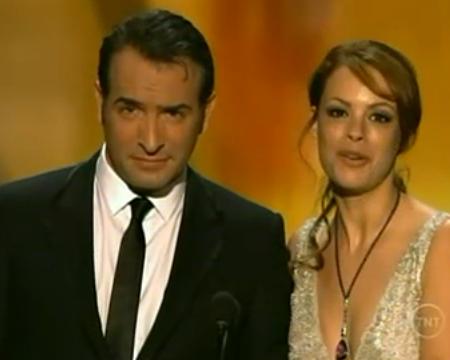
8:22 Dujardin has the collywobbles when he has to read from the teleprompter, but while Bejo is talking, he happily gets back to Eyebrow Acting.

TV BEST ACTOR (DRAMA) 8:23 If Steve Buscemi wins, the Bridesmaids ladies will have to take one for the team.

8:25 Cranston mimes knocking at a door! Adorable. It seems clear he is ready to conquer comedy, now that he already owns dramas and thrillers.

8:27 Announcer: "Please welcome Meryl Streep." Why didn't she just say, "Bow your heads"? Or just, "Subjects!" Or pass a tithing hat.

8:28 Put pockets and a foot-wide belt on it, and Meryl WILL wear it, sugar.

8:31 A number of the Memoriam clips have extremely awkward themes of death: Elizabeth Taylor, Clarice Taylor, Jackie Cooper crying, "I won't go!"

8:34 The advertising slogan for RuPaul's Drag Race is "Gag on the Eleganza!" They trademarked that right before War Horse got to it.

8:35 TV BEST ENSEMBLE (DRAMA) Linda Gray, Larry Hagman, and Patrick Duffy are co-presenting! Glenn and Kenneth feel like the kids on Modern Family now.

8:38 Boardwalk Empire wins Ensemble! Bottoms up, everybody.

8:41 Melissa McCarthy looks right at Kathy Bates and says, "She's awesome." Big crowd-shout for Midnight in Paris. (Okay, can we have Viola now?)

8:42 BEST ACTOR Natalie takes creamy, easygoing, voluptuous pleasure in reading the teleprompter script, just like she did at the Globes. So relaxed!

8:43 You'll literally never guess this, but for Clooney's clip, they picked that staggeringly unconvincing crying-at-her-bedside scene. #SAG

8:44 Jean Dujardin, people!!! We have got a RACE! Gag on THAT eleganza!

8:46 We're seeing a deep bench of happiness for this win. Angelina was all about it. Brad, George all smiles. Albert Nobbs table: into it.

8:48 Meanwhile, anyone born in the 90s may not know this, but eventually, Brad always morphs into his ladyfriend's spitting image. Always.

8:51 BEST ACTRESS The drivel that Ben Kingsley has to recite before presenting Best Actress is choke-worthy even by the standards of these sorts of things.

8:52 Viola's Bronx cheer sounds louder than Meryl's, but they're both impressive. Tilda's is surprisingly robust.

8:53 Tilda cringes and shrugs off her nomination, again.

8:53 VIIIIIIIIIIIIIOOOOOOOOOOOLA.

8:56 Viola pays it forward to Cicely Tyson. Who NEEDS to be on anyone's shortest possible list for Lifetime Achievement next year.

8:57 BEST ENSEMBLE And The Help pulls down Best Ensemble. Cicely gets to go up there after all! 12 actors are on the official list. These are some happy gals!

9:00 Viola Davis: "We ALL of us - I don't care how ordinary you feel - can inspire a change." And with that, an Octavia whoop, and a group hug.

9:01 I would like to thank this ersatz live-feed for giving me access to the show. I have ladled piping-hot viruses into my computer, I'm sure.

9:02 As Angelina and Tilda talk passionately about who knows what (??!!), we sign off. Sorry for clogging the feeds, everybody. Come back, now!

Labels: , , , , , ,

Wednesday, August 11, 2010

Hit Me With Your Best Shot: Angels in America

I struggle with the HBO adaptation of Angels in America because the play means a lot to me, and especially given all the money that was clearly made available to this project, I wish it were a richer, more thoughtful production. Perestroika in particular brims with missed opportunities, though the heavy re-writing only further proves that Kushner has never quite settled on a design for that half of the play (though chaos is clearly an indispensable element). I can see that Nichols and his designers have played up the "staginess" of several interiors so as to keep the project rooted in a sense of theatricality, but a lot of the cinematic embellishments and CGI effects feel too slick and two-dimensional, when the play clearly benefits from as much tangibility as you can bring to it. I'd love to see what John Greyson or Robert Lepage or somebody might have done with the material. Still, it's hard to imagine a really bad production, and this one certainly isn't, because the core text is just so provocative, ambitious, imaginatively drawn, and beautifully written.


I'm picking this image less as the "best" than as a kind of emblem for my feelings. I'm not sure Angels needed this new scene that Kushner wrote for Perestroika, and it feels like a somewhat desperate opening-out of the physical space. I'm not a huge fan of natural location photography with a project like this anyway, since the whole text is constructed as a series of artificial problems and conceits laid over the very real nightmares of our history and our current reality. The beach here feels so ...domesticated, in a play that thrives on fantasy and fire. At the same time, I do appreciate the dynamic of this scene, not just because you see Joe Pitt getting recklessly invested in a relationship he barely understands—and at the same time you're feeling Louis Ironson starting to pull out of it—but because Angels in America is always telling us that denuding ourselves does not pare us down to essentials but in fact exposes our complexities. That in opening yourself to the world of sexuality you inevitably create a storm of debris, big or small, and that somebody else will have to pick it all up, now or later.

From a visual standpoint, in a miniseries that takes playful but earnest care to consider all the characters' potential relations to the angelic, I like how the foamy line of surf hits Patrick Wilson's body just where a tufted set of wings might go. The story, the dialogue, and the bulk of the shots make this Joe's scene, which is fine with me, since I think Wilson gives the best performance in the cast, in the play's most potentially opaque role. But visually, as Joe begins to strip down, we also recognize that it's really Louis's turn to wrestle, Jacob-like, with the naked angel—whatever an "angel" might mean to Louis, or to us, at this point in the piece. The shot and the scene are like a cold parallel to Emma Thompson's magnificent arrivals to Louis's HIV-infected boyfriend, Prior. Joe looms above with a kind of majesty that Wilson's body, the best one that a court of appeals lawyer ever had, only reinforces. Louis, like Prior, crouches below in a panic. This Louis-as-Prior doubling, despite the annoying fact of how the miniseries rejects a lot of the other doublings that the playscript demands, only intensifies insofar as this gray, cruddy beach with the jagged stumps at the shoreline and the capsized hulk on the horizon is like a downscale, mundane precursor of the chilly, magnificent wreck called Heaven that Prior is soon to visit.

If anything, though, it is Joe who is the hapless, Prior-like innocent in this relationship, and Louis who is the flighty, schizophrenic, Angelic agent/invader who likes to think he is a victim. In fairness, Louis does suffer. But nonetheless, the brief, visual confusion of roles in this shot strongly implies that this relationship won't work out.

So, a lot of resonant stuff going on in this otherwise simple shot, though it still feels like the viewer and the play have to do a lot of their own thinking to keep the image and the movie interesting. HBO's vision of Angels is nothing if not concepty but it barely if ever registers as intellectual, a category that the play fully embraces but which Nichols' movie avoids like a kind of ...virus? That's my reaction in a nutshell to this made-for-TV Angels, which I always feel like I'm either overestimating or underestimating. If Patrick's just taking off his clothes in a last-ditch attempt to convert me to the cause, what can I do about that? Let him try.

P.S. I would like to add a few more runner-up shots. Like Nathaniel, I am totally in love with Jeffrey Wright's physical vocabulary as Belize, whom he plays very differently than he did in his Tony-winning take on the same character for Broadway. I like this shot not only because Belize just cracks me up with all his heavy-lidded, low-volume, but prissily catlike gestures, but because I always wonder how much Wright might have felt like Belize, trapped in a play that pretends to have a lot to say about race (and, like Louis, it occasionally does have something to say) but delivers a lot less than it promises. Does Wright ever wish he could just signal the waitress, grab his check, and get outta there? It'd be Belize's best option for finding a private life or an orgasm, since even Hannah Pitt beats him to both. (Also, love those Ann Roth costumes.)


I'm including these three shots of Emma Thompson—the we-get-it, she's-a-religious-icon halo shot, the worthy showstopper that ends Part One, and the Goth-queen hurricane she whips up in Part Two—because even though I felt while watching Angels that Emma could have been more confident with her character work (outside of her marvelously dykey, warm but gruff take on Nurse Emily), I think the piece ultimately benefits from her balls-to-the-wall spirit of exaggeration and risk. You'd not have imagined Margaret Schlegel doing this, and if you fast-forward through Angels instead of actually watching it, she seems like the biggest incentive for a re-watch. I'll certainly take her any day over Mary-Louise Parker, who can always find new opportunities for empty, adenoidal "irony" in virtually any part. The entire HBO version misses Harper so badly, from script to performance, that it's too sad to dwell on.


And lastly, since it's one of the few shots that suggests what Angels might look like with a Tarkovskian sense of cold, stately, unreassuring divinity blowing through it, I'll admit that this shot triggers fantasies of what a totally different film might have looked like. I'm more reconciled to this version than I'm sounding in this post, but I like it best when it prompts celestial visions of other, more persuasively millennial approaches.

Labels: , , , , , ,

Sunday, February 28, 2010

The Best Actress Project: 2009


One of these women is not even nominated, but just shut up about it, okay? Another of these women will go home with an Oscar a week from today, on March 7. Theoretically, of course, more than one could be going home with Oscar—and if we miraculously wind up working that '68 groove and are witness to a Best Actress tie, just imagine the kiss that Bullock and Streep will be forced to exchange!

Anyway, amidst a flu, a writing deadline, the final week of an academic quarter, and my harrumphy status as a conscientious objector to this year's Oscars, this is all you're getting from me this week in terms of pre-Oscar coverage... but I tried to make it count! You were all so wonderfully voluble and spirited in your responses to yesterday's profile of the Women of 1944 that I sort of figured, why wait? These are so fun to write up, even when the fields leave a few things to be desired. (Note: Rankings slightly revised since initial posting.)

And speaking of desire: I think I have a strong idea of who will win my poll as the actress who should be copping this year's Academy Award. Still, I hope that as many readers as possible will seek out The Maid and Beeswax, the least-seen movies of those I have included on my personal ballot, despite being two really invigorating slices of funny-serious cinema, both of which give the DIY aesthetic a really great shake. Make sure to let me know, too, what I absolutely need to rent before I seal this year off. The Burning Plain and Lion's Den are already on DVD, The Private Lives of Pippa Lee bows this week, Séraphine drops later in March, and Cloud 9 will be out in April. I'm intrigued by all five, but go ahead, guide my hand.

P.S. While prepping this new addition to the Best Actress section, I noticed that I never added a poll for 2008, and though the currency of the questions has wilted, my interest in your answers has not!

Labels: , , , , ,

Sunday, November 15, 2009

At Long Last, the Ladies


Because it's ten months overdue. Because Anne Hathaway turned 27 this week. Because Ballast, which I loved, has finally arrived on DVD, and because I'm hoping Tarra Riggs will get more work. Because so many of you have left comments and sent e-mails, wondering what ever happened to Best Actress? Because it's the month of Thanksgiving. This is my way of saying thanks, to them and to you.

Labels: , , , , , , ,

Friday, September 04, 2009

The Fifties: A 2009 Progress Report

You loved them in 2006, you loved them in 2007, you loved them in 2008, and suddenly, here we are again. Two films earlier than I thought we'd be, however. When I saw, and loved, Roy Andersson's mordantly hysterical and brilliantly staged You, the Living tonight with Goatdog, I figured that after this splendid experience, I would make a point of catching the inevitably discussion-worthy Inglourious Basterds, and the completely untitillating but compulsory Taking Woodstock, and then I'd be good 'n' ready to take this annual stroll through the best of what I've seen so far—which, if you're joining for the first time, is published every year after I've caught my 50th U.S. commercial release. But then, I noticed that two films I saw at last April's Nashville Film Festival, Giancarlo Esposito's disappointingly clunky directing debut Gospel Hill and Ondi Timoner's intriguingly "edgy" but finally off-putting documentary We Live in Public, had suddenly opened in New York City. So we've got our customary tally of 50, without a basterd or a hippie in sight.

I admit that I'm not that sad to be skipping forward: I will enjoy playing my exact responses to Basterds and Woodstock a little closer to the vest once I've actually seen them, so that my thoughts are fresher at year's end... and my reason for selecting and archiving "The Fifties" every year is to underscore some great filmmaking from the months of the year that are mercifully light on huge headline-grabbers and awards-PR campaigns, though this also means that many of my anointees are likely to be crowded out of the spotlight, even my own spotlight, once "Best Of" lists and ballots actually do start circulating in January December the morning after Veteran's Day.

Can we all repeat in unison? It is a lazy, Hollywood-centric, studio-driven myth that all the good movies open in the fall and at the holidays. If you're tempted to believe this—and you hold a job and inhabit a city that affords you wider options—you aren't making enough time for the foreign films, past festival winners, and documentaries that are distributed herky-jerky all over the calendar, and you might not be giving due credit to what you have seen and enjoyed in the winter, spring, and summer, while somehow locking into the presumption that everything good is still to come. When I personally look at the fall, I don't get the sense of a huge mountain of treats in the offing, so all the more reason to celebrate what we've got so far... and if you missed 'em, look for 'em! And if I pass on what you thought were some shoo-ins, I'm not trying to be a jerk. I just don't get the fuss.

(P.S. I love my commenters! Even more than usual, the ideas and suggestions in every part of this post have been tested for the better and made more interesting by the contributions of the commenters. Make sure to read them!)

(P.P.S. For a U.K. take on the best of the year up till now, taking a different slate of releases and dates into account, check out Tim's new list.)

BEST PICTURE
The Hurt Locker - The studio serves gourmet, and you chow down on Spam? Buy a ticket!
Julia - Erick Zonca takes huge risks in writing and direction, with stunning payoffs
The Limits of Control - An uneven auteur yields rich, weird, fascinating minimalism
Lorna's Silence - A taut, nuanced story rendered with typical Dardenne eloquence
You, the Living - Like an uproarious trompe-l'oeil exhibit in a Nordic purgatory
(Count the B+'s, and you can see that my Top 10 would so far be filled out with the sprawling but austere Gomorrah, the ingeniously acted and scripted In the Loop, the boldly heightened Sin Nombre, the ruefully elegant Summer Hours, and the vibrantly schizoid Thirst. Though if Prodigal Sons eventually scores a theatrical release, it will enter near the top. What's going on with this movie?)

BEST DIRECTOR
Roy Andersson, You, the Living
Kathryn Bigelow, The Hurt Locker
Jean-Pierre & Luc Dardenne, Lorna's Silence
Jim Jarmusch, The Limits of Control
Erick Zonca, Julia
(No cutesy exceptions: the five best films derive from the five most singular, mature, and risk-taking exercises in direction. For more on "cutesy," see the Comments.)

BEST ACTRESS
Amy Adams, Sunshine Cleaning - Connects with multiple sides, peppy and grim, of her character
Arta Dobroshi, Lorna's Silence - An admirable feat of "being, not acting" acting
Mimi Kennedy, In the Loop - One of the deftest and smartest of multiple, delicious leads
Kim Ok-vin, Thirst - Works overtime to make Thirst hang together; does so with fire and cool
Tilda Swinton, Julia - If anyone touches her in '09, I'll be floored
(Fête Meryl all you want, and yep, she's fun; but I didn't really buy this as more than a broad, loving romp in a simple role. This category changed after the first comment; see below.)

BEST ACTOR
Peter Capaldi, In the Loop - Showy lines, yes, but he grounds them in a sharp, shifting character
Russell Crowe, State of Play - That rarest of breeds, a plausible Hollywood journalist
Robert Downey, Jr., The Soloist - Blends his rascally tics into a lively, believable portrait of emotional aloofness
Mark Duplass, Humpday - Sells a moribund premise with his razor precision on each line and look
Jeremy Renner, The Hurt Locker - A fully integrated, deep, arrogant, no-fat picture of a 21st-century antihero
(How surprising that there are twice as many strong candidates, including almost-as-good costars Anthony Mackie in Locker, Jamie Foxx in Soloist, and Tom Hollander and Chris Addison in Loop, plus spry Paul Rudd in I Love You, Man, beleaguered Sharlto Copley in District 9, and haunted Ciro Patrone in Gomorrah)

BEST CINEMATOGRAPHY
The Hurt Locker - "Gets" every aesthetic and POV that every other Iraq movie tried for, and gets them all
Julia - A restless symphony of unease and frightening, blood-pumping, reckless catharsis
The Limits of Control - Intense seductions of color, geometry, and depth, with witty allusions
Sin Nombre - A rich chromatic experience that never abandons the characters or their worldview
Thirst - A plethora of tricks, color schemes, rapid movements, and ostentatious frames, in a good way

BEST FILM EDITING
Drag Me to Hell - With minor caveats, a flawless hold on pace and tone
The Hurt Locker - Exquisite action and suspense, with character notes and a refusal of clichéd cutaways
Julia - Careful balance of dreadful accumulation and right-off-the-bat lunacy; engrossing
The Limits of Control - It's all in the title: dilates scenes to just the right extreme, whether of dry absurdism, or real menace, or environmental immersion
Lorna's Silence - Balances an unusually plotty, talking-pointish script with needful intervals of social atmosphere and long, well-calibrated takes

BEST SCREENPLAY
Gomorrah - A wealth of details, with just enough connecting threads
In the Loop - Ingenious construction outshines even memorable invective
Lorna's Silence - Judicious pacing of revelations, plausible pile-up of conflicts
The Soloist - Refuses the tempting studio clean-up on several messy points
Summer Hours - Ideal, miniaturist moments with artfully ambiguous gaps

BEST SUPPORTING ACTRESS
Anna Chlumsky, In the Loop - An unlikely but certain bid for smart roles by a onetime child star; tastily comic yet totally true
Marion Cotillard, Public Enemies - Makes everything one could out of a stunted part and plotline
Alycia Delmore, Humpday - A tart, likable read on the girlfriend everyone over- and under-estimates
Gina McKee, In the Loop - Devoted but disdainful; enjoys the wreck everyone makes when they drop her
Naturi Naughton, Notorious - A fierce, fully committed take on L'il Kim, pulling a great "f*** you" diva moment hurling "Get Money" at B.I.G.

BEST SUPPORTING ACTOR
Jason Clarke, Public Enemies - Self-assured reticence and charisma, as Dillinger's most trusted pal
Steve Coogan, In the Loop - Works perfect, angry, funny, righteous magic at the sidelines
Fabrizio Rongione, Lorna's Silence - Implies an entrancing spin-off beyond this movie, and downplays the "villain" notes
Saul Rubinek, Julia - Hard to imagine a surer spin on the infatuated but exasperated enabler
Stanley Tucci, Julie & Julia - Warm and generous, but also knows how even the most loving, candid couples subtly maneuver with each other

BEST MOVIES I DIDN'T MENTION
Sugar and Revanche

SORRY, BUT I'M NOT A BELIEVER
The Brothers Bloom, Moon, Of Time and the City, Ponyo, Star Trek, and Up

Labels: , , , , , , ,

Monday, June 22, 2009

Marvelous Meryl Streep

I promised a return to cinematic matters, though if anyone wouldn't mind a movie blog casting a more-than-occasional eye toward stage drama, it would surely be Meryl Streep. And let's add a few more "surely"s: surely you love her, surely you have been following Nathaniel's month-long tribute to her 60th anniversary on the earth, and now that the big day itself has finally arrived, surely you have already relished his advice about how to celebrate, at least twice. While he's been up to all that public cheerleading, I have quietly (as my sidebar reveals) been filling the holes in my Streep-viewing, to include the PBS taping of Wendy Wasserstein's Uncommon Women...and Others, the only thing she did in 1979 that I don't recommend you watch, unless you're an absolute completist, which would certainly be understandable.
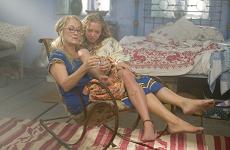
In any event, Uncommon Woman that she certainly is, I've added this tribute to my Best Actress Special Section as a commemoration of her 60th birthday. I hope you enjoy it, I hope you rent widely and adventurously from her back catalogue, and I hope she's got several more decades of time-capsule performances left to share with us.

P.S. If you'd rather hear sensational tributes from people who actually know Meryl, try these from Nora Ephron (perfection), Carrie Fisher, Shirley MacLaine, Diane Keaton, Kurt Russell, Clint Eastwood, Kevin Kline, James Woods (Meryl meets Don!), Robert De Niro, Goldie Hawn, Claire Danes, Jack Nicholson (mooing), Jim Carrey (long, and bad video quality, but very funny), Mike Nichols, and the uproarious Tracey Ullman... and then Meryl says thank you.

Labels: , ,

Tuesday, September 16, 2008

Dumb and Dumber


Mamma Mia! and Tropic Thunder. I'll let you decide which is which. What was I just saying about how much I like reviewing truly good movies?

Labels: , ,

Wednesday, April 18, 2007

New: DVD Spotlight

One new feature of my revised website is a weekly "Spotlight Review" of a film on DVD, where I showcase a full review of a film available on DVD. These choices may be selected for their topical relevance to recent news, or because I've recently revisited the film, or because the filmmakers or actors have another film in current release, or simply because I feel like sharing some love (or venting some opprobrium). Last week, I linked to my review of The Devil Wears Prada, since it was the last DVD review I composed before the site entered its winter hibernation; I also couldn't help stumping for Silkwood, to showcase the difference between good Meryl and great Meryl. Now, in its second week, the Spotlight shines, if that's quite the right word, on Freedom Writers, a good-hearted but gummy-headed 2007 release starring an eager but awkward Hilary Swank. Freedom Writers bows this week on DVD.

Photo © 2007 Paramount Pictures/MTV Films

Labels: , , ,

Sunday, January 07, 2007

That's All

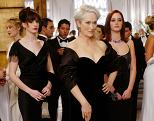
I would so be fired as Miranda Priestly's assistant. Here's a woman who needs a dozen Hermès scarves to land on her desk in the time it takes to purse her lips, and I can't even spit out a review in less than six months. Another... disappointment. Frankly, the movie's a bit of a disappointment, too, although its bright spots are very bright. One wishes that the director and screenwriter had taken equal care with all of their actors and subplots, and that everything bracing and deft in the opening sequences had survived into the crammed and abbreviated second half. Still, I gotta admit this movie is a hoot, and though nobody quite has me screaming "Oscar!", I have several nice things to say, especially with regard to the three leading ladies, in my new full review.

(Image © 2006 20th Century Fox)

Labels: ,

Friday, December 08, 2006

The DVD Wears Prada, and Other Second Dates

The promoters behind the DVD of The Devil Wears Prada have asked me to lend them a little bit of extra publicity, and who am I not to oblige? By all means, rent it. I myself am eager for a second look at Prada, particularly to revisit its best performance—which belongs not to Meryl Streep but to Emily Blunt, as the exasperated assistant who torments Anne Hathaway before they forge a sort of terrorized entente. It's no mystery why Streep feels able and entitled to push Hathaway around and make her work to claim her own starring vehicle, but there's a moment when Blunt asks Hathaway whether she's on her way to some sort of "hideous skirt convention" and I realized that Blunt, without quite hustling her way into the spotlight, was nonetheless staken her own unbashful claim on the movie and getting the maximum zing out of all of her lines fly.

My memory of Prada is that too much of it doesn't zing, or not as often as it should. Simon Baker is especially (and typically) ruinous as a caddish journalist in one of many subplots that the movie doesn't know how to handle, but I'm not even sure the central storyline between Hathaway and Streep really jelled. All the same, I remember having a perfectly zesty time while I was sitting there, and I'm frankly eager just to see the clothes again, so that's why Prada rates on the list of second dates I've lined up for myself in the final, list-preparing weeks of 2006, along with springtime favorites like Clean, Dave Chappelle's Block Party, and Tristram Shandy: A Cock and Bull Story. Already, a recent rencontre with The Notorious Bettie Page, a movie I admired rather less than those other three, proved to be an eye-opener: it turns out the film measures up to its sensational lead performance much better than I understood at the time, and it revealed new layers and ironies beneath that patented, chilly, slightly stolid Mary Harron exterior (see also: American Psycho).

Now, to you, the birdie: besides the upcoming holiday releases and compensatory rentals of films you missed in the theater, what are some titles from 2006 that you're curious to test-drive for a second time?

(Image © 2006 20th Century Fox Film Corp.)

Labels: ,

Saturday, September 16, 2006

Picked Flick #39: The Hours

The Hours, both Michael Cunningham's novel and Stephen Daldry's film, continue to frustrate and upset me, in ways that are at this point indistinguishable from fascination. Sometimes that fascination is purer, more awed. At other times, both the book and the movie emanate a powerful mediocrity, a distinct aroma of cliché, of unmet ambitions. I often furrow my brow at the relentless lyricism of Cunningham's prose, which, in this book as in others, strives rather arduously for showy, synesthetic images where more modest narration would happily suffice. He writes as though with each paragraph he hopes to secure our vote, some badge of our readerly devotion, even though the heady conceptions of his books sometimes trip over all the stylistic filigrees. And yet, Cunningham broaches subjects and themes that are difficult to articulate, or even to acknowledge, and he is capable of real astuteness in how he treats them: the ways in which death can feel impolite, just as caretaking can be officious and desperate; the worrying, thin line between liking someone enormously and loving them merely adequately, and how a shift from one to the other can be more painful than any dislike or hatred; the ways in which people look to art, especially books and music and movies, for telepathic prompts for their own life-choices.

The movie version of The Hours shares the arresting ambitions and the psychological acuity of the book, as well as its prosaic and vaguely elitist excesses. To my mind, in recent popular cinema, American Beauty is the movie's closest cousin, both of them built atop scripts that can seem courageously lucid and dismayingly glib within single scenes or transitions, both directed in a glossy, theatrical, actor-friendly style that serves and also sabotages the material by playing up the artifice. You can hold your ear up to American Beauty or The Hours and hear a worrying howl from deep within the upper bourgeoisie, demanding and deserving to be taken seriously, but you can also somehow hear the production teams slapping their own backs about the casts they've hooked, the certainty of prizes, the Big Issues they broach. However, while the moods and structures of American Beauty, for all of its technical audacity, feel smaller and more market-tested as the years go by, The Hours totally engrosses me. I keep sitting before it, open-minded, sometimes open-mouthed. It becomes clearer, for one thing, that the movie has darkened the book considerably. Disapproval of Richard Brown's esoteric, self-obsessed novel is more general. Vanessa Bell is more unhinged, almost repulsed, by the ravenous loneliness of her sister Virginia Woolf. Laura Brown already intends suicide as she drops her son with an indifferent neighbor. Clarissa Vaughan lets slip a major, unwitting insult to her daughter, and instead of nursing a fond, fumbling reminiscence with Louis Waters on her comfy living room couch, she erupts and nearly dissolves in her cold kitchen, where the light is the color of frost, the faucets detonate for no reason, and Louis looks on, agitated and annoyed, from practically a mile away across the countertop. This last scene is my favorite in the movie: its scary unraveling of Meryl Streep, usually so composed and sometimes to a fault, encapsulates the wholly credible and almost lymphatic unease beneath the film's mannered language, the roiling score, the sometimes precious match-cuts.

I suppose it's no mystery that such a disciple of modern film actresses as myself would get swept up in this movie. I have been known to listen to the Kidman-Moore-Streep commentary track on the DVD while I clean or cook. Still, The Hours collects so many disparate, exciting actors into such a range of parts that it's almost hard to get a bead on the performances: secondary players like Miranda Richardson and Eileen Atkins grow more interesting over time; my regard for all three star turns cycles up and down; and character approaches that click well in one scene, or against one particular co-star, feel subtly wrong in or against another. In some ways, the movie cuts more to the point of Cunningham's novel than his own prose really can: the whole piece activates such complex, elliptical relationships among notions of acting, essence, ritual, privilege, performance, gender, art, sex, and death that it somehow deepens the themes to see the bodies, scrutinize the faces, smell the money, feel the flatness of the screen. A major concern of The Hours is the ambivalence of love, the working out of conflicted emotions over time, even over generations. Fitting, then, that I keep wrestling with this book and this movie, frowning at their shortcuts and platitudes, hooking onto their sublime moments, assigning both texts in course after course, wondering where our attachments to art really come from, how fraught they can be with disapproval as well as wonder. (Click here for the full list of Nick's Picked Flicks.)

Image © 2002 Miramax Films and Paramount Pictures.

Labels: , , , , , , , ,

Wednesday, August 09, 2006

Savoring a Sure Thing

As I keep marching forward through Oscar nominees of the past, I am occasionally regretting that I splurged so early on so much good stuff and left a steaming pile of Greatest Show on Earths and Great Santinis to contend with in my future. "Great," needless to say, is a false promise in both instances. I'm also wading through a lot of interesting mediocrities like Birdman of Alcatraz and—here we go again!—The Great Ziegfeld, for which I've written short reviews.
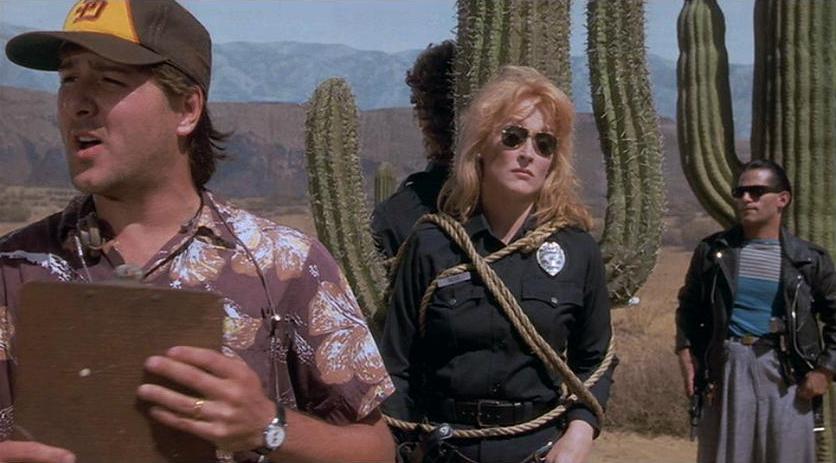
Every now and then, though, it restores my faith to return to a known goodie from Oscar's past that I haven't seen in a long while, and which I'm now bound to appreciate with a different critical eye. A perfect case in point is Silkwood, Mike Nichols' superb and humane dramatization of the life of Karen Silkwood, a nuclear-plant employee who died in a very cryptic auto-crash, just as she was preparing to expose her company's most lethal and reckless abuses against their workers. I've written a long review of the film which I hope you'll read and enjoy, but let me add what an awe-inducing treat it is to see Meryl Streep working at her level best with a top-drawer script and director. Sure she was the best thing in A Prairie Home Companion and among the best in The Devil Wears Prada, but her genius in those movies lay in her savvy, lively approaches to the parts, neither of which permitted a truly satiating characterization. Also, she was so conspicuously better than most of what surrounded her in both films that she was almost an unwitting liability, calling a sizable bluff of two enjoyable larks that could have been much, much better. Still, Silkwood, the first of her many and fruitful collaborations with Mike Nichols—my loving tribute to their subsequent Postcards from the Edge is here—requires no caveats for anyone involved, before or behind the camera. It's a better, fuller, more ambitious movie than it needed to be, and a great palliative, albeit a depressing one, in a summer full of films that are several shades slimmer than they promised to be.

(Image © 1983 ABC Films, reproduced from the Internet Movie Poster Awards site.)

Labels: , ,

Saturday, April 22, 2006

Picked Flick #56: Postcards from the Edge

For reasons I have just specified below, Sandra Bernhard would have won my support for the Best Actress Oscar in 1990, even though Without You I'm Nothing is obviously not the sort of vehicle to which the Academy pays any mind—not only because they resist formal experiments, but because they don't even like to laugh. Unless, that is, the responsible party is someone like Meryl Streep, whose tragic-dramatic prestige conversely assures them that a little merriment never killed anyone. In Postcards from the Edge, Streep sufficiently tickled the voters' funny bones to at least score her a nod the year Bernhard should have won. Streep and Bernhard: few people's idea of a seamless pair, but they do share a knack for zeroing in on their targets, especially their punchlines, without hiding the mechanics of how they're doing it. Streep is a kind of performance artist: you watch the woman she's playing, and you simultaneously watch her play that woman. Sometimes, yes, this method can feel a bit clinical, especially when, as in Out of Africa or Dancing at Lughnasa, the tricksiness of her preferred style is out of proportion to the dullness of the character. At her best, though, Streep's "intellectual" quality is actually a conduit for a bountifully generous entertainer's impulse: both the character and its construction are invigorating spectacles, and for an audience to be gifted with both at once is like following a full and zesty meal with a rich and flavorful dessert. You can even eat them at the same time! You can go back and forth! Meryl's here to give give give. Take what pleases you. Enjoy it all. She, at least, is having a ball.

Postcards from the Edge hails from that period in Streep's career when she suddenly and understandably appeared apprehensive about forever playing pietàs and martyrs and wailing women from across the Earth's four corners. She had a Funny Period the same way Picasso had a Blue one, and though I haven't actually seen any of its other avatars (She-Devil, Defending Your Life, Death Becomes Her), her work in Postcards is so lively in detail that, again, you feel like you're getting several performances for the price of one. Meryl tokes up, she zones out, she trips, she sings twice, she shoots guns twice. But the real action is in the shifting sands of her face and her tiny symphonies of physical accents, whenever she's about the deceptively simple business of selling a line or a scene, or even a fellow actor's performance. Watch what a comic tour-de-force she finds just by crouching among a wire-rack of costumes on a movie-set, her eyes and her relative posture our only inlets into a twelve-tone coloratura of comic humiliation. Waking up, unexpectedly, in a rehab center, she parses out into multiple comic beats what many actors would fold or purée into a single affect: her dazedness, her breath, her shame, her fright, the blinding whiteness of the light and the room, the puzzling discovery of a plastic hospital bracelet around her arm, her dawning recognition that news of her predicament has certainly, already sprinted to undesired destinations. Carrie Fisher has filled her autobiographical script with choice one-liners and her trademark sensibility for observing life askance. "I have feelings for you," confesses a sun-kissed Dennis Quaid, to which Streep responds, "Well, how many? More than—two?", and while the line is a great gift to her (and there's way, way more where that came from), her muffled, almost foggy playing of it is a cadeau to Quaid, an earnest tryer who rarely knows, and certainly didn't know in 1990, how to anchor a scene or vary its rhythm. Streep forces him to shake things up, just like she keeps Shirley MacLaine's campy grandiloquence on a liberal but certain leash, letting her do her Thing, even getting her own zappy charge out of it, but also keeping everyone in service of the movie, especially of Fisher's voice. Like Streep, Fisher is possessed of a sophisticated hamminess that she isn't at all bashful about trotting out, so it's no surprise that the two women are such ample enthusiasts and protectors of each other. Fisher's overriding and self-analytical theme, that she has no idea who she is or who she should be, or whether those two concepts even remotely go together, also creates a winning ironic frame for Streep's own chameleonism: watching her change shape and mental fabric, even within seconds, weds the familiar pleasures to some new questions about exhibitionism and avoidance.

Watching so many modern film comedies, I can't help wishing that they had been made fifty years ago; it's the single genre where the drop-off in quality strikes me as the most precipitous, largely because filmmakers' confidence in things like words, speed, and economy have shriveled to the size of a maraschino cherry. Postcards, though, is a rare example of a film that wouldn't be funny at any brisker pace, or with more rapid-fire actors. A more intricate style wouldn't add much—and besides, at zero cost, cinematographer Michael Ballhaus is already having fun moving Streep around the foregrounds, middle-grounds, and backgrounds of his shots, and she mines different kinds of comic gold depending on where she is: a miracle. Finally, in a major departure from most Hollywood comedies about Hollywood, Postcards feels credibly conditioned in what the industry actually is and how a set might actually feel: the anodyne hallways and lots and trailers, the dead intervals between camera set-ups, the way in which Streep's humbled B-lister keeps getting into personal fender-benders with producers, directors, wardrobe assistants, and crass starlets. Hollywood as a way of life, with its own cadences and its own soil, tillable for its very own jokes, is largely divorced from the clichés of celebrity and grotesque wealth. This Edge, then, is a terrifically accessible place, recognizable as a movie about parents and children, about Achilles heels, about the weeks and months of life that seem totally ceded to personal embarrassment, whether or not you have a drug problem, whether or not your mother is Debbie Reynolds Shirley MacLaine Doris Mann. For her part, Meryl Streep will return at two more points higher on this list, in more recognizably Streepish vehicles, but of all of her movies, this is the one that's most easily and comfortably open to visitors, especially old friends, and it never ages or disappoints. (Click here for the full list of Nick's Picked Flicks.)

Image © 1990 Columbia Pictures.

Labels: , , ,