Saturday, November 26, 2011

Top 100 Films, or Reasons To Be Thankful


I've been adding to my revised Top 100 Films list again, offering 100 words apiece about each of the entries. To give the list some added value, each entry also contains some suggestions about where interested readers might find a scholarly or film-critical response that's well worth your time.

The first ten listings in the new format have promised a place to leave comments, and though some early conversation began in this ribbon-cutting entry, you're welcome to revive the conversation here. If you've got feelings to share about Annie Hall, Eternal Sunshine of the Spotless Mind, The Joyless Street, Letter from an Unknown Woman, Flesh, When Harry Met Sally..., In the Year of the Pig, Nostalghia, 2001: A Space Odyssey, or Riddles of the Sphinx, have at it!

Labels: , , , , , , , , , ,

Saturday, April 09, 2011

Mildred's Almost Piercing

I know I haven't properly blogged or reviewed anything since Joan Crawford filmed the first Mildred Pierce. And I'm still not ready to properly fix that: my real job is still running the show these days, in overdrive.

But I am in the middle of Tweeting my responses to all five installments of Todd Haynes's HBO miniseries of Mildred Pierce, so if you just can't live without hearing me express an opinion, and I can only imagine the masses of people for whom this must be true, head over there. I have to confess to being not quite besotted, which is, for me, an unprecedented response to a Haynes picture. I certainly like it, but I feel as though I'm watching my favorite designer show a collection that has drawn inspiration from a source that doesn't speak in nearly the same way to me. Granted, I would have said the same of Bowie and Dylan, but Haynes made those delectations contagious, whereas Mildred keeps them a little glassed-off. Maybe I just don't relate in the same way to television, which necessarily subdues some of my favorite aspects of Haynes's montage and the resplendent boldness of his visual ideas.

As a fresh take on a source we thought we'd seen—which is to say a "revelatory" return to what this decades-old property always was, or nearly so—this project pays dividends similar to those we found in the Coens' True Grit, and I'm feeling a similarly cool admiration, a sort of museal, intellectual interest spiked by exciting bursts of visual flair. I can't take credit for that analogy, which my friend Richard Knight held out to me a couple weeks ago. I'm also having a hard time not thinking about Carlos, as a five-hour canvas devoted to a figure of voluptuous interest to the filmmaker, sometimes translated in delicious nuance, sometimes through rhetorical strokes I find a little flat. From that angle I admire Mildred, like Carlos, as a statement of the artist's unrepentant fascinations of the moment, and as a major producer's coup in a time of dwindled budgets, hedged bets, and the decline of the two-hour drama, much less the five-hour. I just wish I adored this.

For a few more tidbits, I've got tiny hour-by-hour responses, appreciation for Ann Roth's costumes, and an ongoing Mildred Pierce Actress Watch, in which (you know me) I can't help dwelling on all the extraordinary women in the cast. Though I'll say it again: in an abnormal moment of gendered allegiance, my Best in Show bouquet gets tossed to Brían F. O'Byrne.

P.S. Maybe it's just the emotional release or maybe the project really does accumulate a wallop, but the fifth and final episode, airing tomorrow night, landed with me more than I had expected. Still not in love, but less inoculated than I had felt beforehand.

Labels: , , ,

Sunday, November 15, 2009

At Long Last, the Ladies


Because it's ten months overdue. Because Anne Hathaway turned 27 this week. Because Ballast, which I loved, has finally arrived on DVD, and because I'm hoping Tarra Riggs will get more work. Because so many of you have left comments and sent e-mails, wondering what ever happened to Best Actress? Because it's the month of Thanksgiving. This is my way of saying thanks, to them and to you.

Labels: , , , , , , ,

Tuesday, February 24, 2009

So Let Me Hold You Tight...


...and share a / killer, diller, chiller, thriller - here toniiiight...

Labels: , ,

Thursday, December 11, 2008

Anyone Remember This One?

I bet you do. Doesn't this photo make you want to drop everything and watch it again this instant? I do, which is why it's a favorite.

Labels: , , ,

Wednesday, October 04, 2006

Unlucky Stars

Watching miscast actors give poor performances is just miserable, because there's nothing you can do for them except watch them wriggle. The experience is particularly dolorous when the performers are estimably better than the current script or picture is allowing them to be, and it's worst of all when they are the kind of honest, committed joes who don't just sleepwalk through a bad movie or an ill-fitting vehicle or a poorly written part, but who instead keep trying to redeem the experience. If they're lucky, like Jodie Foster was in Inside Man, the rest of the film hums along with such confidence and panache, making such roomy allowances for experiment and unexpected silliness, that the failure to bring a character into focus doesn't register all that much. (Plus, having beheld Foster's embattled, nostril-flaring resolve one too many times on screen, I found her loose, daring miscalculations in Inside Man almost a pleasure in themselves.) The early fall, however, has brimmed with less fortunate actors, wrangling in vain with major roles in movies that aren't good enough to compensate for them or to distract our attention. You might have thought that the miscasting and careless directing of actors couldn't get any worse than it did in The Black Dahlia, and—well, maybe you're still right. But these three movies, all of them worse than the addled but unnerving Dahlia, give Brian De Palma and casting directors Lucy Boulting and Johanna Ray a dismal run for their money:

Hollywoodland
Director: Allen Coulter
(Mis)Casting Director: Joanna Colbert
This flat-footed procedural offers a marginal Hollywood malfeasance as some kind of plangently tragic conundrum. The question of who killed George Reeves (Ben Affleck), the star of TV's Superman, gets sieved and re-sieved through the dully interlocking stories of his failure to score better parts, his affair with a studio boss' wife (Diane Lane), and his later relationship with a piranha who doesn't care about him (Robin Tunney). Plus, he has the bad luck to be posthumously investigated by a swaggering, irritating, hotheaded detective, instead of by someone that a movie audience might actually want to spend two hours with. Sadly, there is no ironic resonance in the fact that Adrien Brody has barely less contempt for his part as the detective than Reeves had for his padded-suit Man of Steel. Brody constantly winks that he's way too cool for this shoddily written role, perhaps too cool for the industry as a whole—though he sure looks awfully sincere whenever he spouts one of the script's limping banalities about the loneliness of fame or the distorting power of the newsmedia. Presumably, Brody is only too happy to let Affleck hoard all the big press, which reached a sort of dadaist climax when he won the Best Actor award at Venice in September. I can only assume that Catherine Deneuve and her fellow jurors were bribed (money? gelato? weed?) into seeing something remarkable in Affleck's sad spectacle. The "takes one to know one" thesis behind this casting might sound nervy on paper, but however well the sullied inadequacy of Affleck's career and abilities are meant to rhyme with those of Reeves, we still have his minuscule range, stolid physicality, and inveterate self-regard to contend with. Hollywoodland never makes a case that Reeves' death is worth probing, or even mourning; as on Superman, his humanity is utterly stifled by lousy production values and unrewarding stunts. D–

The Science of Sleep
Director: Michel Gondry
(Mis)Casting Director: Julie Navarro
This antic, inventively disheveled, but egregiously overconceptualized movie wins some points for ultimately defying the goopy winsomeness that keeps threatening to take it over. For a long, long time, the mismatch between the giddy, colorful, through-the-looking-glass romanticism of Gondry's visuals and the flat, ashy mundanity of the central love story feels like a galling error. Ultimately, the film justifies our skepticism in a scene of wormy, exhausted anger that's unlike almost anything else in the movie, but the backloading of the film's intelligence isn't sufficient reward for having made it through 100 minutes of capricious indulgence. Gondry, who also wrote the script, has immersed us too heavily, too often, and with such mismanaged abruptness in the arrested-adolescent projections of his protagonist that I, for one, was too exhausted to make the leap into the film's climactic revelations. Plus, to fill the role of a restive, pouting, sexually repressed manchild, Gondry and Navarro have tapped, of all people, Gael García Bernal, whose handsome charisma, confident comportment, and lithe accessibility to both the audience and his fellow actors all make him woefully wrong for this Pee Wee Herman/Chuck & Buck type. Granted, The Science of Sleep would lack much force of irony or discovery had it typecast the part with more overt maladjustment, but García Bernal looks itchy and effortful throughout. Neither he nor Charlotte Gainsbourg looks remotely at peace inside the clamorous, surrealist set-design. In fact, everyone looks uncertain as to how their writer-director is going to pull all of this chaos and whimsy and distant, thrumming sadness into something architecturally sound and emotionally lucid. Few people could or would make a film like this, but the question remains open whether anyone should—especially with a reigning global sex-symbol toiling so far afield from any of his tonal, psychological, technical, or linguistic comfort zones. C

All the King's Men
Director: Steven Zaillian
(Mis)Casting Director: Avy Kaufman
By its very example, All the King's Men formulates an even more stinging indictment of Hollywood than Hollywoodland does in two hours of direct address. King's Men plays as a veritable autopsy of itself; to watch the movie is to watch it go wrong, to observe the tempting gleam of the film that might have been grow ever dimmer. James Horner's score is so hammering and colossal from the outset that you can foresee how overstated and mechanical the whole damned beast is going to be. One is tempted, retroactively, to cede even more of the success of Zaillian's previous features—Searching for Bobby Fischer and A Civil Action—to the subtle, rookie-friendly wisdom of the late Conrad Hall. Sadly, in his stead, cinematographer Pawel Edelman inappropriately mimics the same palette of deep black, burnished golds, and scattered patches of white that made The Pianist both elegant and harrowing, but this look is all wrong for New Orleans, and not nearly complex enough to keep pace with the dense, multi-character plot. Not that Zaillian's script has preserved the plot all that well, either—entire subplots, like the fate of Willie Stark's son, are telegraphed and semaphored without ever reaching their destinations. But the real tragedy of All the King's Men is that its entire cast of luminaries, splashed all over the most self-canonizing preview trailer since Cinderella Man, fall so collectively and humiliatingly on their faces. Jude Law trots out his rendition of the cynical bystander as long as he possibly can; James Gandolfini is amateurish and flat, failing despite his physical heft to plausibly intimidate Sean Penn; Penn himself gives great, deranged stump speeches but falls back repeatedly on old tics in all his other scenes; Mark Ruffalo is milky and hesitant; Patricia Clarkson mines her role for bitter comedy as a way to stand apart from Mercedes McCambridge's long shadow, which fully eclipses her anyway. Worst in show, I'm sorry to say, is Kate Winslet, who doesn't seem to know this admittedly unknowable woman at all, who squats under a succession of terrible wigs, who loses a whole monologue beneath a needlessly overlaid voiceover by Jude Law, and who is lensed again and again through butter-colored scrims and in pools of french vanilla. Having failed to learn her David Gale lesson about staying well away from Southern political dramas, Winslet has only this as a silver lining: Gwyneth Paltrow starred in Hush, Halle Berry in Swordfish, Charlize Theron in The Italian Job, and Reese Witherspoon in Just Like Heaven in the same years they all won their Oscars. The Little Children camp may as well start crossing their fingers. C–

(Image © 2006 Columbia Pictures)

Labels: , , ,

Thursday, June 22, 2006

Picked Flick #46: Titanic

When I first started teaching film, Titanic was invaluable to me, because every single student in my course had seen it, often more than once. As a result, for shared, shorthanded examples of camera angles, color filters, process shots, the comparative scope of a scene vs. a sequence, etc., and just as living proof that movies can unite people and endow us with common language and experience, Titanic was—in the treasure-hunting lingo of Brock Lovett & Co.—a trove, a jackpot. These days, it's hardly worth the trouble of invoking Titanic, because cracking the thick crust of derision or, at best, embarrassed affection is too arduous and digressive a task. Talk about hitting an iceberg: I recognize that even in 1997 and 1998, plenty of people were roundly unseduced by James Cameron's ballad of Jack and Rose. By now, though, Titanic seems to have sunk from a global preoccupation to an abashed recollection or a blacklisted memory.

Both the initial embrace of Titanic and its harsh disavowal, at least in the crowds where I hang out, betray a degree of emotionalism uncommon in the giddy world of movies—testament not only to how the film distinguishes itself from other epic-scale blockbusters by stoking emotion instead of cultivating detachment (it is, in this regard, the anti-Matrix) but to how the sinking of the Titanic itself, with all due respect to the people who died, resonates more in the history of affect than in any real chronicle of worldly consequence. Of course the event was triggered and conditioned by much vaster and more complicated forces—industrialism, social stratification, a booming market in luxuries, a new impetus behind global travel—but it's hard to feel as though any of these concepts operate in any truly complex way within the story of the Titanic, which unfolds as cleanly and simply as a parable. The poor paid for the luxuries of the rich, but death leveled them all. Idealism and ambition ran afoul of a major shoal of hubris. Many, many people died at once, and the foregoing circus of media jubilation around the ship's maiden voyage (as damp a phrase as anyone ever coined) made the deaths somehow more awful by making them so public—a bleak irony, too, since part of the horror of this story is the dark, freezing, lonely privacy in which the ship met its fate, so chillingly captured by that one extreme long shot of the distress flare, a pathetic white comma on the blank black sheet of the oceanic night. Titanic has an ideally sized plot for a movie, and for eliciting mass enthusiasm and identification, because despite the size of the ship and the scale of its infamy, the story's contours remain so manageable. In absolute contrast to something like the JFK assassination, the essential gist and ramification of the story can be quickly known, and since popular imagination has kept it afloat within an envelope of gently precautionary pathos, the tale offers a perfect porthole into broad fields and brushstrokes of feeling: romance, awe, sublimity, sentimentality, gravity, fear, manmade inequities as well as cosmic ones. Cameron's script isn't nearly as ambitious as those he wrote for the Terminator films or for the exemplary Aliens. Nonetheless, his extraordinary visual acumen and his keen regard for the audience's investments even in kinetic and logistic-heavy scenes prepares him perfectly as the director to animate Jack's doomed resourcefulness, Rose's coltish but galvanized resolve, the shipbuilder's avuncular regret, and all those "minor" moments of couples laid together in bed to their final rest, strangers gripping to handrails, waitstaff bolting through the corridors, deckhands crumbling in the face of the panicking crowd, "survivors" condemned to watch what they have just escaped. And he keeps all this in balance while presiding over a gargantuan, exacting, and detailed set, a mythic vision to hold alongside Griffith's Babylon.

Shame about the dialogue, and the high school lit-mag deployment of suicide as a plot device. I know, I know: that song. Many of the performances could stand some tweaking (more than that, in Billy Zane's case), even allowing that they've been evacuated of nuance so as to approximate the idioms of shipboard fictions, and also to purvey the script's distilled emotional states in as unobtrusive a way as possible. Too bad that, for all the justified finger-wagging at class oppression onboard, the world below decks is still something of a fratboy revue of gambols and beer steins, and the story still ends with a crafty and hardworking prole giving his life so that an aristocrat might live. If Titanic were truly building to an intellectual or editorial point, it would have a hard time persuading anybody that Jack's death offered the gorgeous, necessary precondition for Rose's rich, full life of riding ponies and turning pots. But palpably, these aren't the waters in which Titanic means to sail, at least not essentially. Every shot, every terrifically paced and judged cross-cut and interlude—increasingly so, in the film's formally heroic second half—squares the viewer right inside a romantic imagination of beauty and danger that movies almost never attempt anymore. The range of sentiments and the visual lucidity through which Titanic presents itself are tangible and recognizable to almost anyone of any age, and maybe that sounds like a backhanded compliment, but I mean it as an endorsement of the film's refusal to be cynical, or to be simply and flatly procedural like The Poseidon Adventure or Airport, or to wave the flag of its own virtuosity in as shrill and off-putting a way as James Cameron does in his public appearances. The movie knows when to stop showing us smashed hutches and looming rudders against the sky and to contract instead around moments like the one that always, always gets me: Rose, secured on a lowering lifeboat, realizing as Jack recedes in an extreme low-angle shot that the life she is saving for herself is not one she wants to save, and so she clambers back onto the dying animal of the Titanic and runs right back toward Jack. The most sophisticated dramaturgy in the world? No—but at least for me, it reverberates just as much as watching Dorothy walk outdoors into Technicolor or Luke discover that his archenemy is his father or a treasured, long-buried childhood toy melt away in a furnace. Call me crazy, but I'll go down with this ship every time. (Click here for the full list of Nick's Picked Flicks.)

Image © 1997 Paramount Pictures/20th Century Fox.

Labels: , , , ,

Wednesday, October 05, 2005

Daily Update

Things that have caught my eye today:

1. I've been getting around—who knew?? The Film Experience, Queering the Apparatus, and Six Things all shouted me out today for entirely different reasons. And all of this only days after Modern Fabulousity polled me for a music mix to kickstart a new feature on his site. I am feeling all up in my Sally Field '84 right now; I know y'all Oscar obsessives know what I'm talking about. (What, like I'd have a blog if I didn't dig a little bit of that extra attention now and then?)

2. Meanwhile, I've really gotta return the favor, six times over, to Six Things...which, in today's context, seems quite self-serving. But this is a perfect, morsel-sized treat awaiting you every day from the alluringly anonymous par3182. If you aren't treating yourself to it already, you're missing a monkey-barrel of fun, including this and this and this and this and this and this. I tend to postpone my visits so that there's more to read when I go, but I think I gotta stop doing that.

3. Speaking of blogs that I haven't been giving their due, the inimitable Safire has moved her blog, and I'm so stoopid that I didn't catch on for a while. But not only have I seen and corrected the error of my ways, but she made me laugh till I hurt with today's instruction manual for aspiring porn beyotches. If this were the New York Times, this would be the most e-mailed article.

4. Speaking of the New York Times, somebody got wind of my addiction to Op/Ed and realized how much of my cash they've been missing out on for years... and now there's this Times Select B.S. that keeps all the good content away from the non-paying jimmies like myself. Okay, it's not fair to call it B.S., since it's just good business sense. And I don't mean to feed the myth that the New York Times is the be-all newspaper it would love to be. But how'm I gonna know what Frank Rich is saying??

5. At least IMDB is still free, which is how I know that Kate Winslet turns 30 today. A good way to celebrate is to think of a way you could be more like Kate, and then implement that. Since I'm all about Six Things today, I would say that Kate's six best performances are her contributions to: 1) Eternal Sunshine of the Spotless Mind, 2) Heavenly Creatures, 3) Jude, 4) Holy Smoke!, 5) Sense and Sensibility, and 6) Hideous Kinky. (If this were a list of the best overall films in which she has appeared, Titanic, which I still unabashedly love, would be at #3, behind Sunshine and Creatures.) Anyway, happy 30th, Kate! Come visit me!

...and finally...

6) I am waiting to hear back about the possibility of having an academic article of mine included in an anthology being published by an actual university press. No more details, as am nervous and worried re: jinxing myself, but I am compulsively hitting "Reload" on my browser while I'm typing this, so I thought you should know. Cross your fingers, Flick Pick fans!

Labels: ,

Tuesday, March 29, 2005

He's the Top

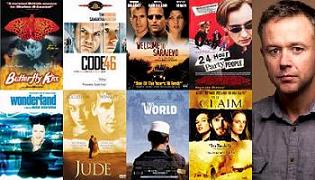
The best English director whom the mainstream still hasn't heard of, and whom the American art-house keeps shrugging off, is the preternaturally prolific Michael Winterbottom, who turns 44 today. In the last ten years, Winterbottom has produced 13 full-length features, and most of them have been terrifically good. You have to reach back to Fassbinder—a hero to Winterbottom, by the way—to approximate that kind of track record. (Or maybe you don't, but I can't think of any rivals.)

Mike recently wrapped principal photography on his upcoming, appropriately tricksterish adaptation of the great 18th-century novel Tristram Shandy, which will hopefully upset literary purists as much as Tony Richardson's Tom Jones did in the early 1960s. Before we find out, there's obviously plenty of good-to-great Winterbottom to explore at the rental store. Go know!

  • Butterfly Kiss (1995) is a road movie about two women caught in a sort of sadomasochistic endgame, with Amanda Plummer (Pulp Fiction) as frenzied as she's ever been as the bondage-wearing, nerve-rattling serial killer in the couple. Sounds wildly over the top, and every once in a while it is, but there is an impressive emotional sincerity to the film, and the feeling of being a caught in a relationship you can't get out of is scarily well-evoked. This is thematically somewhere between Monster and Heavenly Creatures, and if it isn't quite their equal in quality, it's still not easily ignored.

  • As much as Butterfly Kiss intrigued me, I really got on the Winterbottom train with Jude (1996), his bracing adaptation of Thomas Hardy's Jude the Obscure. The essential coldness of the story has not been diminished, though the spirit, intelligence, and enormous charisma of Christohper Eccleston, Rachel Griffiths, and not-yet-a-star Kate Winslet warm the whole thing into something remarkably human and brilliantly accessible. One of the very best of the mid-90s costume dramas, in no small part care of cinematographer Eduardo Serra (The Wings of the Dove, Girl with a Pearl Earring).

  • Welcome to Sarajevo kind of got lost in December 1997, with Miramax leaning so heavily behind Good Will Hunting, but it should have helped Winterbottom cross over. The portrait of English and American journalists covering the standoffs and urban massacres of the Bosnian War is tense and evocative in the spirit of good Costa-Gavras. You do come to care about the characters, especially when Stephen Dillane's taciturn reporter makes a heroically illegal (and vaguely audience-pandering) attempt to smuggle a young Bosnian girl back to England as his child. Whatever its occasional limits, there's no arguing with the editing, the performances, or the well-earned sobriety of the piece.

  • Winterbottom does Hardy again in The Claim, although this time The Mayor of Casterbridge has been transplanted to a McCabe-era Pacific Northwest. Regular Winterbottom screenwriter Frank Cottrell Boyce does a splendid job both of adapting the novel and of particularizing it to its new context, and the acting by Peter Mullan, Sarah Polley, Nastassja Kinski, and where-did-he-go American Beauty alum Wes Bentley is excellent. (Even Milla Jovovich pans out in this film.) Laurels, however, are reserved for Michael Nyman's score and for cinematographer Alwin Küchler, a hero in the making who would return to Winterbottom's side for Code 46.

  • The Berlin Film Festival prize-winner In This World is both a typical and an atypical Winterbottom picture. Its non-actor cast of mostly displaced Afghanis strive for weeks to smuggle themselves to faraway Europe, with uneven results. Filmed in a heartbreaking series of close quarters, agonizing waits, brushes with disaster, and rays of hope, In This World cuts right to the heart of modern problems of asylum, fugitivity, and border-crossing as a means of staying alive. The music is occasionally sentimental, but the editing and the (non-)performances never are, plus the photography and the sound design are modestly scaled miracles. Maybe Winterbottom's best.

  • Released in the US last year to exactly no fanfare, Code 46 has a decent chance of a belated, Blade Runner-type cult following. Formally, it's a film at loose ends, to be sure, which is perfectly consistent with its story and themes. In the near future, tolerable life conditions are found only in the largest, best-fortified cities (echoes of In This World), emotions are downloadable and injectable like antibodies, and the normalized practice of human cloning leads to an epidemic problem of unconscious incest (echoes of Jude). Bear in mind, though, that "incest" isn't a bad synonym for the totally inbred self-absorption of our wealthiest cities and states—yes, even now. If you're a sci-fi fan, even on an occasional basis, you'll marvel at how fully (yet cheaply) Winterbottom and his crack visual team have invented a future. If you're a Samantha Morton fan, you'll remain one. This title is still on the New Releases shelf, right between Closer and Collateral. Stop ignoring it.

In my own Winterbottom adventures, I still have his modest pop success 24 Hour Party People to go, as well as Wonderland, which looks to be his stab at a Hannah and Her Sisters-style female dramedy. (Thanks, Tim!!) 9 Songs, released last year, was widely derided for its mind-boggling amounts of unsimulated sex between its actors, all in the service of not much story—but when it eventually makes its way to America, I'll give it a go. Winterbottom excels at films about journeys, even when they're only internal, which pretty much means that I'll follow him anywhere.

Labels: , , ,

Thursday, March 03, 2005

Why Isn't There More to Say?

After all the build-up, the post-Oscar silence at NicksFlickPicks has been admittedly odd. Blame the flu. But also blame a not especially interesting ceremony featuring a not especially inspired list of winners and nominees. It's not altogether surprising that years with a lot of good movies tend to yield bad Oscar vintages: cult faves like Eternal Sunshine and Kill Bill, Vol. 2 and Before Sunset and Maria Full of Grace register strongly in their niches, but while the art fans are busy dividing themselves over these pet projects, consensus picks that lotsa people like but few people love tend to sweep up. Will anyone ever seriously discuss Finding Neverland or Ray or even The Aviator ever again? There were few if any pop phenoms at this year's awards, few if any upsets, no songs worth whistling, no swans as dresses, no Cher as Spiderwoman. But here are ten things I've still dug up to say:

  1. You mean Best Picture doesn't have to be a letdown?
    Million Dollar Baby is the first Best Picture winner since at least American Beauty, and really since Titanic, that seemed really and truly deserving. It struck me as the easy pick of this litter, though a Sideways win would have been satisfying in its own way. Still, I was psyched. If you want to know why, check out my new review.

  2. But even that wasn't the best Oscar of the night...
    ...since the Original Screenplay citation for Eternal Sunshine of the Spotless Mind at least guarantees that the Academy has some cognizance of what counts as a masterpiece, in at least one category. The Incredibles win for Animated Feature was also gratifying, if unsurprising, as was the triumph of "Al Otro Lado del Rio" as Best Song. Even though I don't swoon over that song (even when sung by the right people!), at least three of the others were such drivel that it was a joy to see them shut out... also, it was the only category where I scored right with a "surprise" prediction. So there's that.

  3. And speaking of Eternal Sunshine and Bests...
    No one looked better than Kate Winslet. No one. No one even close.

  4. Tragedies
    Why did Laura Linney come as Brad Pitt in Troy? Is she trying to announce her candidacy for People vs. Larry Flynt/Sid & Nancy roles? Alternatively, if they decide to remake The Neverending Story, she's a shoo-in for the Southern Oracle.

  5. What did I think about Hilary's speech?
    I was fine with it, though I think I was alone among the group I watched it with. Sure it milked the trailer-park thing a little, but I don't get that Hilary is any more "fake" than anyone else in these circles. She probably would have been my fifth choice of those five, but I still thought she did a good job—this year's race happily lacked a Naomi Watts in 21 Grams, a Salma Hayek in Frida, or a Juliette Binoche in Chocolat, where you're just like "Whaaaa?"—and if I won an Oscar, even my second one, I'd thank everyone in the damn world, too. And by the way...

  6. Is Hilary Swank the new Sally Field?
    Sally began in an inauspicious background: Gidget, The Flying Nun; Hilary was a 90210/Karate Kid/Buffy-the-Movie girl. Sally won in '79 and '84. Hilary won in '99 and '04. I'm not sure either is a great actress (though Hilary was at least unqualifiedly great in Boys Don't Cry). They are both kind of personality performers who really go for the gumption thing. Characters you underestimate till they prove their mettle, unionizing, boxing, farming, writing false news stories, conning Marie Antoinette, shooting Robin Williams, that sort of thing. Sally Redux was all, "You like me, you really like me!" Hilary Redux was all, "I'm just a girl from a trailer park." If history keeps repeating, Hilary's run at Oscar is officially done. (Sally went 2/2 but hasn't been nominated again in 20 years, even in the Year of Gump.)

  7. How about those Oscars presented from the audience?
    Jamie Foxx's Gramma in heaven should whup someone for this. No respect, no dignity, no clips from the winners or even the nominees from Makeup, Animated Short, Live Action short. That's just fucked up, y'all. If Valli O'Reilly and Bill Corso and Chris Landreth and Andrea Arnold want to come to my house and personally show me footage and tell me all about their hard work, they may consider themselves invited.

  8. And what about the Rock?
    I thought he was funny at the beginning, which is the only time I ever really notice the host. He didn't seem to "fit" the Oscars format all that well, and he certainly wasn't all that funny or finessed in introducing the presenters. The Bush/Gap stuff was funn-nee. The ersatz disses on Jude Law/Colin Farrell/Rock himself were hilarious, though Jude obviously is amazing, so my boyfriend Sean Penn may be excused for (rather over-seriously) stepping up for him. Best joke all night: "I had to deal with this movie called Soul Plane. I'll trade you ten Passion of the Christs for one Soul Plane." That said, Whoopi and Steve are still, by far, my faves. And I reiterate: do we need a host? (You know who would be great, smart, funny, elegant, pretty, and articulate, with backgrounds in stand-up and in serious acting? Emma Thompson. Which will also never happen, obviously.)

  9. Am I seriously done ragging the bad stylings and failed humor?
    Josh Groban, be silent. Beyoncé, one note per syllable usually suffices. Robin Williams, shut it: you've been peddling the same "improv" for at least 10 years too long. Salma and Penélope, hop in my Chrysler, it's as big as a whale! Scarlett, stop frying and bleaching your hair. Kirsten, what's with the platinum blonde? Laura Bush, what's with—oh wait, that's Drew Barrymore. Sean, you haven't called in weeks. Renée, EAT, and speak in your friggin' normal voice, the one you use when you're acting. And Melanie, you can't... I feel like... no. It hurts too much. Melanie has become the actress equivalent of the train-wreck in The Fugitive. With her around, I barely noticed that Sally Kirkland was MIA.

  10. But class is class...
    And Cate Blanchett and the extreeemely dapper Morgan Freeman have it. Morgan has such integrity and expresses himself with such sincere authority that I actually believed he was honored to work with Hilary Swank, rather than the other way around. And Cate, I'd love to have seen you win this for Ripley, but it's impossible to begrudge you anything. Talk about charm and grace. Let Marty Scorsese's daughter make her own way. I hope I marry your son. (Sorry, Derek. Sorry, Sean.)

Now, you know y'all have thoughts to share, too...

Labels: , , , ,

Saturday, January 22, 2005

Screening: Hideous Kinky

Y'all, I am touching the void up here in Ithaca. Yesterday it was only 1°F (-32°C) at 7pm, without wind chill. Today, we're in the midst of a 10" snowfall. I just walked a mile in this mess to get to the library to diss it up. And yeah, it was uphill the whole way. If you know Ithaca, you'll believe me.

One good way to combat weather like this is to rent movies that take place in more temperate climes. If you turn off all the lights and draw the blinds, you cna forget. I didn't rent Hideous Kinky for that explicit reason, but it turned out to be a bonus side-effect. The whole movie takes place in Marrakech, Morocco, where 25-year-old "Julia" (a surrogate figure for Esther Freud, Sigmund's daughter, and the author of the novel Hideous Kinky) has absconded with her two young daughters in search of enlightenment, independence, and something a little cozier than the English fog. Julia will look anywhere to feed her appetites—Sufism, itinerant tourism, a casual love affair with an Arabic street performer. It's never altogether clear that she's going to find what she's looking for, nor is it clear that she won't. The distinguishing achievement of Hideous Kinky is that, compared to several movies about young sojourners—especially when those sojourners are women, and even more especially when they are mothers—this film does not exist to judge Julia. Neither an endorsement of her free spirit nor a condemnation of her behavior, Hideous Kinky manages to represent the texture, risks, and pleasures of this lifestyle without much editorializing, and the characterizations of everyone involved, including the young daughters, is pretty compelling. It helps to have Kate Winslet in the lead role of Julia; as we've come to expect, her performance is as committed, lucid, and notably unglamorous (despite her startling radiance, even when she's sweating, which is a lot). Saïd Taghmaoui (La haine) is also a bonus in the key role of Julia's sometime paramour Bilal.

If the tone and characterizations of the movie are kept nicely ambiguous, the visual motifs and the soundtrack straddle their own fences in less persuasive ways. The heavy reliance on 60s and 70s anglo-rock (America, Neil Young, Crosy, Stills & Nash) threatens to collapse the movie into kitsch a couple of times, and director Gillies MacKinnon is not invulnerable to Orientalist temptations. Though several shots imply that Hideous Kinky is a sort of dream-record of the characters' experiences—and that the archetypal exoticism of certain Arabic places, people, and spectacles might thus be taken as character points rather than simple weaknesses of the film—it's still a little distancing. (Jane Campion did something similar with the "Holly Holy" opening of Holy Smoke, also starring Winslet, but the visual technique and sound design made her intentions a little clearer.) Still, this is the kind of movie that you enjoy as you watch, appreciate even more as it continues to reveal new layers, and continue to reevaluate in the hours after you finish. Check it out: it's neither hideous nor kinky, and that's probably for the best.

Labels: , ,