An odd Moroccan wind rains blood on the state of Georgia...NICK:
 If you've had seven spare hours lately - and who hasn't? - you'll have joined us in revisiting two of Oscar's grandest, prosiest, most impassioned historical epics. There had never been a movie quite like
Gone with the Wind (1939), and in many respects, there's hasn't been one since: a cultural lodestone from the eve of the book's publication through the deliriously publicized build-up to the picture to its relentless, Sherman-style takeover of the box-office, where it still reigns handily as the all-time champ if you adjust for inflation.
Gone with the Wind had more authors than you could shake your last carrot at, and it shows: directorial styles, camera distances, rhythms of dialogue, lighting regimens, and story emphases shift frequently over the course of its 238 minutes. For some viewers, this mars the movie and for some it deepens and enriches its interest; some critics are tempted to overlook the film's oscillations and inconsistencies, where others marvel at its overall coherence despite all the cooks in the kitchen. Some viewers don't even notice. So frankly, dears, do we give a damn?

And how about all the competing tones and authorial signatures in
The English Patient, Miramax's first Oscar win after several years as the chic, funky, and dangerous bridesmaid? Anthony Minghella's glossy and story-driven direction sometimes matches Michael Ondaatje's spindly, image-driven mosaic. Harvey Weinstein's obsession with mainstreaming the arthouse and producer Saul Zaentz's fondness for European and literary pedigrees certainly worked out with AMPAS, to the tune of nine wins: one more than
GWTW, unless you count the latter's technical and honorary citations. But is the movie they made all of a piece, or is it a pile of glittery, unreconciled fragments? Do the plot strands blend together or do some get lost within this romantic braid?
NATHANIEL: I think unreconciled fragments are the point, frankly (my dears), since
The English Patient is such a memory tone poem. Not that I love all the fragments.
The English Patient loses me whenever Willem Dafoe holds up his thumbless hands and the political intrigues bore me. But I lost the thread of your question as soon as you said "romantic braid"—anything referencing hair entangles me immediately in visual flashes of Kristin Scott Thomas's miracle bangs, Ralph Fiennes at his sandy prettiest, Naveen Andrews wringing out his massive locks, and especially the scene where Hana (Juliette Binoche) chops hers off in a moment of rushed practicality. She looks fabulous afterwards—I'm sure she's a good nurse but I think she missed her calling.
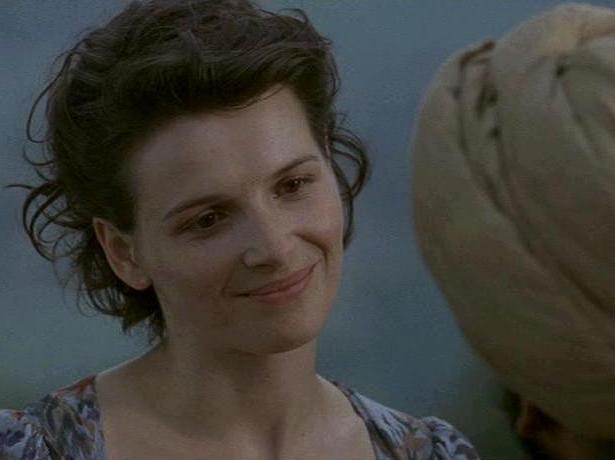

Hana as Coiffeuse > Scarlett as CouturierThis brings me to a major point in the movie's favor, which is its tactile quality. I often feel like if I touch the screen I'll feel the heat of skin, the smoothness of the sand, the texture of hair, and even the cold outer shell of bombs and worn book covers. Good movies always work sight and sound but how many evoke any of the other senses?
 NICK:
NICK: A great point, and a great one to get in early. I'm nosing in before Mike even gets to talk, but I remember being surprised (sort of) when Peter Greenaway took such strong public exception to
The English Patient, since among narrative films it's the only contemporary of
The Pillow Book I could think of that had a similar knack for that tactile, synesthesiac vibrancy that you're talking about. All those plums and paper maps and dust storms and shampoos.
MIKE: I can't help but think of
The English Patient in terms of halves: the half driven by divine coincidence versus the half driven by contrivance; the half made of unapologetically melodramatic moments and huge emotional swells versus the half where everything is so polite, even despite the various explosions and romances; the half that's so three-dimensional, sensual, and sensory that I want to put it in my mouth and/or rub it all over my body (and it sounds like you guys agree with me) versus the flat whodunit (or whoisit, or isithim).

I'm talking about the good half and the not so good half, the pre-war and the post-war, the Ralph-as-gawky-god and the Ralph-as-whispery-pudding, the "Kristin Scott Thomas is a love goddess who seems uncomfortable in her own body, which makes her even more attractive" half, and the "Juliette Binoche is vague and cold beyond the requirements of her character" half. I don't know how this relates back to Nick's original question, since I haven't read the novel and can't say whether what works is Minghella channeling a 1930s epic weepie or Minghella trying to shove some Ondaatje into the film. Oh, yeah: what I'm saying is, "What Nathaniel managed to say in one sentence."
The film's best moments feel like they're from another era, say, the era of
Gone with the Wind (woo, segue). A weeping Ralph carrying Kristin's body out of the cave, the incredibly hot prelude to their first assignation ("You still have sand in your hair"): huge, unabashedly romantic moments that compelled me to watch them again before I could finish this paragraph. These moments reminded me of similarly huge moments in
GWTW that I had seen and heard so many times that, when I finally got around to watching it for the first time, I thought would be sapped of their power, but they weren't. They're so much a part of the epic fabric of the film that anything muted or attenuated would have seemed out of place. I was so swept away that I really didn't notice all the oscillations and inconsistencies you mentioned in your opening, Nick. Maybe on second viewing I'll be able to see some of them.
NATHANIEL: I don't notice the tonal or visual schizophrenia of
Gone with the Wind that much, either. I blame that almost entirely on Vivien Leigh. I like to think of
GWTW's entire cast, numerous setpieces, and multiple acts in exactly the way that Scarlett herself seems to think of them: as either annoyances, obsessions, crushes, flatteries, inconveniences, backdrop, excuses for bad behavior, frenemies, threats, or... other. It's ALWAYS about her. Even when it's not.
 Scarlett/Vivien throwing Georgia shade at the mention of Melanie/Olivia
Vivien Leigh is the top. When you hear about someone carrying a film, this is what they mean. That she carried it for four hours with an 18-inch waist as a virtual unknown in the midst of that veritable hurricane of apocrypha which surrounds this production—I'm sorry! This is supposed to be about what's on the screen. Not what happened behind the scenes or the legend accumulated. I get distracted. But maybe Oscar does, too. If you'll allow me an obscene exaggeration: I sometimes forget (mostly when I'm not watching it, which is often... it's four hours long!) that
Gone With the Wind is a movie at all. It's a historical and cultural event that happened, rather than a story on celluloid. When that happens, isn't Oscar almost a given? See also:
Titanic,
The Sound of Music, et cetera...
I'm suddenly curious about which of those huge unstoppably effective moments Mike was referencing and which of
Gone With the Wind's disparate personalities Nick likes most and least.
 MIKE:
MIKE: The big one for me was Viv's "As God is my witness, I will never go hungry again!" soliloquy. I felt it coming a mile off—it might as well have been heralded by a troupe of trumpeters. Chills ran up and down my legs and arms: here it comes. And then it was so shattering, so strong, so desperate—and so contrived. But it blew me away, even though I was expecting to giggle through it. See also: "Frankly, my dear, I don't give a damn."
You bring up a good point, Nathaniel, about how hard it is to separate what's on screen from what went into it, and what came after it. Part of what makes it work is the fact that it was such a miracle that it worked at all, and there's a danger that its ubiquitousness will ruin the experience for first-time viewers (although it didn't for me).
NATHANIEL: "Never go hungry again"—the crazy thing about that pre-intermission curtain call is how "The End" and "Stay Tuned!" it is at once. If this movie were made now they would just chop it in half and demand your ticket dollars all over again for part two the following year.
A moment I love that I rarely hear discussed is the eruption of the news of war at the Wilkes plantation. The choreography is just thrilling. All those people running, colorful dresses swirling across the screen at various angles down towards the doors as Scarlett O'Hara alone zig-zags through them upstream, lost in a very different moment than the larger one. Movies today, outside of some action movies or auteur flicks, don't often have this kind of emotionally attuned and narrative revealing choreography—it's all closeups and reaction shots now—and I think the movies are worse for it.

That said, for as much as I can get swept up in the movie there is the nagging reminder that this lush world, built on the backs of slaves, deserved to be blown away. The slaves talking about beating the Yankees are particularly disturbing to me—Stockholm Syndrome anyone? It's always been a little odd to me that Hollywood romanticized the South so much. Are Civil War era movies ever about the North?
NICK: Sorry to duck out for so long from my own party. I was busy upstairs making a dress from my own drapes. I'm not even going to delve into the complicated waters of whether this movie actually waxes nostalgic about slavery or whether it has an appropriately harsh view of the Peculiar Institution. Though I will note that we see black slaves picking cotton in a field before we see anything else, and slave labor is often what's depicted beneath the occasional "That was the South, gone forever!"-type intertitles. Make of that what you will.
What I was getting at about the changing aesthetics, though I'm not the first to notice this, is that the first third or so of the movie (let's call it the Cukor part) has so many more close-ups, such gentler lighting, and so many more expressive movements of the camera or of choreographed bodies within the frame: that shot you mention, Nathaniel, of Scarlett floating up the steps while the men of Twelve Oaks are all racing downward is a perfect example. By contrast to this, Melanie's pregnancy and (even more so) the escape from Atlanta are rendered almost completely (and mostly by William Cameron Menzies, I think) through old-fashioned cross-cuts, like when Rhett worries out loud about explosives and we cut to a pile of boxes that say "Explosives."


Cukor's GWTW is lovely! Menzies' GWTW is...so literal!And then as the film continues, under the hands of mad Victor Fleming and staid Sam Wood, the lighting and color choices get much harsher, there's a lot more black and weighty diagonals, and the camera stays further away for lots of group scenes. At moments, the movie looks like Fritz Lang shot it (check out Barbara O'Neil as the dead Mrs. O'Hara on her
Caligari-ish catafalque), and some of the Technicolor has a kind of violent,
Red Shoes intensity to it, as when Bonnie takes her final horse ride or when Scarlett's accosted by her own husband on those huge, nightmare stairs.


It makes sense that the prevailing mood changes over the course of these particular events, but the early emphasis on personality-driven characterization and elegant movement in the early scenes turns into a broody, sometimes very tense, occasionally clunky pile-up of narrative scenes about running a sawmill or duping the police or pond-hopping to London or semi-hating your own spouse. It's partly great acting but partly the totally different photography that sometimes makes Leigh look like a totally different woman in the first half of
GWTW vs. the second. I'm mostly cool with that—this movie gives you SO MUCH, and so much to chew on—but I miss the verve and lightness of the magnificent first half when I have to flip the disc over and press onward through the sudsier, stiffer second.
But with all this talk of
GWTW's iconic imagery, you can feel that
The English Patient is often aspiring to the same kind of iconicity: the bi-plane crash, Hana's flight through the church, Almásy toting Katharine out of the cave. Do these images resonate for you, or are they instances of the movie trying too hard?
 NATHANIEL:
 I like it when movies try too hard ("...sometimes", he quickly adds). At least I do if what they're trying for is heightened. It's one reason I am counting down the days impatiently until
Australia hits... But back on topic: I love Hana's flight through the church—it's the image that always pops into my brain if i hear the three words "The English Patient"—but in other instances I feel how self-conscious the movie is, even as I'm a little bit swept up in it (i.e. Almásy & Katharine's affair). I guess I wish that
The English Patient was either more heightened (more of the real through unreal filters please: like those odd birds-eye flights over sand, all foldy like bedsheets) or a little more focused.
I've never been in love with it though it didn't make me as crazy the second time through as it made
Elaine:
Oh. No. I can't do this any more.
I can't. It's too long.
(to the screen) Quit telling your stupid story,
about the stupid desert, and just die already!
(louder) Die!!Mike?
 MIKE:
MIKE: "What I want to know is, did they shrink them down, or is that a really big sack?"
Huh? Oh, right, we're talking Oscars. Yeah,
The English Patient works best for me when it's going for the big score: I still cry like a baby when Ralph's crying like a baby toting Kristin out of the cave, I get a little steamed up during their assignation in the alcove, and I feel dizzy during Hana's flight in the church—incidentally, the only thing that really works for me about the postwar storyline. I want more grand gestures, doomed romances, tragic sacrifices, and Ralph looking like a tormented Muppet (sorry, Nick, I stole that from you). The past is veiled with smoke and dust and gauzy curtains, lit with reddish fiery sunsets and sunrises, and it's a much better place for both the main characters and us, the viewers, at least when it comes to
The English Patient.
And it's not even trying to bite off as much as
Gone with the Wind, which does want to be all things to all people (and its reputation and box office might indicate that it succeeds). Nick, having you spell out the pre- and post-intermission differences makes them completely obvious, and while I'm not going to say I subconsciously noticed all of them, I am going to say that even absent the too-many-cooks explanation for them, all those tonal, compositional, and narrative changes serve the story pretty well. One could probably exhaustively explain why each one of them works, but someone else has probably already done that in book-length form, and besides, I wouldn't always agree with the reasoning: there's a definite change once you have to flip that disc, and it's a change from something I absolutely love to something I heartily like and respect. From certain off-board grumblings, it sounds like "like" and "respect" might be in short supply during our next installment...
As God as my witness, readers, I'll never watch
Braveheart again! Actually, I have to, but to ease my suffering in advance, please tell us what you think about
Gone with the Wind's rose-colored plantations, the fierceness of Vivien Leigh, the sensuality of
The English Patient, and the relative merits of its duelling plotlines. And we didn't even
start on Clark Gable, on Max Steiner's score, on Gabriel Yared's score and Walter Murch's sound bridges, on those political intrigues that bore Nathaniel, on birthin' no babies, on whatever happened to the size of Kip's role (he has arguably the biggest part in the novel), on that gorgeous notch in a woman's neck, on Kristin Scott Thomas bumping her head on those bleachers, on that poor horse who drops dead on the way back to Tara (best acting ever by an animal, or a snuff film straight outta PETA's collective nightmare?), or on the surreal strain of pretending for four hours that Leslie Howard is a sexpot.
What do you remember, from the amnesiac haze of your hospital gurney, and from beneath your Muppet makeup? What do you give a damn about?Tags:This Week: Nathaniel's screen shotsPreviously: ep.1:
Wings & No Country; ep.2:
Broadway Melody & Departed; ep.3:
All Quiet & Crash; ep.4:
Cimarron & Million Dollar Baby; ep.5:
Grand Hotel & LOTR:ROTK; ep.6:
Cavalcade & Chicago; ep.7:
It Happened One Night & A Beautiful Mind; ep.8:
Mutiny on the Bounty & Gladiator; ep.9:
Ziegfeld & American Beauty; ep.10:
Zola & Shakespeare; ep.11:
You Can't Take It with You & TitanicCompendium: My ongoing
"Best Pictures" Special Section, with reviews, rankings, polls, and links to all of our discussions
Labels: 1930s, 1990s, Adaptations, Best Picture, Blog Buddies, Juliette Binoche, Kristin Scott Thomas, Oscars, Ralph Fiennes, Vivien Leigh
 Nick's Flick Picks: The Blog


 Happy '08! I hope everyone had a great New Year's Day, my favorite day in the entire year to play it cool, keep things close to home, hang out on the futon and on the phone—and hence, no blogging yesterday. But, there will be copious entries soon enough, with end-of-year best lists to compile, and a major birthday to celebrate. (And no, I'm not talking about
  So what does every movie on my
  If that list isn't stupendous enough, consider that I've already elected against work as strong as Nina Hoss' in
  The above were at least runners-up. Katherine Heigl in
  Granted, the film does not always benefit from Minghella's taste for romantic projections or his fervently literary emotionalism. His best visual and tonal ideas arise in that opalescent monastery where Binoche takes care of Fiennes, but not so his most rigorous concentration on plot or character; in fact, Minghella quite defies the emphases in Ondaatje's novel and inflates the Almásy-Katharine liaison into an erotic reckoning so potent it's almost embarrassing. Other problems emerge from the clash of impulses between aestheticism and political anatomy, and from Minghella's vague, uneven management of key characters like Willem Dafoe's Caravaggio and Naveen Andrews' Kip. But if all of this makes The English Patient a film of moments more than a sturdy whole, the moments are often glorious, and even as I confess my awareness of the movie's limitations, I maintain that its blend of bathos, adventure, contemplation, and cosmetic luster remains hard to beat. Kristin Scott Thomas fuses sexiness and intelligence in such layered, fascinating ways that she almost single-handedly validates the film's entire project of eroticizing ideas (or is it of intellectualizing eros?). Binoche finds an ideal film and character for her translucent style of acting; her early reading of the line "I don't know anything" tells you all you need to know about the character. The sound design is dense and often pristine, doing just as much as Stuart Craig's excellent production design and Ann Roth's typically subtle costumes to mask the film's low budget and, better, to foster its ambitions.
 Three years later, Minghella returned with another prestige literary adaptation, and this time he had more money to throw around. But beyond being even more plushly outfitted than its predecessor, The Talented Mr. Ripley is in nearly every respect the more impressive, surprising film. Minghella tinkers with Highsmith even more than he did with Ondaatje, but rather than bend the material in more conventional directions as he did in The English Patient, he warps and weaves Ripley into an object of even more sidewinding, epicurean perversity than the novel is. Where The English Patient is suffused with death and immersed in the impermanence of things, The Talented Mr. Ripley has the guts as well as the chops to turn a story about killing into a parable of invention, of production, illuminating not just how Tom Ripley turns himself into someone else, but how each new imposture and each new murder actually creates something new—a new sense of who and what Tom is, of who and what he craves, of where he is going, of what he has been up to all along, of what the world must be, at essence, if Tom and his story are possible. Even though we, unlike any of the characters, know what Tom is doing and how he's managing it (often barely), we still end the film with an uncanny sense of several Toms existing, of not knowing where or how to fix him, of not quite believing there is only one Tom. And unlike The English Patient, the film takes perfect measure of every character and performance. Cate Blanchett's heartbreakingly gauche heiress and Jude Law's apollonian narcissist are the crowning glories, though Gwyneth Paltrow's seething anger at being so constantly abandoned, underestimated, and ungratified is a more impressive acting achievement than most reviewers admitted. I saw The English Patient four times in the theater, besotted by its conception and by the pure beauty of how it looked and sounded; Ripley, though, is the film I now dip into more often, and the one from which I learn more. Both films offer enticing signs that all is not lost in the territory of the upscale period drama, and that even within our illiterate age, ardent booklovers can both make and enjoy spectacular films. (Click
  Truth: John Boorman's
  Reconciliation: So, hold what was good about that one scene, skip In My Country (whose meager box-office implies that you already did skip it), and venture instead to the library for the script of Tug Yourgrau's