Happy '08! I hope everyone had a great New Year's Day, my favorite day in the entire year to play it cool, keep things close to home, hang out on the futon and on the phone—and hence, no blogging yesterday. But, there will be copious entries soon enough, with end-of-year best lists to compile, and a major birthday to celebrate. (And no, I'm not talking about
Todd's 47th today, though I should be — bon anniversaire, mon cher!)
Moviewise, I've got two heavy hitters blowing into the Windy City this weekend—critical darling
There Will Be Blood and well-reviewed documentary
The Price of Sugar, an Oscar semifinalist. Basically, I'm waiting on these titles and
Persepolis (opening on Jan. 11), plus some last-minute rentals like
Offside and
The Namesake, before my theatrical survey of 2007 will be complete enough to draft my annual
Honorees. Errant 11th-hour releases like
The Great Debaters,
The Kite Runner, and the is-it-out-or-not?
Grace Is Gone also have outside shots in at least one category, but they're a tad less pressing.

So what does every movie on my
Still To Be Seen itinerary have in common? Not a single one of them has a female lead... well, give or take Hilary Swank in
P.S. I Love You and little Dakota Blue Richards in
The Golden Compass, neither of whom looks remotely prepossessing in the trailers, and I'll probably pass on both movies anyway. All of which makes Best Actress (and isn't this fortuitous?) the one category for which I can already posit a semifinalist list. And what a list it is! Anybody here would have qualified for my final five in
'01,
'03, or
'05, and given how many of them are solid Oscar hopefuls, I'm expecting an Academy shortlist that trounces last year's admirable derby of Cruz, Dench, Mirren, Streep, and Winslet. Here are the fourteen glorious contenders:
JULIETTE BINOCHE in
Flight of the Red BalloonNIKKI BLONSKY in
HairsprayJULIE CHRISTIE in
Away from HerMARION COTILLARD in
La Vie en roseKATE DICKIE in
Red RoadCATHERINE FROT in
The Page TurnerANGELINA JOLIE in
A Mighty HeartLAURA LINNEY in
JindabyneLAURA LINNEY in
The SavagesANAMARIA MARINCA in
4 Months, 3 Weeks, and 2 DaysELLEN PAGE in
JunoPARKER POSEY in
Broken EnglishPARKER POSEY in
Fay GrimTANG WEI in
Lust, Caution
If that list isn't stupendous enough, consider that I've already elected against work as strong as Nina Hoss' in
Yella, Amy Adams' in
Enchanted, Marina Hands' in
Lady Chatterley, Ashley Judd's in
Bug, Luisa Williams' in
Day Night Day Night, Julie Delpy's in
2 Days in Paris, Christina Ricci's in
Black Snake Moan, Mirjana Karanović's in
Grbavica: The Land of My Dreams, and Amber Tamblyn and Tilda Swinton's muted but interesting pas-de-deux in
Stephanie Daley.
Other people would have advocated for Nicole Kidman in
Margot at the Wedding, but I just didn't find much modulation or depth in her admirably sour exterior; or Keira Knightley in
Atonement, but her vocal work drove me batty and she didn't find a way into the character that I felt or believed, though the script is certainly not her friend in pursuing that venture; or Isabelle Huppert in
Private Property, refreshingly casual and direct as a discontented mother but abandoned by the script before she's broached any deeper territory; or Jodie Foster in
The Brave One, nailing Erica's tough carapace but pretending to be in a smarter movie than she's in (plus she takes that unsalvageable ending even further over the top than it's already going); or Halle Berry in
Things We Lost in the Fire, who mostly shows how much better she'd be in
Monster's Ball now than she was six years ago, with an artfully restrained and shaded but still rather limited performance; or the much-beloved Carice van Houten in
Black Book, but I found her to be more of a pose-striker and an agreeable, flexible participant in Verhoeven's flamboyant mise-en-scène than a particularly whipsmart or engaging performer. (She also, for all of her virtues, made Ellis/Rachel a bit of a wash as a spy: how many sidelong fretful glances and nervous fingers and anxious over-the-shoulder looks is a disguised Jewish spy at war with the Nazis really supposed to allow herself? Tang Wei knew better than this little minx.)

The above were at least runners-up. Katherine Heigl in
Knocked Up, Vittoria Mezzogiorna in
Love in the Time of Cholera, Markéta Irglová in
Once, and Belén Rueda in
The Orphanage never excited me all that much. Cate Blanchett was almost as bored as I was during
Elizabeth: Full Throttle. Don't even get me started on Helena Bonham Carter, as blank and superficial in her acting of
Sweeney Todd as she is patently deficient in her singing; or Molly Shannon in
Year of the Dog, disappointingly inadequate to her movie's difficult tone and to all of her close-ups; or Keri Russell, exuding the same lockstep mediocrity and lack of real ideas or feelings as is the rest of
Waitress; or Asia Argento, who won lots of fans at Cannes but broods her way through
The Last Mistress in a series of increasingly dull grimaces and off-putting bits of naughty-bobcat improvs; or Marianne Faithfull in
Irina Palm, well-buzzed on the festival circuit but pitifully stiff and inert in an underconceived part.
So, with all of that said: my list of 14 semi-champions will be whittled down to five later this week, as we kick off the 2007 Nick's Flick Picks Honorees. In truth, four of them are already locked for inclusion, four are confirmed also-rans, and the other six are competing for that fifth spot on the final list... so go ahead and state your cases for your favorites! Plus, we've got 19 other categories to sort through, and even
more to say about actresses of the past as well as the present. But you'll have to stay tuned for those tidbits. Enjoy '08, vote Democratic, and keep coming back!
Labels: Best 2007, Best Actress, Cate Blanchett, Halle Berry, Isabelle Huppert, Jodie Foster, Julie Christie, Juliette Binoche, Laura Linney, Movies 2007, Nicole Kidman, Parker Posey
 Nick's Flick Picks: The Blog


 If you follow this site at all, you might know that I've worked myself into a tiny lather in recent years – drawing bubbles from my admittedly small soapbox – as both an incorrigible devotee of the Oscars and a somewhat cranky critic of how long, expensive, and over-crowded with nuggets and chatter the so-called "awards season" (or, worse, the "campaign season") has become. It's hard enough when so many of the wrong films seem either pre-targeted for consideration or disappointingly excluded from it. I find my Oscar addictions, which are no one's fault but my own, prompting me to think and write more about movies I don't really care about, just because they're likely to be nominated, than about movies for which I might actually have a thought-out, passionate, more valuable critique to put forward.
 Beyond forming these aggravated opinions in recent years, I have jumped to my own conclusions about what is or isn't a "legitimate" event and what seems, by contrast, like a pure publicist's coup, with little to teach anyone about filmmaking. I haven't been consistent or very well-informed in arriving at these knee-jerk opinions, so I usually keep them to myself. Yesterday, though, in a
  The movie version of The Hours shares the arresting ambitions and the psychological acuity of the book, as well as its prosaic and vaguely elitist excesses. To my mind, in recent popular cinema, American Beauty is the movie's closest cousin, both of them built atop scripts that can seem courageously lucid and dismayingly glib within single scenes or transitions, both directed in a glossy, theatrical, actor-friendly style that serves and also sabotages the material by playing up the artifice. You can hold your ear up to American Beauty or The Hours and hear a worrying howl from deep within the upper bourgeoisie, demanding and deserving to be taken seriously, but you can also somehow hear the production teams slapping their own backs about the casts they've hooked, the certainty of prizes, the Big Issues they broach. However, while the moods and structures of American Beauty, for all of its technical audacity, feel smaller and more market-tested as the years go by, The Hours totally engrosses me. I keep sitting before it, open-minded, sometimes open-mouthed. It becomes clearer, for one thing, that the movie has darkened the book considerably. Disapproval of Richard Brown's esoteric, self-obsessed novel is more general. Vanessa Bell is more unhinged, almost repulsed, by the ravenous loneliness of her sister Virginia Woolf. Laura Brown already intends suicide as she drops her son with an indifferent neighbor. Clarissa Vaughan lets slip a major, unwitting insult to her daughter, and instead of nursing a fond, fumbling reminiscence with Louis Waters on her comfy living room couch, she erupts and nearly dissolves in her cold kitchen, where the light is the color of frost, the faucets detonate for no reason, and Louis looks on, agitated and annoyed, from practically a mile away across the countertop. This last scene is my favorite in the movie: its scary unraveling of Meryl Streep, usually so composed and sometimes to a fault, encapsulates the wholly credible and almost lymphatic unease beneath the film's mannered language, the roiling score, the sometimes precious match-cuts.
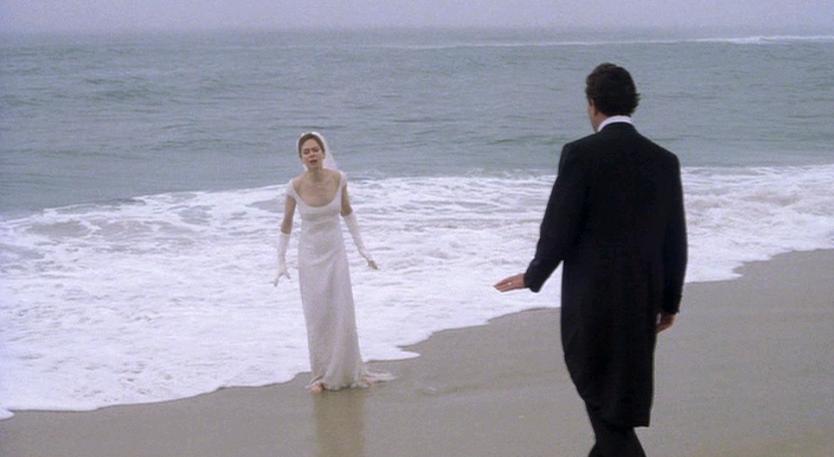 Nicole Kidman isn't even 40 yet but she has already offered a peculiarly fascinating entry in this delicious tradition. One of many astonishing passages in Birth, preceding a coda as fragile and clear as a bell jar, involves her pleading monologue to a spurned lover, a thrumming fugue of stuttering self-delusion of a breed seldom heard since Safe's Carol White soliloquized about diseases and reading labels and going into buildings. Still, Kidman's Anna Morgan is a mess well before this. When we meet her, she is standing at the graveside of a husband already dead ten years, her breath visible as she stands shivering in a minidress, winter coat, and heavy boots. With her short, Rosemary's Baby haircut, Jonathan Glazer's procession of intimate close-ups, and Harris Savides' opalescent cinematography, there is no visual or cosmetic barrier between us and Kidman's tremulousness. Where so many of the actress' recent roles have disclosed her surprising steeliness—as Virginia Woolf, as Isabel Archer, as the mother in The Others and the sometime martyr in