"To see 42nd Street billed below /
Drab ol' /
Cav-ohl-CADE!"
(bum, bum-bum, doo-di-doo...)NICK: As we march through
Best Pictures from the Outside In, we learn that certain maneuvers can always help if you're trying to net an Oscar. Grand visual scale. Weighty historical themes. But perhaps none is so effective as a one-word title that starts with C. You think I kid, but:
Casablanca won Best Picture despite being over a year old at the time, and despite being the kind of timeless popular classic that inevitably loses.
Crash won despite the
Brokeback momentum and a low critical profile.
Cimarron won with literally nothing on its side except the C thing.
Chocolat and
Cleopatra earned jaw-dropper nominations for no earthly reason.
Cabaret came thiiiis close to swiping the top prize from
The freaking
Godfather. Shit, this trick even worked for
Cher.

Certainly, this tried 'n' true shortcut to glory has to explain part of the
Chicago and
Cavalcade phenoms.
Chicago had ace timing and good tonal judgment on its side: riding the crest of the musicals' resurgence; boisterous but still snarky (for the kids!); radiating a kind of holiday-season pedigree without being a downer like
The Hours and
The Pianist, or a head-scratcher like
Talk to Her or
Adaptation, or full of fat old naked people like
About Schmidt. But you don't have to look long at
Chicago, especially at its faux locations and its odd cast, to see how much Miramax was skimping on this production while hemorrhaging money into
Gangs of New York, at least before Harvey realized somewhere around Christmas Eve that he'd bet on the wrong reindeer.
Still, if
Chicago is, like its two snake-skinned protagonists, a slightly tattered winner,
Cavalcade is a case of blatant, unremitting, left-the-house-but-forgot-to-put-pants-on Folly. I'm going to leave it to my brethren in arms to start the autopsy on this one, but bear this in mind, all of you: since
1932-33 was the "bridge year" ceremony between the old August-to-July Oscar timetable and the new, more sensible calendar-year plan, AMPAS had 18 months of movies to choose from, and they went ... with ... this. What can we even say? Or do I speak too soon? Are there
Cavalcade fans in the hizzouse? I concede that it has some great hats, and the camera never once fell off the tripod.
 NATHANIEL:
 Didn't it? It sure as hell would have been easy to disguise a falling camera amidst
Cavalcade's interminable swirling montages of TIME PASSING that start to eat up the film's running time the closer it gets to the end—which, in a gimmicky narrative trick, is also New Year's Day 1933... the year the film came out.
Theoretically, I have nothing against "political as personal" narratives, the kind of intimate journey that's actually a historical drama, but you have to be so careful with them. If they aren't masterfully handled, they can read as so gimmicky and simplistic in their self absorption...
Cavalcade was basically
Forrest Gump for people who prefer Noel Coward and tea time to Tom Hanks and chocolate boxes.
GOATDOG, né MIKE: Well, it's clear that the reason why the camera never fell off the tripod is that
Diana Wynyard was keeping such a close eye on it. Why did she keep looking at the camera, guys?
NICK: I assumed she had spotted a shiny quarter on the ground, somewhere to the right of the camera crew, and she was nervous someone would scoop it before
Frank Lloyd yelled 'Cut.' (
Ed.: More thoughts about the 1933 Best Actress race
here.)
MIKE: It creeped me out, especially when combined with that "Norma Shearer's not sure how to deliver this line" combination: chin tucked, eyes elevated, looking just a hair past the camera and intoning in a voice that's both breathy and congested. God, that's got to be
serious stuff she's saying, because she looks like she might fall over with the weight of all that
seriousness (not to mention the seriousity). I swear, this is the worst nominated performance I've ever seen, or at least that I've seen in a few weeks.


(Norma Shearer and Diana Wynyard engage in a brutal Far-Off Look-Off)NATHANIEL: The
First Lady of MGM and I are laughing off that lowball insult with our eyes crossed and heads thrown back. And besides: there's nevermore to be any question about which is the worst nominated performance of all time. That "honor" goes out to Richard Dix of
Cimarron. How soon we
forget, Goatdog. How soon we forget.
MIKE: Ouch! Why'dya have to bring up
Cimarron again, Nathaniel? I was obviously doing such a good job of forgetting it even exists.
But back to
Cavalcade. I'm totally with both of you that this botches the "let's look at exactly 33 years of history through this one family" thing in every possible way. What events do we get? The Boer War, the
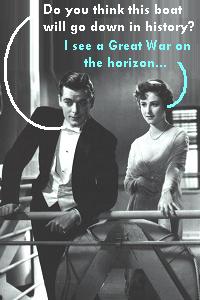
Titanic (surely the worst scene in the film—all that unintentionally silly foreboding dialogue), and World War I, with a handful of throwaway scenes inserted where someone walks on camera, mentions some historical personage, and walks off, leaving one of the film's increasingly shitty montages in his or her wake. So here's my challenge: say something nice about
Cavalcade that doesn't involve hats or tripods. I dare ya. I'll start: I liked the old biddy who hangs around in the kitchen, who's always telling dire tales of woe.
NICK: Is this the
"Little Bit of Good in Everyone" game? I guess I didn't hate what
Herbert Mundin and reliable scarecrow
Una O'Connor were doing with their roles as the loyal housekeepers—that is, early in the film, when their emotions had some layering and their relations with the Marryots seemed interestingly ambiguous. But then, the director and the script conspire to push both actors to garish extremity after the first forty minutes or so. Does that still count? Nathaniel, got a better one?
NATHANIEL: There's a moment late in the picture that I do like. It's not giving us the old razzle dazzle—it's just a simple quiet touch. The news has arrived that there's a new war in town, World War I. The youngest son shares his patriotic enthusiasm but his mother, who's already lost one child, can't. She's silent and looks devastated yet what you hear is the cheering from the crowds outside her window. It's an effective juxtaposition, and for a moment the movie had me. But then Wynyard spoils it by going into a bad speech that essentially explains the dichomoty we've just felt in beautiful miniature.
Otherwise, hmmm. I love the posh accents? The way everyone keeps saying "marvelous." In truth, though, I found
Cavalcade much easier to sit through than
Cimarron because when it's bad, it's bad in an entertaining way. I love the unintentionally subversive, nearly incestuous sexuality. There's far too few characters for a film meant to represent every part of English history, so all the adult lovers began their relationships as childhood playmates. Sick! And I actually loved the
Titanic scene for its demented determinist chutzpah. I saw it coming but I just couldn't believe they were going to go there... And they did!
The movie is awful but it's awful in that egomaniacal, forceful way that will be familiar to anyone acquainted with the talentless ambitions of Roxie Hart.
Cavalcade isn't going to quit until its final curtain call. It wants to tell you everything about British history as badly as Roxie
wants to be a ce•leb•ri•ty / that means somebody everyone knows...NICK: Indeed, Nathaniel. As Roxie and Velma
sing in this version, "We move on..."
MIKE: Is this where I say
Renée Zellweger is by far the best thing in
Chicago, aside from the editing? And the fact that she can't really dance all that well, and has a passable singing voice, is just marvelous, since she's playing "a two-bit talent with skinny legs"? Because this is where I'm saying it. She nails that character, the way she slips between wide-eyed naïveté and street-smart sass, and as long as she avoids doing that squinting thing (maybe her eyes are crossed like Norma's, but she's smart enough to hide it), she's a joy to watch. Certainly light years ahead of a certain Oscar-winning costar who can dance and sing but forgets to make her character interesting. Renée wasn't the best Best Actress nominee in 2002 (have to go with
Julianne Moore), but she's higher on my list than
Nicole Kidman's nose.
NICK: The contrast in my first two viewings of
Chicago still summarizes what I admire about it and what I don't. On opening day, in the huge and gaudy/splendid
Clearview Ziegfeld in New York City, with a sold-out crowd squeezed in among all the red velvet walls and sitting before the huge screen,
Chicago was
spectacular entertainment. Energetic, sleek-looking, designed for 100% entertainment in the moment. And I agree that Renée aced the daydreaminess but also the brittleness and smallness of Roxie. A great audience surrogate, selling the conceit of Roxie's "mind's eye" with no problem—partially through her own newness to the genre but also through some really smart acting, especially in her book scenes.
Two months later, in a smaller, gummier theater, with my partner, who totally cares about musical execution and coherent physical performance in a way that I don't,
Chicago looked slipshod and a little desperate. It had a bag of old Fosse tricks and hand-me-down lighting designs that were just enough to get by—but, anachronistically, one could imagine Michael Kors spotting all of its last-minute hems and crooked seams, and Nina Garcia admitting that she was bored. And the major performers seemed either in over their heads (Zellweger, Gere, Reilly) or capably but joylessly hitting her marks, and only intermittently connecting with her colleagues (I'm with you, 'Dog).
I still see both
Chicagos: the zesty and formidable good-time machine and the patchy first-timer production that's still looking for an overall shape and a richer, more integrated troupe. Although, either way, I always hate "Razzle Dazzle," and I always love that guns-blazing finale.
NATHANIEL: Preferring Roxie to Velma, boys?
'Whatever Happened to Class?' Oh, sorry. That's a deleted number there, lost from stage to screen. I get that Renée understands Roxie as a character, and I still admire that she snagged her first two nominations for comedic work (not easy to do), but I just... can't agree.


See, I fall into Nick's partner's school of feeling when it comes to this genre. I need the proper skills exhibited. I care not a whit about verisimilitude of character in these cases. I want the full razzle dazzle of skilled performers when it comes to musicals... even if the characters aren't supposed to have great skill. You can hear the opposite complaint about Renée in
Chicago in various critiques of Liza Minnelli in
Cabaret. The reasoning goes that Liza is way too skilled to be playing Sally Bowles, who is a minor league performer. But I say, ALWAYS err on the side of too good when it comes to musicals. Musicals live or die by their numbers, so they need to be great even if the characters aren't.
Cabaret is one of the greatest musicals of all time, but if they had cast for a performer representing Sally's supposed skill level, it couldn't have been.
I agree that "Razzle Dazzle" is a disaster of direction (and everything else), but that final number, for all its energy—I love the lights and gunfire—actually hurts me more in a "what could have been" way. Catherine Zeta-Jones moves like a real musical theater performer, and I love her every twist, hair toss, and gesture. But Renée just keeps spoiling the lines and frame. It makes me crazy... her characterization be damned.
NICK: What about "We Both Reached for the Gun," Nathaniel? I find that to be the most complete and charmingly mounted number in the movie, and Renée really sells the dummy act (helpful practice for her
Cold Mountain perf, where she moved her mouth perfectly to
Elly May Clampett's voice.) Anyway, if you're going to spring for Zellweger anywhere in the film, might it be here?
I totally take your points, and remember hearing them from D–––– many times in my kitchen, in my living room, while taking out the trash, et al. But for me, what a musical performer most needs to do is serve the film and the ensemble. Zellweger's uncertain, occasionally storky dancing totally works for Roxie, and she's giving her all, whatever that might be, to THIS movie. CZJ barely looks at Roxie, ever, and seems all the while like she's claiming a fiefdom over all starring roles in all future musicals, and assuaging her boredom in book scenes by imagining where she'll store her fan letters and her inevitable Oscar. Of course I admit that she's not bad, just chilly. I
am surprised she has gotten no musical work since this (and not much work, period).
NATHANIEL: In an opposing way we're both coming from the same place. I see your "Renée sells it as Roxie might" and raise you a "CZJ ferociously (and yes, coldly) demands it only for herself, just as Velma would."
NICK: Point: Nathaniel.
NATHANIEL: Either way, I think they're an engaging, thorny duo, and I like the movie quite a bit for all of its half successes. But how about that Fanny Bridges in
Cavalcade for a musical/comedy trio? She's a star across the pond, 'round about the same time as that killer diller double act in Chicago. Velma and Roxie would eat her alive but I love that both Velma and Fanny are hanging on desperately to old acts. Velma is coming at it practically—hey, it used to work,
viz. "My sister and I had an act that couldn't flop"—but what's Fanny's excuse? She's still peddling the same exact dance moves she was rehearsing when she was an eight-year-old.
MIKE: And the clouds parted—I never realized that they're basically contemporaries. What a bizarre contrast. Fanny's obviously being presented as a successful act, which is so mind-boggling, because she's so terrible, singing about the blues in her high, clear voice and ruffles, kicking her legs up. She don't know from the blues, despite the fact that she's just endured most of
Cavalcade's running time. Am I a bad person for hoping that one of those zeppelin bombs would solve her career problems for her?
NICK: Let's make this act five-wide, throw in the
Mahoney Sisters from
The Broadway Melody, and give Velma and Roxie some more options about how to use those automatics.
 MIKE:
MIKE: Re: Renée, though, I guess I'm expressing my admiration for
this awkward performance in
this particular role. There's no way I would extend any goodwill at all to Richard Gere's non-dancing and horribly affected singing; I'd like to pitch him out of the film, and I think his scenes lost a lot of energy when they depend on things he doesn't possess, like charm and ability. I'm lukewarm on Queen Latifah and John C. Reilly, too.

So we covered the RZ vs. CZJ point of contention; what do you think about the editing, which seemed to provoke a lot of arguments at the time? Even after repeat viewings, I think that's one of Oscar's smartest picks in that category in a long time. Despite the "I want to see a dancer complete a movement" complaints, and the argument that the editing was designed to disguise the fact that most of the cast couldn't dance very well, I think Martin Walsh was just going for something else entirely: he created something approaching full integration of body movements, music, and plot, to an extent that most musicals don't attempt—they tend to sit back and follow the performers. I think it's an amazing achievement, and it still carries me past some of the film's rough patches.
NICK: I generally like the editing: it's so fleet and suggestive so much of the time that you notice when the camera's just plopping back and gawking, or when a performer like Reilly isn't giving Walsh any interesting movements or angles to cut on. A few of the numbers do feel over-edited to me ("Cellblock Tango," for instance) but there are at least as many moments where that fusion you describe just pops off the screen. Renée and Dominic West's early, elated romp in the bed is one. Her projection of herself onto the stage in Velma's place is another, with those urgently interwoven push-ins. I agree that the editing, more than any other single contribution to the film, often supplies a verve and a sense of continuity to the movie that is always welcome, and often very exciting, even on a small screen.
NATHANIEL: I'm one of those grouches who likes to complain when the editing on musical films covers up for lumpy dancing... but otherwise, I basically agree with the points as stated. It's over-edited surely (the Richard Gere body-double tap-dance is a major sore point) but if editing has to work double duty as coverage, the least it could do is perform its work with verve and rhythm as Martin Walsh does here.
Speaking of editing... good cutting is all about communication and combinations.
Chicago has it and the movie is compulsively watchable and compelling. Good cutting can make a picture cruise by. It may surprise you to hear how these pictures clock in. Contrary to commonly held beliefs,
Cavalcade does not continue for centuries. It's curtains at 110 minutes. Curiously
Chicago, fleet of foot even while dancing with clumsy ones, is actually 3 minutes longer.
Cavalcade's cornucopia of contiguous catastrophes and current events needed Martin Walsh as badly as
Chicago did.
And in closing... I concur: Oscar is crazy with C words. It's a conspiracy.
 READERS, we love you. And you love us. And we love you for lovin' us... but we simply cannot do it alone. Don't make us feel like Mr. Cellophane. Chime in with your thoughts below, especially if you found some nugget of value in Cavalcade that we missed, or you'd like to take the stand for or against Chicago, or you can explain how Camille, Carrie, Clueless, Collateral, and Crank all inexplicably missed their dates with Best Picture.Stats: Cavalcade
 was nominated for four Oscars, winning Best Picture, Best Director, and Best Art Direction.
Chicago was nominated for thirteen and won six: Best Picture, Best Supporting Actress (Zeta-Jones), Best Art Direction, Best Costume Design, Best Film Editing, and Best Sound.
Tags:This Week: Nathaniel's tie-in entry
Previously: ep.1:
Wings & No Country; ep.2:
Broadway Melody & Departed; ep.3:
All Quiet & Crash; ep.4:
Cimarron & Million Dollar Baby; ep.5:
Grand Hotel & LOTR:ROTKLabels: 1930s, Best Picture, Blog Buddies, Movies 2000-04
 Nick's Flick Picks: The Blog

 One of my students made this discovery a few hours ago, and neither he nor I can quite believe it. In his case, because I think he's not used to seeing his professors quoted in relation to web-zine articles about Vince Vaughn. In my case, because I'm not used to seeing myself quoted anywhere, much less by people whom I've never met. But as Rotten Tomatoes counts down the ten-best reviewed movies that featured Vince in a major role, there I am, stumping as ever for The Cell. You'd think they'd have cited Mr. Ebert, since he also had the movie on his Top Ten list that year, and last time I checked, he was still somewhat better-known than I am, and his endorsements carried sway with a marginally larger group of people. But especially in the month of Halloween, and especially as I'm walking a fantastic crop of students through another modern masterpiece of this genre, I'm always glad to keep spreading the enthusiastic word about Tarsem's dazzling feature debut. I suppose it was never going to happen that my other favorite Vince Vaughn movie would qualify for this list, but at least Jeff Giles, the author of the Rotten Tomatoes piece, withstands the usual urge to take a drive-by swipe at it.


 A shame about
  If you were bummed that I ended the 2000 retrospective (at least for now!) with such a


 Thankfully, sometimes Oscar does do the right thing with its top prize, and even more thankfully, some films are brimming with beautifully played and directed scenes, and with three-dimensional dramatic situations. I'm the only one of the three of us who was left wanting just a bit more from
  Outside the semi-regular Oscar posts, I realize this blog has been a bit bound and gagged lately, and yet the host site has not been stagnating as much as it may appear. As a place-marker and promissory note for future writing (as I finish revising the Julie and Vanessa essay, heading to my editor any day now...), let me just call some quick attention to some of the subtle but important changes that I hope you'll enjoy over at
  Squint, and you'll see Joan Crawford standing on the edge of the uppermost balcony... but this girl isn't about to throw any jewelry over the railing for anybody.
 Quite unexpectedly, at least for me, the real Seabiscuit of the bunch turns out to be
  As for the


 The movie version of The Hours shares the arresting ambitions and the psychological acuity of the book, as well as its prosaic and vaguely elitist excesses. To my mind, in recent popular cinema, American Beauty is the movie's closest cousin, both of them built atop scripts that can seem courageously lucid and dismayingly glib within single scenes or transitions, both directed in a glossy, theatrical, actor-friendly style that serves and also sabotages the material by playing up the artifice. You can hold your ear up to American Beauty or The Hours and hear a worrying howl from deep within the upper bourgeoisie, demanding and deserving to be taken seriously, but you can also somehow hear the production teams slapping their own backs about the casts they've hooked, the certainty of prizes, the Big Issues they broach. However, while the moods and structures of American Beauty, for all of its technical audacity, feel smaller and more market-tested as the years go by, The Hours totally engrosses me. I keep sitting before it, open-minded, sometimes open-mouthed. It becomes clearer, for one thing, that the movie has darkened the book considerably. Disapproval of Richard Brown's esoteric, self-obsessed novel is more general. Vanessa Bell is more unhinged, almost repulsed, by the ravenous loneliness of her sister Virginia Woolf. Laura Brown already intends suicide as she drops her son with an indifferent neighbor. Clarissa Vaughan lets slip a major, unwitting insult to her daughter, and instead of nursing a fond, fumbling reminiscence with Louis Waters on her comfy living room couch, she erupts and nearly dissolves in her cold kitchen, where the light is the color of frost, the faucets detonate for no reason, and Louis looks on, agitated and annoyed, from practically a mile away across the countertop. This last scene is my favorite in the movie: its scary unraveling of Meryl Streep, usually so composed and sometimes to a fault, encapsulates the wholly credible and almost lymphatic unease beneath the film's mannered language, the roiling score, the sometimes precious match-cuts.
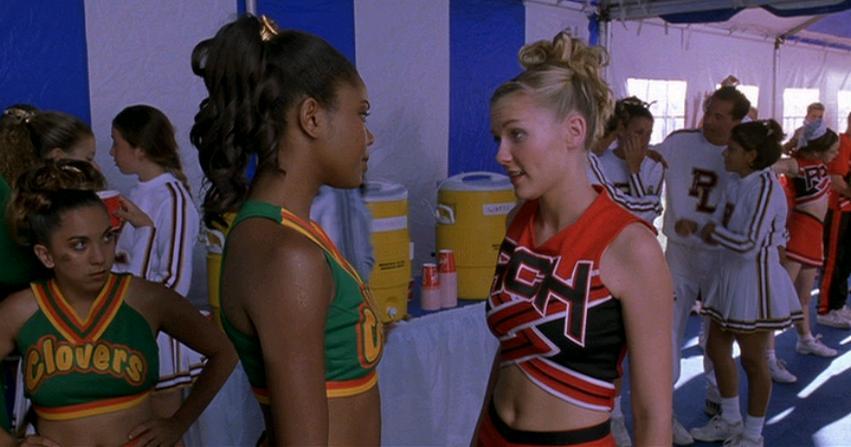 I haven't met anyone who thinks Bring It On is a bad film, though I can only assume such characters exist. Rather, in my experience, Bring It On cleaves its viewership into two camps: those who see a merely adequate but derivative and utterly unspecial movie about cheerleading forchrissakes, and those who see the Grand Illusion of modern high-school comedies. I have found that it is difficult to communicate across the divide between the agnostics and the devotés. It's even a little bit difficult to communicate among the devotés, because for the converted, to be in the presence of Bring It On is to be bathed in total, self-evident pleasure. Explanation falters out of what amounts to unnecessity, but let's try. Let's start with the single frame I have reproduced here, from a mutedly climactic scene where duelling squad captains Torrance (Kirsten Dunst) and Isis (Gabrielle Union) exchange succinct, slightly tense, but generous advice about how to keep their cheerleaders in perfect formation during their respective routines at the national competition. Note that almost every primary color as yet discovered by man is evidenced in this shot, but the overall effect is more engaging than garish. Note that the strong, diagonal, and yet flattering designs for the uniforms of the Rancho Carne Toros and the Compton Clovers toe a precocious line between a silly, unexploitative sauciness and a tough, sporting conviction about the tasks at hand. Note that the framing plays up a symmetry between Torrance and Isis, conveying that these longtime rivals have entered into something like a mutual understanding, even as the sharp contrast between the two backgrounds—blue and white color bars behind Isis, a percolating crowd behind Torrance—continue to set them off from each other. Actually, I emend myself: Torrance is the Prime Meridian of this shot, exactly dividing the two background fields on either side of her, subtly reminding us that the scene isn't so much about a standoff between the mavens as a turning point within Torrance herself, who now meets Isis as a fond equal without relinquishing any of her own competitive zeal. Chicas, you can pause or replay Bring It On liberally and find care, undertones, and tiny formal ironies like these. It isn't Orson Welles, but for crying out loud, when was the last time color, composition, blocking, and design were this precisely calibrated in a teen comedy?
 This kind of haughty, anti-intellectual approach is most thrillingly avoided in the tantalizing and fact-soaked film The Corporation, an emblem of leftist cinema at its most honest and effective. Indeed, The Corporation does a magisterial job of raising all sorts of urgent alarms about the traumatic effects of modern capitalism, without privileging reductive cant over concise, illustrated argumentation, and without preaching only to the pre-converted. The premise of the film's opening sequences is sublimely simple, but unexpectedly imposing: that is, to define what a corporation is, exactly—one professor at the Harvard Business School abashedly realizes that nobody has ever quite put this query to him before—and then to sketch the conceptual contours and legal entitlements that don't just allow but require corporations to maximize profits without any ethical qualms or qualifications. From here, the movie hurtles into its second conceit, aligning the hard-wired behaviors of corporations with the basic symptoms of diagnosed psychopaths, and then through a roulette wheel of eloquent case histories. Many of these, like the extended pièce de résistance about how FoxNews quashed their own story about America's contaminated milk supply, achieve the expected goal of arraigning white-collar pirates and amoral dollar-chasers, but the detail and power in the arguments are more supple and lifelike than one usually finds in films of this type. Plus, the pirates often furnish their own swords on which to fall. Wall Street trader Carlton Brown admits that he and every other trader he knows spent September 11, 2001, gleefully selling gold to the highest bidders and relishing the market's good fortune, quite literally. Lucy Hughes, a chirpy vice-president from Initiative Media, tips her hand about how she abets toy manufacturers and other clients to brainwash children into demanding their products. "Is it ethical? I don't know," Lucy admits, but it's the job she has to do, and she does it well. Chris Komisarjevsky, a corporate spin doctor whom some Orwellian neologist has rechristened a "perception manager," describes his job as though the corporations themselves—rather than, say, impoverished laborers or lampooned environmentalists or snookered consumers or corraled protesters or, in one especially vile anecdote, Bolivian citizens who were taxed by Bechtel for the privilege of drinking their own river and rain water—were the victims of an enormously sentimentalized marginality. "I help corporations have a voice," Komisarjevsky testifies, "and I help corporations share their point of view about how they feel about things." Though we almost never hear the interviewers' prompts, it takes a seasoned and careful approach to draw out motivations and rationalizations from such a broad spectrum of CEOs, activists, traders, historians, professors, consultants, and spies. Furthermore, these accounts always refine our sense of how capitalism operates, from its skyscraper summits through its middle management to its immiserated workers: the full canvas of the movie is richer and more important than the local shocks, cheers, or hisses occasioned by any given detail.
 And yet, it's as misleading as it is nearly unavoidable to consider Erin Brockovich a star vehicle, because Soderbergh's eye and his guiding hand are just as attentive, as creative, and as revelatory with regard to everything and everyone else in the film. Even the title is misleading: Erin Brockovich sounds like the story of one imposing woman, who, incidentally, could hardly have chosen a better name for herself: soothingly vowelly at the outset, and then, without a moment's notice, armored and aggressive with hard, intimidating consonants. But where, in that deceptively monolithic title, could we possibly sense the perfection with which the movie nails the entire Hinkly community, the weirdly telegraphed malice of overstuffed manila files, the dead air of an office where co-workers stolidly tolerate each other, and where new arrivals hang their dreams of individuality on the prospect of choosing their own code for the Xerox machine? How can we know that Albert Finney's Ed Masry will emerge just as roundedly and memorably as Julia's Erin, or that just when Erin is getting pretty easy to take at face value, Cherry Jones will pop up to slam a door in her face with ample justification, or Aaron Eckhart will withstand another caustic, patently defensive, and narcissistic put-down from this ersatz champion of the little people? "What about you, George?" Erin huffs, as though it simply hasn't occurred to her that other people need her, and that more than that, they need the parts of themselves that she has colonized along her admittedly valiant warpath toward social justice. Erin Brockovich isn't just about a woman who bucked the system but about the way that even a fully warranted outrage, hers or ours, often spills over into careless, omnivorous contempt. Like My Best Friend's Wedding, it doesn't quite end as you'd expect, but it's enormously freeing to the actress, the film, and even the entire genre that new gradations of "resolution," new compromises in tone and perspective, are finally permitted.
 While an oft-promised DVD collection from Palm Pictures remains a dream perpetually deferred, I have only my two-year-old recollections of Barney's formidable imagery and curiously interwoven "plots" to write from. Of course, the whole reason why the Cremaster Cycle ranks so high on this list is that Barney's outlandish mise-en-scène, forever emphasizing the organic, the amorphous, the massive, the adhesive, and the fluorescent in quite literal ways, also retains those very qualities in my memory. I saw the movies in superficially "numeric" order (i.e., 1 and 2 on one night, 3 the next, and 4 and 5 after that), but even following that schema, you implicitly sense that 4 and 1, the first films produced, supply the erstwhile Rosetta Stones to what more fully follows. These, the shortest installments, condition the viewer into the remarkable plasticity of Barney's visions, his outré cosmetic mutations of his own body, his recurring propensity for gonadal tropes and visual puns, and his fusion of mass-cultural signifiers like zeppelins, stadiums, land-speed races, and flight attendants with his carefully considered though highly subjective apprehensions of specific occult histories: drawn from the Isle of Man in Cremaster 4, but also from Hungary, Utah, and New York City in subsequent iterations. Both within each movie and across the whole series, Barney expectorates a kind of gestalt system that no one can comfortably articulate—not even he, I suspect, based on the "synopses" at the entrancing but opaque Cremaster
  As with The Crying Game, but working in an opposite direction, I have experienced a pretty notable swerve in my repsonse to In the Mood for Love. In this case, I have grown almost habituated, if such a thing is possible, to Love's rapturous mise-en-scène and its intricately woven sound elements, hypnotized and transported as I am by the miracle that is Maggie Cheung. I love the word "equipoise," but I wonder if it describes any single thing in the universe so well as it does Cheung's absolute and yet sensationally un-fussy control over the line of her body, the most minute calibrations of every feature, every lash. Sitting in a chair, casting her eyes over a newspaper, her posture is not an I or an S or an L, but some kind of sublime, pristine character missing from our alphabet. Her playing of scenes like Mrs. Chan and Mr. Chow's evening out at a restaurant is suffused with an emotional urgency that is almost chemical, nowhere manifest and yet everywhere felt; by comparison, even such an accomplished telepath as Julianne Moore seems like she's doing handstands and flagging out semaphores in the somewhat analogous scenes in The End of the Affair. Other actors have dazzled in Wong's movies, though usually by sculpting themselves into ravishing emblems of cool like Brigitte Lin in Chungking Express or Carina Lau in Days of Being Wild, or black holes of devouring need like Leslie Cheung in Happy Together, or plaintive alter egos like Tony Leung in almost everything. But Cheung in In the Mood for Love exhibits an utter, respectful reverence for the art-object that Wong is creating around her, without ever seeming merely ornamental or rooting herself into any one attitude or affect. She is sad, resigned, perceptive, aroused, a good neighbor, a rattled wife, a creature of new and sudden impulse, a pilgrim returned to former haunts, and in every one of these guises, she has the clarity and soft color of blown glass, but also the veins and arteries of a human person.