Nick's Flick Picks: The Blog

The Fifties for 2012: Picture and Director
This is the last stop for The Fifties. Thanks to everyone who read and commented, especially after I've been out of commission for so long, and don't be shy if you didn't! Thanks also to Tim Robey and Joe Reid who published their own versions of this feature in recent weeks. I haven't revisited their lists while I was posting my own, so as not to pilfer ideas, but they're great and distinctive run-downs.
Speaking of pilfering, I've decided to nick the Academy's new practice of having a flexible concertina for the number of Best Picture nominees, instilling the cutoff point where I feel it naturally falls, between 5 and 10. And so:

Best Picture
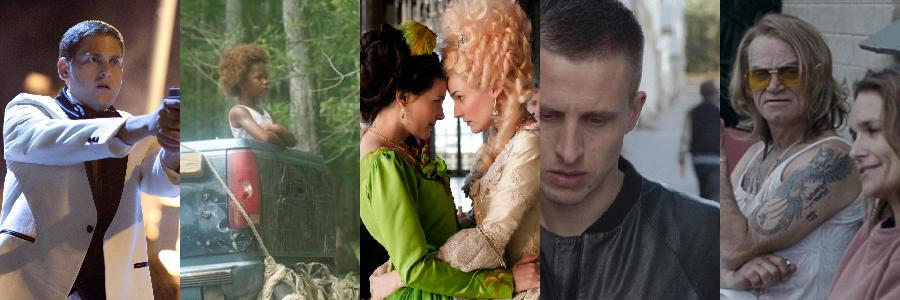
Beasts of the Southern Wild, for plunging into the kind of mythographic storytelling we celebrate in our novels but often deny our movies, and for absolutely nailing it;
Damsels in Distress, for returning from long absence and from diminishing returns of two prior movies with his warmest, most eccentric film, still very much his;
In the Family, for proving that low-budget regional films, the kind that get affirmative-actioned into lots of local festivals, can outrun much bigger dogs;
Magic Mike, for being not quite the movie advertised or expected, and being funnier, more incisive, more ambitious, and more heterogeneous than that one;
Miss Bala, for having the formal and technical wherewithal to tell a story of brute social machines with apt stylistic determinism, and for nailing it;
The Snowtown Murders, for being such a complete package I've cited it in every category, and for earning the immersion in sordidness that gives me qualms about it; and
The Turin Horse, for telling an overtly apocalyptic story, detailing a quotidian existence with uncommon texture, and asking if the latter entails the former.
Honorable mentions are honorable but don't feel mentionable: I graded A Simple Life the same as some of these nominees, but its staying power and degree of difficulty rank slightly below those of the movies I've listed; the same is even truer of Corpo Celeste. The only movie that's truly tempting to sub in here is 21 Jump Street, which only seems more eclectically, amiably, berzerkly accomplished on second viewing, and is such a welcome surprise inside such an empty-looking gift horse. Expect at least a re-grade.

Best Director
Justin Kurzel for The Snowtown Murders, for mastery of craft that still avoids an airless film-school feeling, and ratcheting up confrontational material without going for prurience;
Gerardo Naranjo for Miss Bala, for achieving deep, taut frames even as he plays menacingly with their borders, moves the camera brilliantly, and stays focused on the story;
Steven Soderbergh for Magic Mike, for his great, distinctive strength of immersing us in his characters while also subtly dramatizing his actors' relations to their characters;
Béla Tarr for The Turin Horse, for beating even Haneke at sustaining bleak preoccupations without just parodying himself, treating humanity seriously as a guttering flame; and
Benh Zeitlin for Beasts of the Southern Wild, for having such temerity, working with kids and water and magical realism and a raw nerve of recent cultural memory, and making it all click.
Honorable mentions include Patrick Wang for In the Family, Whit Stillman for Damsels in Distress, Ann Hui for A Simple Life, and Phil Lord and Christopher Miller for 21 Jump Street, for all the reasons listed above. Benoît Jacquot and Tony Gilroy adroitly manage two forms of palace intrigue for two different eras, diffusing unease across memorable characters in Farewell, My Queen and The Bourne Legacy. And Paul Thomas Anderson (The Master) and Nuri Bilge Ceylan (Once Upon a Time in Anatolia) once again make me excited that they are alive and making tough, inimitable movies, even if I'll be more excited when they don't insert themselves quite so fussily between their images and their spectators.
Speaking of pilfering, I've decided to nick the Academy's new practice of having a flexible concertina for the number of Best Picture nominees, instilling the cutoff point where I feel it naturally falls, between 5 and 10. And so:
Best Picture
Beasts of the Southern Wild, for plunging into the kind of mythographic storytelling we celebrate in our novels but often deny our movies, and for absolutely nailing it;
Damsels in Distress, for returning from long absence and from diminishing returns of two prior movies with his warmest, most eccentric film, still very much his;
In the Family, for proving that low-budget regional films, the kind that get affirmative-actioned into lots of local festivals, can outrun much bigger dogs;
Magic Mike, for being not quite the movie advertised or expected, and being funnier, more incisive, more ambitious, and more heterogeneous than that one;
Miss Bala, for having the formal and technical wherewithal to tell a story of brute social machines with apt stylistic determinism, and for nailing it;
The Snowtown Murders, for being such a complete package I've cited it in every category, and for earning the immersion in sordidness that gives me qualms about it; and
The Turin Horse, for telling an overtly apocalyptic story, detailing a quotidian existence with uncommon texture, and asking if the latter entails the former.
Honorable mentions are honorable but don't feel mentionable: I graded A Simple Life the same as some of these nominees, but its staying power and degree of difficulty rank slightly below those of the movies I've listed; the same is even truer of Corpo Celeste. The only movie that's truly tempting to sub in here is 21 Jump Street, which only seems more eclectically, amiably, berzerkly accomplished on second viewing, and is such a welcome surprise inside such an empty-looking gift horse. Expect at least a re-grade.
Best Director
Justin Kurzel for The Snowtown Murders, for mastery of craft that still avoids an airless film-school feeling, and ratcheting up confrontational material without going for prurience;
Gerardo Naranjo for Miss Bala, for achieving deep, taut frames even as he plays menacingly with their borders, moves the camera brilliantly, and stays focused on the story;
Steven Soderbergh for Magic Mike, for his great, distinctive strength of immersing us in his characters while also subtly dramatizing his actors' relations to their characters;
Béla Tarr for The Turin Horse, for beating even Haneke at sustaining bleak preoccupations without just parodying himself, treating humanity seriously as a guttering flame; and
Benh Zeitlin for Beasts of the Southern Wild, for having such temerity, working with kids and water and magical realism and a raw nerve of recent cultural memory, and making it all click.
Honorable mentions include Patrick Wang for In the Family, Whit Stillman for Damsels in Distress, Ann Hui for A Simple Life, and Phil Lord and Christopher Miller for 21 Jump Street, for all the reasons listed above. Benoît Jacquot and Tony Gilroy adroitly manage two forms of palace intrigue for two different eras, diffusing unease across memorable characters in Farewell, My Queen and The Bourne Legacy. And Paul Thomas Anderson (The Master) and Nuri Bilge Ceylan (Once Upon a Time in Anatolia) once again make me excited that they are alive and making tough, inimitable movies, even if I'll be more excited when they don't insert themselves quite so fussily between their images and their spectators.
Labels: Australia/NZ, Béla Tarr, Best Director, Best Picture, Fifties, International, LGBT, Mexico, Steven Soderbergh
posted by NicksFlickPicks at 12:00 AM
3 comments