Sunday, August 03, 2014

The Fifties 2014: Actor, Actress, Director, Picture


ACTOR

NICK'S PICKS:

Macon Blair, Blue Ruin: Communicates the everyman quality of the character without condescending to him. Never turns into a killing machine.

Jim Broadbent, Le Week-end: Just as he was nearing Maggie Smith levels of typecasting, he plays someone angrier, sadder, hornier, more fun.

Pierre Deladonchamps, Stranger by the Lake: Not a wallflower or an idiot but shows us the character's nerves and his unreliable conscience.

Ralph Fiennes, The Grand Budapest Hotel: Distinctive enough he isn't just doing "a Wes Anderson character," and he's dapper, funny, and sad.

Sergio Hernández, Gloria: We sense his desire for Gloria and the certainty that he will disappoint her. You resent him but still sympathize.

Runners Up: Tom Cruise, Edge of Tomorrow; Jake Gyllenhaal, Enemy; Archie Alemania, Norte, the End of History
On the Radar: Tom Hiddleston, Only Lovers Left Alive

Read more »

Labels: , , , , , , , , , , ,

Saturday, March 01, 2014

Oscar 2013: Predictions, Preferences


All feature-film categories now complete!

Look how distressed Sandra Bullock is, trying to glance into her crystal ball, straining to quantify how many Oscars her movie Gravity will win tomorrow.  I'm sporting the same look on my face as I publicly prognosticate winners for the first time since Jennifer Lawrence was in the Brownies.  But why not take a stab at it?  I've been spouting off on every other angle of the Academy Awards this year: diagnosing the narrowing field of "top" competitors for The Advocate; debunking popular myths about the Oscars and their biases in The Washington Post; and discussing some favorites among this year's nominees and some formative Oscar moments with Der Spiegel, though if Sie kein Deutsche sprechen, you won't be able to read it.  What I have not done anywhere, in any language, is forecast who is winning or fess up to my own choices.  So many of my favorite people are sticking their necks out.  So, as Charles Busch belts out in Die, Mommie, Die! - widely regarded as a near-miss for a Best Picture nod in 2003 - "Why not me?"

Best Visual Effects
Gravity will stomp all over its competitors, making it the sixth Best Picture nominee in a row to cop the prize (after Benjamin Button, Avatar, Inception, Hugo, and Life of Pi, just so you don't have to look it up).  You may take this streak as proof of the Academy's growth over the years—since even within my lifetime as an Oscar queen "effects movies" were often persona non grata in Best Picture—or all you may see is an industry increasingly compelled toward digital extravaganzas. Either way, Gravity would probably mop the floor even with the five past winners I just named, much less with the competitors it has to vanquish here... which in a way is too bad, because there's a lot to say for the invigorating spectacles and sleek execution of several sequences in Star Trek and Iron Man 3.  I was less taken with the effects work in The Lone Ranger (yes, even as regards that train crash), and The Hobbit: The Desolation of Smaug was one of a handful of Oscar nominees I missed in theaters. Will: Gravity  Should: Gravity  Hey, Where's The Great Gatsby, which owes the bulk of its locations, color schemes, camera movements, and memorably debauched extras to digital intervention

Best Makeup and Hairstyling
From an impressively strong field we slide over to an annoyingly weak one. Dallas Buyers Club will probably win on default, since voters tend to gravitate to Best Picture nominees unless there's a stirring reason not to.  Jackass Presents: Bad Grandpa is many things, but not that.  (Actually, Bad Grandpa on its best day is only a couple of things, which disappointed me, since I thought the first Jackass movie was a hoot.  Especially seeing it in a Detroit shopping mall, with people flashing laser sights on the screen midfilm.)  The Lone Ranger has the more-is-more thing nailed down, and a lot of graphically arresting cosmetics have been lovingly applied to actors like Barry Pepper and Helena Bonham Carter.  Still, AMPAS has recently rejected some ostentatious contenders who would have been shoo-ins in the Rick Baker era (The Time Machine, Norbit, Hellboy II) when a more broadly admired film presents itself as an option (Frida, La Vie en rose, and Benjamin Button in those cases).  I think it might have been nice if more of the Buyers Club's subscribers had looked visibly ill.  I would love to see a bruising throwdown between those who insist that Johnny Depp's bird-stapled-to-his-head "Native American" is the year's most horrifying faux-archetype and those who proffer Jared Leto's eyebrowless transwoman for the same distinction.  But failing that battle, and following the canny publicizing of Dallas's breathtakingly low budget, Adruitha Lee and Robin Mathews ought to get own their chance to say "All right, all right, all right!" or possibly even speak about Neptune. Will: Dallas Buyers Club  Should: Lone Ranger  Hey, Where's American Hustle, obviously, but also the lightly greyed hair of Llewyn Davis and the wax-museum quality of so many of his acquaintances.  Also, Cate Blanchett's Park Avenue blonde tresses in Blue Jasmine, which are turning into dark roots before her eyes, or ours at least.

Best Supporting Actor
On the subject of Dallas Buyers Club, I thought the movie was fantastic and Jared Leto pretty good the first time I saw them.  Upon revisiting a week or so ago, Dallas betrayed more stress marks, and Leto—by now vaulted from Casting Stunt That Paid Off to Prohibitive Favorite for the Oscar—still seems ...pretty good, without quite explaining what Rayon's doing in this script.  There are some pearl-clutching gestures and other frou-fra in the performance that make it seem stale, conceived more for an audience than from a character who's been built feet up, as they say in American Hustle.  And speaking of Hustle, Bradley Cooper has a large enough part in that movie that he's drawn fire for being a lead falsely slumming in this category.  Yet there are lots of ways to confront the question of who's really "supporting" in a film.  Leto's scenes are more limited, but every single one is handed to the character to be charismatic, or tragic, or funny, or all three, just like Angelina Jolie's and Jennifer Hudson's scenes were in their Oscar-winning vehicles. The movie arguably supports him more than the reverse. Cooper is on screen bunches but, like most of his Hustle castmates, acts an over-the-top character in a strong way and still doesn't seem like he's showboating, or depriving his co-stars of the cues they need to enrich their work.  He and Abdi are the Bests in Show in their movies without ever looking like they realize it.  Fassbender, like Leto, is cleverly playing a thesis that's been posited in the script in place of a real character: in one case, the AIDS patient with a wavering commitment to living, in the other, a slave-owner as one-man multiplex of grimy perversions.  Hill is ...uh, very good in 21 Jump Street and Moneyball.  I have no idea who he's playing in Wolf of Wall Street, no matter how hard he's working to keep the badminton birdie from landing. Will: Leto  Should: Cooper  Hey, Where's James Gandolfini, who didn't need an iota of gratuitous sentiment to merit a nod for his middle-aged romantic, so tentative yet brave, so relaxed yet staunchly principled.  Plus the usual surfeit of guys who got no promotion (Ben Mendelsohn in Place Beyond the Pines, David Oyelowo in The Butler) or who indulged in the sin of acting in non-American films (Yiftach Klein in Fill the Void, Peter Kazungu in Paradise: Love).

Read more »

Labels: , , , , , , , , , , , , , , ,

Thursday, October 11, 2012

The Fifties for 2012: Picture and Director

This is the last stop for The Fifties. Thanks to everyone who read and commented, especially after I've been out of commission for so long, and don't be shy if you didn't! Thanks also to Tim Robey and Joe Reid who published their own versions of this feature in recent weeks. I haven't revisited their lists while I was posting my own, so as not to pilfer ideas, but they're great and distinctive run-downs.

Speaking of pilfering, I've decided to nick the Academy's new practice of having a flexible concertina for the number of Best Picture nominees, instilling the cutoff point where I feel it naturally falls, between 5 and 10. And so:


Best Picture
Beasts of the Southern Wild, for plunging into the kind of mythographic storytelling we celebrate in our novels but often deny our movies, and for absolutely nailing it;

Damsels in Distress, for returning from long absence and from diminishing returns of two prior movies with his warmest, most eccentric film, still very much his;

In the Family, for proving that low-budget regional films, the kind that get affirmative-actioned into lots of local festivals, can outrun much bigger dogs;

Magic Mike, for being not quite the movie advertised or expected, and being funnier, more incisive, more ambitious, and more heterogeneous than that one;

Miss Bala, for having the formal and technical wherewithal to tell a story of brute social machines with apt stylistic determinism, and for nailing it;

The Snowtown Murders, for being such a complete package I've cited it in every category, and for earning the immersion in sordidness that gives me qualms about it; and

The Turin Horse, for telling an overtly apocalyptic story, detailing a quotidian existence with uncommon texture, and asking if the latter entails the former.

Honorable mentions are honorable but don't feel mentionable: I graded A Simple Life the same as some of these nominees, but its staying power and degree of difficulty rank slightly below those of the movies I've listed; the same is even truer of Corpo Celeste. The only movie that's truly tempting to sub in here is 21 Jump Street, which only seems more eclectically, amiably, berzerkly accomplished on second viewing, and is such a welcome surprise inside such an empty-looking gift horse. Expect at least a re-grade.


Best Director
Justin Kurzel for The Snowtown Murders, for mastery of craft that still avoids an airless film-school feeling, and ratcheting up confrontational material without going for prurience;

Gerardo Naranjo for Miss Bala, for achieving deep, taut frames even as he plays menacingly with their borders, moves the camera brilliantly, and stays focused on the story;

Steven Soderbergh for Magic Mike, for his great, distinctive strength of immersing us in his characters while also subtly dramatizing his actors' relations to their characters;

Béla Tarr for The Turin Horse, for beating even Haneke at sustaining bleak preoccupations without just parodying himself, treating humanity seriously as a guttering flame; and

Benh Zeitlin for Beasts of the Southern Wild, for having such temerity, working with kids and water and magical realism and a raw nerve of recent cultural memory, and making it all click.

Honorable mentions include Patrick Wang for In the Family, Whit Stillman for Damsels in Distress, Ann Hui for A Simple Life, and Phil Lord and Christopher Miller for 21 Jump Street, for all the reasons listed above. Benoît Jacquot and Tony Gilroy adroitly manage two forms of palace intrigue for two different eras, diffusing unease across memorable characters in Farewell, My Queen and The Bourne Legacy.  And Paul Thomas Anderson (The Master) and Nuri Bilge Ceylan (Once Upon a Time in Anatolia) once again make me excited that they are alive and making tough, inimitable movies, even if I'll be more excited when they don't insert themselves quite so fussily between their images and their spectators.

Labels: , , , , , , , ,

Monday, January 23, 2012

I'll Take a Final Stab at This

Jan. 11: Oscar ballots are due shortly. The BFCA awards (a ridiculous enterprise, which I disdain) and Golden Globe awards (a ridiculous enterprise, which I treasure) will both play out by the end of the weekend. Plenty of signs still await us as to who might win, but I don't think we'll get any more tips about the nominations. So, I'm fixing my predictions now, albeit leaving them to acting, directing, and Best Picture for the moment. I will expand to the other categories before Jan 24 and announce the update on Twitter. (You're following, right?)

By the way, this year's Oscars are going to be awesome, because Emmanuel Lubezki is finally going to win, and for a Malick film! Anything that annoys you about the awards trudge season in the next six weeks, just think about that.

Jan. 18: Predictions in below-the-line categories added.
Jan. 23: Last switch, Beginners for 50/50 in Original Screenplay.

PICTURE: The Artist, The Descendants, The Help, Hugo, Midnight in Paris, Moneyball, The Tree of Life, War Horse Missed: Extremely Loud & Incredibly Close 8/9!
Anything Else to Consider? Bridesmaids was my closest runner-up in my previous attempt at predicting, because the people who love it, and there are a lot of them, may well rank it first: for affection-based reasons and from a temptation to endorse career opportunities for women, especially in comedy. It's harder to leave out than it was last time, just as it's harder to leave in The Tree of Life and War Horse, but I'm sticking with the same line-up. The Malick has even more passionate devotees than The Thin Red Line did in 1998, and War Horse feels like a rallying-point for whomever pushed, you know, The Cider House Rules and The Green Mile across the line. Tinker Tailor Soldier Spy and, even more so, The Girl with the Dragon Tattoo have suggested estimable fan bases and hit audiences at a good time for nomination recognition. They are feasible nominees, but I'm still not feeling it. Still no idea what to think about Ides of March.

DIRECTOR: Woody Allen, Michel Hazanavicius, Bennett Miller, Alexander Payne, Martin Scorsese 4/5
Anything Else to Consider? I have dropped Terrence Malick for Allen, whose nods from the Globes and the DGA bode well, as does the fact that his previous nomination was even longer ago than Malick's. I still desperately want to go out on a limb for Asghar Farhadi, especially as I now hear Separation screeners went out really early: great move, Sony Pictures Classics! I imagine, though, that Miller will draw huge support not just from Moneyball's many, many fans but from people who admire him for salvaging the project from abortive ruin, and in such an easy-breathing, audience-stroking way that still emits credible personality. If they went for him for Capote, which was colder and made a tenth as much money, why wouldn't they here? Meanwhile, Payne movies have repeatedly done less well with AMPAS than in precursor season—no script nod for About Schmidt, no Giamatti for Sideways—so I'm hoping that he's vulnerable. Even though I'm sure he isn't.

ACTRESS: Glenn Close, Viola Davis, Meryl Streep, Kristen Wiig, Michelle Williams 4/5
Anything Else to Consider? After the frontrunner trifecta, the last two spots go to some combo of Close, Rooney Mara, Tilda Swinton, and Wiig: three women who went to bat for long periods and in multiple capacities to get their movies made, plus Mara, the quasi-overnight sensation. Mara's movie dropped at the right moment, and her reviews are even stronger than the film's. Perceptions that she's been prickly or presumptuous in interviews might matter more, and without the extra force of a "Scrappy Novice Pulls Herself Up By Her Bootstraps" narrative that served Lawrence, Sidibe, et al, she looks a bit like a 1%er in a big fat studio movie. Surely more tempting to AMPAS, which is full of people in Close's age-range, to reward 30 years of project development and general fondness for an un-Oscared vet, even if they don't watch or like the movie? And easier, I think, to thank Wiig for writing herself a sensational vehicle (boy, do they love actors who do that) and for making something so profitable that a lot of other people might get more, better, and/or funnier work because of it. Between popping in a Bridesmaids screener or a Kevin screener, what would Ernest Borgnine do? Or Sid Ganis? Or indeed, Rooney Mara? (Okay, Rooney would watch both.) Or, having run out of time to watch all your screeners, you vote for the funny, bank-making bridesmaid and the five-time Oscar bridesmaid, right?

ACTOR: George Clooney, Jean Dujardin, Gary Oldman, Brad Pitt, Michael Shannon 4/5
Anything Else to Consider? I'm dropping Fassbender for Oldman. Shame is really divisive and a harder movie to get people to watch, surely, than Tinker Tailor, though both feel like modest hits in proportion to their scales. Plus, "let's make Fassbender happen" and "let's act like we've always supported Oldman" seem about even to me as narrative hooks. Shannon's hook still seems even better to me: an open-ended, all-American indie that invites you to participate in it, especially at the end, whereas the other two sort of expect you to be fine with feeling frozen out. Demián Bichir's SAG nod doesn't seem to have produced a lot of buzz, and Gosling's vehicles didn't land in a "Best Actor" way, even if he owned the year. Rescidivist, old-guard Clint-worship makes DiCaprio the only other spoiler I'm really wondering about at this point.

SUPPORTING ACTRESS: Bérénice Bejo, Jessica Chastain, Melissa McCarthy, Octavia Spencer, Shailene Woodley 4/5
Anything Else to Consider? I'm dropping Janet McTeer for Chastain, in a very competitive heat. Almost dropped McCarthy instead, but felt odd projecting Bridesmaids to gain heat elsewhere and lose it where it's actually had some. (Then again, only some.) With six more or less neck-and-neck performances, I'm assuming that the best-loved movies have the edge. Does anyone like Albert Nobbs as much as the Help, Descendants, Bridesmaids, and Artist factions love those show-ponies?

SUPPORTING ACTOR: Kenneth Branagh, Albert Brooks, Jonah Hill, Brad Pitt, Christopher Plummer 3/5
Anything Else to Consider? Short of Patton Oswalt or mayyyybe Ben Kingsley elbowing in on Jonah Hill's action, I just don't see a lot of movement in this race. If you don't live in New York or Los Angeles, Extremely Loud & Incredibly Close still feels more like a myth, and a widely-loathed myth at that, than a movie. Obviously, those two markets are the only ones that really affect Oscar-nod outcomes, but even there, does anyone still think Max Von Sydow is happening? I wish Mortensen felt more likely, but people aren't talking much about the movie, even though it's holding up as best as can be expected (though no more than that) given the currently glutted market. Caesar and Uggie can stroke each other's fur consolingly in the corner. I know, I know, chimps have hair, not fur. Whatever. A commenter reminded me about Nick Nolte, whom I admit I'd forgotten about, and he has definitely been pulling down some nominations. But if I liked Warrior and I'm an awards geek, and I forgot about him, what does that say about the heat around his performance?

Predictions always look like one-third a plausible Oscar scenario, one-third a reflection of what idiosyncratically resonated with you about past Oscar rosters, and one-third what you're loving or hating at the moment you predict. I'm sure this is the case here.


CINEMATOGRAPHY: The Artist, The Girl with the Dragon Tattoo, Hugo, The Tree of Life, War Horse 5/5
Anything Else to Consider? Tinker Tailor Soldier Spy feels very competitive, and Harry Potter, Drive, J. Edgar, and Moneyball are not out of the question.

DOCUMENTARY FEATURE: Bill Cunningham New York, Hell and Back Again, If a Tree Falls, Paradise Lost 3: Purgatory, Project Nim Missed: Pina 3/5
Anything Else to Consider? I've only seen half of those, so I'm picking a little blindly, with We Were Here, Buck, Undefeated, Jane's Journey, and others posing serious opposition.

ORIGINAL SCREENPLAY: The Artist, Beginners, Bridesmaids, Midnight in Paris, A Separation 4/5
Anything Else to Consider? This race feels as crammed with full-tilt possibilities as it did in 2008, when Woody Allen got blanked for Courtney Hunt and Martin McDonagh. I'd put 50/50, Take Shelter, and Win Win as the most likely spoilers, with Margin Call and Margaret after that, and Young Adult still hanging on.

ADAPTED SCREENPLAY: The Descendants, The Help, The Ides of March, Moneyball, Tinker Tailor Soldier Spy 4/5
Anything Else to Consider? I can't figure out whether Hugo or The Help will lose a spot to Ides of March; possibly neither of them will, but Ides just seems so Writer's Branch-friendly and the two Hs don't. The Girl with the Dragon Tattoo and War Horse pose outside threats, but does anything else?

ANIMATED FEATURE: The Adventures of Tintin, Arthur Christmas, Cars 2, Chico & Rita, Rango Missed: A Cat in Paris, Kung Fu Panda 2 2/5
Anything Else to Consider? Puss in Boots probably makes more sense than the more outré Chico pick, but especially when the overall field has proved uninspired, this branch has proved susceptible to Secret of Kells-style surprises of late. Winnie the Pooh, despite great reviews, and Rio, despite great box-office, haven't had any luck on these rosters so far this season.

FOREIGN LANGUAGE FILM: Footnote, In Darkness, Pina, A Separation, SuperClásico 3/5
Anything Else to Consider? Monsieur Lazhar and Seediq Bale feel like strong plays, and people who have seen Bullhead seem quite enamored. I'm not even sure I can work out which of the three semi-finalists are the Executive Committee's pet causes. Omar Killed Me feels like the straggler to me, but after Zem's multi-faceted career, I'm pleased for him.

FILM EDITING: The Artist, The Girl with the Dragon Tattoo, Hugo, Mission: Impossible - Ghost Protocol, Moneyball 4/5
Anything Else to Consider? War Horse and Tinker Tailor are the most considerable threats outside this list, I think, but fondness for the former seems mo muffled, and the confusing plotting of the latter is surely down to the editing as much as anything. And how many quick inserts of portentous-looking faces do we need? Best Picture heavyweights should always be considered here, and the Descendants team is pushing hard for a nod. Tintin's action set-pieces might impress, too, though even in this field, animation and motion-capture have some high hurdles to clear. I'd have thought well-liked action blockbusters like Rise of the Planet of the Apes, Super 8, or Harry Potter might stake a claim here, but the A.C.E. ballot suggested no enthusiasm. They didn't for Ghost Protocol, either, but after the swell box-office and the dazzling set-pieces, can it really be ignored?

ART DIRECTION: The Artist, Harry Potter, Hugo, Tinker Tailor Soldier Spy, War Horse Missed: Midnight in Paris 4/5
Anything Else to Consider? Note that, without trying, I am duplicating the BAFTA list. I realize the Guild conspicuously omitted War Horse from their own nominees, and maybe I ought to take the hint, but is Spielberg really to be overlooked for the Elizabethan dioramas of Roland Emmerich's team in Anonymous, or the cool appeal of Dragon Tattoo, or the Disneyfied South of The Help? Possibly, but hard to believe.

COSTUME DESIGN: Anonymous, The Artist, Hugo, Jane Eyre, Tinker Tailor Soldier Spy 4/5
Anything Else to Consider? My Week with Marilyn might get by on period setting alone, and for padding out Michelle Williams' figure, even though the costumes are nothing special. Troy Syndrome could always yield a crazy-good nod (Immortals?), a crazy-dumb one (Pirates?), or just a crazy one (W.E.?). Thor might be the most Troy-ish contender of the lot, and the Guild went for it. I thought A Dangerous Method had some of the year's best tailoring and most character-specific designs, but Oscar has never once sprung for Denise Cronenberg. J.Edgar's not impossible, but has its fan base, if it ever existed, withstood a sparkless season?

ORIGINAL SCORE: The Artist, The Girl with the Dragon Tattoo, Hugo, Tinker Tailor Soldier Spy, War Horse Missed: Tintin 4/5
Anything Else to Consider? Once again, turns out I'm repeating BAFTA. First, if The Descendants qualifies here, please somebody swing by and check my pulse.

SOUND MIXING: Hugo, Mission: Impossible - Ghost Protocol, Pirates of the Caribbean: On Stranger Tides, Super 8, Transformers 2/5
Anything Else to Consider? I hesitate at ignoring The Artist and at suppressing my own desires to see Hanna in the mix (heh heh). War Horse, Tintin, Fast Five, Harry Potter, and Rise of the Planet of the Apes must be tempting choices for the pop crowd. Tinker Tailor and Rango certainly deserve consideration for fans of subtlety and idiosyncrasy. Girl with the Dragon Tattoo will draw at least a few votes from both factions. Moneyball scored a nod from the Cinema Audio Society; I can't work out why, but I'm glad to hear support for the movie is broad, even in unexpected quarters.

SOUND EDITING: The Adventures of Tintin, Fast Five, Hugo, Rise of the Planet of the Apes, Super 8 Missed: Drive, Girl with the Dragon Tattoo 1/5!
Anything Else to Consider? I'm sure I'm over-estimating the differences between the Sound Mixing and Sound Editing rosters, although the nominators in the Sound branch have been refreshingly willing to do this of late. Animation tends to do well here, and while I'm rooting for Rango to get the nod, Tintin is fresher in the mind. All those car noises in Fast Five and chimp-screeches in Apes seem tough to avoid; The Artist, for its belated but witty sound elements, and Hugo, given its loudness and density, could lend the category some Best Picture prestige. M:I-4, Pirates, Transformers, Harry Potter, Super 8, and War Horse will make major pushes to unseat one, two, three, or more of these picks. I frankly won't be stunned if I'm wrong across the board.

MAKEUP: Anonymous, Gainsbourg: A Heroic Life, The Iron Lady 1/3
Anything Else to Consider? Betting against the Best Picture front-runner is probably folly, and betting against two of them is probably... follier? I think The Artist has a much better shot than Hugo. In fact, I'd be less surprised to see Harry Potter or Albert Nobbs than Hugo. Gainsbourg: A Heroic Life is the hardest semi-finalist to gauge, since AMPAS has opted more than once for this kind of off-the-radar title when the work is good enough.

VISUAL EFFECTS: Captain America, Harry Potter, Hugo, Rise of the Planet of the Apes, Transformers 4/5
Anything Else to Consider? The branch has tipped five other semi-finalists (M:I-4, Pirates, Real Steel, Tree of Life, and X-Men). The Tom Cruise box-office juggernaut could easily crash the front-runners' party. I hate leaving off the engrossing cosmogony and nanobiology in The Tree of Life, but it's the sort of Visual Effects work critics and Oscar nods love to endorse and Oscar never does. The other three I'm not particularly worried about, though not having seen Real Steel or Pirates, which made a lot of people a lot of money, I'm perhaps being cavalier.

ORIGINAL SONG: "The Keeper," "Lay Your Head Down," "Life's a Happy Song," "The Living Proof," "Man or Muppet" Missed: "Real in Rio" 1/2
Anything Else to Consider? The In the Land of Blood and Honey track? The novelty number from Captain America? The Elton John drivel? I don't enjoy thinking about this absurdly capricious category.

Labels: , , , , , , ,

Tuesday, December 27, 2011

I'll Take One Stab at This

Since Oscar ballots went out today, and I have a hard time imagining anything else transpiring in the coming weeks that will significantly change what we know already in the Picture, Director, and Acting races, I'm going to pony up to the bet-placing table and prognosticate. One update to follow in January to incorporate more of the non-celebrity fields. (I hate calling them the "technical categories." Emmanuel Lubezki and Skip Lievsay and Sandy Powell are artists, people. You know it, and I know it.)

Also, read this, which is lovely, funny, and beautifully thought-out, and way more valuable than what I'm doing here.

PICTURE: The Artist, The Descendants, The Help, Hugo, Midnight in Paris, Moneyball, The Tree of Life, War Horse
Anything Else to Consider? Bridesmaids, because people genuinely love it and it might have helped green-light some more projects, and A Separation, if it pulls off the kind of below-the-radar City of God surge of which it seems capable (though of course I still doubt this, especially up top)

DIRECTOR: Michel Hazanavicius, Terrence Malick, Bennett Miller, Alexander Payne, Martin Scorsese
Anything Else to Consider? I'm wondering if emeritus contenders Woody Allen or Steven Spielberg can elbow one of these guys aside, but otherwise, I think that's your roster. Again, maybe Asghar Farhadi if Separation is getting out to more people than we realize.

ACTRESS: Glenn Close, Viola Davis, Rooney Mara, Meryl Streep, Michelle Williams
Anything Else to Consider? I think Tilda's going to lose her standard spot in the precursors to the same things that brought down Angelina Jolie for A Mighty Heart: film's too small, and it's not a screener a lot of folks are just dying to pop in. If there's a seventh factor, I guess it's Charlize Theron, but I really don't think so.

ACTOR: George Clooney, Jean Dujardin, Michael Fassbender, Brad Pitt, Michael Shannon
Anything Else to Consider? Unlike Kevin, I think Take Shelter will draw eyeballs; everything from Chastain Curiosity to Boardwalk Empire to a full year of strong reviews will help. Leonardo DiCaprio, Demián Bichir, Gary Oldman, Ryan Gosling (for Drive), and even Woody Harrelson are all possible threats, in about that order. Crowded race.

SUPPORTING ACTRESS: Bérénice Bejo, Melissa McCarthy, Janet McTeer, Octavia Spencer, Shailene Woodley
Anything Else to Consider? Can you survive vote-splitting with your own projects and vote-splitting with your scene partner? I'd like to see Chastain here, but since someone has to go, I'm guessing it's her. Redgrave's Volumnia still gnashing her war-monger's teeth in the corner, where she's been most of the season.

SUPPORTING ACTOR: Kenneth Branagh, Albert Brooks, Jonah Hill, Brad Pitt, Christopher Plummer
Anything Else to Consider? The longest list of possibilities, to include Max von Sydow, Viggo Mortensen, Nick Nolte, Ben Kingsley, Patton Oswalt, Andy Serkis, and Armie Hammer. Yet Plummer remains, for me, the most heavily fore-ordained winner of the night. Exciting that all five of the other races seem genuinely open as of Christmas!

(Again, one update and additional categories to follow in January)

Labels: , , , , , , , ,

Monday, December 05, 2011

Eyes on the Critics' Prize: Dead Ringers

The other day I was chatting with my pal and yours Joe Reid about how exciting the annual critics' prizes can be, especially when the voters feel cleared to ignore the publicist-stamped and buzz-backed contenders in a given vintage and to venture off the prix-fixe menu. This doesn't mean that critics' organizations should be obligated to avoid the worthiest among the Oscar frontrunners, only that it is disheartening—and increasingly frequent—that many of these groups seem disinclined to entertain the possibility. If you're a paid critic or, one way or another, a moneyed cinephile (the situation I project, sight perpetually unseen, onto most members of the National Board of Review), there is simply no way that you don't see, for example, five better performances by women in second- or third-tier roles than Shailene Woodley's in The Descendants. Not to pick on Shailene, who does as much as anyone to try to make that beached whale float, if not actually swim. But also: come on. That's a lot of movies in a lot of genres from a lot of countries to comb through just to find one gal who can seem convincingly drunk while throwing shit over a fence, and then Stick Up For Dad when the script decides, quite abruptly, that the time has come.

Then again, the coverage of the critics' prizes is often so indistinguishable from a guessing-game about who will win the Oscar that you cannot easily fault the balloters for playing right into the hands of that discourse. Pundits, subsequent voters, and PR flaks pay much closer attention to them than the public at large does, and periodical editors seem determined to package the story this way, rather than running the kind of press that might encourage us to consider, say, the National Society of Film Critics as a body on the order of the Pulitzer or Booker juries: a body whose approval is an accolade in itself, which I'm certain is how many recipients perceive it, and not as a stepping stone to some later, very different, peer-administered prize. Voting critics, finding themselves in this climate, inspire me whenever they try to launch a Marcia Gay Harden or a Jeremy Renner or a Pan's Labyrinth or a Gosford Park or a Fernanda Montenegro—a plausible longshot, but a longshot nonetheless—further into the hunt for Academy Awards. This seems like an apt, exciting use of their professional pulpit, though it's at least as exciting when they rally around a Luminita Gheorghiu, a Lupe Ontiveros, a Bill Nighy, or a William H. Macy (circa 1998, not 1996), not so much daring AMPAS to follow their lead as demonstrating some measure of indifference. These choices feel inexplicable except as honest responses to the self-presenting virtues of the hundreds of movies that critics see in a year, and as showcases of the integrity of a critic's labor and purview. (Or maybe it's the only way to get a nutter of a Montenegro disciple or someone mad for Vlad Ivanov to end the filibuster? If so, don't tell me.)

In any case, I'm interested in knowing what someone who spends the whole year watching hundreds of movies really thought was the best—someone whose tastes have been ratified by readers and editors, even if I don't always agree with her or him, or with those readers and editors. I don't just want to think of these verdicts as irreducibly uncertain tea-leaves or even as self-consciously activist interventions into the Oscar narrative. They should have more standing in themselves than I feel they are often given.

So, following this mammoth intro, Joe and I thought we might post a couple short pieces this season that fondly recall some moments when one of the voting groups we care about most (NSFC, Los Angeles, New York, Boston, or even that dotty old dowager, the NBR) lent their imprimatur to some really distinctive choice that meant something to us, or wound up meaning something substantial to the fortunes of the recipient. AMPAS didn't bite in any of these cases, and we don't care. Or at least, the point of this exercise is not to blow raspberries at Oscar, whom we'll never divorce, for better or worse, no matter how much he abuses us, and regardless of how many good things we got goin' on the side. (After The King's Speech, though, and Tom Hooper specifically, I'm very tempted to adopt separate residences, and file our taxes independently. Thank God I never took Oscar's name, though I prefer it to mine.) The point is rather to toss bouquets to the LAFCA, or the NYFCC, or whomever endorsed the work in question—sometimes creating the very prompt that led us to see the movie, and thereby facilitating a really moving encounter with an interesting piece of work.

These entries will be brief; the details are boring, but Joe and I are both having to spend a lot of extra energy on work these days and away from the movies we wish we could write about, read about, and talk about a little more. This is a small, stop-and-start contribution to awards season we can afford to make, and hopefully a welcome aperitif to other, more number-crunchy, more crystal ball-obsessed coverage. If you haven't seen the movies, or didn't realize they had won something big, check 'em out!

For example, if you haven't seen David Cronenberg's Dead Ringers, and especially if your cinephilia was born in the era of A History of Violence and Eastern Promises, then you should really run, not walk, to pick up the DVD wherever you can still buy a DVD anymore. Dead Ringers got strong but divided reviews when it premiered in 1988. The Fly, which had done excellent box-office in 1986, and whose star, Jeff Goldblum, might have scooped some critics' prizes of his own if Bob Hoskins hadn't claimed them all that year, had at least primed mass-market critics to start extending Cronenberg new benefits of the doubt. Still, I think it helped Dead Ringers's case even more at year's end that 1988 was such a diffuse vintage in terms of critical consensus. Of the five groups I listed above (NSFC, NYFC, LAFC, BSFC, NBR), all five picked a different Best Picture, all five picked a different Best Director, and only two of them opted for the same movie in both categories. Furthermore, only two of the films (Accidental Tourist in New York, Mississippi Burning for the National Board of Review) and only one of the directors (Parker, for Mississippi) was slated at Oscar time. None won.

Within that climate of atomized opinions, it helps for a film to nail a tough, highwire task—the broodily philosophical eroticism of Unbearable Lightness of Being, the hilariously philosophical eroticism of Bull Durham, the, uh, unnervingly philosophical eroticism of Dead Ringers—in a way that galvanizes a self-selecting but implacably committed fan base. That's what seemed to happen for the Cronenberg movie. Jeremy Irons's unshowily showy double-performance as the doomed gynecologists Beverly and Elliot Mantle had earned standout notices even in reviews that seemed uncomfortable with the film. Maybe it was no surprise that at least one group (the NYFC) would sing his praises, though this was still nervy territory for a group that had opted for upscale comedies or semi-comedies, all of them unmistakable as Oscar Pictures, for their Best Film prize in five out of six years from 1983-1988. Irons was so conscious of the boost in pedigree, reputation, and (best of all) creative opportunity that he gleaned from Dead Ringers and its critical laurels that, unusually, he thanked Cronenberg ("...and some of you may understand why...") in his speech when he later won his Oscar for another movie.

Irons's win was a great critics-prize moment, but I feel even more indebted to the Los Angeles crowd for gold-starring Cronenberg's disquietingly sleek, hypnotic, technically virtuosic, scarlet-and-chrome direction as well as the distinctively strong impression that Geneviève Bujold makes in the crucial role of Claire Niveau, a part that could easily have been played as a misogynistic freakshow, a histrionic addict, or a disembodied "everyone's addicted to something" placeholder within the script's thematic architecture. Bujold takes a woman who could be boiled right down to a grotesque high concept—a pill-popping actress and bondage enthusiast whose mutated, three-chambered uterus is an object of horror and fascination for the Irons characters—and she makes her mordantly intelligent, frankly self-confident, and incongruously "normal" without being boring for a single second. She never seems like she's not doing something for her scenes, whether inserting an unexpected pause or offering a smile when you expect a grimace or playing a confrontation as a seduction, and yet she never ever feels like she's acting for a camera. She suggests a filthy mind, a fond self-image, and a feminine practicality all at the same time, with zero signs of strain. She also puts as human a face on Cronenbergian mutation, in the unexpected register of wry understatement, as Goldblum more flamboyantly does in The Fly, in the (context-appropriate) register of operatic tragicomedy.

The arc and reception climate around Cronenberg's career shifted after Dead Ringers, but it shifted even more palpably after these prizes for Dead Ringers. At the box-office, the film had been neither a hit nor a miss on release, relative to its production cost. With respect to its genre, though, whatever you'd say its "genre" is, and with respect to its pair of admired but hardly bankable leads, and with respect to a filmography whose back-page titles included They Came from Within and Rabid, its awards haul was an absolute bonanza. The last 20 years of Cronenberg's career, if you ask me, turn as much on the pivot of December 1988 as on any other single moment. This is as perfect a case as I can think of of the critics on two coasts voting for no discernible agenda beyond their sense of what work most merited a trophy, and in calling out achievement for what it is—not for how plausibly they could vend that achievement to AMPAS or to the HFPA. In so doing, they effectively certified the film for a lot of connoisseurial audiences, in and out of "the industry," who would have ignored the slightly Guignol marketing and the skin-crawling storyline. The risk they took would have been very similar within a comparable career tone and timeline—and in valorizing spiky creativity and sudden transcendence of cult-driven status—to some group anointing Fincher, Norton, and Bonham Carter for Fight Club in '99, which of course no one seems to have even thought about doing. If that's a more historically accessible example for you, and you know what it would have meant to set aside a sprawling field of "safe" pictures as well as exciting experiments in 1999 to endorse David Fincher's schizophrenic demi-ode to pugilistic nihilism and to masculinity eating itself alive, then you've got the flavor of what the NYFC and LAFC did in '88.

You can't expect such prescience every time a critics' group meets, much less can you expect a validation of your own tastes, which of course this series is certain to flatter. Still, the Dead Ringers prizes in 1988 managed the gorgeous hat-trick—the three-chambered glory, if you will—of being perfect choices in the present, a bold endorsement of a filmmaker with a highly idiosyncratic past, and a direct propagation of his increasingly interesting future, built to an unusual degree off the boost the critics gave him and continued to give him. (The gongs for Naked Lunch in 1991, especially from the National Society and the New York crowd, were hard-won, delicious, and perhaps even more surprising, given the sturdiness of competition and the rococo uncanniness of Naked Lunch.) If that's not a perfect summation of year-end voting bodies at their absolute best, then it's at least a perfect summation of why they interest me so much... and why I have my fingers crossed for December 11, when the Boston and Los Angeles crowds both weigh in. Give us change we can believe in, dames and fellas, and any Cronenbergian film critics sporting your own self-evolved genders! Go ahead, win the future!

Labels: , , , , , , , ,

Tuesday, September 20, 2011

The Fifties for 2011: Drivers and Vehicles

We'll finish with the lead actors and actresses. But first...


Best Director
Patricio Guzmán for Nostalgia for the Light, for only seeming to force awkward metaphors, then slowly cajoling us into the full, conflicted logic of the poem he has written to his country;

Abbas Kiarostami for Certified Copy, for folding his usual fondness for metafilmic puzzles within a romantic plot and emotional throughline that feel as immediate as a fond caress;

Terrence Malick for The Tree of Life, for the warmth and immodesty of his daring, for seeing in a man a child, and in a child grief, and in grief and grace the origins of the world;

Mike Mills for Beginners, for making a film about a cartoonist, a kooky actress, a dying gay man, and a chatty dog that is not a sitcom but a roomy, melancholy valentine; and

Aleksei Popogrebsky for How I Ended This Summer, for using image, sound, edits, actors, tempo, and locale so electrically that story bumps don't matter, and the experience brims with energy.

Honorable mentions, filling out an irritatingly male-only roster, are Michelangelo Frammartino for Le Quattro Volte, Cary Fukunaga for Jane Eyre, Benjamin Heisenberg for The Robber, Steve James for The Interrupters, Lee Chang-dong for Poetry, Radu Muntean for Tuesday, After Christmas, and Michael Rowe for Leap Year.


Best Picture
Beginners: Tactful, tender, and generous, rich in humor and characterization. Joins the Junebug Hall of Fame for exquisite modesty;

Certified Copy: Disarmingly lived-in, even warm for a study of romantic skepticism and ambivalence. Concepty, yes, but rings with truth;

The Interrupters: An achievement fully comparable to Hoop Dreams, with some of the year's most indelible moments and characters;

Nostalgia for the Light: Even when forcing analogies a bit, a humbling blend of awe, empiricism, history, reverie, and mourning; and

The Tree of Life: A brother's grief kiln-blasted and glazed into a grand, restless, ecstatic lament for a living and dying world.

Honorable mentions, in order, to How I Ended This Summer, Poetry, Tuesday, After Christmas, Le Quattro volte, and The Robber.

Labels: , , , , ,

Wednesday, November 03, 2010

Voting Like It's 1947

After all this 1947 viewing I've been doing, considerably aided by your suggestions, I've hit the quotient of 30 U.S. release-year contenders that makes me feel justified in posting a personal Oscar ballot for the year. Which is the only framework in which I can really summon the will to discuss "ballots" and "voting" today. My only misgiving is that I've seen so many great performances, especially given the vivid and large ensembles of so many of the noirs and pseudo-noirs, that I wish the list hadn't just wound up looking like I did what Oscar voters so often appear to do: start with their five favorite movies and just keep ticking them off through every category. Lots of very close calls in arriving at these groups of five, and almost always at the expense of candidates whose films would have thrown more variety into the list.

So, by way of honorable mention, and since the main page for 1947 already clarifies my next stable of candidates for Best Picture...

Best Director: Alf Sjöberg, Torment; Jean Renoir, The Woman on the Beach; Carol Reed, Odd Man Out; Robert Rossen, Body and Soul; Robert Montgomery, Ride the Pink Horse or Lady in the Lake; Vittorio de Sica, The Children Are Watching Us

Best Actress: Joan Crawford, my beloved Possessed; Shirley Temple and Myrna Loy, The Bachelor and the Bobby-Soxer

Best Actor: Roger Livesey, I Know Where I'm Going!; Cary Grant, The Bachelor and the Bobby-Soxer; Victor Mature, Kiss of Death; Robert Ryan, The Woman on the Beach; Ronald Colman, A Double Life; Edmund Gwenn, Miracle on 34th Street; Dana Andrews, Boomerang!; Nikolai Cherkasov, Ivan the Terrible, Part 1

Best Supporting Actress: Elsa Lanchester, The Bishop's Wife; Celeste Holm, Gentleman's Agreement; Marilyn Nash, Monsieur Verdoux; Gloria Grahame, Crossfire

Best Supporting Actor: Robert Alda, The Man I Love; Thomas Gomez, Ride the Pink Horse; Lloyd Gough, Joseph Pevney, and Canada Lee, Body and Soul; Lloyd Nolan, Lady in the Lake

Two bonuses: one is that Oscar's Best Supporting Actor lineup from 1947 turns out to be a really high-grade lineup, to include very solid work from Robert Ryan and Charles Bickford, though I preferred them both in other movies; the other is that, while I can't make up my mind about hypothetical Cinematography nods, I cannot see how the Academy omitted Body and Soul and Nightmare Alley. The Ghost and Mrs. Muir is very, very pretty but not quite in the same league, and I can't speak from Green Dolphin Street, but as ever, I think I smell a rat.

Not done with '47 till the next Best Pictures installment goes up, so I may still sneak in a few more titles. Recommend away if you've got performances to stump for, in addition to the films you might have pointed me toward in the previous entry.

Labels: , , , , , ,

Saturday, October 23, 2010

October Oscar Nomination Predix


Colin and Helena probably don't need to look quite so apprehensive about the names written on that sheet. I'm guessing theirs are both on it, and Colin's already got a winner's asterisk next to his. But since I'm feeling in a weirdly predictive post-midnight mood, here's the only stab I'm taking at Oscar nomination predictions until January rolls around.

BEST PICTURE 127 Hours, Inception, The Kids Are All Right, The King's Speech, Love & Other Drugs, The Social Network, The Town, Toy Story 3, The Way Back, Winter's Bone
Alternates: Made in Dagenham, Another Year, The Fighter, True Grit

BEST DIRECTOR Danny Boyle (127 Hours), David Fincher (The Social Network), Tom Hooper (The King's Speech), Christopher Nolan (Inception), Peter Weir (The Way Back)
Alternates: Darren Aronofsky (Black Swan), Lisa Cholodenko (The Kids Are All Right), Edward Zwick (Love & Other Drugs), Ben Affleck (The Town)

BEST ACTRESS Annette Bening (The Kids Are All Right), Anne Hathaway (Love & Other Drugs), Jennifer Lawrence (Winter's Bone), Julianne Moore (The Kids Are All Right), Natalie Portman (Black Swan)
Alternates: Nicole Kidman (Rabbit Hole), Sally Hawkins (Made in Dagenham), Lesley Manville (Another Year), Michelle Williams (Blue Valentine)

BEST ACTOR Javier Bardem (Biutiful), Jeff Bridges (True Grit), Colin Firth (The King's Speech), James Franco (127 Hours), Ryan Gosling (Blue Valentine)
Alternates: Robert Duvall (Get Low), Jake Gyllenhaal (Love & Other Drugs), Paul Giamatti (Barney's Version), Jesse Eisenberg (The Social Network)

BEST SUPPORTING ACTRESS Helena Bonham Carter (The King's Speech), Lesley Manville (Another Year), Miranda Richardson (Made in Dagenham), Jacki Weaver (Animal Kingdom), Dianne Wiest (Rabbit Hole)
Alternates: Kristin Scott Thomas (Nowhere Boy), Hailee Steinfeld (True Grit), Kimberly Elise (For Colored Girls), Rebecca Hall (The Town)

BEST SUPPORTING ACTOR Andrew Garfield (The Social Network), Jeremy Renner (The Town), Sam Rockwell (Conviction), Mark Ruffalo (The Kids Are All Right), Geoffrey Rush (The King's Speech)
Alternates: Christian Bale (The Fighter), Colin Farrell (The Way Back), Ed Harris (The Way Back), Dustin Hoffman (Barney's Version)

Labels: , , , , , ,

Thursday, August 26, 2010

The Fifties for 2010: Best Director

So, re-entering the now: seasoned readers will know that every year, once I've crossed the threshold of seeing 50 commercial releases, I pause for a midterm progress report of bests in several categories, which doubles as a kind of For Your Consideration ad for achievements that I'm hoping other people will recall at year's end (or else hunt down, if they didn't see them the first time). I'm going to move in reverse order of the categories I just rehearsed from last year's Honorees. And so, without further ado...


(...although, if I can just add a little ado, can I say how exciting it is to see this list filled with five filmmakers ranging from their early 30s to their early 40s, none of whom has more than three features under her or his belt, two of whom got their first solo directing credits for these films, and three of whom are women? And I promise, I arrived at this list before considering any of that. It's a new day!)

Maren Ade for Everyone Else, since she proves the term "actor's director" needn't imply inattention to visuals and structure—but still, get a load of those performances;

Jessica Hausner for Lourdes, because she hovers between spoofing her subject and seeming spooked and humbled by it, while maintaining pristine, enigmatic formal control;

Giorgos Lanthimos for Dogtooth, for evoking more about petty tyranny and ignorant complicity by refusing to be literal, allowing himself humor, and trusting his originality;

Kimberly Reed for Prodigal Sons, for an 80-minute master class in imposing clear, forceful, and moving arcs onto complex and wholly intimate material, without losing nuances; and

Lee Unkrich for Toy Story 3, a playroom Preston Sturges who spins a rich central story about love and betrayal, couched amid sublime comic supports, pristinely concluded.

Extremely honorable mentions to Jacques Audiard for bringing his trademark blend of gritty realism and lightning verve to the prison tale A Prophet; to Bong Joon-ho for justifying Mother's wilder excesses by crystallizing his tones and intents so purely when it counts most; and to Andrea Arnold for sustaining the promise of Red Road in Fish Tank, which mirrors the Audiard in its blend of scrappy entrapment and fablic embellishments, and draws an ensemble of performances to die for. Those three runners-up would be full-time ballot contenders in a whole lotta years. I guess this year is shaping up okay? The only catch: Toy Story 3 is the only legitimately new film of 2010 anywhere among these eight.

Further honorable mentions to Roman Polanski for The Ghost Writer, Noah Baumbach for Greenberg, Mia Hansen-Løve for The Father of My Children, David Michôd for Animal Kingdom, and Frédéric Mermoud for Accomplices. The first, second, and fourth actually did bow on the world stage this year—albeit very early, at Sundance and Berlin!—so that's something.

Labels: , , , , ,

Wednesday, August 25, 2010

2009 Honorees: Directors

The last category where I'll be profiling Bests from last year, either because I didn't fall in love with a lot (non-festival documentaries were generally weak, and Score comes down to Duplicity, The Informant!, and not a lot else), or I'm having a hard time remembering (if I don't do Sound right away, I turn forgetful), or else it's just the same films crowding all the categories (viz. Beeswax, Duplicity, In the Loop, Summer Hours, and Whip It in Best Ensemble, with The Hurt Locker, The Maid, and others following up).

These Best Director picks won't come as much of a shock given the Top Ten List I published lo these many months ago, but it's still worth applauding from our seats for...


Roy Andersson for You, the Living, for working from a palette of theater, painting, and still photography without just dabbling; the ambivalence and wit feel shaped by cinema;

Kathryn Bigelow for The Hurt Locker, for conceiving a ruminative movie in long shot around Mackie, and a relentless one in close-up around Renner, and knowing how to mix them up;

Jean-Pierre & Luc Dardenne for Lorna's Silence, for equaling the elegance of L'Enfant but with richer, less abstract emotion; the finale's debatable, but all else clicks, and I like risks;

Jim Jarmusch for The Limits of Control, for taking a bold gamble on geometric, rhythmic, chromatic, and tonal abstraction; I was spellbound, and he rarely has that effect on me; and

Erick Zonca for Julia, for driving his film with the pedal-to-floor ferocity of an old sedan crashing across a policed border, yet every element is tightly managed.

Extremely honorable mentions to the warmth, spryness, and subtlety that Andrew Bujalski brings to Beeswax; to Sacha Gervasi's sensationally funny-sad shaping of material in Anvil! The Story of Anvil, which could have been played for jokes or banalities; to Olivier Assayas for the tenderness and finely edged toughness of Summer Hours, which implies a modern France while having the elegance and lovely remoteness of an object from the past; and to my constant muse and inspiration, the single reason I write about film today, Jane Campion, who showed again in Bright Star that there are many ways of exploring a period, communicating a love-bond, or evoking as fragile and internal an act as poetry on screen.

Further honorable mentions to Park Chan-wook for Thirst, Tony Gilroy for Duplicity, Drew Barrymore for Whip It!, Sebastián Silva for The Maid, Armando Iannucci for In the Loop, Cary Fukunaga for Sin Nombre, and Frederick Wiseman for La Danse. And speaking of established masters, I didn't love everything that Aleksandr Sokurov did with The Sun or Claire Denis did with 35 Shots of Rum, but no one else could or would have made those intriguing pictures, and at their best moments, who could match them?

Labels: , , ,

Friday, July 24, 2009

Mrs. Miniver and Mr. Schindler: Best Pictures 1942 and 1993


NICK: Having watched my conspirators in pleasure show such effort and ingenuity in our last two installments to put our disparate films in dialogue with each other, I get to enjoy a ready-made Oscar juxtaposition of World War II dramas: Mrs. Miniver, the first entrant from this AMPAS-beloved genre to swipe the top prize, and Schindler's List, frequently hailed as a highpoint in the Best Picture heritage. Neither film is a battlefield picture; instead, they each focalize the magnitude of the war through the expanding consciousness of the titular character and the subversion of her or his habits of thought and action. Both were the first movies by their pedigreed, Oscar-friendly auteurs to cop the Best Picture and Best Director trophies after multiple winless nods.

Of course there are also clear markers of dissimilarity between these films and the stories they tell. Mrs. Miniver presents the war only semi-directly as a blend of farewells, alarms, thrift, social disruption, and local casualties; Schindler's List boldly reconstructs and scrutinizes the supremacist and genocidal ethics and terrible, sometimes enforced complicities that both inspired and drew force from the Nazi war machine. Kay Miniver is a radiant paragon of noble citizenship and domestic steadfastness; Oskar Schindler is a rake and a profiteer whose unlikely emergence as an objector and protector arrives with all kinds of vagaries and caveats attached. Mrs. Miniver was not in every respect a picture that Wyler cherished; Schindler's List was self-consciously conceived, produced, and received as the technical, cultural, and moral apotheosis of Spielberg's career, even if some audiences were more skeptical than others of its structural existence as a studio-produced Holocaust diorama in wide commercial release, in venues where the floors are inevitably dotted with trodden Goobers and the popcorn odors waft in from the next-door screenings of Beethoven's 2nd.


In fact, Schindler's List is so patently the mightier text and social artifact that those modest, resilient, upper-middle-class Minivers may have a hard time getting out from under Spielberg's shadow—so let's start with them first. I think it's the case that we've all seen Mrs. Miniver twice. What do you guys think about it, and did your feelings change at all from the first to the second viewing?

MIKE: I don't like Mrs. Miniver. I like Kay Miniver at times, but I don't like very much about the film she's in. It's a serviceable propaganda piece, but it's nothing more than that aside from a series of ugly hats perched on stiff upper lips. I don't completely agree with Wyler's longtime collaborator Lillian Hellman that "it's such a piece of junk, and it's below [him]," because there are a couple good scenes in there that have resonance beyond the film's very utilitarian purpose, but I do agree that it is beneath Wyler.

The two scenes I like most take place in the bedroom (a mostly sexless place, because Walter Pidgeon is in it). First is Garson's cautious, teasing reveal of that terrible hat, the one that looks like a sparrow crashed into a beaver; both Garson and Pidgeon seem at ease around each other, and you can believe that this relationship once generated enough passion to produce three kids. The second, and the best scene in the film, is the aftermath of Dunkirk, when Pidgeon, puffed up with pigeonly pride at his accomplishments, is aghast to discover that his pretty li'l wife had some adventures of her own. Pidgeon is looser than he's ever been in his entire screen career, and Garson shows a sexy playfulness that unfortunately few directors let her use.

NATHANIEL: I cherish both the scenes of which you speak but I'd disagree about this particular bedroom being a sexless place, despite the separate beds. The second time through I kept expecting Pidgeon and Garson to make a fourth baby at any minute. This is not to say that they struck me as in lust with each other but that the "old marrieds" feel rang true. That ease of which you spoke is evident in the silences, the way they touched (loved the spank), the way the actors sometimes don't even look at each other but you can see that they're fully aware of the other's presences. And I especially like those sequences you mentioned because they show this comfortable couple creating drama where none really exists—initially hiding things that they totally plan to share—merely for the flirty diversion it provides. My whole life I've been hearing that Mrs. Miniver is nothing but a propaganda piece but I happen to quite like it.
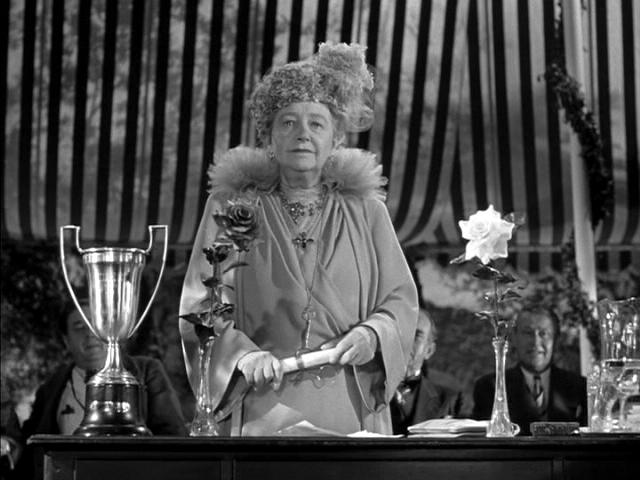
It's not exactly a great movie, I'll give you that. But as war films go, I like that it's light on its feet and sustains its energy well despite nearly being a one set film. (Was it my imagination or was the editing here much busier—more cuts—than in most early '40s movies?) You really do get the sense of war intruding on otherwise peaceful and happy existences. Most war films tend to err on the side of the dully sober. I admire that this one makes no judgments about the frivolity of flower shows, joy rides, college "phases," and expensive hats but instead posits that people should be able to enjoy these things. Freedom is worth fighting for! Yeah yeah yeah. You hear that all the time in war movies, including this one. Frivolity is worth fighting for, damnit! That's something you don't hear as often.

One nagging question though: Shouldn't that "Mrs. Miniver" rose have wilted long before the flower show? You see it in the first scene, already in a vase, and it survives a summer break, a whirlwind courtship and honeymoon and the first months of The Blitz?

Damn.

MIKE: Neither time nor war nor ugly hats can wilt the Miniver Rose, Nathaniel. Not even Nazis can remove its bloom.

THE BENING Well, I'll tell you, Nathaniel—eggshells and Miracle-Gro!

NICK: You pretty much take her everywhere these days, don't you, Nathaniel? Has she introduced you to Juli yet?

To the matter at hand: I feel like I come down somewhere between the two of you, a snug and lovely place to be. I appreciate Mrs. Miniver's sincere-feeling investment in domestic rituals and in personalizing the homefront. Having been a homefront kid while my dad was gone commanding a unit in a war, I am probably well-disposed to the blend of dogged optimism, worried fright, and the odd layer of "business in usual" that Mrs. Miniver showcases. I think the film is better, though—and this is where I see Wyler's gift—at capturing those frictions in specific images and textured performance choices than in the blocky, overstated ways in which the script aims to tackle this stuff. I mean, the whole flower competition eats an awful lot of time on its way toward a fairly certain outcome, but Wyler and Whitty pull out some comic and even some poignant tension in it as she debates with herself. The movie never convinces, or should I say never pretends, that there's much at stake in dime-a-dozen conflict scenes like Teresa Wright lobbying for her grandmother's victory or Garson and Whitty going to toe-to-toe about the engagement, and even the famous scene of the German pilot skulking into chez Miniver is so baldly telegraphed and unsubtly conceived.

But even in these scenes, and in many others, I do admire the layered characterization: headstrong Wright nervously stroking the upholstery when meeting Vin for the third time, the slightly harrowing way in which Vin's little brother likes to play-act being a dive bomber, Garson relentlessly sewing in her fake but admirable cool inside the air-raid shelter. I admire that Wyler punches up the German-intruder scene by starting it off in such incongruously bright light and wide-open space, and having the superficially intrepid Garson so awkwardly handling the gun by its barrel, upside-down, when she's retrieving it for the police. Like you guys have said, the actors are often really great with spontaneity, ensemble playing, and crisply humanizing detail, which are pleasures in themselves. But then, they sometimes backfire into making me wish the whole movie were firing on more cylinders to really get the most from this team, and they can't always compensate for all the obnoxiously haloed lighting and the pathetic miniature-models in the river patrol scene, or the dialogue teetering from chunky bits of "patriotism" to little dime-novel ejaculations ("Good old, Vin!").

And if Mike hates the hats, I don't like that Greer Garson—to me, one of the most beautiful women in Hollywood's past—has to make her big entrance in a scalloped-doily hat and a dress that has spaghetti stitched to the neckline. But then she heads right into that delicious, charming convo with the guy who feels as guilty about buying cigars as she does about her beaver-sparrow hat. Again! You're always getting the good with the bad in this pic.


"I survived the London Blitz, and all I got was this hideous ensemble."

NATHANIEL: Funny you should say that, for "the good with the bad" is how I'd describe quite a few of Steven Spielberg's hugely beloved pictures. But it's hard to describe the magnificently controlled Schindler's List that way. Unless you're referencing the pink coat but I'd rather not start off with the one blemish. That's not just spaghetti on an otherwise beautiful dress, it's the tomato sauce, too.

MIKE: The red-coated girl was part of what displaced Schindler's List from its position at the top of my top 100 list. (New list forthcoming!) I think it's one of few places where Spielberg underestimated his audience's ability to comprehend the extent of the ghetto liquidation. I know he used it to show Schindler himself finally understanding, but surely this man didn't need such a specific reminder.

The other reasons stem from how even in the middle of its undeniably horrific events, it backpedals at times, as if Spielberg were too wedded to Hollywood tropes to carry through. To start out, I don't think it downplays the extent of the Holocaust to tell about the lucky survivors, so I'm not in the Claude Lanzmann camp that views this film as a misguided attempt to dramatize an event that cannot be dramatized. But there's a line in there somewhere, and Spielberg crosses it in two major scenes. First is the old man whom Goeth chooses to execute, but every German pistol within a stone's throw somehow jams, saving his life and stretching believability too far. Second, and much more egregious, is the scene where the women are led into the shower rooms at Auschwitz but are greeted with water instead of poison gas. This, for me, is unforgivable: if there's a single image that sums up the Holocaust's mechanized, efficient destruction of humanity, it's the gas chamber, and the cheap "gotcha!" when that water comes down is among Spielberg's most cowardly mistakes as a director.

And I'm not sure what I'd think if it turned out to be true. This feels like melodrama, not reality. The film is certainly melodramatic at times, especially the scene on the train tracks where Schindler weeps about how many more people he could have saved, but that scene tears me up every time. I don't mind being manipulated if it's done so well.

NICK: Wow! And I so often feel like the carpy one. Admittedly, I agree with a lot of this: the shower scene at Auschwitz and the failed execution of the rabbi are highly dubious and feel like Spielberg devices. Then again, that brutal kick that Goeth gives the old rabbi at the end of that scene registers very strongly. Even stronger to me is the haunting shot of the naked women running into that cavernous shower; the enormity of everything the scene and the film have conjured up to that point is so profound that I don't think the sequence or the film escapes paying tribute to what we all know about the gas chambers. But yes, it's a major stretch, on very thin ethical and narrative ice, and I can see taking major exception. Whereas the girl in the red coat has never really bothered me. Neither of her appearances goes as far into sentimentality as they could have, and seeing her dead—especially in the fairly offhanded way that the moving camera frames her, in the barrow with several others—makes her a somewhat important ballast against the film's decisions elsewhere to focalize so many characters who don't die.

I have my own caveats, but given that this feels like one of the most considerable films ever to win the prize, I get to play the annoying do-gooder who says, Surely we want to foreground the positives. And I know you both hold the movie in very high esteem. I'll start with some of the peaks and strengths that really stood out to me this time. The production design is uncommonly persuasive and detailed, from apartments to camps to cellars to exteriors to cabarets to trains to the extraordinary range of palette, even within the monochrome scale. The mournful Itzhak Perlman theme is as powerful as it always was, but I was almost as struck this time by Spielberg's and Williams' astonishing and risky irony of using hard, dogged piano in the cross-cutting between the establishment of the factory and the assemblage of the ghetto, as though both grow out of the same grinding, mercilessly bureaucratic urge. I saw a much more rounded, bullish, many-sided character coming from Liam Neeson than I had remembered in the past—to include that, rather like the Minivers, he rarely stops believing in the value and defensibility of casual, "frivolous" pleasures, though he's obviously an epicurean and a spendthrift in ways they aren't.

The liquidation of the ghetto is so indelibly shot, edited, mixed, choreographed, and performed that I don't even know what to say about it. While I'm feeling speechless for a moment (it never lasts), rattle off some more high points.

NATHANIEL: You've barely scratched the surface of its many triumphs. I hadn't seen it since December 1993 and the things I most loved about it then were just as impressive: the harrowing liquidation sequence you've mentioned, the harsh beauty of the cinematography surveying all that ugliness, the framing device (which was so moving and earned here but unfortunately regurgitated without inspiration for Saving Private Ryan), and that astonishingly cruel performance by Ralph Fiennes. He seems to have swallowed whole the too-often-abstracted concept of evil. It can't be fully digested—who can ever fully digest the enormity of man's inhumanity to man that the Holocaust represent?—so it seems to have just settled in his lazy gut, completely rotting him from the inside.

The thing that most struck me on this second viewing that I know I didn't appreciate or fully grasp in 1993, before I had any real experience of the corporate world, was how the film is in many ways as much of a business thriller as it is a war drama. And a hugely successful one at that: you're tense with fear at Schindler's political missteps (the kiss at the party), you're gripped by the intricacies of his game plan and game face, and you're caught up in the power struggles. I love that Amon Goeth seems so untouchably powerful at first only to be understood, gradually, as something as banal and impotent as a middle manager. Mostly importantly to this war drama's parallel business thriller is that you're rooting for Schindler to succeed but this makes you so complicit in all of his awful compromises and the dehumanizing deals he's continually making. He grasps the humanity of the "enemy" more than the other men sporting swastikas, but he won't let that get in his way. At least at first. I feel certain that a third viewing would reveal yet more intricacies about the dehumanizing business of war.

NICK: Genius! I love this take on the movie. I totally agree, and it opens so many things to think about. Related to your great point: in this last viewing (my third), I seized on that moment when they've just banged out the list, and Stern can't figure out how Schindler is going to secure all of these "indispensable workers," and he looks at Schindler and suddenly says, "You're not buying them." Kingsley's ambiguous reading of this line is so artful, because you can't tell just then whether he's appalled at the obscenity of purchasing these people, or whether he's thunderstruck at the moral gesture to which this profligate hedonist is actually committing himself. Obviously the movie and even the scene wind up tilting toward (b), but the implications of (a) are never completely removed.

Couldn't help interjecting. Mike, what do you love?

MIKE: Did I mention that it's still in my Top 10? I agree with everything positive you guys have said; it's almost easier to enumerate the few flaws than to get a handle on how amazing this film is. Foremost for me are Ralph Fiennes's performance as Amon Goeth and Janusz Kaminski's impeccable cinematography. Fiennes is the most-ripped-off supporting actor in the history of the category, not because Tommy Lee Jones wasn't great, but because Fiennes gave one of the two or three best supporting performances ever.

And I, too, am in awe of your "business of war" take on the film, Nathaniel. Bravo! It really nails something that I hadn't thought about—Schindler's complicity, for most of the film, with the Nazis, and our complicity with him. But I can't quite accept Goeth as a banal middle manager. There's a fervor there, whether it's mental illness or genuine belief in the cause, that you'd never get at ConHugeCo. He's not just putting in his time.

I know we try to stick to the films and avoid what went on outside them (Oscar campaigns, etc.), but with both these films, it struck me how much their internal self-importance translated to their public reception. Judges sentenced hate crime perpetrators to watch Schindler's List, and Spielberg released a teacher's guide to be distributed with free copies of the film to high schools; for Miniver, BBC Radio played the vicar's closing speech to British troops, and Roosevelt and Churchill requested special screenings of the film to increase support for the war effort. It's pretty convenient for this series that we have two films that took on such political importance; what do you guys think about that?

NATHANIEL: Doesn't "internal self-importance" often translate to public reception? Or rather, isn't it always aiming to do so? I guess the difference here—with your well-chosen but, I assume, not isolated examples—is that both films were bulls-eyes in their respective eras.

People don't talk about Mrs. Miniver much anymore but it was a huge success in its time. The IMDb even references this tagline for the film: "Voted the Greatest Movie Ever Made!" Now, I'm not sure who was voting (Greer Garson?) but the picture was beloved and respected. And we all know how quickly Schindler's List started to show up on "greatest movies of all time" lists.

I've often groused about the "Subject Matter = Quality" equation with Oscar (and with critics and audiences to some extent, too). Subject matter never automatically equals quality. Subject matter is just wallpaper. It's how you decorate the rest of the room that counts. So in the cases when artistic ambition lives up to the grandness of certain subjects or themes, which excite people even when the artistry isn't much to rave about, it's easy to see why the public reception borders on ecstasy.

NICK: I know exactly what you're both getting at: it's totally weird that Schindler's List beat The Piano, one of the greatest films of all time, perhaps the greatest, for Oscar's top prize. I couldn't agree more. And without that sense of Schindler's internal self-importance? Never woulda happened. I appreciate the tact you both showed in hinting at this point without wanting to hurt me by spelling it out, but I think transparency is important.

[THE BENING murmurs inaudibly to NICK]

NICK:: So it turns out that it's not that weird, and that a lot of people think Schindler's List is also one of the greatest movies of all time. And apparently – wait – [one more whisper from THE BENING] – apparently miscarriages of justice are pretty frequent in Oscar history, especially recently. Very interesting, Annette.

Given that AMPAS was so swept up in patriotic fervor in 1943 that it was giving plaster statuettes so as not to waste the country's valuable metals, it's even less surprising that internal self-importance + Oscar's frequent Anglophilia pushed Mrs. Miniver over the victory line. If you scatter-plot that year's ten nominees, it makes sense as a consensus pick, sharing the propagandistic fervor of 49th Parallel and Wake Island but with healthy doses of the sentimentality you see in Random Harvest, The Pride of the Yankees, and The Pied Piper (which is sort of Mrs. Miniver starring an old codger instead of Greer Garson). Schindler's win needs no more contextual explaining than you guys have already provided, and there's every reason for Oscar to feel proud about that one. Since you both confessed to your reservations, I'll say that the story does feel weirdly disproportioned to me; Spielberg and Zaillian start wrapping things up just when Schindler has published his list, short-changing our curiosities about how he got away with his factory being a "model of non-production" and how their lives as Schindlerjüden actually looked and felt, to include their relations with him. The movie suddenly races to its own finish line: marital reunion, European cease-fire, big farewell, and we're done! But in and of itself, and especially by comparison to many other Best Picture winners, the selection of Schindler's List comes close to being an absolute good.


As always, readers, we want to know your thoughts: are you more of a Nathaniel or a Mike in response to Mrs. Miniver? If you're a Lillian Hellman, let it all out. What do you think of Schindler's List? Which of its virtues have we still not begun to evoke, and what reservations do you feel compelled to express?

Also don't forget the Best Pictures Tournament that's an ongoing accessory to this series. We last voted five installments ago, which means it's now time to vote on your favorite winner from 1938-1942 and from 1993-1997. The collective favorites and rankings among the three of us are already posted, but you've got 90 days to change our minds!

Tags:
This Week: Nathaniel's post

Previously: ep.1: Wings & No Country; ep.2: Broadway Melody & Departed; ep.3: All Quiet & Crash; ep.4: Cimarron & Million Dollar Baby; ep.5: Grand Hotel & LOTR:ROTK; ep.6: Cavalcade & Chicago; ep.7: It Happened One Night & A Beautiful Mind; ep.8: Mutiny on the Bounty & Gladiator; ep.9: Ziegfeld & American Beauty; ep.10: Zola & Shakespeare; ep.11: You Can't Take It with You & Titanic; ep.12: Gone with the Wind & The English Patient; ep.13: Rebecca & Braveheart; ep.14: How Green Was My Valley & Forrest Gump

Compendium: My ongoing "Best Pictures" Special Section, with reviews, rankings, polls, and links to all of our discussions

Labels: , , , , , , ,