NICK:
NICK: Having watched my conspirators in pleasure show such effort and ingenuity in our
last two installments to put our disparate films in dialogue with each other, I get to enjoy a ready-made Oscar juxtaposition of World War II dramas:
Mrs. Miniver, the first entrant from this AMPAS-beloved genre to swipe the top prize, and
Schindler's List, frequently hailed as a highpoint in the Best Picture heritage. Neither film is a battlefield picture; instead, they each focalize the magnitude of the war through the expanding consciousness of the titular character and the subversion of her or his habits of thought and action. Both were the first movies by their pedigreed, Oscar-friendly auteurs to cop the Best Picture and Best Director trophies after multiple winless nods.
Of course there are also clear markers of dissimilarity between these films and the stories they tell.
Mrs. Miniver presents the war only semi-directly as a blend of farewells, alarms, thrift, social disruption, and local casualties;
Schindler's List boldly reconstructs and scrutinizes the supremacist and genocidal ethics and terrible, sometimes enforced complicities that both inspired and drew force from the Nazi war machine. Kay Miniver is a radiant paragon of noble citizenship and domestic steadfastness; Oskar Schindler is a rake and a profiteer whose unlikely emergence as an objector and protector arrives with all kinds of vagaries and caveats attached.
Mrs. Miniver was not in every respect a picture that Wyler cherished;
Schindler's List was self-consciously conceived, produced, and received as the technical, cultural, and moral apotheosis of Spielberg's career, even if some audiences were more skeptical than others of its structural existence as a studio-produced Holocaust diorama in wide commercial release, in venues where the floors are inevitably dotted with trodden Goobers and the popcorn odors waft in from the next-door screenings of
Beethoven's 2nd.


In fact,
Schindler's List is so patently the mightier text and social artifact that those modest, resilient, upper-middle-class Minivers may have a hard time getting out from under Spielberg's shadow—so let's start with them first. I think it's the case that we've all seen
Mrs. Miniver twice. What do you guys think about it, and did your feelings change at all from the first to the second viewing?
MIKE: I don't like
Mrs. Miniver. I like Kay Miniver at times, but I don't like very much about the film she's in. It's a serviceable propaganda piece, but it's nothing more than that aside from a series of ugly hats perched on stiff upper lips. I don't completely agree with Wyler's longtime collaborator Lillian Hellman that "it's such a piece of junk, and it's below [him]," because there are a couple good scenes in there that have resonance beyond the film's very utilitarian purpose, but I do agree that it is beneath Wyler.

The two scenes I like most take place in the bedroom (a mostly sexless place, because Walter Pidgeon is in it). First is Garson's cautious, teasing reveal of that terrible hat, the one that looks like a sparrow crashed into a beaver; both Garson and Pidgeon seem at ease around each other, and you can believe that this relationship once generated enough passion to produce three kids. The second, and the best scene in the film, is the aftermath of Dunkirk, when Pidgeon, puffed up with pigeonly pride at his accomplishments, is aghast to discover that his pretty li'l wife had some adventures of her own. Pidgeon is looser than he's ever been in his entire screen career, and Garson shows a sexy playfulness that unfortunately few directors let her use.
NATHANIEL: I cherish both the scenes of which you speak but I'd disagree about this particular bedroom being a sexless place, despite the separate beds. The second time through I kept expecting Pidgeon and Garson to make a fourth baby at any minute. This is not to say that they struck me as in lust with each other but that the "old marrieds" feel rang true. That ease of which you spoke is evident in the silences, the way they touched (loved the spank), the way the actors sometimes don't even look at each other but you can see that they're fully aware of the other's presences. And I especially like those sequences you mentioned because they show this comfortable couple creating drama where none really exists—initially hiding things that they totally plan to share—merely for the flirty diversion it provides. My whole life I've been hearing that
Mrs. Miniver is nothing but a propaganda piece but I happen to quite like it.
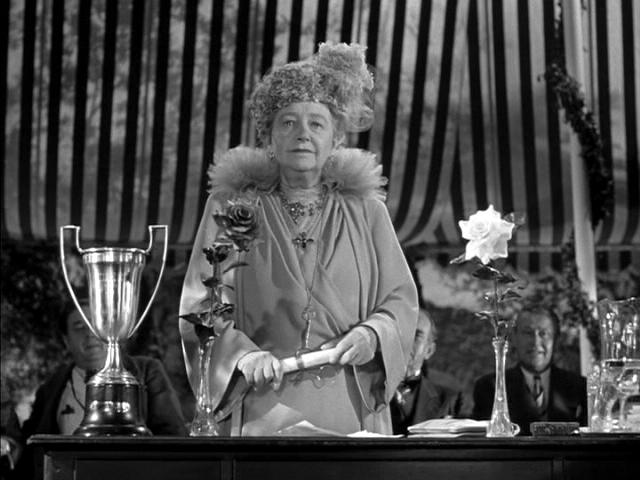
It's not exactly a great movie, I'll give you that. But as war films go, I like that it's light on its feet and sustains its energy well despite nearly being a one set film. (Was it my imagination or was the editing here much busier—more cuts—than in most early '40s movies?) You really do get the sense of war intruding on otherwise peaceful and happy existences. Most war films tend to err on the side of the dully sober. I admire that this one makes no judgments about the frivolity of flower shows, joy rides, college "phases," and expensive hats but instead posits that people should be able to enjoy these things.
Freedom is worth fighting for! Yeah yeah yeah. You hear that all the time in war movies, including this one.
Frivolity is worth fighting for, damnit! That's something you don't hear as often.

One nagging question though: Shouldn't that "Mrs. Miniver" rose have wilted long before the flower show? You see it in the first scene, already in a vase, and it survives a summer break, a whirlwind courtship and honeymoon and the first months of The Blitz?
Damn.
MIKE: Neither time nor war nor ugly hats can wilt the Miniver Rose, Nathaniel. Not even Nazis can remove its bloom.
 THE BENING
 Well, I'll tell you, Nathaniel—eggshells and Miracle-Gro!
NICK: You pretty much take her everywhere these days, don't you, Nathaniel? Has she
introduced you to Juli yet?
To the matter at hand: I feel like I come down somewhere between the two of you, a snug and lovely place to be. I appreciate
Mrs. Miniver's sincere-feeling investment in domestic rituals and in personalizing the homefront. Having been a homefront kid while my dad was gone commanding a unit in a war, I am probably well-disposed to the blend of dogged optimism, worried fright, and the odd layer of "business in usual" that
Mrs. Miniver showcases. I think the film is better, though—and this is where I see Wyler's gift—at capturing those frictions in specific images and textured performance choices than in the blocky, overstated ways in which the script aims to tackle this stuff. I mean, the whole flower competition eats an awful lot of time on its way toward a fairly certain outcome, but Wyler and Whitty pull out some comic and even some poignant tension in it as she debates with herself. The movie never convinces, or should I say never pretends, that there's much at stake in dime-a-dozen conflict scenes like Teresa Wright lobbying for her grandmother's victory or Garson and Whitty going to toe-to-toe about the engagement, and even the famous scene of the German pilot skulking into
chez Miniver is so baldly telegraphed and unsubtly conceived.
But even in these scenes, and in many others, I do admire the layered characterization: headstrong Wright nervously stroking the upholstery when meeting Vin for the third time, the slightly harrowing way in which Vin's little brother likes to play-act being a dive bomber, Garson relentlessly sewing in her fake but admirable cool inside the air-raid shelter. I admire that Wyler punches up the German-intruder scene by starting it off in such incongruously bright light and wide-open space, and having the superficially intrepid Garson so awkwardly handling the gun by its barrel, upside-down, when she's retrieving it for the police. Like you guys have said, the actors are often really great with spontaneity, ensemble playing, and crisply humanizing detail, which are pleasures in themselves. But then, they sometimes backfire into making me wish the whole movie were firing on more cylinders to really get the most from this team, and they can't always compensate for all the obnoxiously haloed lighting and the pathetic miniature-models in the river patrol scene, or the dialogue teetering from chunky bits of "patriotism" to little dime-novel ejaculations ("Good old, Vin!").
And if Mike hates the hats, I don't like that Greer Garson—to me, one of the most beautiful women in Hollywood's past—has to make her big entrance in a scalloped-doily hat and a dress that has spaghetti stitched to the neckline. But then she heads right into that delicious, charming convo with the guy who feels as guilty about buying cigars as she does about her beaver-sparrow hat. Again! You're always getting the good with the bad in this pic.
 "I survived the London Blitz, and all I got was this hideous ensemble."NATHANIEL:
 Funny you should say that, for "the good with the bad" is how I'd describe quite a few of Steven Spielberg's hugely beloved pictures. But it's hard to describe the magnificently controlled
Schindler's List that way. Unless you're referencing the pink coat but I'd rather not start off with the one blemish. That's not just spaghetti on an otherwise beautiful dress, it's the tomato sauce, too.
 MIKE:
MIKE: The red-coated girl was part of what displaced
Schindler's List from its position at the top of my top 100 list. (New list forthcoming!) I think it's one of few places where Spielberg underestimated his audience's ability to comprehend the extent of the ghetto liquidation. I know he used it to show Schindler himself finally understanding, but surely this man didn't need such a specific reminder.
The other reasons stem from how even in the middle of its undeniably horrific events, it backpedals at times, as if Spielberg were too wedded to Hollywood tropes to carry through. To start out, I don't think it downplays the extent of the Holocaust to tell about the lucky survivors, so I'm not in the Claude Lanzmann camp that views this film as a misguided attempt to dramatize an event that cannot be dramatized. But there's a line in there somewhere, and Spielberg crosses it in two major scenes. First is the old man whom Goeth chooses to execute, but every German pistol within a stone's throw somehow jams, saving his life and stretching believability too far. Second, and much more egregious, is the scene where the women are led into the shower rooms at Auschwitz but are greeted with water instead of poison gas. This, for me,
is unforgivable: if there's a single image that sums up the Holocaust's mechanized, efficient destruction of humanity, it's the gas chamber, and the cheap "gotcha!" when that water comes down is among Spielberg's most cowardly mistakes as a director.
And I'm not sure what I'd think if it turned out to be true. This
feels like melodrama, not reality. The film is certainly melodramatic at times, especially the scene on the train tracks where Schindler weeps about how many more people he could have saved, but that scene tears me up every time. I don't mind being manipulated if it's done so well.
 NICK:
NICK: Wow! And I so often feel like the carpy one. Admittedly, I agree with a lot of this: the shower scene at Auschwitz and the failed execution of the rabbi are highly dubious and feel like Spielberg devices. Then again, that brutal kick that Goeth gives the old rabbi at the end of that scene registers very strongly. Even stronger to me is the haunting shot of the naked women running into that cavernous shower; the enormity of everything the scene and the film have conjured up to that point is so profound that I don't think the sequence or the film escapes paying tribute to what we all know about the gas chambers. But yes, it's a major stretch, on very thin ethical and narrative ice, and I can see taking major exception. Whereas the girl in the red coat has never really bothered me. Neither of her appearances goes as far into sentimentality as they could have, and seeing her dead—especially in the fairly offhanded way that the moving camera frames her, in the barrow with several others—makes her a somewhat important ballast against the film's decisions elsewhere to focalize so many characters who don't die.
I have my own caveats, but given that this feels like one of the most considerable films ever to win the prize, I get to play the annoying do-gooder who says, Surely we want to foreground the positives. And I know you both hold the movie in very high esteem. I'll start with some of the peaks and strengths that really stood out to me this time. The production design is uncommonly persuasive and detailed, from apartments to camps to cellars to exteriors to cabarets to trains to the extraordinary range of palette, even within the monochrome scale. The mournful Itzhak Perlman theme is as powerful as it always was, but I was almost as struck this time by Spielberg's and Williams' astonishing and risky irony of using hard, dogged piano in the cross-cutting between the establishment of the factory and the assemblage of the ghetto, as though both grow out of the same grinding, mercilessly bureaucratic urge. I saw a much more rounded, bullish, many-sided character coming from Liam Neeson than I had remembered in the past—to include that, rather like the Minivers, he rarely stops believing in the value and defensibility of casual, "frivolous" pleasures, though he's obviously an epicurean and a spendthrift in ways they aren't.
The liquidation of the ghetto is so indelibly shot, edited, mixed, choreographed, and performed that I don't even know what to say about it. While I'm feeling speechless for a moment (it never lasts), rattle off some more high points.
 NATHANIEL:
 You've barely scratched the surface of its many triumphs. I hadn't seen it since December 1993 and the things I most loved about it then were just as impressive: the harrowing liquidation sequence you've mentioned, the harsh beauty of the cinematography surveying all that ugliness, the framing device (which was so moving and earned here but unfortunately regurgitated without inspiration for
Saving Private Ryan), and that astonishingly cruel performance by Ralph Fiennes. He seems to have swallowed whole the too-often-abstracted concept of evil. It can't be fully digested—who can ever fully digest the enormity of man's inhumanity to man that the Holocaust represent?—so it seems to have just settled in his lazy gut, completely rotting him from the inside.

The thing that most struck me on this second viewing that I
know I didn't appreciate or fully grasp in 1993, before I had any real experience of the corporate world, was how the film is in many ways as much of a business thriller as it is a war drama. And a hugely successful one at that: you're tense with fear at Schindler's political missteps (the kiss at the party), you're gripped by the intricacies of his game plan and game face, and you're caught up in the power struggles. I love that Amon Goeth seems so untouchably powerful at first only to be understood, gradually, as something as banal and impotent as a middle manager. Mostly importantly to this war drama's parallel business thriller is that you're rooting for Schindler to succeed but this makes you so complicit in all of his awful compromises and the dehumanizing deals he's continually making. He grasps the humanity of the "enemy" more than the other men sporting swastikas, but he won't let that get in his way. At least at first. I feel certain that a third viewing would reveal yet more intricacies about the dehumanizing business of war.
NICK: Genius! I love this take on the movie. I totally agree, and it opens so many things to think about. Related to your great point: in this last viewing (my third), I seized on that moment when they've just banged out the list, and Stern can't figure out how Schindler is going to secure all of these "indispensable workers," and he looks at Schindler and suddenly says, "You're not buying them." Kingsley's ambiguous reading of this line is so artful, because you can't tell just then whether he's appalled at the obscenity of
purchasing these people, or whether he's thunderstruck at the moral gesture to which this profligate hedonist is actually committing himself. Obviously the movie and even the scene wind up tilting toward (b), but the implications of (a) are never completely removed.
Couldn't help interjecting. Mike, what do you love?
MIKE: Did I mention that it's still in my Top 10? I agree with everything positive you guys have said; it's almost easier to enumerate the few flaws than to get a handle on how amazing this film is. Foremost for me are Ralph Fiennes's performance as Amon Goeth and Janusz Kaminski's impeccable cinematography. Fiennes is the most-ripped-off supporting actor in the history of the category, not because Tommy Lee Jones wasn't great, but because Fiennes gave one of the two or three best supporting performances ever.

And I, too, am in awe of your "business of war" take on the film, Nathaniel. Bravo! It really nails something that I hadn't thought about—Schindler's complicity, for most of the film, with the Nazis, and our complicity with him. But I can't quite accept Goeth as a banal middle manager. There's a fervor there, whether it's mental illness or genuine belief in the cause, that you'd never get at ConHugeCo. He's not just putting in his time.
I know we try to stick to the films and avoid what went on outside them (Oscar campaigns, etc.), but with both these films, it struck me how much their internal self-importance translated to their public reception. Judges sentenced hate crime perpetrators to watch
Schindler's List, and Spielberg released a teacher's guide to be distributed with free copies of the film to high schools; for
Miniver, BBC Radio played the vicar's closing speech to British troops, and Roosevelt and Churchill requested special screenings of the film to increase support for the war effort. It's pretty convenient for this series that we have two films that took on such political importance; what do you guys think about that?
 NATHANIEL:
 Doesn't "internal self-importance" often translate to public reception? Or rather, isn't it always aiming to do so? I guess the difference here—with your well-chosen but, I assume, not isolated examples—is that both films were bulls-eyes in their respective eras.
People don't talk about
Mrs. Miniver much anymore but it was a huge success in its time. The IMDb even references this tagline for the film: "Voted the Greatest Movie Ever Made!" Now, I'm not sure who was voting (Greer Garson?) but the picture was beloved and respected. And we all know how quickly
Schindler's List started to show up on "greatest movies of all time" lists.
I've often groused about the "Subject Matter = Quality" equation with Oscar (and with critics and audiences to some extent, too). Subject matter never automatically equals quality. Subject matter is just wallpaper. It's how you decorate the rest of the room that counts. So in the cases when artistic ambition lives up to the grandness of certain subjects or themes, which excite people even when the artistry isn't much to rave about, it's easy to see why the public reception borders on ecstasy.
NICK: I know exactly what you're both getting at: it's totally weird that
Schindler's List beat
The Piano, one of the greatest films of all time, perhaps the greatest, for Oscar's top prize. I couldn't agree more. And without that sense of
Schindler's internal self-importance? Never woulda happened. I appreciate the tact you both showed in hinting at this point without wanting to hurt me by spelling it out, but I think transparency is important.
[
THE BENING murmurs inaudibly to
NICK]
NICK:: So it turns out that it's
not that weird, and that a lot of people think
Schindler's List is also one of the greatest movies of all time. And apparently – wait – [one more whisper from
THE BENING] – apparently miscarriages of justice are pretty frequent in Oscar history, especially recently. Very interesting, Annette.

Given that AMPAS was so swept up in patriotic fervor in 1943 that it was giving plaster statuettes so as not to waste the country's valuable metals, it's even less surprising that internal self-importance + Oscar's frequent Anglophilia pushed
Mrs. Miniver over the victory line. If you scatter-plot that year's ten nominees, it makes sense as a consensus pick, sharing the propagandistic fervor of
49th Parallel and
Wake Island but with healthy doses of the sentimentality you see in
Random Harvest,
The Pride of the Yankees, and
The Pied Piper (which is sort of
Mrs. Miniver starring an old codger instead of Greer Garson).
Schindler's win needs no more contextual explaining than you guys have already provided, and there's every reason for Oscar to feel proud about that one. Since you both confessed to your reservations, I'll say that the story does feel weirdly disproportioned to me; Spielberg and Zaillian start wrapping things up just when Schindler has published his list, short-changing our curiosities about how he got away with his factory being a "model of non-production" and how their lives as Schindlerjüden actually looked and felt, to include their relations with him. The movie suddenly races to its own finish line: marital reunion, European cease-fire, big farewell, and we're done! But in and of itself, and especially by comparison to many other Best Picture winners, the selection of
Schindler's List comes close to being an absolute good.

 As always, readers, we want to know your thoughts:
 are you more of a Nathaniel or a Mike in response to
Mrs. Miniver? If you're a Lillian Hellman, let it all out. What do you think of
Schindler's List? Which of its virtues have we still not begun to evoke, and what reservations do you feel compelled to express?
Also don't forget the
Best Pictures Tournament that's an ongoing accessory to this series. We last voted five installments ago, which means it's now time to vote on your favorite winner from
1938-1942 and from
1993-1997. The collective favorites and rankings among the three of us are already posted, but you've got 90 days to change our minds!
Tags:This Week: Nathaniel's
postPreviously: ep.1:
Wings & No Country; ep.2:
Broadway Melody & Departed; ep.3:
All Quiet & Crash; ep.4:
Cimarron & Million Dollar Baby; ep.5:
Grand Hotel & LOTR:ROTK; ep.6:
Cavalcade & Chicago; ep.7:
It Happened One Night & A Beautiful Mind; ep.8:
Mutiny on the Bounty & Gladiator; ep.9:
Ziegfeld & American Beauty; ep.10:
Zola & Shakespeare; ep.11:
You Can't Take It with You & Titanic; ep.12:
Gone with the Wind & The English Patient; ep.13:
Rebecca & Braveheart; ep.14:
How Green Was My Valley & Forrest GumpCompendium: My ongoing
"Best Pictures" Special Section, with reviews, rankings, polls, and links to all of our discussions


Labels: Best Actress, Best Director, Best Picture, Best Supporting Actress, Greer Garson, Oscars, Ralph Fiennes, Steven Spielberg
 Nick's Flick Picks: The Blog


 It has become increasingly obvious that I won't be enjoying any big trips this summer, but there are always new methods for taking matters into your own hands. Needing a break from all of the high-intensity academic writing of the last year, and a different kind of break from the big Oscar projects, and inspired by all the fascinating coverage that came out of this year's Cannes Film Festival, I decided to take unusual advantage of working at a major research university and reassemble a Cannes Film Festival from the past for my own enjoyment. Some people like to restage Civil War battles or the Lewis & Clark Expedition, and I really can't speak to that, but if you want to resuscitate two weeks on the Croisette, here's what you do:
 • Visit the official page for the year you have picked at the
  • Retrieve as many of the programmed films as you can get your hands on, through a combination of the public library system, the Interlibrary Loan office,
  • Do your best to ascertain the order in which the Competition films debuted, because it's fun to simulate the particular sequence, contexts, and suggestive associations among different films that a Cannes journalist might have experienced at the time. This can be tricky, but some reading ability in French will help, since
  • For added historical context, read a little of the initial Cannes coverage in Le Monde, Figaro, the Guardian, the Telegraph, the New York Times, the Los Angeles Times, the Washington Post, and especially Film Comment to learn what was in the air, culturally and politically and cinematically, at the time your festival fired up. This always yields fascinating tidbits, and if you wind up getting a little advance sense of which films flew and which ones bombed, that's fine, because usually when you show up to a festival, you already have some sense of the buzz around certain titles, including the ones about which everyone stays oddly silent. Just take it as a bad sign if, without variation, you always wind up agreeing.
 I decided to return to the
  In general, the Palme was seen as a two-way race between the picturesque pop of The Mission and the austere, differently picturesque, semi-penetrable spiritual agonies of Andrei Tarkovsky's The Sacrifice, which I've also seen though I don't remember it all that well. Both movies grabbed multiple prizes from different bodies beyond just the main jury, controversially chaired by the devoutly mainstream Sydney Pollack. The Ecumenical Jury and the FIPRESCI International critics gave their annual citations to Tarkovsky, while the Technical Grand Prize council, who often cited films by director rather than singling out individual craftsmen, bestowed their plaque on Joffé. Pollack's crew did what they could to distribute the wealth of prizes in other ways, partly by divvying up Best Actress and Best Actor to two performances apiece from different films—the only time that has happened in Cannes history. Still, 1986 is remembered as one of those two-racehorse years on the Croisette, sort of like the 1994 Oscars and, possibly, the 2010 Oscars. Note which side always comes out on top in these situations.
 Aside from these two films plus Andrei Konchalovsky's
  Campion won the Short Film competition for her peerless student film
  The biggest story at Cannes that year, proving that some things never change, is that the U.S. had recently commenced a major bombing campaign in Libya, which had already claimed the life of one of Muammar Qaddafi's children (although this report was later exposed to be false). Security was at maximum intensity at Cannes, which gleams just across the Mediterranean from Tripoli, and virtually all the American talent that had previously planned to support their films in person wound up canceling their visits: Scorsese, Spielberg, Shepard, Whoopi Goldberg, Rosanna Arquette, Walter Matthau, Jon Voight. The casually fearless Robert Altman, the more bullishly fearless Eric Roberts of Runaway Train, and Griffin Dunne, the heavily invested star and producer of Scorsese's After Hours, were the only Yanks to hit the Croisette. By all accounts, the paparazzi were pissed, though the jury wasn't impressed enough by the intrepidity of Altman, Roberts, or Dunne to give a prize to any of them (though Scorsese did win Best Director). Military ships patrolled the shoreline at all hours, as did a giant replicated galleon commissioned to advertise the Opening Night film, Roman Polanski's comic farrago
  Among the 20 Palme entrants, I've been able to scrounge up all of them except for Raúl de la Torre's Argentinean political allegory