Friday, July 03, 2015

The Fifties for 2015


I'm back with one of my most popular features: The Fifties, honoring the year's best filmmaking achievements among the first 50 U.S. releases I saw in 2015.  I think this is the earliest I've ever hit this numerical milestone; it's nice to be drafting this post on July 2, at the exact midpoint of the year.  Many of the films I'm honoring are either still in theaters or newly available on DVD and streaming services, so I hope you'll investigate any titles you've missed.  And, as ever, please suggest your own favorites in the comments, especially if you suspect I've missed the film.

I've gobbled up so many movies post-graduation—ten features in five days, after seeing only three in theaters during the previous two months—that I hustled all the way to a tally of 56 before I could catch my breath. Amy, The Look of Silence, Phoenix, and Tom at the Farm have not technically opened yet, and I'll only believe the last one's planned release when I see it. I'll sideline these for now, which means Tom's Lise Roy, Amy's impressive sound mix, Phoenix's mishandled but interesting script, and just about every stunning aspect of The Look of Silence (easily one of the year's best films, towering over all of the other documentaries I've seen) won't get recognized below.

Otherwise, the eligible movies were '71, About Elly, Amour fou, Blackbird, Blackhat, Boy Meets Girl, Clouds of Sils Maria, Dope, The Duke of Burgundy, Eastern Boys, Eden, Ex Machina, Far from Men, Far from the Madding Crowd, Fifty Shades of Grey, Futuro Beach, Gerontophilia, Gett: The Trial of Viviane Amsalem, Girlhood, Heaven Knows What, The Hunting Ground, Inside Out, Insidious: Chapter 3, It Follows, It's All So Quiet, Jauja, Joy of Man's Desiring, Jurassic World, The Last Five Years, Li'l Quinquin, Love & Mercy, Mad Max: Fury Road, Madame Bovary, Magic Mike XXL, Maps to the Stars, Me and Earl and the Dying Girl, Of Horses and Men, The Overnight, Paddington, A Pigeon Sat on a Branch Reflecting on Existence, Play, The Princess of France, Serena, Spy, Testament of Youth, Timbuktu, The Tribe, When Evening Falls on Bucharest, While We're Young, White God, Wild Tales, and The Wolfpack.  And the nominees are...


BEST PICTURE
Girlhood (rent it!), tough-minded but affecting coming-of-age ensemble drama
It Follows (DVD in July), an ingenious and brilliantly executed horror yarn
Li'l Quinquin (rent it!), Bruno Dumont's amazingly effective foray into comedy
Mad Max: Fury Road (in theaters), tense, implacable, and baroquely conceived
Timbuktu (rent it!), a quietly confident and increasingly tense social document
The Tribe (in theaters), come for all-signing conceit, stay for potent storytelling

Also: I followed Oscar's lead and drew a contour line around the choices that most excite me, though the wonderful Eastern Boys, Pigeon Sat on a Branch..., Eden, Princess of France, and Jauja are all closely clustered just beneath this sextet, and The Look of Silence would unquestionably appear if it had opened yet.


Read more »

Labels: , , , , , , , , , , , , , , , ,

Saturday, May 23, 2015

Cannes 1995: Day 7: May 23


Nasty Love, Italy, dir. Mario Martone

It is on to-day, honey. The hits keep getting bigger!  Four of the Competition titles from the last 48 hours have handily eclipsed the rest of the field, but today's discoveries are invigorating in a different way than yesterday's because they were so much less heralded. Mario Martone, highly regarded in Italy but barely known outside of it—he's competed for the Golden Lion four times, and swept the Donatello awards a few years back with his prestige literary adaptation We Believed—wowed me more or less from out of nowhere with the directorial verve of Nasty Love, simultaneously steely and luscious, sexy and sad. Many of the most conspicuous directorial signatures of Cannes '95 have been high-handed or humorless; Martone figures out how to impress and entertain at once. No slight on sobriety, though, when it's done with the odd, immaculate mannerism of Terence Davies's The Neon Bible, though I'm suspicious I may have responded better to this one than at least a couple of my peers. All that, plus L'enfant noir is an uncommonly beautiful West African coming-of-age tale, and Safe is one of the definitive movies of the decade. Hard to swing a better day at a festival than this.

Read more »

Labels: , , , , , , , , , , , , ,

Monday, May 18, 2015

Cannes 1995: Day 2: May 18


Sharaku, Japan, dir. Masahiro Shinoda

The Main Competition offerings today were determinedly more esoteric than the opening-night film. Souleymane Cissé's Waati was the only one of 24 Palme contenders that eluded me entirely, MIA even from this box-set of that renowned Malian director's work. I did locate the day's other Main Competition title via the website SamuraiDVD, even though it isn't a samurai film. (Technicalities.) Still, even once it's in your hand, Sharaku is such a tough nut to crack that U.S. distribution never happened.  That doesn't mean I was unseduced...

Updated: For even richer thoughts on many of the films listed below, head over to the first Jury Roundtable, where we all go into more detail about our reactions.
Read more »

Labels: , , , , , , ,

Tuesday, January 20, 2015

Top 10 U.S. Releases of 2014


Click here for some context on this list, or here for its companion list.

Stay tuned for #1-#7!  In the meantime...

8. The Missing Picture Especially compared to the two films further down this list, Rithy Panh's The Missing Picture inspired no controversy at all—except, perhaps, on the question of when exactly it opened. A tiny commercial bow was planned late last year for LA, though evidence suggests no ticket-buyer saw it until last March. Such are the vortices of minutiae into which a Top 10 list gets pulled, when the point is to showcase artistry as keen, inventive, and affecting as Panh's, narrating his country's and his family's experience of the Khmer Rouge takeover of Cambodia in the 1970s. Forsaking a talking-head approach to history, Panh assembles an eclectic archive of stock footage, movie clips, superimpositions, and abstract sound elements that testify to the unstable, prismatic qualities of public and personal history, even as his soft-spoken account of genocide and systemic oppression evokes the stubborn, harrowing factuality of the past. Famously anchoring the film's mix of styles and source materials are Panh's handmade dioramas of Cambodians usurped, imprisoned, indentured, and buried. Watching the film again for the first time since TIFF 2013, I realize how many times I've misremembered these wood-carved villagers as clay sculptures: they're as poignantly expressive as stop-motion figures, as palpably stamped with their creator's doting attention, to such an extent I conflated the two. Whittling and painting them by the dozens—suggesting a mass-production of bodies, but evading tyrannical-conformist connotations by subtly humanizing each doll—Panh tells a gruesome history in terms that he and his audience can bear. Still, The Missing Picture remains, of course, a deeply sobering experience. You could see it as a document of traumatic repetition: not just of immersion in an intolerable history but of daily, painstaking labor that simultaneously puts the past to sleep and wakes it back up. The viewer gets enfolded in a similar ambivalence: you'd love for the man and the country to be able to forget, but you also recognize the necessity of never forgetting how a nation of people were stripped of every individual possession but their spoons; how 250 grams of rice somehow fed 25 people per day; how a nine-year-old boy reported his starving mother for stealing a mango in a field; how the regime's oddly poetic prohibition on poetry ("the spade is your only pen, the rice field your only paper!") unwittingly inspires painful, poetic reflection among those few who survive. Through the titular, oft-repeated conceit of the "missing picture," Panh asserts that despite his film's expressive diversity, notwithstanding every photo and figurine and audio collage, this period in Cambodia's past is defined by what nobody can show. The kernel of history remains out of reach and surpasseth understanding. The Missing Picture may in that sense be a film structured around an omission, but look how beautifully and bravely it struggles to fill that gap.

9. American Sniper You know what Clint Eastwood's movie about the "most lethal sniper in American history" lacks even one of? A single scene where Chris Kyle embraces that tag. Every time someone tries to print the legend to his face, he opts for non sequiturs, quick subject-changes, or J.M.W. Turner-esque grunts.  Clearly, the film has roundly reimagined Kyle from his real-life namesake, who seemed only too proud to trumpet and embellish that mythological reputation, for reasons that invite a separate inquiry. Just as clearly, the film's Chris Kyle—an utterly coherent characterization of its own, more challenging to hawks or doves than the real Kyle was—is caught within a vertiginous experience that his own legend does nothing to ease or elucidate. Nationalistic, mission-oriented, smart, dim, haunted, gruff, focused, arrogant, repeatedly humbled, empowered and chilled by a red-meat upbringing, prone to racist word and deed, prone to selfless thought and act, capable of moral reflection but seemingly uneasy with it, capable of giving and receiving and reneging on love, Chris emits a plethora of contradictory attitudes and positions. Sniper never reduces these, even as its hurtling momentum, its inductive approach to character, and the exigencies of battle preclude it from flaunting its own complexity or apologizing for its compromises. "It's a hell of a thing, killin' a man," William Munny apostrophized in Eastwood's grim and heavily lacquered Unforgiven, an accomplished film that foregrounded its own rhetoric; it anticipated and even wooed an audience of artistically inclined revisionists, assuring us that it grasped its moral paradox, that it felt the clamp of guilt. American Sniper, faster, brighter, bloodier, and lodged inside contemporary quagmires, radiates a similar but less articulated moral despair.  Its agonies are expressed everywhere from the arrogant, overwhelming roars of American warcraft to the utterly un-rousing score to the sickening, raspberry blasts of blood that accompany every kill. It neither characterizes a single Iraqi in depth nor presses very far into most of its American characters nor shows almost any Iraqi (with one Guignol, discordant exception) doing anything I wouldn't imagine an American doing in the reverse position... if we can even imagine ourselves in the reversed position. Sniper's reception suggests that many pro- and anti-war audiences and critics expect films on this subject to come right out and flatter them in undiluted terms. This film doesn't do that.  Exceptionally well-made, well-shot, well-mixed, and with a tension in the cutting that few Eastwood movies and few modern war films have achieved, American Sniper is as cinematically deft as it is culturally divisive.  Op/eds and awards pundits keep trying to spin it as the anti-Selma.  I look at the pair of them, one an exhortation for justice and the other a hydrochloric assault on ethical conviction—one a study of a group challenging The System, the other a study of a man who, for better and worse, subsumed himself to a system—and I think these two Best Picture nominees are the two bravest, and the two most worth saving.  In serious terms, with both feet planted in the real world, they showcase complex men and communities that too few movies ask us to consider, much less to assess in such rounded, inspiring, but discomfiting ways.  Which, speaking of...

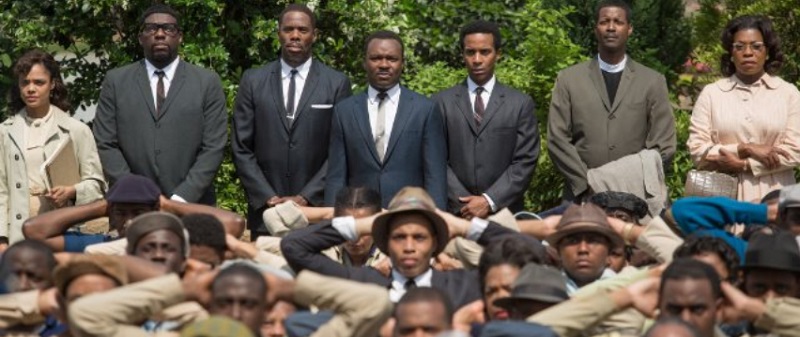
10. Selma A great tweeter called @DanBlackroyd came up with these apt words, angry but beautiful and totally on-point, following that notoriously low tally of Oscar nods: "Selma will be written about for years to come. Its legacy is intact. The Academy needed Selma way more than the other way around. Trust." He's so right. But if you wanted to parse the thought differently, part of why the Academy needs this movie, and why this movie merits more awards, is that it's the rare film that unabashedly needs us—that reaches for us and involves us. It's not the kind of historical drama that unfolds behind plate glass.  Beyond its epic yet intimate staging of events in the mid 1960s (superlative), beyond its close but woeful presaging of events in the mid 2010s (urgent and humbling), observe the consummate engineering of the film. Its broadest arc moves from an opening, monolithic close-up on one man to a closing, diamantine montage of thousands. It pivots on sequences like the second attempted march toward Montgomery, which King unexpectedly halts.  Minutes go by before the film spells out his thought process, enlisting us in the meantime to do the necessary work, to practice thinking like an activist, to deduce why this counter-intuitive move could possibly make sense in the moment... which does not, by the way, mean forbidding us or the other characters from questioning King's wisdom.  Selma inspires us to feel and to cogitate, and to act in our communities.  To act as communities!  The film percolates with expansive ideas and also with subtle filigrees of framing, figuration, and form.  Not just in content but in its texture and its frequently self-effacing technique, Selma honors the candid but deceptively complicated man at its center, and it honors even more that ethos of coalition, resilience, and solidarity for which both Kings and Lewis and Abernathy and Nash and Rustin Cooper and Boynton and Young and Williams and their many colleagues all stood (and sometimes knelt, and occasionally fell).  Selma sparks our memories, solicits our horror, and mobilizes our sense of what's right—not for each of us individually, but for all of us together.

Labels: , , , , , , , , ,

Top 10 World Premieres of 2014


Click here for some context on this list, or here for its companion list.

Stay tuned for #1-#8!  In the meantime...

9. American Sniper You know what Clint Eastwood's movie about the "most lethal sniper in American history" lacks even one of? A single scene where Chris Kyle embraces that tag. Every time someone tries to print the legend to his face, he opts for non sequiturs, quick subject-changes, or J.M.W. Turner-esque grunts.  Clearly, the film has roundly reimagined Kyle from his real-life namesake, who seemed only too proud to trumpet and embellish that mythological reputation, for reasons that invite a separate inquiry. Just as clearly, the film's Chris Kyle—an utterly coherent characterization of its own, more challenging to hawks or doves than the real Kyle was—is caught within a vertiginous experience that his own legend does nothing to ease or elucidate. Nationalistic, mission-oriented, smart, dim, haunted, gruff, focused, arrogant, repeatedly humbled, empowered and chilled by a red-meat upbringing, prone to racist word and deed, prone to selfless thought and act, capable of moral reflection but seemingly uneasy with it, capable of giving and receiving and reneging on love, Chris emits a plethora of contradictory attitudes and positions. Sniper never reduces these, even as its hurtling momentum, its inductive approach to character, and the exigencies of battle preclude it from flaunting its own complexity or apologizing for its compromises. "It's a hell of a thing, killin' a man," William Munny apostrophized in Eastwood's grim and heavily lacquered Unforgiven, an accomplished film that foregrounded its own rhetoric; it anticipated and even wooed an audience of artistically inclined revisionists, assuring us that it grasped its moral paradox, that it felt the clamp of guilt. American Sniper, faster, brighter, bloodier, and lodged inside contemporary quagmires, radiates a similar but less articulated moral despair.  Its agonies are expressed everywhere from the arrogant, overwhelming roars of American warcraft to the utterly un-rousing score to the sickening, raspberry blasts of blood that accompany every kill. It neither characterizes a single Iraqi in depth nor presses very far into most of its American characters nor shows almost any Iraqi (with one Guignol, discordant exception) doing anything I wouldn't imagine an American doing in the reverse position... if we can even imagine ourselves in the reversed position. Sniper's reception suggests that many pro- and anti-war audiences and critics expect films on this subject to come right out and flatter them in undiluted terms. This film doesn't do that.  Exceptionally well-made, well-shot, well-mixed, and with a tension in the cutting that few Eastwood movies and few modern war films have achieved, American Sniper is as cinematically deft as it is culturally divisive.  Op/eds and awards pundits keep trying to spin it as the anti-Selma.  I look at the pair of them, one an exhortation for justice and the other a hydrochloric assault on ethical conviction—one a study of a group challenging The System, the other a study of a man who, for better and worse, subsumed himself to a system—and I think these two Best Picture nominees are the two bravest, and the two most worth saving.  In serious terms, with both feet planted in the real world, they showcase complex men and communities that too few movies ask us to consider, much less to assess in such rounded, inspiring, but discomfiting ways.  Which, speaking of...

10. Selma A great tweeter called @DanBlackroyd came up with these apt words, angry but beautiful and totally on-point, following that notoriously low tally of Oscar nods: "Selma will be written about for years to come. Its legacy is intact. The Academy needed Selma way more than the other way around. Trust." He's so right. But if you wanted to parse the thought differently, part of why the Academy needs this movie, and why this movie merits more awards, is that it's the rare film that unabashedly needs us—that reaches for us and involves us. It's not the kind of historical drama that unfolds behind plate glass.  Beyond its epic yet intimate staging of events in the mid 1960s (superlative), beyond its close but woeful presaging of events in the mid 2010s (urgent and humbling), observe the consummate engineering of the film. Its broadest arc moves from an opening, monolithic close-up on one man to a closing, diamantine montage of thousands. It pivots on sequences like the second attempted march toward Montgomery, which King unexpectedly halts.  Minutes go by before the film spells out his thought process, enlisting us in the meantime to do the necessary work, to practice thinking like an activist, to deduce why this counter-intuitive move could possibly make sense in the moment... which does not, by the way, mean forbidding us or the other characters from questioning King's wisdom.  Selma inspires us to feel and to cogitate, and to act in our communities.  To act as communities!  The film percolates with expansive ideas and also with subtle filigrees of framing, figuration, and form.  Not just in content but in its texture and its frequently self-effacing technique, Selma honors the candid but deceptively complicated man at its center, and it honors even more that ethos of coalition, resilience, and solidarity for which both Kings and Lewis and Abernathy and Nash and Rustin Cooper and Boynton and Young and Williams and their many colleagues all stood (and sometimes knelt, and occasionally fell).  Selma sparks our memories, solicits our horror, and mobilizes our sense of what's right—not for each of us individually, but for all of us together.

Labels: , , , , , , , ,

Wednesday, December 31, 2014

Best of 2014: In Salute of Collaboration, Pt. 1


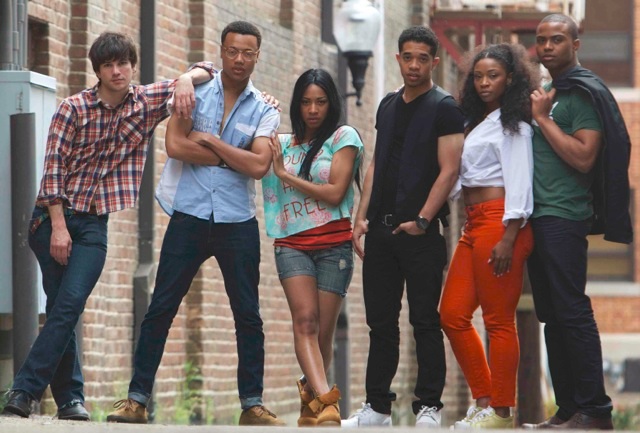
Kevin Allesee, Julian Walker, Nikki Jane, Gary LeRoi Gray, Wanita Woodgett, and Torrey Laamar in Blackbird.

"The thing that counts the most with me is the friendships, and the love, and the sheer joy we have shared making movies together. My friends."

If you don't know who said that and when, it is conceivable that you are reading the wrong blog, but that's okay.  It just means our lives are very different, which is fine.  The first reason these words linger in my mind today, even more than it does every day (no, seriously), is that during a month when everybody's making lists of the best single films and most outstanding individual accomplishments of the year in film, I realize how little we salute collaborations.  Outside of acceptance speeches or unbreakable ties on Ten Best lists, it's hard to pay tribute to the aspect of movielove that isn't about beholding solo artists' achievements but about relishing teamwork among filmmakers, or bonds between characters, or resonances across films.

The other reason is that New Year's Eve and New Year's Day are always occasions when I dwell on my own gratitude for the relationships that sustain my life and enable my good fortune.  This blog isn't the place to repay more private debts, but much of the thankfulness I feel is toward movie artists, for how they inspire, educate, and move me—often via their own visible camaraderie.  I genuinely feel happier in my life and better able to communicate, empathize, rebound from hardships, and admit my limitations because of the impressions of life, however reassuring or confronting, that I glean in the cinema.  So here are 52 occasions, one per week of the year, when the currents running between characters or the collaboration nourished among creative artists filled me with joy, admiration, humility, or insight.  I've limited myself to movies either released in 2014 or bowing at festivals in the last year, hopefully to arrive on screens near you in 2015.  I didn't love every movie, but that's the whole point: all of these relationships were gems to me, even the ones that were nestled in the rough.

1. Regina Hall and Kevin Hart, About Last Night - In their support of Michael Ealy and Joy Bryant and in their frisky, cantankerous rapport with each other, Hall and Hart generated the closest thing I saw in any 2014 romantic comedy to the vivid, spiky ensemble work that sustained the genre in the classic decades.  They don't play down to the genre, or defer to their co-stars.  Contemporary and frequently raunchy as they are, they act like they're in Libeled Lady, or a sexed-up, 21st-century Palm Beach Story.  As tasty as the whole film was, I wanted to keep watching their characters, even though you wouldn't necessarily want to be them or count on them in real life.  And with so many filmmakers giving Hart a long leash to improvise or ceding him his own unchallenged spotlight, which he's often very good at filling, it was great to see an actress go so fully toe-to-toe with him (among other bodily contacts).

2. Catherine Breillat and Isabelle Huppert, Abuse of Weakness - With typical flintiness, Breillat answered my question to her at TIFF '13 by saying that Huppert was the only professional actress she had any interest in working with.  As a piece of acting, Huppert's rendering of a palsied, embittered, undisguised surrogate for Breillat is often impressive but somewhat uneven, though less so than the film, which starts out strong, stagnates for a while, but sticks its pointed landing.  Setting all that somewhat aside, as an instance of making oneself a conduit for a forceful, sui generis filmmaker with something angry, complex, and somewhat inchoate to say about an extremely difficult time in her life, Huppert's work is exceedingly generous without being at all soft.

3. Alex and Ali, Alex & Ali - I hope more people get to see this documentary about a man from the U.S. South and a man from Iran who were friends and lovers a half-century ago, when the latter's family hosted the former as an exchange student, and who are now attempting to reconnect at a very different time, personally and politically.  The story is as harrowing as it is happy, and I won't reveal how they resolve their very difficult circumstances, but their willingness to be filmed at all was inspiring enough.  Their candor about thorny matters of head and heart, unfolding unpredictably in real time, is all the more so.  Sobering and valuable storytelling, straight from life.

Read more »

Labels: , , , , , ,

Monday, June 30, 2014

Best Supporting Actress 1964: Oscar Noms & Better Ideas

Nathaniel has just posted this month's Supporting Actress Smackdown, dedicated to the nominated ladies of 1964. I'm not going to say this is Oscar's worst lineup in this category, but it's the only one I could think of where I don't like any of the five movies and don't love any of the five performances. I had one heck of a grouchy ballot, though I have to say, even more than usual, reading my fellow panelists' comments and participating in the first-ever post-Smackdown podcast gave me so many new ideas about the films, the nominated turns, and entire ways to think about acting. So, huzzah to Joe Reid, StinkyLulu, beloved actress Melanie Lynskey, and hat-wearing, chalk-gardening, iguana-taming, beach-dancing, Charlotte-hushing hostess Nathaniel Rogers, whom I love not only for his website and his insights into actressing but for the scrupulous eight-point agendas he sends before these conversations. (Just like he loves me for writing five 64-word capsules about these performances. I am amazing.)

Still, this doesn't change my opinion that AMPAS needed help picking better Supporting Actress alternatives in 1964. Given that the year's big hits and nomination leaders included Becket, Dr. Strangelove, The Best Man, Fail-Safe, Seven Days in May, Zulu, and A Hard Day's Night, I understand why they didn't feel surfeited with distaff contenders. But look—they didn't need to abandon the eligibility list or even move out of their favored genres and character types to produce a richer field:
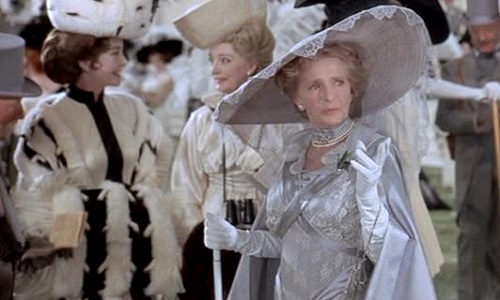
Nominated: Gladys Cooper, as Henry Higgins's acerbic high-society mother in My Fair Lady

What I Thought: On the evidence of this film, Cooper's aged more gracefully than Cukor. She seems to be giving a tart but unostentatious reading of Mrs. Higgins, but like many of the actors, she is stymied by her director's distant, stagebound camera. We don't spend much time with her and barely see her when we do, making a capable if unchallenging performance seem even more minor.

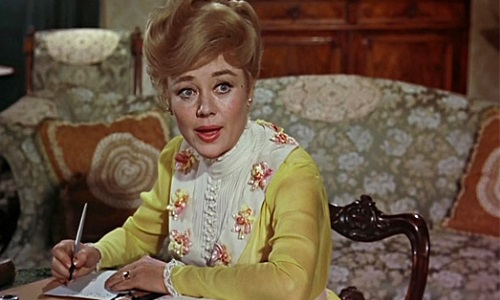
Why Not Instead: Glynis Johns's dizzy suffragette in Mary Poppins, if Oscar insisted on short-listing a vivid peripheral player in one of the year’s big musical juggernauts, rendered by an irresistible character actress whose previous nominations had yielded no wins?
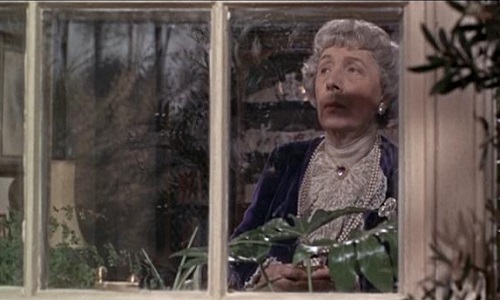

Nominated: Edith Evans, as the haughty, intractable guardian of a tiny pyromaniac in The Chalk Garden

What I Thought: If more people knew this movie, I would say, "Ask about me, Olivia, ask about me!" to narcissists at parties, and my intimates could all chortle. So GIF-able, Edith! Otherwise, this feels like a Dench-in-Chocolat nod. I know she's a Dame but it's hardly a peak role, and her emphasis on imperiousness clogs other possibilities in it. Moment to moment, her choices feel obvious.

Why Not Instead: Future Dame Maggie Smith, who's so saucy and insouciant as Anne Bancroft's torpid yet chatty frenemy in The Pumpkin Eater, the kind of movie that pedigreed English actresses should be making instead of odd Disney-Du Maurier mashups like The Chalk Garden. The many, gangly ways Smith finds of disrespectfully inhabiting Bancroft's kitchen are nod-worthy enough. Yootha Joyce is also pretty remarkable as a psychotic in normal-woman's clothing in the scene at the hair salon.
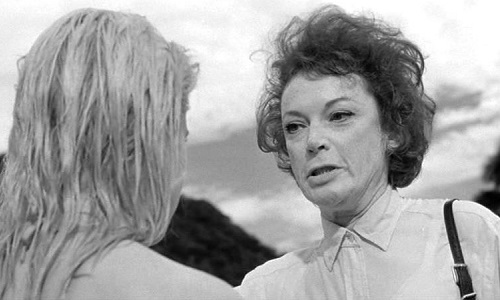
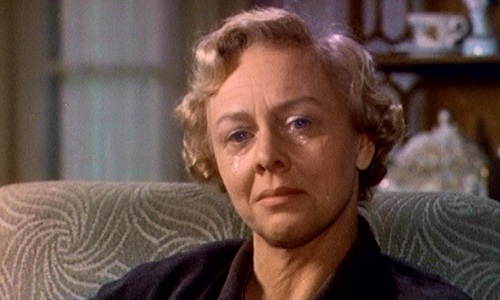
Nominated: Grayson Hall, as the self-hating Sapphic chaperone and geyser of anger in The Night of the Iguana

What I Thought: Hall is even more transfixing than the iguana, and almost more than Ava Gardner caressing shirtless houseboys in the moonlit surf. She's the first coming of Grace Zabriskie. I'm impressed her presence didn't get staler, given how the script keeps on forcing her through the same scene: approach neurotically, throw tantrum, swear revenge, repeat. Sadly, she short-changes the semi-repressed cravings that define the character.

Why Not Instead: Louise Latham in Marnie, who gives a master class in how to telegraph asphyxiated desires and make an instantly perverse impression while still flipping nimbly through every page of the character's highly compromised biography. She's as drily, tensely, indelibly quasi-maternal as Hall is, only she actually is the mother in question. Bonus points: equally bad hair!
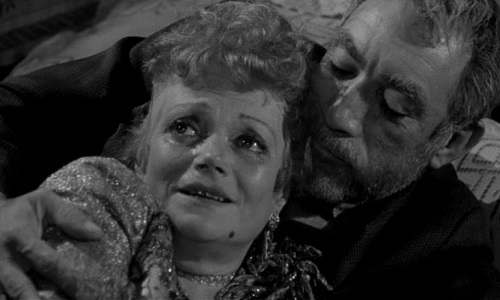

Nominated: Lila Kedrova, the deserving winner, as the nostalgic hotelier, voluptuous but tremulous, in Zorba the Greek

What I Thought: I object to the role, which forces its interpreter through serial stereotypes: the delusional coquette, the gaudy epicurean, the whimpering toddler in an aging courtesan's body. Kedrova leans into some of these clichés, mugging with her face and body, limiting the impact of her sorry fate when it (inevitably) comes. But she works with what she's got, livening up this weirdly self-serious travelogue picture.

Why Not Instead: Irina Demick in The Visit, who's got a tough row to hoe in this allegory of mercenary money-hunger and human brutishness, another European movie with a motley cast. She anchors her own B–plot as a somewhat self-deceiving adulteress while busily crossing and re-crossing the film's vision of Moral Lines. She, too, has a funny ak-sahnt but she acts with greater candor and less forcing of effect.
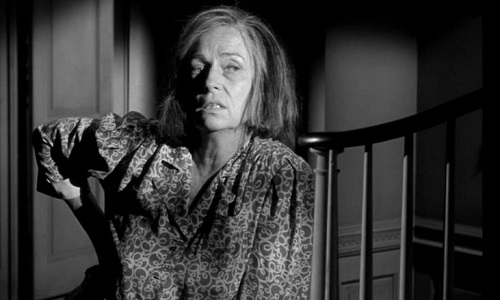
Nominated: National treasure Agnes Moorehead, entering the Kitsch Hall of Fame as the servant in Hush...Hush, Sweet Charlotte

What I Thought: Charlotte should be delicious but instead it tars everyone involved, giving them too little (Astor) or goading them to vandalize their talents (Davis). De Havilland proves you can enjoy yourself without sacrificing dignity. Hopefully Moorehead at least had fun. She’s a kick to watch, appears to recognize what claptrap she's in, and overacts as only a great actor could. But an Oscar, for cartooning?

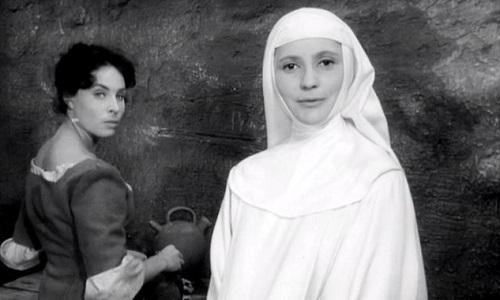
Why Not Instead: Anna Ciepielewska, that household name, who keeps the audience guessing throughout the classic demon-possession drama Mother Joan of the Angels, a 1961 film that appeared on Oscar's eligibility list for 1964. Is Sister Małgorzata, forever running errands for the convent, the only nun who has resisted Satan's call? Or is she baiting the locals into trusting her, all the better to seduce and snare them? It's a carefully balanced turn even in an equally gonzo but more earnest high-Gothic environment than Charlotte's.


What's that, Oscar? Still not biting? That's weird, but I'll give you one more shot to mend your ways. With less pressure to ape your own wonky template, what about this ballot?

Julie Christie, who's not exactly breaking the mold of the opaque, bewitching Mystery Girl in Billy Liar (another film belatedly eligible for Oscar in 1964) but who makes a remarkable impression given the limits of the role, suggesting for the first time in her glorious career how gifted she'll be at implying a lot but specifying little beneath her characters' pearlescent surfaces. She even manages to imply that Liz is just eccentric enough, or maybe just sympathetic enough, to be an appealing partner for Tom Courtenay's Billy, without implying they're likely to wind up together. Certainly, Supporting Actress nods have gone to bigger ciphers, less deftly and appealingly etched than this one.
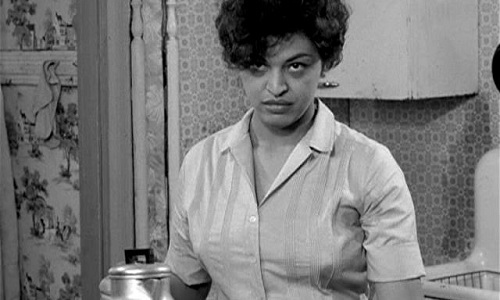
Gloria Foster, future Oracle of the first Matrix movie, who blows pretty much everyone on this page out of the water in a few sequences of the groundbreaking African-American drama Nothing But a Man, playing the steel-spined wife of the protagonist's distant and morbidly alcoholic father. Is Lee an enabler, or a voice of hard truth to both father and son? In Foster's wizardly hands, with incredible, unfussy directness, the answer is both. What are her feelings, exactly, for Ivan Dixon's Duff? Everything Foster does, every way she is, seems to inform Duff's revised approach to his own bond with Abbey Lincoln's Josie (wondeful), but the actress is enigmatic enough that we're not quite sure what Duff is learning from Lee. I craved a sequel, though in truth I would have followed any of these characters into their own movie. Rent it.
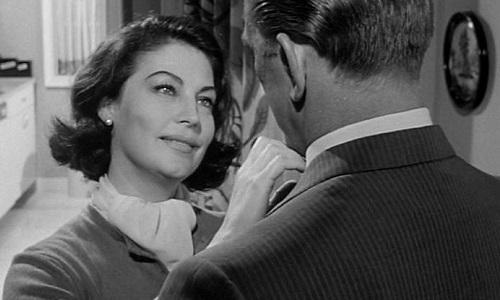
Ava Gardner, who twice over seemed within striking distance of her second career nomination in 1964. She's a famously relaxed and effectively sensual presence in The Night of the Iguana, where she might have confused voters by straddling the lead-supporting line. Hall got nominated instead, as did Edmond O'Brien for John Frankenheimer's paranoid military thriller Seven Days in May, where Gardner effectively has the Kim Basinger part: the serene but plot-crucial female role in a big manly ensemble. She aces it, particularly in an extended rencontre with Kirk Douglas. He's in her apartment on false pretenses, but Gardner adds so much poignancy and layering to the sequence beyond its narrative import. What a year.

Speaking of people who barely missed, Irene Papas, who's at least as striking a presence as Kedrova in Zorba the Greek and figured importantly in several films AMPAS and critics' groups recognized across a decade, from Electra to Z to The Trojan Women, without ever scoring an Oscar nod for herself. I tend to dislike parts like the Widow in Zorba, a sort of unexplored placard for The Suffering of Women in Foreign Cultures, but Papas individualizes this nameless character. Cacoyannis and Lassally often get lured into filming Papas's face, dress, and body for graphic impact rather than character-revealing detail, but she still cuts through their aestheticizing visual schemes. (And if we're fishing around for international talents, borderline-lead Gunnel Lindblom in Bergman's The Silence was also eligible in 1964.)
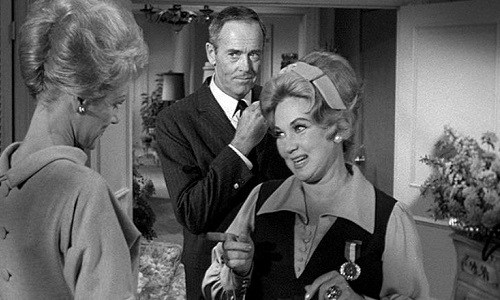
Ann Sothern, who scored a Golden Globe mention for her busybody lobbyist in Gore Vidal's political pressure-cooker The Best Man. Sothern mostly recedes after making a big early impression, and maybe she goes with the slightly misogynist vein of the part, which understands women and women's investments in politics in a pretty narrow way. But Sothern gives Sue Ellen Gamadge potency, ferocity, and a gift for turn-on-a-dime public pretense, which is more than was asked of her in her belated nomination for 1987's The Whales of August. Note: this part was assayed recently on Broadway by Supporting Actress perennial Angela Lansbury and in an earlier Broadway production by Elizabeth Ashley. Along with Sothern, Ashley was the other 1964 Golden Globe nominee dropped for Oscar's ballot. She's not one of The Carpetbaggers's many, many problems, but I think my work here is done... beyond exhorting you to contribute your own suggestions below!

Labels: , , , , , , , , , , ,

Thursday, August 15, 2013

Hit Me With Your Best Shot: The Color Purple


I read Alice Walker's The Color Purple for the first time in the backseat of a car during Spring Break of my junior year of high school, while my parents drove me from Virginia to New Jersey to start looking at colleges.  I would say, "By the end of the book I was audibly crying," except that would imply I wasn't already crying at several earlier stages.  As soon as I finished the book, I read it again, and then I read Damage by Josephine Hart (!), and then Girl, Interrupted by Susanna Kaysen, and then The Color Purple again, and I cried again.  After well over a thousand miles of driving up and down and around the northeast (thanks, Mom and Dad!), I had a new favorite novel.  The cheap, tan, pulpy paper became somewhat damp from the stickiness of car travel and the saltiness of teenaged tears.  You can still make out the giveaway waviness in a few pages of my copy, which I bought for that trip in 1994 and still keep in my office.

The image above might be my favorite from the film, not remotely dulled for me by its ubiquitous reproductions (in slightly stylized form) as the poster image for the movie and the cover art for my paperback.  There is so much here: an elegantly simple device to communicate the passage of time; a distinctive but unfilled outline, heralding the imminent arrival within the frame of a new, debuting, but instantly iconic actress; a gesture to the Old Southern art of cut-paper silhouettes, evoked as gently here as it is brutally, dazzlingly reprised in the art of Kara Walker; an echo of prior images when Celie's and Nettie's candlelit shadows played pat-a-cake on two walls of a bedroom, such that we instantly grasp adult Celie's Bible and other books as her next-best-thing substitute for a vanished and deeply-missed sister; the rough, milled texture of the wallpaper, connoting the texture of those pages Celie is turning; and an indelible, two-ply image of reading itself as both a lonely activity and a life-saving rescue.  The low contrast and other qualities of the light here make the image unmistakably sad, even if you don't know the context.  At the same time, the shot is just warm enough—softer and more tender than the harsh, lapidary colors sneaking through the curtains at left—that you also sense the intimacy of the scene.  You'd imagine that, having read five books during a week of car travel, or three books a total of five times, that I must not have been much of a talker.  In fact I was, especially with my equally garrulous parents, but they knew I loved to read and had no problem leaving me to it even in the tight space of a four-door.  What they thought about hearing me cry with my nose in a novel I have no idea; I can't remember if I talked to them about what I was reading.  But I do recall, with fondness and wistfulness, that sense of feeling totally alone when I was reading, even when the people I loved most in the world were eighteen inches away.  This shot is a perfect index for that kind of feeling.  "I'd like to thank everyone in this book for coming," Alice Walker writes on her never-bettered dedication page, and for hours of reading The Color Purple, Celie and Mister and Shug and Nettie and Sofia and Squeak and the rest were the only people I recognized around me.

Read more »

Labels: , , , , , , , ,

Wednesday, October 03, 2012

The Fifties for 2012: Best Supporting Actress

Some more great acting from the earlier part of the year.  My fifth choice involves a role so modest  that neither the film's publicity materials, its trailer, nor the long arm of Google Image furnishes a single shot of the actress in character.  In truth, she's already lost her spot to a performance I've subsequently seen from this year, but all the more reason to celebrate this selfless turn!


Best Supporting Actress
Carmen Ejogo for Sparkle, for reinvesting such nuance, glamor, and depth in the stock role of the swishy-hipped fallen angel, and for that dinner-table confrontation;

Louise Harris for The Snowtown Murders, for shading this unnerving, heartbreaking turn as a blind-eyed mom with expert skill, while maintaining an amateur's unfakeable transparency;

Diane Kruger for Farewell, My Queen, for giving this charismatic queen a reflex narcissism that's barely conscious of itself, while endowing her, too, with an astonishing delicacy;

Noémie Lvovsky for Farewell, My Queen, for her subtleties in the semi-backgrounded mezzo role of the lady in waiting, making her as fascinating as the women she summons or attends; and

Elizabeth Marvel for The Bourne Legacy, for her invaluable role in one of those ambiguously sinister encounters at which this film excels, cutting through the scene like dark glass.

Honorable mentions do not, for the record, include Anne Hathaway in The Dark Knight Rises, Amy Adams in The Master, Sarah Silverman in Take This Waltz, or Samantha Morton in Cosmopolis, all of whom attracted their passionate devotees.  I found the first two intriguing but inconsistent, never dispelling my sense of the laudably ambitious performers being miscast; the other two make an impression without, by my count, having all that much to do.  This hasn't been a banner category so far this year, which might make the Oscars interesting.  I quite liked Rachel Weisz in The Bourne Legacy, balancing the game and the haughty sides of her persona better than most of her roles since Constant Gardener. I wanted to spend more time with her, as I did the bayou teacher and the ambivalent birthday girl that Gina Montana and Kjærsti Odden Skjeldal sketch so briefly but memorably in Beasts of the Southern Wild and Oslo, August 31st, respectively. MyAnna Buring sure made the most of a potentially abrasive or unmemorable part in Kill List. In a different generic universe, the uproarious Kathryn Hahn and Michaela Watkins are magicians with their punchline characters in Wanderlust.  One of those ladies would qualify here with just another showcase scene or a slightly elevated degree of difficulty.

Labels: , ,

Monday, July 11, 2011

Cannes 1986: Directors' Fortnight


Note that in the still image from Denys Arcand's The Decline of the American Empire, the image makes a democratic attempt to include as many people as possible but without any sense of a real perspective: symptoms of financial comfort aside, this could be almost anyone, talking about almost anything, in a musical, a comedy, an over-lit drama, a sitcom, or a miniseries. Note that in the image from She's Gotta Have It, composed with a bit more visual flair, the woman is technically in the foreground, but the focus is clearer on the man lying on the other side of her, and the lighting calls your attention to him, too. I would suggest these images and their implications as pretty good stand-ins for their films, which were early, much-ballyhooed breakouts of the Directors' Fortnight section of the 1986 Cannes Film Festival. I've reviewed Denys Arcand's epic chatfest here and Spike Lee's fetching and appealingly rough-edged debut here. Let me know your thoughts!

Labels: , , , , , , ,

Sunday, October 18, 2009

CIFF 09: Precious

(NOTE: Review has been revised and, if you can believe it, expanded.)

Since I've been away for two days from regular, review-based festival coverage—busy, I don't mind saying, submitting a dossier of 400+ pages of new writing and teaching materials to ensure the security of my job for the next three years—I figured I needed to come back full swing to keep you hooked on this CIFF material. So what better time to reveal the one exception I made to my general rule of avoiding the marquee presentations of imminent commercial releases? Even if I'm at least as excited about the possibilities of Antichrist, playing elsewhere in the festival lineup, and of Where the Wild Things Are, which I'm dutifully skipping till the festival is over, there was no way anyone was keeping me away from Precious. At this point the film needs no introduction, though my review merits the forewarning that it's one of my longer pieces. Possible spoilers along the way, unless you've already been inundated with coverage about the film, which has tended to speak pretty liberally about its structure and key scenarios. I like the film but couldn't quite love it; as engrossed as I was, I had qualms about the terms on which my fascination and even my sympathy were being elicited. I'll hope to be hearing from you in the Comments, even after the movie rolls out for its hugely hyped commercial release.

Precious played two dates at the Festival, including the Centerpiece Gala where Lee Daniels and Gabourey Sidibe won awards for artistic achievement. The film opens commercially in the U.S. on Fri, 11/6.

Labels: , , ,

Thursday, September 24, 2009

Start the Car, I Know a Whoopee Spot


Where the city's cold, but cinema is hot! With the ticket counters opening and the new website premiering yesterday for the Chicago International Film Festival, we have officially arrived at one of my favorite periods of the year, and certainly the month when I am happiest to be a Chicagoan. Sure, I still dream one day of making it to Toronto, Telluride, or one of the European festivals, but the CIFF is a bonafide cornucopia and deserves much wider recognition than it gets. Then again, part of why its profile remains a little lower than those of some other festivals is that this one isn't a sales market and, despite wonderful Gala Presentations where I've met the likes of Laura Linney in the past, it doesn't host a lot of flashbulby premieres. What CIFF willingly forgoes in global press scoops it gains back tenfold in the privilege it gives to average moviegoers to enjoy the films, afford the tickets, and hobnob much more closely with visiting filmmakers than it's possible to do at a Toronto or a Cannes, with their phalaxes of studio scouts and frenzied, hierarchalized reporters.

This year's special guests will include Career Achievement Award winner Uma Thurman and her most recent director Katherine Dieckmann, Precious helmer and Artistic Achievement Award winner Lee Daniels, the same film's Breakthrough Performance honoree Gabourey Sidibe, plus Willem Dafoe, Lone Scherfig, Martin Landau (proving that the much-hyped but distro-seeking Lovely, Still still exists!), Virginia Madsen and her Emmy-winning mother Elaine, Ben Foster, Oren Moverman, John Woo, and Patrice Chéreau. Cinephiliac celeb-spotters could do a lot worse, and Special Presentations of The Yellow Handkerchief (from the where's-he-been director of My Son, the Fanatic) and of the Tennessee Williams-scripted and Bryce Dallas Howard-starring The Loss of a Teardrop Diamond, directed by Safe ensemble member Jodie Markell, are promising guest visits without naming names. (A hint: it's probably not Tennessee Williams.)

Of course, the emphasis remains deservedly on the movies, and I've already bought tickets to a baker's dozen, being as scrupulous as I can to avoid imminent commercial releases, even the one's I'm dying to see. I fully expect to buy plenty more, particularly for movies from Iran, Mexico, Taiwan, the UK, Ireland, Israel, Chile, Syria, Australia, South Korea, France, Switzerland, Italy, the USA, and the Philippines that are unlikely to sell out, even though that Filipino entry, The 'Thank You' Girls (pictured left), is free one night if you show up in drag.

Of course, life always intervenes to dictate that I see slightly less than I intend, and my attendance last year got cut short by my sublime trip to the concurrent London Film Festival. Still, with only two days to enjoy last year's offerings, I filed early, elated reviews of Julia and Ballast, both of which surfaced on my year-end Top Ten list, which is surely the most you can ask of two days at the movies. The year before, I got my first looks at 4 Months, 3 Weeks, and 2 Days, Taxi to the Dark Side, Yella, Silent Light, and Flight of the Red Balloon and told you at length everything to love and occasionally not to love about Michael Clayton, Hallam Foe (later released Stateside as Mister Foe), Stuck, Control, the since-unseen Mohsen Makhmalbaf film Scream of the Ants, and the entrancing Argentine dystopian comedy The Aerial/La Antena (pictured left), which scored two citations in my annual awards that year.

I can't say it more clearly: attend this festival, if you're anywhere near the Windy City. Where the Wild Things Are, New York, I Love You, and, God help us, Couples Retreat will all still be waiting for you after the two-week event wraps on October 22. Meanwhile, eye this space for CIFF09 dispatches, starting October 8!

Labels: , , , , , ,

Friday, September 11, 2009

I Can't Do Friday All By Myself...


...so I decided to ease into it with Tyler Perry and his bumptious, earnest, patchy, draggy, and sort of wonderful I Can Do Bad All By Myself, which admittedly makes all kinds of disappointing choices in editing, story structure, match cutting, and character profiling. (We get it - he's perfect, and he's terrible!) There's nothing in the movie to resemble the pleasingly graceful camera movements in last fall's sudsy but delicious Tyler Perry's The Family that Preys, or the impressively pared-down directness of Perry's own performance in that joint, or the consummate candor and luminosity of Alfre Woodard's performance, especially in close-up.

But I'll tell you, I Can Do Bad... still makes for a great kickoff to the weekend. Every critic has got at least a couple of genres that they are willing to indulge, and if you're going to throw this much sisterly charisma and bracing music on the screen, I am going to enjoy myself, even more than during the belly laughs Madea sometimes gets from me when she's threatening to shank some kids. I was hoping that the opening, big-'fro run-through of Aretha's "Rock Steady" really was sung by Taraji P. Henson, who works that multi-threat, Toni Collette-style, funny and crafty and oversized and sympathetic groove in movie after movie (though I think she got Oscar-nommed for one of her weakest performances). Turns out that's steadfast R&B/gospel trouper Cheryl Pepsii Riley doing the actress's vocals, but Henson still lip-synchs the smack out of 'em, and it's a great opening for a movie that gives her plenty of chances to delight in small ways, even if it never goes for broke by really cutting her loose, comically, musically, or emotionally.

Henson was a big enticement behind my purchase of this ticket (she was great in a second-tier role in Family that Preys), but you usually have to pay more than $6 to get two full-length stage recitals apiece from the legendary Gladys Knight and the legend-to-be Mary J. Blige. Knight, in her modest, controlled, but forceful way, tears up a sort of secular spiritual bit called "The Need to Be," and though I wasn't taken with the title number that gets somewhat obligatorily foisted on Blige, watching this woman sing is as electrifying as listening to her. Her whole body becomes this wild muscle, flexing 101% conviction in every phrase of every song. Her sign-off rendition of her own hit "Good Woman Down" is so thumping and kinetic (the stylish turquoise dress doesn't hurt), that she almost literally blows Henson off the stage and makes you wonder if she hasn't earned the lead role in the next Perry production. In future years, we'll be as happy to have Blige recorded on film, doing her magical thing, as we are having Lena Horne and Billie Holliday tucked away into sublime corners of their occasionally lackluster vehicles.

I Can Do Bad All by Myself is, finally, a middling movie, but Perry's protracted attention to these and other musical performances varies the rhythm and dials up the emotional intensity of the film to its incontestable peaks. I stopped even minding about the gratuitous and klutzy flashbacks, which raise questions like, who brings a bag of groceries to work? Meanwhile, the other lead story that ought to grow out of this frustratingly uneven but easily enjoyable soap is the commanding performance by Hope Olaide Wilson as a 16-year-old with a barbed-wire attitude and a tough row to hoe. You can sometimes see Wilson wishing that Perry and her other co-stars would rein things in a little and treat the material as frankly as she's doing, but she isn't being a drama queen. It's a forceful and honest performance, sailing over the hurdle of how to hold our attention and our empathy despite being so sour for almost the full 113-minute running time. Complexions aside, she's a dead ringer for Anna Paquin, and I hope she gets the same kind of professional nurturing and career opportunities.

And speaking of careers, I've already been peppier and more productive this afternoon by having started my Friday with a party instead of ending it with one. Thanks, Tyler, and thank you, ladies! Praise God for long but flexible hours, and TGIF, everybody.

Labels: , ,

Monday, August 24, 2009

Films of the 00s: Ali

My first retrospective trip back to the movies of 2001 is another conversation review with Mainly Movies, this time devoted to Michael Mann's idiosyncratic and commercially underperforming bio-epic Ali. No question the movie is internally inconsistent in style, rhythm, and emphasis, but I couldn't help noticing that Ali was often invoked with embarrassment if not outright derogation in recent reviews of Public Enemies, and having admired the movie tremendously during its commercial run even as I struggled a bit to grasp what Mann was up to, I've been eager for a long while to revisit the movie and stick up for its intelligence and its unusual ambitions. I can see why Tim feels that the movie "has more flow than shape," and I have a few misgivings of my own (and a few more that, as ever, I didn't find time to err in this space), but we both still respect the movie tremendously, with perhaps a bit more visceral enthusiasm on my part. Have a look, and tell us what you think.

Labels: , ,

Friday, July 17, 2009

Films of the 00s: Bamboozled

Delivered with admiration in this centennial year of the NAACP!

"Four score and seven years ago... they was kickin' our black asses!" So begins one of Honeycutt's embarrassing but inspired comic riffs as the host of Man-Tan: The New Millennium Minstrel Show, the ghastly revue at the center of Bamboozled's estimable storm. I wish that my returning buddy Tim and I had found room to pay more tribute to how funny Bamboozled can be when it wants to be, how the Man-Tan show actually operates, and what tertiary figures like Honeycutt or his near-doppelganger, the protagonist's wreck of a father, bring to the proceedings. But there's only so long that we can bend your ear, and almost everything in the dizzying, maddening, electrifying Bamboozled invites heaps of conflicted commentary. I tried my best in my initial review, written nine years ago in graduate school, but I got more out of my new confab with Tim. We start with our memories of seeing the film for the first time:

TR: "Bamboozled...was one of the first films I reviewed for the Telegraph where I really wanted a lot more space. It was released in the UK in April 2001, a few months after I started the job, and I remember coming out of the screening buzzing, and with my thoughts pulling in all sorts of different directions. Because the movie already had the whiff of commercial pariah about it, this wasn't to be a lead review, and I knew I had a tough job on my hands communicating how this fascinating mess was actually to be recommended in fewer than 300 words: the flaws were manifest, the underlying intelligence, scalding and confrontational as it is, needed some careful argument to disinter...."

ND: "As far as I'm concerned, in the year 2000, I saw Bamboozled in a racially segregated, semi-concealed theater, and it only showed once per night, and I was the only patron there. Hence my sharp and bitter sense, during that first screening, that Lee was shooting grenades at vicious, longstanding American problems that powerfully persist, albeit under different guises...."

From there, we have plenty to say about the film's ceaseless self-divisions, the wavering targets and cogencies of its satire, the parts that work best, the parts that don't work at all, what do with the ending, and what is finally most important to emphasize about such a confoundingly sloppy-smart film. Again, there are entire shelves, whole aisles of cans of worms that we couldn't open. But the conversation isn't over yet! - as always, we hope you'll enjoy the whole piece and share your thoughts in the Comments field.

(By the way, as any Chicagoan who keeps track of how AMC plays the downtown 600 Michigan Ave complex against the nearby and much more deluxe Rivers East multiplex can tell you, the practices of quietly segregated booking are not gone, and not absent even in major cities. Look, too, at this article, linked yesterday by Nathaniel, about current distribution problems facing the Sophie Okonedo vehicle Skin in the UK and certainly, though the article doesn't reach this far, in the US.)

Earlier in this series: Mission to Mars, The Beach (with Tim), Dôlè, La Captive, American Psycho, and Wonder Boys

Labels: , ,

Thursday, July 09, 2009

Films of the 00s: Dôlè

Judging from the comments (what comments?), this retrospective series about buried gems and split decisions from the last ten years is more fun for me to write than for you to read, but what can I tell you. I like it, and I'm learning a lot, as I certainly did in my first encounter with Dôlè, a Gabonese film from 2000 that had been pitched to me in the past, somewhat maladroitly it turns out, as a West African Boyz N the Hood. That's tall praise and there's a nugget of merit behind it even if I don't think the comparison really holds. Still, while Dôlè isn't a slam-dunk, it's an engaging and a visually accomplished 79 minutes, which certainly eclipses lots of better-marketed movies that have some comparable inspirations at heart. To wit:

"A Slumdog Millionaire nearly ten years avant la Boyle, this shortish Gabonese feature has the good sense to avoid either the chirpy fructification of poverty as entertainment or the sensationalizing of grisly violence as an entrée into the life of some dream-deferred youths. School kid Mougler (David Nguema Nkoghe) wants to get in on the hip-hop game with his pals, especially lead emcee Baby Lee (Emile Mepango Matala), who sports a Fugees T-shirt while he rehearses the French-language lyrics of his favorite artists and chastises his buddies for mucking up their parts. It would be easier to hold the rhythm and master the words if these kids had a radio, which they still refer to as a 'ghetto blaster,' a few years after you stopped hearing that term quite so much in the American streets. Despite the likelihood that huge swaths of Dôlè's audience won't ever have seen a Gabonese film, or perhaps any West African film or any images of Gabon or Libreville at all, writer-director Imunga Ivanga isn't interested in the kind of social cross-section that would contextualize where and how and in relation to whom these kids live, to include whether they have their own 'ghetto' to blast. It doesn't quite look it, but unlike Boyle, Ivanga associates the frustration of have-nots with a series of sharply coded rules, fantasies, and assumptions, not with grabby emblems of abjection or televised deliverance..." (keep reading...)

Like a lot of African films, especially those without the auteurist pull of a Sembene or a Mambéty imprimatur, Dôlè is distributed in rentable, projectable, and purchasable formats by California Newsreel, which deserves all the thanks and the dollars it can get. Encourage your local or university library to buy it and then check it out.

Labels: , , ,

Saturday, November 29, 2008

As I Lay Thanking


I'm in an infinitely better place than these women—click on the photo if you want to know why—but still, it must be said: I've had a frustratingly flu-like cold since Tuesday, right through Thanksgiving, so at any given moment that I wasn't calling a family member or cooking a holiday dish, I've mostly been splayed out on my red futon, trying to let the seasonal tide of gratitude and life-loving overcome my incipient grouchiness about my raspy throat and my upset stomach. Unable to complete any professional tasks, I tried to think of something lovely I could produce for this site—often a delightful restorative when I'm in low spirits or ill health, even if this tends to make my sentences even longer and my number of typos even more disheartening. And I thought, while I'm feeling so thankful and full-stomached, why not revive my very favorite of my dormant writing projects? Why not seize upon this time to transcribe my feelings of gratitude toward movies I especially adore?


A few of you have noticed that, three years after I began the Favorites countdown, and almost two years after slamming into a brick wall at #34, I've gone back to clean up the graphics, fix some links, and most importantly, rearrange the lists to reflect that it's a new day. Cuz you know some movies I like a bit less than I did three years ago, and some a lot more (which I sometimes only realized by re-watching them for this feature), and some didn't even exist when I started this project, so ghastly has my procrastination been. Here are the old entries for the ten films that dropped off my list when I revised it two months ago. The recalibrated list still has some gaps where new movies will debut to replace the retired ones, or where movies scheduled to drop from my revised Top 100 list (coming in January!) are resurfacing instead on the mutually-exclusive Favorites listing, or where formerly high-ranked Favorites from '05 have slipped to lower rungs. The current and forthcoming #68, for example, would have been #33 when I last checked in, and my purely gratuitous list-maker's panic in the face of this obvious travesty ("But I don't like this more than Bram Stoker's Dracula, I don't!!!") partly explains why it took me so long to resume.


Anyway: such are the holes I'm filling now with new entries, and LOOK: I've got four of 'em already! And what a combo, right? Click on the images, please enjoy, and I hope you all had a terrific Thanksgiving, whether or not you live someplace where it made any sense to celebrate it.

Labels: , , , , , , , ,

Tuesday, December 25, 2007

Merry Xmas, and Stop Smiling!

Not as contradictory as it sounds. I do wish you a Merry Christmas, gleefully, sincerely, quickly, and somewhat exhaustedly, after all the baking I did last night and all the essay-writing (seriously!) I'm having to do this morning, in advance of my annual professional party. (At least writing this paper has involved sustained attention to two delicious movies.)

Speaking of delicious movies, and in the spirit of gift-giving, the best cinematic stocking-stuffer of the year is absolutely the elegant and richly outfitted Charles Burnett Collection from Milestone Video, centered around the seminal and at-long-last-available Killer of Sheep. As you probably know, after 30 years in a limbo of non-exhibition, the 30-year-old Killer finally bowed on commercial screens in the late spring. I was wowed by the movie in August, when it arrived to Chicago's Music Box Theatre and have been even more deeply wowed after two further revisits. After some hemming and hawing, I have elected not to include the movie in my upcoming Top Ten List and year-end awards, since I experienced all those #1 spots for Army of Shadows last year to be something of a cop-out. But, still pending There Will Be Blood, Persepolis and eight other (read: less auspicious) theatrical releases, Killer of Sheep does look to me like the movie of the year. My ongoing friendly relations with Stop Smiling Magazine allowed me to publish this online review, which I hope you'll enjoy...on or after today's joyeux noël. More from me before year's end!

Labels: , , , ,

Saturday, January 20, 2007

Still Not Smiling

My kindest benefactors on the web, over at Stop Smiling Magazine, have given me yet another forum to sing the praises of a stunning DVD, this time for When the Levees Broke: A Requiem in Four Acts, Spike Lee's 4-hour documentary on the flooding of New Orleans and its nearly apocalyptic aftermath for so many residents of that city. Levees actually expands as a nearly 6-hour film on the DVD, and once you've gotten started, you really shouldn't stop; the exclusive 105 minutes of previously trimmed material is actually some of Lee's best, correcting for some of the main feature's tendency to muffle its critique of Mayor Ray Nagin. The whole work, whatever its flaws or self-imposed limitations, is prodigious, detailed, expansive, and important in a way that precious few films in 2006 were, and despite appearing on HBO, it's certainly making an active end-run for my Top Ten List.

Meanwhile, speaking of lists, and of earlier benefactors, my comrades over at Cinemarati, a terrific consortium of web-based critics to which I belonged from 2002-2005, has commenced their annual counting-down of the year's best movies. So far, we have gotten the party started with Nathaniel's eloquent summary of the virtues of Volver (which I'd imagined would place a little higher); at #19, Michael Dequina is dazzled by Dreamgirls; and at #18, my old college chum Lynn Lee directs our attention to A Scanner Darkly, a nervy midyear offering that deserved a better shot than the major, Car-prone and penguin-happy critics' groups afforded it. Cinemarati has a wide-ranging membership of amateur and professional critics with enormously different tastes, so expect an interesting list, and forage around the rest of the blog and the individual members' sites while you're at it.

Labels: ,