Friday, May 22, 2015

Cannes 1995: Day 6: May 22


Land and Freedom, UK, dir. Ken Loach

And now we're finally talking. Ken Loach and Hou Hsiao-hsien serve up the meatiest, chewiest Palme contenders so far, and without pushing too far outside their stylistic comfort zones, they make some of the most forceful work in either of their filmographies. Regrettable, maybe, that Kids stole a lot of the media attention, but in the context of Cannes, it proved something less of a sensation than its makers and distributors might have hoped. Meanwhile, Chris Newby premiered some British cinema as dissimilar as you could imagine to Land and Freedom, except perhaps in its ethic of unanticipated affinities and identifications across difference, and Iranian master Mohsen Makhmalbaf furnished one of the most austere but committed of several films overtly commemorating the 100th anniversary of the medium...

Read more »

Labels: , , , , , , , ,

Tuesday, January 20, 2015

Top 10 U.S. Releases of 2014


Click here for some context on this list, or here for its companion list.

Stay tuned for #1-#7!  In the meantime...

8. The Missing Picture Especially compared to the two films further down this list, Rithy Panh's The Missing Picture inspired no controversy at all—except, perhaps, on the question of when exactly it opened. A tiny commercial bow was planned late last year for LA, though evidence suggests no ticket-buyer saw it until last March. Such are the vortices of minutiae into which a Top 10 list gets pulled, when the point is to showcase artistry as keen, inventive, and affecting as Panh's, narrating his country's and his family's experience of the Khmer Rouge takeover of Cambodia in the 1970s. Forsaking a talking-head approach to history, Panh assembles an eclectic archive of stock footage, movie clips, superimpositions, and abstract sound elements that testify to the unstable, prismatic qualities of public and personal history, even as his soft-spoken account of genocide and systemic oppression evokes the stubborn, harrowing factuality of the past. Famously anchoring the film's mix of styles and source materials are Panh's handmade dioramas of Cambodians usurped, imprisoned, indentured, and buried. Watching the film again for the first time since TIFF 2013, I realize how many times I've misremembered these wood-carved villagers as clay sculptures: they're as poignantly expressive as stop-motion figures, as palpably stamped with their creator's doting attention, to such an extent I conflated the two. Whittling and painting them by the dozens—suggesting a mass-production of bodies, but evading tyrannical-conformist connotations by subtly humanizing each doll—Panh tells a gruesome history in terms that he and his audience can bear. Still, The Missing Picture remains, of course, a deeply sobering experience. You could see it as a document of traumatic repetition: not just of immersion in an intolerable history but of daily, painstaking labor that simultaneously puts the past to sleep and wakes it back up. The viewer gets enfolded in a similar ambivalence: you'd love for the man and the country to be able to forget, but you also recognize the necessity of never forgetting how a nation of people were stripped of every individual possession but their spoons; how 250 grams of rice somehow fed 25 people per day; how a nine-year-old boy reported his starving mother for stealing a mango in a field; how the regime's oddly poetic prohibition on poetry ("the spade is your only pen, the rice field your only paper!") unwittingly inspires painful, poetic reflection among those few who survive. Through the titular, oft-repeated conceit of the "missing picture," Panh asserts that despite his film's expressive diversity, notwithstanding every photo and figurine and audio collage, this period in Cambodia's past is defined by what nobody can show. The kernel of history remains out of reach and surpasseth understanding. The Missing Picture may in that sense be a film structured around an omission, but look how beautifully and bravely it struggles to fill that gap.

9. American Sniper You know what Clint Eastwood's movie about the "most lethal sniper in American history" lacks even one of? A single scene where Chris Kyle embraces that tag. Every time someone tries to print the legend to his face, he opts for non sequiturs, quick subject-changes, or J.M.W. Turner-esque grunts.  Clearly, the film has roundly reimagined Kyle from his real-life namesake, who seemed only too proud to trumpet and embellish that mythological reputation, for reasons that invite a separate inquiry. Just as clearly, the film's Chris Kyle—an utterly coherent characterization of its own, more challenging to hawks or doves than the real Kyle was—is caught within a vertiginous experience that his own legend does nothing to ease or elucidate. Nationalistic, mission-oriented, smart, dim, haunted, gruff, focused, arrogant, repeatedly humbled, empowered and chilled by a red-meat upbringing, prone to racist word and deed, prone to selfless thought and act, capable of moral reflection but seemingly uneasy with it, capable of giving and receiving and reneging on love, Chris emits a plethora of contradictory attitudes and positions. Sniper never reduces these, even as its hurtling momentum, its inductive approach to character, and the exigencies of battle preclude it from flaunting its own complexity or apologizing for its compromises. "It's a hell of a thing, killin' a man," William Munny apostrophized in Eastwood's grim and heavily lacquered Unforgiven, an accomplished film that foregrounded its own rhetoric; it anticipated and even wooed an audience of artistically inclined revisionists, assuring us that it grasped its moral paradox, that it felt the clamp of guilt. American Sniper, faster, brighter, bloodier, and lodged inside contemporary quagmires, radiates a similar but less articulated moral despair.  Its agonies are expressed everywhere from the arrogant, overwhelming roars of American warcraft to the utterly un-rousing score to the sickening, raspberry blasts of blood that accompany every kill. It neither characterizes a single Iraqi in depth nor presses very far into most of its American characters nor shows almost any Iraqi (with one Guignol, discordant exception) doing anything I wouldn't imagine an American doing in the reverse position... if we can even imagine ourselves in the reversed position. Sniper's reception suggests that many pro- and anti-war audiences and critics expect films on this subject to come right out and flatter them in undiluted terms. This film doesn't do that.  Exceptionally well-made, well-shot, well-mixed, and with a tension in the cutting that few Eastwood movies and few modern war films have achieved, American Sniper is as cinematically deft as it is culturally divisive.  Op/eds and awards pundits keep trying to spin it as the anti-Selma.  I look at the pair of them, one an exhortation for justice and the other a hydrochloric assault on ethical conviction—one a study of a group challenging The System, the other a study of a man who, for better and worse, subsumed himself to a system—and I think these two Best Picture nominees are the two bravest, and the two most worth saving.  In serious terms, with both feet planted in the real world, they showcase complex men and communities that too few movies ask us to consider, much less to assess in such rounded, inspiring, but discomfiting ways.  Which, speaking of...

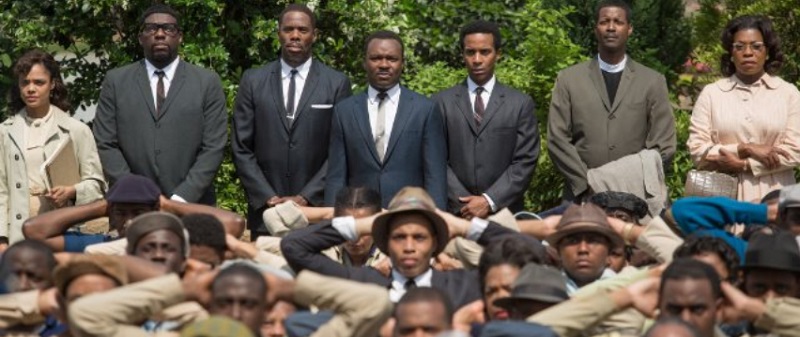
10. Selma A great tweeter called @DanBlackroyd came up with these apt words, angry but beautiful and totally on-point, following that notoriously low tally of Oscar nods: "Selma will be written about for years to come. Its legacy is intact. The Academy needed Selma way more than the other way around. Trust." He's so right. But if you wanted to parse the thought differently, part of why the Academy needs this movie, and why this movie merits more awards, is that it's the rare film that unabashedly needs us—that reaches for us and involves us. It's not the kind of historical drama that unfolds behind plate glass.  Beyond its epic yet intimate staging of events in the mid 1960s (superlative), beyond its close but woeful presaging of events in the mid 2010s (urgent and humbling), observe the consummate engineering of the film. Its broadest arc moves from an opening, monolithic close-up on one man to a closing, diamantine montage of thousands. It pivots on sequences like the second attempted march toward Montgomery, which King unexpectedly halts.  Minutes go by before the film spells out his thought process, enlisting us in the meantime to do the necessary work, to practice thinking like an activist, to deduce why this counter-intuitive move could possibly make sense in the moment... which does not, by the way, mean forbidding us or the other characters from questioning King's wisdom.  Selma inspires us to feel and to cogitate, and to act in our communities.  To act as communities!  The film percolates with expansive ideas and also with subtle filigrees of framing, figuration, and form.  Not just in content but in its texture and its frequently self-effacing technique, Selma honors the candid but deceptively complicated man at its center, and it honors even more that ethos of coalition, resilience, and solidarity for which both Kings and Lewis and Abernathy and Nash and Rustin Cooper and Boynton and Young and Williams and their many colleagues all stood (and sometimes knelt, and occasionally fell).  Selma sparks our memories, solicits our horror, and mobilizes our sense of what's right—not for each of us individually, but for all of us together.

Labels: , , , , , , , , ,

Top 10 World Premieres of 2014


Click here for some context on this list, or here for its companion list.

Stay tuned for #1-#8!  In the meantime...

9. American Sniper You know what Clint Eastwood's movie about the "most lethal sniper in American history" lacks even one of? A single scene where Chris Kyle embraces that tag. Every time someone tries to print the legend to his face, he opts for non sequiturs, quick subject-changes, or J.M.W. Turner-esque grunts.  Clearly, the film has roundly reimagined Kyle from his real-life namesake, who seemed only too proud to trumpet and embellish that mythological reputation, for reasons that invite a separate inquiry. Just as clearly, the film's Chris Kyle—an utterly coherent characterization of its own, more challenging to hawks or doves than the real Kyle was—is caught within a vertiginous experience that his own legend does nothing to ease or elucidate. Nationalistic, mission-oriented, smart, dim, haunted, gruff, focused, arrogant, repeatedly humbled, empowered and chilled by a red-meat upbringing, prone to racist word and deed, prone to selfless thought and act, capable of moral reflection but seemingly uneasy with it, capable of giving and receiving and reneging on love, Chris emits a plethora of contradictory attitudes and positions. Sniper never reduces these, even as its hurtling momentum, its inductive approach to character, and the exigencies of battle preclude it from flaunting its own complexity or apologizing for its compromises. "It's a hell of a thing, killin' a man," William Munny apostrophized in Eastwood's grim and heavily lacquered Unforgiven, an accomplished film that foregrounded its own rhetoric; it anticipated and even wooed an audience of artistically inclined revisionists, assuring us that it grasped its moral paradox, that it felt the clamp of guilt. American Sniper, faster, brighter, bloodier, and lodged inside contemporary quagmires, radiates a similar but less articulated moral despair.  Its agonies are expressed everywhere from the arrogant, overwhelming roars of American warcraft to the utterly un-rousing score to the sickening, raspberry blasts of blood that accompany every kill. It neither characterizes a single Iraqi in depth nor presses very far into most of its American characters nor shows almost any Iraqi (with one Guignol, discordant exception) doing anything I wouldn't imagine an American doing in the reverse position... if we can even imagine ourselves in the reversed position. Sniper's reception suggests that many pro- and anti-war audiences and critics expect films on this subject to come right out and flatter them in undiluted terms. This film doesn't do that.  Exceptionally well-made, well-shot, well-mixed, and with a tension in the cutting that few Eastwood movies and few modern war films have achieved, American Sniper is as cinematically deft as it is culturally divisive.  Op/eds and awards pundits keep trying to spin it as the anti-Selma.  I look at the pair of them, one an exhortation for justice and the other a hydrochloric assault on ethical conviction—one a study of a group challenging The System, the other a study of a man who, for better and worse, subsumed himself to a system—and I think these two Best Picture nominees are the two bravest, and the two most worth saving.  In serious terms, with both feet planted in the real world, they showcase complex men and communities that too few movies ask us to consider, much less to assess in such rounded, inspiring, but discomfiting ways.  Which, speaking of...

10. Selma A great tweeter called @DanBlackroyd came up with these apt words, angry but beautiful and totally on-point, following that notoriously low tally of Oscar nods: "Selma will be written about for years to come. Its legacy is intact. The Academy needed Selma way more than the other way around. Trust." He's so right. But if you wanted to parse the thought differently, part of why the Academy needs this movie, and why this movie merits more awards, is that it's the rare film that unabashedly needs us—that reaches for us and involves us. It's not the kind of historical drama that unfolds behind plate glass.  Beyond its epic yet intimate staging of events in the mid 1960s (superlative), beyond its close but woeful presaging of events in the mid 2010s (urgent and humbling), observe the consummate engineering of the film. Its broadest arc moves from an opening, monolithic close-up on one man to a closing, diamantine montage of thousands. It pivots on sequences like the second attempted march toward Montgomery, which King unexpectedly halts.  Minutes go by before the film spells out his thought process, enlisting us in the meantime to do the necessary work, to practice thinking like an activist, to deduce why this counter-intuitive move could possibly make sense in the moment... which does not, by the way, mean forbidding us or the other characters from questioning King's wisdom.  Selma inspires us to feel and to cogitate, and to act in our communities.  To act as communities!  The film percolates with expansive ideas and also with subtle filigrees of framing, figuration, and form.  Not just in content but in its texture and its frequently self-effacing technique, Selma honors the candid but deceptively complicated man at its center, and it honors even more that ethos of coalition, resilience, and solidarity for which both Kings and Lewis and Abernathy and Nash and Rustin Cooper and Boynton and Young and Williams and their many colleagues all stood (and sometimes knelt, and occasionally fell).  Selma sparks our memories, solicits our horror, and mobilizes our sense of what's right—not for each of us individually, but for all of us together.

Labels: , , , , , , , ,

Thursday, January 01, 2015

Best of 2014: In Salute of Collaboration, Pt. 4


Ukrainians gathered on Independence Square in Maidan

(Catch up on Part 1, Part 2, and Part 3, and afterward, keep reading through the big finish.)

31. Claude Lanzmann and Benjamin Murmelstein, The Last of the Unjust - Critics largely treated Unjust as though it were extra recommended reading attached to the prodigious syllabus that is Lanzmann's Shoah. But the projects are very different, and this is a prodigious event in itself. Murmelstein, once the Chief Rabbi of Vienna and later the appointed supervisor of the Jewish ghetto and concentration camp at Theresienstadt, remains for many people an emblematic face of Nazi collaboration, and he knows it.  So not only is he rare for being the unambiguous center of an epic-length Lanzmann documentary but he arrives to his interviews as Lanzmann's subjects seldom do: fully aware of the frameworks and biases that many, many people will apply to his testimonies, if they even listen at all.  He seems to have decided that all he can tell is the truth, his truth, and hope for some benefit of the doubt. The documentarian seizes on Murmelstein's candor and his amazing recall of salient details, including the horrible fates of prior Theresienstadt supervisors.  The narrative appeals to the part of Lanzmann that likes to complicate received narratives, even if Murmelstein isn't always prepared (who is?) for such astringent, indefatigable probing.  He tows a line of asking for understanding without begging for sympathy, with Lanzmann both helping him draw that line and repeatedly shoving him off it. As heavy as the film is, it's remarkable how invigorating it is to see a weighty conversation about an absolutely intractable circumstance get the screen-time and thorough contextualization it deserves, sustained by a vigorous inquirer and an impressively reflective subject.

32. Roger Ebert and Steve James, Life Itself - A lighter documentary, but far from insubstantial, particularly since neither Ebert nor James is interested in doting hagiography. Affection for Ebert flows across Life Itself and from multiple sources; anyone eager to honor his memory or his durable, capacious careers as journalist, critic, and media personality would do well to rent the film. But the scenes that stick are those where James wants to shoot something Ebert doesn't want filmed (like the excruciating suction of his esophagus), or where Roger and his wife Chaz are of different minds about how much to broadcast of his ongoing medical challenges or of bad news arriving in real time. Occasional conflicts like these help make Life Itself a Steve James film, not just a loose facsimile of Ebert's memoir or a straightforward extension of his self-perceptions. The same could be said of the fair hearing Gene Siskel gets in Life Itself, neither sidebarred nor sentimentalized nor set up as the obvious lesser of two equals.  Just as Jamesian is the prismatic view of complex professional pressures, the tough ligatures linking work to family or individual to community. It says plenty about Ebert that he wanted an actual filmmaker to document his life, not just a trusted friend, and that he'd want the movie to be good, not just fond.

33. Cheng Pei-Pei and Ben Whishaw, Lilting - It's difficult to play two characters who, beyond misunderstanding each other, have absolutely no context for grasping or reading each other.  It's even harder to do that without the actors suggesting that they themselves are out of sync, or without resorting to the kind of broad, superficial semaphores of impatience that suggest a clean, improbable rapprochement is just around the corner. Cheng Pei-Pei and Ben Whishaw clear all these obstacles in Hong Khaou's delicate film. They offer Lilting such a strong center that it survives the vaguer storytelling and characterizations all over its margins. Cheng is an elderly, unassimilated Chinese immigrant to the UK who has recently lost the son who placed her in an assisted living center. She does not realize he did so only temporarily, until he could screw up the courage to come out to her as gay and convince her to live with him and his boyfriend, whom Cheng's character already doesn't like. The son died before he could clarify anything, so now the mother and the boyfriend glare at each other across linguistic, cultural, and generational barriers, and across chasms of secrecy and grief, while also contending with other, private matters that add to their sorrow and anger. Much of this is communicated via silent expressions; even when they speak through a translator, all we need to know is written on the features of Cheng's and Whishaw's faces. The film is a tiny labor of love, kept aloft by the year's unlikeliest star pairing, and one of its most moving.

Read more »

Labels: , , , , , ,