Wednesday, May 27, 2015

Cannes 1995: Day 11: May 27


Dead Man, USA, dir. Jim Jarmusch

Two Hugh Grant movies played the last three days at Cannes, in sync with a carefully timed visit from His Floppy-Hairedness, Marquess of Stutter. That may have been the big news at the time, whereas now The Englishman Who Went Up a Hill But Jesus This Title Is Long is the most patently dated element of the final full day of programming. All three of the other films listed below, despite slipping in at the eleventh hour, have had much more lasting impacts. La Haine caught on quickly, of course, sending shockwaves through French film culture and public discourse. 20th-anniversary pieces have popped up in many major European papers this spring. Dead Man wafted in and out on the final day with remarkably little fanfare, just as Jarmusch's delicious Only Lovers Left Alive did two years ago; I'm pretty reconciled to Just Not Getting Dead Man, but I see completely why so many cinephiles are impassioned about it. Despite its stiffing by the jury and, evidently, by the programmers—way more than La Haine, it's the sort of movie that works by osmosis, and needs time to unwrap its ideas—I'd wager that it now boasts the highest critical stature of any of the Palme competitors from this good-to-middling vintage. My favorite film and happiest discovery among these three was the Burkinabe ensemble dramedy Haramuya, which nimbly alights on multiple storylines among young and old, male and female, in modern-day Ouagadougou. Today it is most celebrated by African cinema devotées for its rare attention to urban teens in a contemporary setting. I'd have had a hard time seeing it without my university connections, but keep an eye out for that title. It was the second movie I watched of the 53 I screened over the six weeks for this feature, and it's easily in the top two or three of those I'm most eager to check out again.

Read more »

Labels: , , , , , , , , , ,

Monday, May 25, 2015

Cannes 1995: Day 9: May 25


The Convent, Portugal, dir. Manoel de Oliveira

This third-to-last day of the Competition is a riddle to me, even more so than whatever syndrome is or isn't making King George III mad, or why Benoît does any of the things he does in Don't Forget You're Going to Die, or wtf is happening in the crypt or the church or the cave or the woods or the beach or the first reel or the second reel or the third reel in The Convent.  Just when the Palme race started to heat up with much more exciting contenders than we'd seen in the early days of the festival, Day 9 feels larded with puzzling, truncated, or frankly mediocre work, in and out of the Main Competition.  The things that make Beauvois's and de Oliveira's films frustrating to watch admittedly make them more interesting as time passes. Either might have been served by an earlier berth in the schedule, an idea we'll revisit when we land on Dead Man on the final day.  Most of the sidebar stuff could just as easily not have played at all, but I have to say, after so many unsatisfying narratives and inchoate statements, it was sure was fun watching Antonio Banderas fire away at bad guys with weaponized guitar case.

Read more »

Labels: , , , , , , , , , , , , ,

Friday, May 22, 2015

Cannes 1995: Day 6: May 22


Land and Freedom, UK, dir. Ken Loach

And now we're finally talking. Ken Loach and Hou Hsiao-hsien serve up the meatiest, chewiest Palme contenders so far, and without pushing too far outside their stylistic comfort zones, they make some of the most forceful work in either of their filmographies. Regrettable, maybe, that Kids stole a lot of the media attention, but in the context of Cannes, it proved something less of a sensation than its makers and distributors might have hoped. Meanwhile, Chris Newby premiered some British cinema as dissimilar as you could imagine to Land and Freedom, except perhaps in its ethic of unanticipated affinities and identifications across difference, and Iranian master Mohsen Makhmalbaf furnished one of the most austere but committed of several films overtly commemorating the 100th anniversary of the medium...

Read more »

Labels: , , , , , , , ,

Thursday, May 21, 2015

Cannes 1995: Day 5: May 21


Carrington, UK, dir. Christopher Hampton

What's going on?  It would be a significant overstatement to say Cannes 1995 wasn't giving us anything to enjoy or admire in its first 100 hours. Sharaku and Angels and Insects have real lingering power, The City of Lost Children at least offers grand spectacle, and the programming in Directors' Fortnight and Un Certain Regard picked up some of the Main Competition's slack. Carrington might be the high-water mark of the Competition thus far. One week later, the jury certainly held that view; give or take Sharaku, I'm inclined to agree with them. But as much as I've always liked Hampton's movie, it's a surprising apex, one-third of the way into the world's most auspicious film festival. Plenty of worthy rental choices below, but also a couple of indifferent doodles and must-avoids.

Updated: For even richer thoughts on many of the films listed below, head over to the first Jury Roundtable, where we all go into more detail about our reactions. 

Read more »

Labels: , , , , , , , ,

Tuesday, May 19, 2015

Cannes 1995: Day 3: May 19


Beyond Rangoon, UK/USA, dir. John Boorman

1995 boasted the largest roster of Competition titles in recent Cannes history—which is all the more surprising given that some of these entries, like Angels and Insects, would have played equally well in the sidebars, and others, like Beyond Rangoon, could have been skipped altogether. But if the Palme contenders hadn't yet yielded much excitement, the sidebars were starting to pop with buzzy titles, hailing from Tinseltown and Tehran...

Updated: For even richer thoughts on many of the films listed below, head over to the first Jury Roundtable, where we all go into more detail about our reactions.
Read more »

Labels: , , , , , , , , , ,

Friday, January 02, 2015

Best of 2014: In Salute of Collaboration, Pt. 5


Liv LeMoyne, Mira Barkhammar, and Mira Grosin in the aptly titled We Are the Best!

After installments 1, 2, 3, and 4, we reach the final dozen partnerships I want to salute from the last year of ticket-buying and festival-hopping.  Please note that I hadn't seen Selma when I plotted out this series, or else I would have recognized its sprawling and sterling supporting ensemble of activists—Stephan James, André Holland, Wendell Pierce, Tessa Thompson, Common, Lorraine Toussaint, Henry Sanders, Keith "Short Term" Stanfield, Niecy Nash, Oprah Winfrey, Colman Domingo, Ruben Santiago-Hudson, and more. They convey so much with few if any King-like moments to seize the spotlight, evoking several historically august personages without pulling focus or acting "important." And I still haven't screened Leviathan, A Most Violent Year, Cake, The Good Lie, Top Five, Inherent Vice, American Sniper, or several other commercial releases that seem like viable plays for this type of recognition... to say nothing of the many, many festival titles I've missed.  But conceding all those necessary omissions, there's still so much to savor.

41. Tom Hiddleston and Tilda Swinton, Only Lovers Left Alive - Talk about directorial conceptions that would be hard to penetrate: Only Lovers is a mordant hipster globe-hopping comic romantic political vampire story about devotion over time, the dying world, the gutting of Detroit, dysfunctional relatives, and rad taste in guitars. It's funny, spooky, taciturn, and strange. As much as Tilda Swinton seems like an osmotic chameleon—capable of turning into anything she touches, the weirder the better—I refuse to believe it doesn't take work. Even though Tom Hiddleston joined the movie late, when Michael Fassbender had to bail, he seems like he's always been there: not just throughout pre-production, but for the last 2,000 years. One imagines that pretending to be in love with Swinton or Hiddleston would be easy, but wittily conveying several centuries of familiarity and un-gloopy admiration is surely a special skill. I was in the seeming minority in being spellbound by Jarmusch's Limits of Control a few years ago, which also featured Swinton and John Hurt, but that was unmistakably one man's weird vision; actors offered themselves as manipulable pawns. Only Lovers Left Alive is just as idiosyncratic, yet it feels co-authored by everyone in it, but especially by its leads, like a funky hallucination they had together. Pull up a popsicle and enter the dream.

42. The Miners and the Queers, Pride - Matthew Warchus directed one of the year's largest ensembles; there must be two-dozen actors with speaking parts and legible arcs in Pride. The clear mapping of everyone's journeys, both common and private, plays like an unpretentious miracle. More than most films in this feature, Collaboration is the explicit theme of Pride, and its ethos of empathetic mobilization is impossible to refuse. It's hard enough these days to drum up people's energies in solidarity of their own tribes, as evidenced by how little business Pride did compared to what it deserved. WTF, gays?? But it's even harder to mobilize people on behalf of folks who don't remind them of themselves, particularly across the urban-rural gulf. Even free-thinkers and anti-patriarchs like Xavier Dolan (Tom at the Farm) and Josephine Decker (Thou Wast Mild and Lovely) seem openly terrified of crossing that particular divide. So at risk of just effusing over this movie's blatant message and with all due respect to how expertly it pulls off its projects, the common cause hammered out within the story between the Welsh laborers and the lavender Londoners was one of the most transformative spectacles in a year of cinema. Extra points for the film's repeated attention, witty but pointed, to the vestiges of sexism among even the most emancipated or outwardly effeminate of men.

43. Ossama Mohammed and Wiam Simav Bedirxan, Silvered Water, Syria Self-Portrait - Have you ever painted a self-portrait? Have you ever done it with your paintbrush on one continent and your canvas on another?  And also while the canvas is on fire?  That's more or less what Mohammed and Bedirxan accomplish in the year's most bracing movie, and arguably its most urgent.  He's a renowned film artist who has expatriated to France to escape the burgeoning Holocaust at home, and also to safeguard and disseminate footage of that violence that has already been entrusted to him. She, a Kurdish activist more recently settled in Syria, is now a stalwart holdout. Intent on documenting the ravages and tending to the mostly-abandoned children of Homs, she is eager for an expert's advice about what to shoot and how to export the footage. These two never met until "their" film premiered at Cannes. What is indescribably horrifying to watch is also indescribably ennobling to behold: two swimmers caught in strong, bloody currents, clinging to each other across time zones, surviving the cataclysm, inciting us to action and inspiring us to realize our own potentials as witnesses and testifiers.

Read more »

Labels: , , , , , , , , , , , , , ,

Friday, December 09, 2011

Eyes on the Critics' Prize: Under the Skin

I first learned about Carine Adler's Under the Skin from the trailer that showed at Boston's Coolidge Corner Theater, during an excursion to that venue in the spring of 1998. That timing means I was probably seeing Taste of Cherry, a move that made such profound artistic and intellectual impressions on me that I didn't expect to leave the cinema still haunted by a two-minute promo that played before the actual feature began.

U.S. ads for Under the Skin were full of breathless blurbs for its young, unknown star: "...and introducing international sensation Samantha Morton!" "Samantha Morton is extraordinary!" "A wild and heartbreaking actress!" This register of excitement has more recently attached to Sundance revelations like Jennifer Lawrence, Felicity Jones, and Elizabeth Olsen, but compared to the generously long theatrical runs that Martha Marcy... and Winter's Bone managed in high-traffic arthouses, Under the Skin was more of a Tyrannosaur, and maybe even less hyped than that. "International sensation" or not, you really had to be reading festival coverage or hitting well out-of-the-way cinemas to know about the movie, or to catch the preview-reel glimpses of its tiny but feral star, so instantly and intimidatingly charismatic, whether rattling at fences, strutting around in a fake fur four sizes too big, or firing off those wounded and terrible stares. The reviews that did circulate frequently compared her to recent-newbie Emily Watson, laying groundwork for Charlie Kaufman's straight-faced casting joke ten years later in Synecdoche, New York, but I remember thinking of Annie Lennox, circa "Beethoven (I Love To Listen To)."

The trailer for Under the Skin sells it, only somewhat misleadingly, as a triple-headliner in which Morton shares the screen with Claire Rushbrook, the rebarbative daughter of Brenda Blethyn's Cynthia in Secrets & Lies, and with British 60s icon Rita Tushingham, in a terrible wig that you're correct to peg as one of those huge, woolly insults that regularly gets added to the tremendous injury of chemotherapy. Tushingham, playing Morton's and Rushbrook's mother, is diagnosed with a tumor very early in the film and is dead inside of a quarter-hour, but some artfully unsettling edits obscure just how long the character has actually been ill, and how far any "treatments" have proceeded within her clearly doomed case. No matter how sudden her passing actually is, and no matter whether the wig is covering a head poisoned to baldness or just an unloved thatch of grays and whites, her daughters certainly receive the death as an absolute shock. Neither of them is recovering her breath quickly: Rushbrook's Rose because she is heavy with her first child and can't tolerate losing her own Mum just as she's about to share so many memories and seek so much advice, and Morton's Iris because as headstrong and bold a personality as she has already incubated for herself, she is clearly not ready to be a parentless girl.

Rushbrook, such a bitter pill in Secrets, is impressively comely and textured here as the pulled-together sibling, though she does not deny herself a few grandiloquent sulks and rages. Nonetheless, Under the Skin is unambiguously Morton's show. Narrative questions abound: when will Rose have her baby, and how much does Iris resent her settled domesticity—maybe even envy it, maybe even aspire to undo it? So shortly after confiding her near-virginity to her one close friend, is Iris freewheeling into a series of risky sexual encounters because this is what Iris would be doing anyway at her age and station, or because she is seeking voluptuous solace for the loss of her mum? If so, what is up with that? Or is her curiosity about her sister's body—a reaction flavored with wonder, tedium, and active disdain—making her curious about whatever her body might be capable of withstanding, or enjoying, or choosing of its own accord?

Under the Skin is a warring-sisters-who-love-each-other drama, a randier Brit parallel to Georgia, complete with closing song. Concurrently, it is a grief drama as well as an erotic adventure laced with danger, pleasure, and humiliation, refreshingly centered in a female perspective that is neither censorious of libidinal urges nor blind to their risks and ramifications. More than any of these things, Under the Skin is a collage of moods and textures, often turning on a dime: a sisterly rapprochement that suddenly tears off a bigger scab than the one it just healed, a mundane living-room bicker interrupted by some loopy and attention-seeking charades, a sexual enthrallment, physically embodied and inwardly narrated, which is simultaneously cross-cut with the blasting of a coffin in a crematorium oven. The movie gets away with almost all of it, even this last provocation, without seeming pretentious, tasteless, or desperate to shake you. Prototypical scenes involve Morton's Iris duking it out with a random passerby over the use of a payphone, Iris assaulting Rose at a train station and then rebuffing a Samaritan for intruding into their intimate scuffle, and Iris learning the hard way, in an impressively uninterrupted shot, that the slightly boring boyfriend she has recently shunned is not just dawdling around, waiting on her return. Often enough, it's Morton's electricity that lends fire or frizz to a mundane encounter. Then again, she's just as capable of lowering the temperature on a baity bit of screenwriting by underplaying in that sphinxlike way of hers, or by retreating into one of her icy, dilated silences.

In one episode, tonally daring without getting off on sensationalism, Iris attracts a one night stand who's more brutish with her than she seems to have expected or asked for. As she giggles through his rough seductions, it's unclear whether she is marshaling humor to normalize and disavow something she wishes weren't happening, or if she is genuinely finding this coercive-submissive bit more titillating than she would have thought. That she's wearing Mom's chemo wig and her matronly, garish coats and dresses as she picks these men and takes them home only adds more mystique to the psychology of what Iris is up to, and to the number of facets Morton is able to explore as she holds Iris up for us and turns her in the movie's prismatic light. Morton seems like a more intuitive than technical actress, yet she has that Kazan-style knack for appearing to observe the character and to be her at the same time. She's both a critical reader of Iris and an almost worryingly wholescale possessor of her body, both highlighting and erasing her own labors as an actress the way Gena Rowlands used to do, despite a wholly different repertoire of movements and mannerisms.

I didn't actually see Under the Skin for another five or six years after I learned about it, by which time Morvern Callar had become enough of a personal religion that it was high time to catch up on past Mortoniana. These remain the two movies in Morton's career that place her most squarely front and center, luring us with her otherworldly blend of emotional nakedness and unnerving impenetrability. They would make for quite a double feature, particularly since they share some aesthetic motifs as well: images and lines of dialogue repeated as structuring motifs, totemically recurring snatches of music, a fascination with placing Morton's mercurial visage under color-filtered club spots, freezing street lamps, and sere fluorescent side-lights. She's once again playing a character who reveals herself through behavior rather than dialogue, though the behavior seems to be surprising her almost as much as it is us. And Iris, unlike Morvern, doesn't imagine for a moment she needs to leave Britain to "get away"; she's looking for the secret city inside the city where she already lives, and skulking around the forbidden cities inside her mind and her body, too. I doubt it would even occur to her to go anywhere. Morton, stiff-necked and yet constantly darting her eyes and swiveling her gaze, plays Iris as someone with almost zero peripheral vision. She really drinks in whatever's in front of or behind her, yet she barely considers anything that might be away from her. This makes the loss of her mother all the more confounding, to the point where Iris imagines she is still around, and lies to her sister (and possibly to herself) about what she's done with her ashes.

Stylistically, as its title signals, Under the Skin does not don the kind of cool mask that Morvern does. If the Ramsay film plays 300 variations on Morton's face, Carine Adler's film (as remarkable a debut for the writer-director as for her actress) is at least as preoccupied with her body. Adler lets lengthy scenes play out as medium- and long-distance sequence shots, in which Morton is sometimes as tense as steel cording and sometimes as furious as a lynx. Sometimes she luxuriates in languid reveries, though in the biggest departure from Morvern, she's quite chatty, a pip at parties, and a passive-aggressive pest. If Morvern has the glistening surfaces and thrumming, viscous undertows of a record like PJ Harvey's To Bring You My Love, then Under the Skin is more of a Rid of Me, maybe even a 4-Track Demos, both in the sense that it's got high-voltage hooks and bracing aspects that stand fully on their own merits and in the sense that it simultaneously portends even greater, more daring, more elliptical triumphs to come.

Sadly, those subsequent triumphs have not arrived for Adler the way they have for her newly minted star. Despite the Boston Society of Film Critics anointing her as their extremely inspired choice for Best New Director in 1998, Adler has never released a second feature—though I think I read recently that she is working on one. (Ring a bell, anyone?) The same group selected Morton as their Best Actress, in a year when Fernanda Montenegro and Ally Sheedy scooped the lion's share of these prizes—and when critics proved entirely resistant to the Blanchett-vs.-Paltrow duel that dominated the Oscar chatter. In recognizing Morton, the Beantown crowd proved remarkably prescient about a performer who would soon enough be wowing audiences in Jesus' Son, Sweet and Lowdown, Minority Report, and Morvern Callar. They also managed to cast an even stronger vote for shoestring cinema and artisanal programming than their peer groups, although Central Station and High Art were hardly megaplex bookings.

Under the Skin was Morton's Hunger. Though she managed to be everywhere within three years' time, much like her exact contemporary Michael Fassbender has managed to be (and in a similarly broad spectrum of parts), the Boston writers earned their bragging rights, at least among the North American critical establishment, for spotting her first and in foreseeing where she was headed. Though it took me a while to catch up, I so appreciated the tip-off. To sustain the analogy, I am still eager to see Carine Adler's Shame, though in a way, that's exactly what Under the Skin already is. In any event, if I'm now paying forward to you the brilliant recommendation I inherited from Boston's gutsiest exhibitors and then from their savviest critics, I'm delighted to do it.

P.S. A gracious thanks to DVD Beaver, my source for all the images I have reproduced for this article. If you're interested in buying a DVD, use a link from this site, and keep Gary Tooze doing what he does best!

P.P.S. If you enjoy this sort of performance-centered review, especially with an actress at its center, be sure to visit the special section devoted to the Best Actress Oscar at my main site... and expect new content over there after New Year's!

Previously in this series: Dead Ringers ('88) — Safe ('95)

Labels: , , , , ,

Monday, May 24, 2010

Actress Files: Rachel Roberts

Rachel Roberts, This Sporting Life
★ ★ ★ ★
(lost the 1963 Best Actress Oscar to Patricia Neal for Hud)

Why I Waited: Until very recently, I also had Leslie Caron's and Shirley MacLaine's nominations to fill in from the same year, which, short of Hud and , has generally not offered a treasure-chest of great discoveries. Still, I figured it helped to catch 'em in close succession for sake of comparison, and if the Criterion Collection endorses this film, I figured it was worth looking forward to.

The Performance: To read Mark Harris's Pictures at a Revolution, as everyone seems to have done by now, is to make the indelible acquaintance of Rachel Roberts, the banshee wife of Rex Harrison, downing bottles of liquor till she's barking like a dog, howling for sex on or under the table, and rivaling the hundreds of animals on the Doctor Dolittle set for sheer cacophony and uninhibited instinct. This portrait hardly resonated with the imposing face but cast-iron reserve of the school mistress I had met in Picnic at Hanging Rock, and though I know I've seen her in two other pictures—Sidney Lumet's Murder on the Orient Express, which I've seen twice, and John Schlesinger's Yanks, for which she won her third BAFTA—I can barely remember more than a vague image of her from either performance. Not only has it been strange trying to reconcile the actress who is so often described in awestruck tones by the most demanding critics with these utterly evanescent semi-impressions, but I couldn't imagine anyone as harrowingly outlandish as Harris describes being so forgettable.

Just a scene or two into her one Oscar-nominated performance in Lindsay Anderson's This Sporting Life, I decided that I had seen Roberts before on one other occasion, playing one of the velociraptors who ferret those two kids out of the stainless-steel kitchen in Jurassic Park. With her scalpel brows, her incensed gaze, and an aura as tense as the surface of a drum, Roberts seems more than cut out for the role of the furious harridan. If anything, one of her obstacles, especially in a performance like this, is that her natural features and resting facial expressions imply that she's innately overacting the part, such that Roberts needs to act peevish, pessimistic, and miserly without looking like she just is this way; she may even need to pull back from the profound sourness that seems to course in waves off her body. But obviously, if she'd made this kind of forceful impression in the other films, I'd have a clearer recall of whom she played, and how. By contrast to those trace recollections, though, This Sporting Life's Margaret, more frequently called "Mrs. Hammond," constitutes an impressive etching of scabrous disillusion—suggestive of what the vituperative daughter in Secrets & Lies or the young protagonist of last year's Fish Tank might turn into after 25 more years of unreliable men, cruel setbacks, gruff but committed maternity, and tiresome chores in dark apartments.

Mrs. Hammond lost her husband Eric, a promising rugby player, in a freak drilling accident. We later connect this mishap to the tense, murky, disconnected impressions of danger and violence in the film's prologue, abstractly cross-cut with the groaning, intimidating sights and sounds of another rugby match (plus some chords of shrill, modern, experimental music thrown in for good measure). There is some question as to whether Mrs. Hammond has curdled into the broody, lemon-sucking skeptic she is today because of her husband's loss—as well as the various forms of class-based vulnerability that had him working such a risky job in the first place, despite the ostensible attention and salary paid him by the men who run the squad. Alternatively, Mrs. Hammond's withering hardness may itself have been one of the burdens that her husband had to shoulder during his life, possibly prompting him to tempt fate with tactical on-the-job carelessness. Does Mrs. Hammond know that some people think this about her? Did she conceive the possibility that she motivated Eric's suicide long before anyone else did, perhaps even while Eric was still alive? How much grief or humiliation is mixed in with her toxic mood of distrust and resentment? She still polishes Eric's shoes and leaves them out well past his death, but in the spirit of any plaintive, denial-based longing that he'll come swinging back into the door one day. Roberts suggests a powerful, ongoing, even carnal attachment to a man we suspect she would keep at arm's length, maybe even scream at, if he materialized for one more visit from the grave. No "ditto" and floating pennies and Whoopi-channeling and late-night pottery for these two; we imagine that no woman could look so armored and so forthrightly scabbed if Eric's premature death had interfered with previously uncomplicated bliss. Nothing about Margaret seems uncomplicated, not even her straight, no-chaser penumbra of hostility.
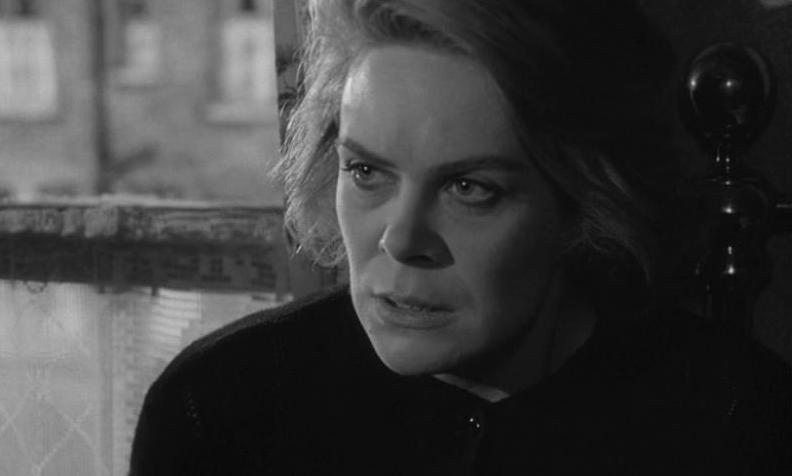
At present, Mrs. Hammond rents a room to another rising rugby phenom named Frank Machin (a hulking and excellent Richard Harris), and when she says she's only doing it for the money, we know she isn't making it up. Bent over a sewing machine, shooting off fuck-you glares while she makes the beds and brushes off Frank's tyro enthusiasm about his rise up through the ranks, Roberts's Margaret unquestionably feels that she's seen this all before: as an abandoned woman, as a wife who competed with the rival thrills of sport, as a toiler and saver in a highly class-stratified society where the working class oughtn't lie to themselves about their long- or even their short-term prospects. It's a brusquely pragmatic arrangement, and yet Mrs. Hammond does seem to study Frank as someone for whom she harbors both contempt and a grudging interest, as someone who might teach her something about the man she lost and/or pushed away, as someone whose own motivations for charming her children and begging romantic affection from her don't make immediate sense... though she may not be as dead-set against his hardbodied appeal as she thinks she is. And the prospect of more money—for all that she doubts whether Frank's burgeoning celebrity within the league will continue paying dividends or inspiring protectiveness from his owner-managers—cannot be lost on Margaret, either. She cracks one of many bitter jokes when Frank, after some nervy negotiation, returns to the flat with a kingly £1,000 paycheck. Shimmering with pride and excitement, he wants her to guess his worth before showing her the check. "Threepence?" she fires back, like a taut tripwire of emasculating blasts, yet her bolted-down frown does crack into its first smile as he divulges the actual fortune. Then again, it's only another moment before she reflects, spitefully, "It's a bit more than I got when my husband died... You didn't have to do anything for it... Some people have life made for them."

Mrs. Hammond's basic sense is that the world is rude, buffeting, and venomous, which is quite possibly what the "sporting" in This Sporting Life would mean to her: to hail from her caste or Frank's is to be the sacked and winded player, if not the tossed and manhandled ball, if not the stamped earth, routed with cleats, over top of which other people hammer and pounce at their tainted, pyrrhic goals. Roberts has to suffuse Mrs. Hammond with this outlook at all times, and even make her a deliberate poisoner of other people's self-contentment. The risk, not entirely avoided, is that Mrs. Hammond will play as a one-note figure, a shrew, a kitchen-sink Maleficent with blazing, belligerent irises. She bristles, repeatedly, upon being told that things will get better when she knows they won't, upon being pulled into bed by a rugged Adonis whose interest seems to dismay her when it isn't merely irritating. She's a knife-edged presence, written and directed with a kind of implacability that inherently constrains the range of variation in the performance. Moreover, because a certain acidic quality seems to come so easily to Roberts as it is, her enactment of Mrs. Hammond can feel, if not relentless, then at least somewhat qualified in scope, or like a product of can't-miss casting as much as skilled portraiture. Roberts pops off with some harangues, she takes literal and metaphoric blows in due course, and she's shot and lit with an intensity that frames the performance as an embodiment of an intractable, almost antagonizing force, rather than a human-scale character. You see fairly quickly where the performance is centered, and basically where it is headed, and how fundamentally occupied Roberts will remain in bringing Mrs. Hammond's already-impressive boil to an even more aggravated roll without appearing to overact.

But I must say, Roberts's moments of stock ferocity are much fewer and farther between than they might have been; that it's an achievement in any event to sustain such basically ill temper for two hours without the viewer wishing to be rid of you; and that she shades and layers Mrs. Hammond's personality over the course of This Sporting Life in ways that enrich the film as it plays. It's partly down to her and to the even hardier performance she helps elicit from Harris that This Sporting Life seems more complex as you mull it over, even after some climactic bouts of histrionic misery and needless literalizing of themes threaten to dull the force of a very strong, very sharp, robustly executed picture. When Frank takes his landlady and her children out for a day of picnic and sun, Roberts swipes a few occasions to show us a Margaret who enjoys a game, who appreciates company, who is pleased at seeing her children happy and her own consternations rendered unnecessary. Still, she unveils these hints in very brief, surgical strokes, avoiding the clichéd approach of showing a Mrs. Hammond who "softens," categorically, during anything so paltry as one sojourn in the fresh air. Indeed, her devices for evoking a bit of levity or unguardedness in Mrs. Hammond always manage to underscore, at the same time, the very formadibility of her usual defenses and overall disabusement. She fosters an impression not of a warmer woman eager to escape the body of this frosty and ornery one, but of a creature of kiln-fired habit for whom any restored sense of comfort pushes her awkwardly off balance, as though she's walking on legs she hasn't used for years.

One of the centerpiece scenes in Frank and Margaret's relationship—and in the script's mapping of how blue-collar heroes are as coarsely unprepared for privilege as they are systematically denied it—involves a doomed outing to a high-quality restaurant. Roberts is at her most labile leading up to this excursion: intrigued and even excited to be going, chagrined at the mink coat that Frank has bought her (which she knows her neighbors will castigate as the bit of childish ostentation it is), hopeful of finding some steady way of relating to this man who is also an eager and quite literal meal-ticket, furious at seeing what asses he makes of both of them in public, gratified in some dark way at having been right that he's an oaf, that the whole world is rigged, that she was foolish to imagine some deliverance into ease. This sequence hit home harder for me than some dramatically pivotal but on-the-nose exchanges between Frank and Margaret in the graveyard behind a chapel, although, during those latter scenes, Roberts takes a punch to the face with less flinching than many a male action hero. And it's here, as she howls about the late husband whom she dares Frank to even speak about, as she lacerates him with allegations that men as a race are a categorical horror, as she signals with a new kind of pain in her eyes that she'd yell just about anything to get him to leave her alone—it's here that Roberts makes Mrs. Hammond's anger the most total and harsh it has been to that point, but also the most polychromatic in its breadth and outrage and woundedness. She's a woman who's been used badly; a woman who maybe rebukes herself for not succeeding in keeping either of two men; a woman who might hate herself precisely for turning such a scouring, blaming eye on herself; a wise woman; a narrow woman; a self-consciously cash-strapped woman; a raped woman; a woman who'd rather be raped than paraded in tacky and ill-earned finery; a woman who saw all of this coming and didn't listen to herself; a woman who didn't see this coming and can't believe she's allowed Frank so close to her.

Sometimes you look at Roberts and see mostly that white-hot expression that serves as a backbone for most of her performance. That expression in turn can feel like the only affect she's recruiting into a scene: potent, but slightly familiar, and evidently close at hand for this performer. But at least as often, you look at that white-hot light and remember that white is not the absence of color but the total of all of them, and that inside the deceptive purity of Margaret's rage, there's a whole spectrum of separate frequencies. Not unlike the Patricia Neal performance that beat her to the trophy, Roberts's work comprises a series of deepening plunges into a predominating chord of feeling: plangent but aroused taken-for-grantedness in Neal's case, domestic truculence, ardor, and a taste for conflict in Roberts's. It's a smaller part than her male costar's and, in many ways, it exists to refract onto his. But Roberts, like Neal, manages not to seem like she's "supporting" anyone. She has her own story to tell, through and as this scrupulously drawn character. Within the film, you really feel the change once Mrs. Hammond, like Hud's Alma, departs for good; later, it's impossible to think back on the films without seeing these women's faces.

The Best Actress Project: 1 More Down, 16 to Go

Labels: , , , , ,

Saturday, April 25, 2009

Nashville Film Festival 2009: Best of the Live Action Shorts

Here they are, in alphabetical order. Seek them out, and show them love:

Bravo: Instead of Abracadabra
(22 min., Sweden; IMDB)
While hunkered in our festival hotel this week, Nathaniel and I read a published estimate that 40% of the nation's college seniors expect to move back in with their parents after their imminent graduations, with no particular plan for their next forward maneuver. The Swedish delight Instead of Abracadabra suggests that becoming the village magician is not the ideal advance, except insofar as 25-year-old Thomas (Simon J. Berger) delights us as much with his flamboyant, slightly self-deluding treading of water as he flusters his father and worries his beaming, defensive mother for the very same reason. Thomas has cobbled together an act that he describes, in a foray into English, as "upclose gothic death and mayhem," and if you translate this out of his preferred Napoleon Dynamite dialect, this basically involves exploding some hamsters (or seeming to), lighting his own thumb on fire (or seeming to), and spearing his mother in the side with a machete (oops). Thomas finally has the will to raise his game when a beautiful new neighbor commissions him as entertainment at his son's birthday party, and though the comic dynamics of the pooh-poohing Dad and the rose-spectacled Mom are nothing new for indie cinema, the viewer's oddly mingled investment in Thomas surpassing himself and/or making a spectacular shambolic failure of himself provided a perky high-point of belly laughs and undemanding entertainment that is always welcome at any point in a heavy-hitting festival. I wouldn't be surprised if Oscar got excited about Abracadabra (which is almost entirely a compliment) or if, in certain film-nut circles, the enthusiastic refrain "Chimay!" graduated to the plane of "Vote for Pedro" or the Moldy Peaches. A delicious sugarcube of Scandinavian quirk.

Bravo: Love You More
(15 min., U.K.; IMDB)
This debut short by the acclaimed English artist Sam Taylor-Wood delivers a comparable adrenalin-rush of giddy entertainment as Abracadabra but with higher-key energy, more aggressive colors and edits, and a nimbly managed structure pivoting on the triple repetition of the eponymous track by the Buzzcocks. These three encores of the song correlate to a jubilant erotic encounter between two punk-era teenagers who have barely clocked each other before reaching for the same album in the record store. Taylor-Wood arrives into her first directing gig with extraordinary prestige and a bevy of connections on her side; as an innocent of the gallery-art world, I had frankly never heard of her, but it's not every short film that logs the late Anthony Minghella (producer), Nina Gold (casting), Seamus McGarvey (cinematography), and Patrick Marber (screenplay) on its credit sheet. And yet it isn't the air of celebrity or the availability of money that lifted Love You More above so many worthy competitors to earn our Honorable Mention prize for the whole live-action division. Taylor-Wood, McGarvey, the production designer, the sound-mixing team, and the two lead actors all have the knack for evoking a specific cultural moment as a personal watershed without glopping around in nostalgia or self-congratulation, and the libidinal velocity of shopping, flirting, listening, coupling, recoupling, parting, and looking forward to tomorrow have rarely been captured with such unfluffy authenticity and such verve.

Bravo: Next Floor
(12 min., Canada; IMDB)
"Are we sure we want to confer our two top prizes on our two best-connected artists?" my jury asked ourselves before finalizing our decisions. We can't be accused of privileging the films for this reason: again, I didn't know who Sam Taylor-Wood was, and my co-conspirators had never heard of Denis Villeneuve, whose debut feature Maelstrom, narrated by a lamprey eel awaiting death on a butcher's block (seriously) I had enjoyed some years ago at a campus cinema. Plus, if we really wanted to reward celebrity, we could have anointed any of the unspeakable affairs helmed by Courteney Cox, Chiwetel Ejiofor, or Demi Moore, about which I universally refuse comment. As actors are always intoning on interview shows, with perfect integrity and a little self-righteousness, it's about the work, and the work didn't get more ambitious, impressive, insinuating, or accomplished than Villeneuve's Matthew Barney-meets-Peter Greenaway parable of a gastronomic orgy held silently by some swannish aristocrats in some baroque mansion lit—or, as it were, not lit—as though it were the bottom of the ocean. From the opening shot, the hawk-eyed servants handing out the oil-slickened meats and the effulgent canapés and vegetables make a habit of staring severely at each other and at the viewer, suggesting some kind of malign conspiracy or foreknowledge... but that doesn't forestall our surprise when the floor collapses under the weight of this stabbing, slathering meal, and the anonymous over-eaters gather their wits amid the spilled wine, the debris, and the plaster dust. What happens next, and next, and next, may be predictable to some viewers and jaw-dropping to some, but even the coolest onlookers in the film start to look increasingly perturbed, maybe even frightened by what they witness. Villeneuve is holding out a big, unembarrassed, topical indictment of largesee and consumption for anyone who wants to see one, but the aural and visual atmosphere of the piece are too boldly overwhelming to recapitulate as one-dimensional dogma, and the sheer scale of the architecture and choreography that went into this bitter little passion-play are enough to strike you with awe. Even in a crowded and ornately impressive field, Next Floor didn't struggle too much to amass our Grand Jury Prize into its swelling cache of awards.

Bravo: Omelette
(7 min., Bulgaria; IMDB)
I'm sure there are wise programmers at the BFI or at Lincoln Center who know better, but from my vantage, Bulgaria hasn't made the kind of move toward global vitality as a cinematic culture (much less global recognition as such) that Romania and Hungary and the Czech Republic and several of the formal Yugoslav republics have in recent decades. All the same, Omelette, excerpted from an omnibus project of 15 short films encapsulating each of the 15 years of Bulgaria's political transition out of communism, is strong, distilled, confident, and resonant enough that one wonders about the surprises and provocations in store from film artists in that country. Omelette is so tightly shot and narratively proscribed that it would work perfectly within the anthology format for which it has been conceived, but as in those superior Romanian films we've all been so excited about, the candor and lack of pretention in the filmmaking belie strong and layered conceptions underneath. Three eggs break or almost break over the brief course of Omelette, and the source of the damage—external actor, personal error, ferocious frustration—tell their own crystallized history of domestic anxiety as it spills into self-destructive behavior, but not on such a grand scale that it can't, we hope, be curbed. A short short film is probably harder to knock out of the park than a medium- or large-scale short film, but Omelette's striking economy of means and expression demonstrate a talent at the very skill that the narrative laments: the necessity of doing a lot with a little. Well played, Nadejda Koseva.

Bravo: Terminus - watch it in full!
(8 min., Canada; IMDB)
Director Trevor Cawood's incorporation of tactile, fanciful visual effects into a general idiom of sallow urban realism (dank subway stations, greenish medical examining rooms, beige-on-yellow conference rooms) is a feat in itself, classing him in that Michel Gondry league of filmmakers who, at their peaks, can harmonize the mundane with the cheekily impossible in ways that resonate brightly with their audiences. I stand by that sentiment even if "brightly" isn't always the first word you reach for while watching Terminus, in which the stoop-shouldered residents of a composited Canadian city—Terminus was shot in Montréal and Vancouver—are individually stalked by ever more startling, abstracted forms: a tap-dancing man made of floating stones, a stretch of mean-spirited airport conveyer belt, a crouching statue in the vein of Henry Moore. There's no accounting for how these sculptural phantasms came to be, or whether the humans they pursue can perceive each other's specters, or what each particular, dogged form has to do with the individual it is trailing. Nor is there any diegetic explanation for the film's appearance of taking place sometime in the 1970s, or maybe everyone in fantasy-Canada takes their vintage shopping really seriously. Terminus makes such affective sense, goofy but unnerving, that these questions seem either like the wrong ones or like excitingly open-ended riddles. The film takes a tonal and narrative risk toward the end, accented by a quick insert of the front wheels of a bus, that recalibrates the stakes of the film just when it threatens to come across as an exceptionally weird and well-directed TV spot. There's no punchline to Terminus and no tying off of its enigmatic threads; the strange world that Cawood has envisioned keeps shuffling forward, one soft-shoe, one stony alter ego, and one sleepless night at a time.

Labels: , , , , ,

Wednesday, October 22, 2008

London Film Festival: Genova, The Possibility of an Island, and Let's Talk About the Rain

The festival experience is starting out beautifully, with oodles on offer and efficient organization and careful projection and big, appreciative crowds. I've never seen so many people in a theater for a James Gray or a Michael Winterbottom film. There were more paying customers at a weekday afternoon screening of The Possibility of an Island, Michel Houellebecq's fantastical, philosophical, theoretical smorgasbord of hogwash, than there were at my evening showing of Tropic Thunder last month in Chicago. I wish the actual movies had been better so far: in addition to Island, which I lay into here, I had a disappointing experience with what I hoped was a sure thing, Michael Winterbottom's grieving-family drama Genova. Winterbottom and regular producer even popped up like gophers after the screening to answer the questions of an almost all-student audience, which would have been a transporting experience for a fan like me if Genova had anything to say or if Winterbottom even now seemed sincerely invested in what he'd created.

Ah, well. The beginnings of festivals are the easiest parts, because the general excitement level is still so high that you can stomach your share of mediocrities. And truth be told, lesser works by Gray or Winterbottom are still illuminating about the medium and dotted with memorable grace notes. And blazing, idioglossic trash like The Possibility of an Island is impossible to conceive under almost any other circumstances, unless Ursula K. Le Guin and Slavoj Žižek dropped a little acid and made a filmed homage to an Iron Maiden album cover. Who would want to miss that?

P.S. Another esteemed director, another subpar product. Is it turning into a curse? Agnès Jaoui puts a foot wrong, for me, by putting her feet so safely and modestly right for a lot of other people. This screening of Let's Talk About the Rain at least drummed up some laughter and warm applause of a kind I hadn't heard in the last 36 hours, but it's the definition of a movie that you wouldn't want to write home about. Next up at bat: Oliver Stone.

Labels: , , , , , ,

Wednesday, October 10, 2007

Chicago Film Festival: Hallam Foe

David Mackenzie is back to some of his Young Adam tricks in Hallam Foe, and once again, the most riddlesome tricks of all are a) how he gets the movie to spring as excitingly as it does from a sketchy story with significant limitations, and b) why the movie fails to work a little better despite all the evident and encouraging talent involved. Hallam Foe orbits around the twin suns of Collision and Surveillance, as encapsulated in the opening sequence that starts with the title character (Jamie Bell) squatting in his treehouse to spy on his sister, who at that moment is taking an amorous roll in the glade with her boyfriend. After streaking himself up with some "barbarous" makeup and a makeshift headdress made of a badger hide, Hallam war-whoops his way down a pulley-and-cord contraption and crashes right into the humiliated lovers. The whole sequence, improbable in incident and choreography, serves primarily to acquaint us with Hallam Foe's bold and peculiar experiments in exaggerated reality. As befits a film about an incorrigible peeping tom, Hallam Foe is full of point-of-view shots and furtive, handheld pokes around corners and to the sides of various barriers. Just as markedly, however, but with much more distinctive formal panache, Mackenzie and cinematographer Giles Nuttgens (The Deep End) perpetually shuttle Hallam in and out of strong but strikingly different lighting schemes, soundscapes, and color patterns. Though these contrasts and effects occasionally spill into overstatement—trains that sound like entire artillery brigades, saturated colors and overexposed light to signal big emotional climaxes—Hallam Foe cannot be accused of concealing its investment in the dramatic heightening of sensation, the privileging of psychic logic and hormonal pulls over safer and more quotidian forms of "realistic" storytelling. Indeed, the film's evocation of Hallam's jumpy and inchoate overstimulation is its sustaining badge of craftsmanship and creative vivacity. Click here to read the rest...

Photo © 2007 Scottish Screen/Ingenious Film Partners

Labels: , , , , ,