Tuesday, May 31, 2016

Cannes '96, Expert Witness #6: Stephen Cone

Stephen Cone is an actor-writer-director I'd be dying to meet if I didn't know him already. By living in the same city, haunting the same movie spots, and now teaching at the same institution, I've been fortunate to keep crossing Stephen's path, and he's such a warm, smart, interesting guy. This is just what you'd hope from seeing his films, which maintain a fundamental empathy with their characters even as the stories take risky turns and grapple with human complexity. I marveled at this quality of Stephen's work, compassionate without being dull or soft, cognizant of merit in very different people's positions, when I saw his debut feature The Wise Kids. Still my favorite movie about young contemporary characters navigating dilemmas of faith and sexuality—sometimes separately, sometimes together—The Wise Kids is a minor miracle in a modern culture where these subjects, among others, are so hard to broach in a non-polarizing way that retains mystery and respects variety.

Several aspects of story, tone, and style link Stephen's subsequent features together, but at the same time, there's almost nothing they all have in common. The Wise Kids, Black Box, and Henry Gamble's Birthday Party handle large ensembles with impressive balance, but This Afternoon constrains its canvas to just two characters and sees quite far into both of them, especially the woman played so shrewdly by Nikki Pierce. Black Box, which stars another actor-writer-director, Josephine Decker, takes a backstage plot of theater production to some impressively stark places. I hadn't fully expected this from someone who makes decency and human fellowship as textured and interesting as Stephen does in Wise Kids and Henry Gamble. That said, those movies take their own detours into coldness, cruelty, and sorrow, which are all the more bracing because they unfold against broader, appealing backdrops of kinship and camaraderie.

Whoever you are, if you haven't seen Stephen's movies, you should. Henry Gamble, brand new on DVD and streaming, is a gorgeous place to start. Meanwhile, as we learn so often at Cannes, where David Lynch's jury fell for the narratively controlled and stylistically cool Pianist and the mad, more-is-more, midnight-movie barker George Miller stumped for the stripped-down didacticism of Ken Loach, you can't necessarily predict filmmakers' tastes from the kinds of movies they make. I asked Stephen some questions inspired by his own work and my guesses about what might interest or inspire him. I also asked some that were more open-ended and, as with all my favorite film buddies, his answers surprised me as often as not.

ND: Fairly early at Cannes '96, Secrets & Lies, Fargo, and Breaking the Waves emerged as the three films to beat for the Palme. As I've asking all my interlocutors, had you been on the jury, divvying prizes among that trio, which would you have recommended for the Palme? What do you most love or admire about it?

SC: If I were the 35-year-old filmmaker/cinephile I am now, I likely would've championed Secrets & Lies, the beautiful, humanist ending of which I think about quite often. The whole film has a special, direct, emotional power that has come to be a staple of Leigh's work. He's one of my favorite filmmakers, but I consistently underrate or even forget about him. That could have something to do with his never being in fashion.

That said, 16-year-old aspiring actor/filmmaker Stephen would've given the prize to Fargo—which I still like now, though I'm not big on the Coens' 90s work in retrospect. It's not inexhaustible to me, like much of their recent work is. The unbelievable richness of their masterful No Country-through-Llewyn Davis stretch to me makes Fargo look like a middling Disney film. And I don't like von Trier at all now; Melancholia's okay, but that's it. I find him to be cartoonishly cynical and stupid, though he very much appealed to my sense of discovery in the late 90s and early 00s.

Read more »

Labels: , , , , , , , , , , , , ,

Monday, May 09, 2016

Cannes 1996: Day 1: May 9


Patrice Leconte's Ridicule (IMDB) begins with a dolled-up and pissed-off 18th-century Frenchman striding through the gilded hallways of a fellow aristocrat's estate. Having cornered the elderly, incapacitated owner in his opulent bedroom, he pulls out his penis in close-up and pisses all over this vieux monsieur's silk vestments and ruffled shirts. That's the movie in a nutshell: extravagant finery, mounted for maximal oohs and ahhs from the art house crowd, inclined to abrupt and wicked assaults on itself and its audience. That's also the Cannes Film Festival for you, a fussy, self-fashioned pinnacle of artistry and glamour, barely concealing its lip-smacking hunger for controversy, vulgarity, grandiosity, and humiliation.  Opening Night is frequently an occasion for dire catharsis, as some lumbering commercial calculation like The Da Vinci Code or some beige flash in the middlebrow pan like Blindness gets trotted out to the global cinemarati. They, in turn, gnash their incisors on these stale appetizers before the real haute cuisine starts arriving the following morning.

By the standards of Cannes openers, Ridicule is a substantially above-average achievement. That is to say, it's a perfectly fine movie, engaging throughout, impressive in several passages, shaky in a few others. Styled as a kind of homegrown Dangerous Liaisons (Fanny Ardant's final shot owes an all-but-explicit debt to Glenn Close's indelible signoff as Merteuil), Ridicule handily seduces the wigs-and-bustles audience while baring a sharper-than-usual set of teeth. The critique of royal decadence—moral, verbal, sexual, monetary, gustatory, political—is nothing new in itself, but the stakes ramify outward from Versailles in unique and memorable ways. Beyond just vanquishing rivals and chasing tail, though he manages plenty of both, naïve protagonist Grégoire Ponceludon de Malavoy (demonlover's Charles Berling) is mastering the art of weaponized badinage for a specific purpose, which palpably fascinates the filmmakers.  He wants to rid his swampy village of mosquito-borne illness and thus needs palace financing for a complex engineering scheme that will rehabilitate public health and local ecology.

Read more »

Labels: , ,

Sunday, November 22, 2015

Nick's Flick Picks: The Force Awakens


What are those guys doing in Claire Denis's Beau travail? Has anyone ever figured that out?  My guess is that, after many years of assuming that my website would never get its act together, they have just found out there are long-postponed updates to the Top 100 listings, where I've recently celebrated Hiroshima mon amour, The Wages of Fear, and The Third Man, and to the Favorites countdown, where I've shared some of the backstory that led to my late-breaking ardor for Beau travail and Naked Lunch, both of which survived cool first impressions to become personal pets and central frames of reference for my book, The Desiring-Image.  (I've also, incidentally, re-programmed both features to ditch the cumbersome frames, streamline the html, and make for easier viewing on tablets as well as laptops. Hope that's all working on your end.)

I'm drafting another essay for work, and as usually happens when writing juices flow in one part of my life, they start moving in others as well. I've already written the next entries on both countdowns, so maybe I can keep some momentum going through the holidays. Some of you have been waiting on these for ten years!  Hope you'll share your thoughts about these posts and others soon to follow.

Subsequent entries added to Favorites: Crash, Walking and Talking, Eyes Wide Shut, Opening Night, Blonde Venus
Subsequent entries added to Top 100: Under the Sun of Satan

Labels: , , , , , , , ,

Tuesday, September 01, 2015

Toronto Film Festival XXL

Channing Tatum, Magic Mike XXL

Sep 10: I'll update this post with my tweeted responses to these films, hopefully once a day.

Sep 8: Completed my final ticket selections this morning during my assigned window for the Back Half Pass (which gives you a slightly discounted rate for movies playing in the last five days of the festival). That's 45 features, two programs of 15 shorts, and 14 tickets I got for other people, and I got my first choices across the board. Clearly the other shoe will drop somehow, but for now I'm all blissed out.  I'll try to post some updates here during the fest, but my Twitter account will be the place to catch more immediate responses.  Please follow!  And track these other friends who always provide great TIFF impressions, too: Alex, Amir, Angelo, Bill, Calvin & Yonah, Catherine, Joe (also @decider), Katey, Lev, Nathaniel, Tim, and Yaseen.  If you see a movie you like, I'd love to hear about.  As, I'm sure, would any filmmakers on Twitter, especially those who aren't in the Gala divisions.  I've had great experiences cold-tweeting (?) directors whose work I just saw, and I heartily recommend it.  And if there's no way you can be at TIFF but spot a film you desperately wish you could access, tweet a filmmaker about that, too.  See if there's a college, cinema, library, or other institution near you that might be willing to host a screening, with or without the director's involvement.  Tschüss!

Sep 6: Could things be better? I logged on precisely at 8am Chicago time to buy single tickets this morning and was #143 in line. Others who did the same were 600 spots behind me; by the time I completed checkout at 8:30, there were more than 2600 people waiting. I got into all 13 showings I was hoping to add, too. With the total currently standing at 41 films and from 30 different countries, I have another half-dozen titles to add on Tuesday, when my Back Half pass goes into effect.  And then, just four days from now, the games begin!  Amy and Bradley are still dancing, girl. Channing, keep spinning, keep burning it up. Did he who made the lamb make thee?

Sep 1: I'm updating my listings below to reflect some of the Middle Eastern and African programming that I will be catching in Toronto, in cahoots with my favorite TIFF programmer, Rasha Salti. I didn't know Rasha at all or much about her cinematic beat until 2013, when Ladder to Damascus, Rags and Tatters, and Noye's Fludde (Unogumbe) all ranked among my favorites of the whole festival.  Last year, Silvered Water, Syria Self Portrait and Iraqi Odyssey were my absolute peaks of TIFF, with Timbuktu not far behind, and Rasha and I got to talking.  This year, I'm collaborating with her to see and promote her programming, all grouped here, because it's so dependably excellent, yet few of the films ever achieve a DVD release, much less a commercial distribution. So let's get behind these phenomenal movie-makers and under-heralded cinematic traditions.

Sep 1: Toronto International Film Festival season has begun, baby, and we at Nick's Flick Picks (read: I) could not be happier.  I'll be there longer than I ever have before, and seeing an even greater number of movies.  Logged in this morning at my TIFF-appointed time to make my first 30 ticket selections, 20 of which were for me, 10 for friends who wanted to see movies we worried would sell out.  I'll keep updating this entry over the next week or so as my itinerary expands, when individual tickets go on sale, and when my Back Half discount kicks in.  So, keep checking this page, and click the links if you want to learn more about the movies.  I don't, really: I'm picking based on affinity for the filmmakers, general buzz, and the dimmest notion of premise (and in some cases, I don't even know that).  I like going in as cold as possible, so I'm going to keep it that way.

The list is bound to get more esoteric, since I prioritized films that seemed likely to draw big crowds and/or I hoped to see in the first few days.  And if you're like, "These already look pretty esoteric," then that's Nick's Flick Picks for you.

MY TIFF ITINERARY (Updated 9/20)

3000 Nights (Palestine, dir. Mai Masri)
B+  Stirring drama inside Israeli women's prison, with mostly Palestinian inmates. Gutsy takes on solidarity, maternalism.

Anomalisa (USA, dirs. Duke Johnson and Charlie Kaufman)
C+  Could summon no enthusiasm. The self-pity of Kaufman's men is usually ballasted by much more creative detail or insight.

Arabian Nights, Vol. 1: The Restless One (Portugal, dir. Miguel Gomes)
A  A+? So many good films here but this inhabits a whole other level as piebald art and political intervention.

Arabian Nights, Vol. 2: The Desolate One (Portugal, dir. Miguel Gomes)
A–  Less obviously intricate than Vol 1, and more frontal in stating themes—I thought. Then I grew less sure.

Arabian Nights, Vol. 3: The Enchanted One (Portugal, dir. Miguel Gomes)
A  What Obama said about guns and religion, but about chaffinches. Heavy histories shrink to bearable fetishes.

As I Open My Eyes (Tunisia/France, dir. Leyla Bouzid)
B+  Sonorous, trenchant portrait of an artist as a young woman, riding sharp lines between petulance and dissidence.

The Assassin (Taiwan, dir. Hou Hsiao-hsien)
B+  A royal marriage of many lines, sumptuous, as much Unforgiven as Scarlet Empress. Hou's hand still unsteady on story.

Bang Gang (A Modern Love Story) (France, dir. Eva Husson)
B+  Remarkably assured, richly executed debut. Not all story beats fresh but layered, meticulous study.

Beasts of No Nation (USA, dir. Cary Joji Fukunaga)
B–  Value, impact hard to deny but formal and narrative storytelling are a little crude. Young Attah is a find.

Blood of My Blood (Italy, dir. Marco Bellocchio)
C+  My astigmatism around high-theatrical Italian melodrama persists. Less crude than Vincere but ideas seem simple?

Cemetery of Splendour (Thailand, dir. Apichatpong Weerasethakul)
B  Reader, I must confess I'm starting to find Weerasethakul tedious, as much as I admire his directorial craft.

Chevalier (Greece, dir. Athina Rachel Tsangari)
B  Greek surrealist, quasi-Apatovian remake of American Psycho business-card scene. Finds its berth fast, hangs out a while.

Dégradé (Palestine, dirs. Arab Nasser and Tarzan Nasser)
B–  Entrapment, suffocation are topics, occasionally effects of one-set suspenser in Gaza salon. Bold vision. Hang in there.

Dheepan (France, dir. Jacques Audiard)
A–  Sleek, observant, steadily winching synthesis of prior Audiard themes. Psychology deftly externalized. Actors keep it hot.

The Endless River (South Africa, dir. Oliver Hermanus)
B  Strikingly shot. Taps a rich seam of region-specific tensions and story traditions. Maybe exploits them a bit.

Eva Doesn't Sleep (Argentina, dir. Pablo Agüero)
Eva Perón as Addie Bundren. Caryl Churchill-esque. Brute embodiments and symbolic afterlives in unwinnable duels.

Evolution (France, dir. Lucile Hadžihalilovic)
What if Matthew Barney and Jacques Cousteau co-directed a YA dystopia? I couldn't imagine, but Lucile Hadžihalilović did.

Fire Song (Canada, dir. Adam Garnet Jones)
C–  Noble intents, rare focus, and solid production values lose out to stiff writing and editing, erratic hold on character.

Francofonia (France/Germany/Netherlands, dir. Aleksandr Sokurov)
Louvre, the End of History. Witty, moving essay on doomed objects surviving, enemies collaborating, time as tight knot.

Frenzy (Turkey, dir. Emin Alper)
B+  Formally stunning mitosis of one suspense thriller into two, enigmatically related. Two parts Audiard, one Don't Look Now.

Girls Lost (Sweden, dir. Alexandra-Therese Keining)
C+  A century after Florida Enchantment, we're still using magic-beans device for transgender tale. Shaky on its own themes.

Green Room (USA, dir. Jeremy Saulnier)
Blue Ruin had assets in all areas; this has zero in any. What happened? Quoth its own eviduh, "This is taking too long."

High-Rise (UK, dir. Ben Wheatley)
TIFF canceled my screening.

The Idol (UK/Palestine, dir. Hany Abu-Assad)
Couldn't access the screening.

In Jackson Heights (USA, dir. Frederick Wiseman)
A–  Most democratic US community abounds with sidewalk pedagogy and filibusters. Everyone tries to save everyone.

In the Shadow of Women (France, dir. Philippe Garrel)
B+  Tiny ficelle of a film takes witty stock of knotted infidelities. Neither one-sided nor free of judgment.

Ixcanul (Guatemala/France, dir. Jayro Bustamante)
Guatemalan drama quietly, sturdily makes expert choices scene after scene, culminating in my biggest jaw-drop of the fest.

Let Them Come (Algeria/France, dir. Salem Brahimi)
Couldn't access the screening.

Minotaur (Mexico/Canada, dir. Nicolas Peréda)
A–  Totally bewitching miniature about profound indolence. Possibly class critique of a new, Lynch-meets-Pina Bausch type.

Mountains May Depart (China/France/Japan, dir. Jia Zhangke)
B–  Hi, I'd like a Hong Sang-soo, a Stella Dallas, a Notes on a Scandal (iced), and a small side of Drrrainage?!

Much Loved (France/Morocco, dir. Nabil Ayouch)
A–  Bracing, gutsy, humane drama of Moroccan prostitutes. Moving and nuanced images, sounds, and characters. Pass it on!

No Men Beyond This Point (Canada, dir. Mark Sawers)
Wound up skipping for Ixcanul

The Other Side (France/Italy, dir. Roberto Minervini)
B+  Beasts of one nation, arguably under God, arguably indivisible. An upsetting revelation no matter how "true" it is.

The Pearl Button (Chile/France/Spain, dir. Patricio Guzmán)
B+  Empathic, poetic speculation from a filmmaker whose equanimity is a miracle. Not quite Nostalgia but much-needed.

Price of Love (Ethiopia, dir. Harmon Hailay)
B  Some story beats are sadly familiar, but this streetside Ethiopian drama conveys them with nuance and piquant detail.

The Promised Land (China, dir. He Ping)
D  Way too airy-fairy Chinese romance between ballerina and hockey coach. Barely a premise, endlessly pre-rehearsed.

Return of the Atom (Finland, dirs. Mika Taanila & Jussi Eerola)
B–  Vividly mounted and persuasive on its basic grounds, but several editing and sound choices baldly manipulate.

Right Now, Wrong Then (South Korea, dir. Hong Sang-soo)
A–  Lovely. Iridesces with sadness. Hong's Purple Rose of Cairo? Well, that's not exactly true. Nothing ever is.

Schneider vs. Bax (The Netherlands, dir. Alex van Warmerdam)
B  Another 18th-century comedy about 21st-century mercenaries. Merrily morbid, somewhat for its own sake. Thin look.

Short Cuts Program #5 (Canada/France/Germany/Iraq/Spain/UK, dir. Misc.)
B–  No clinkers, few coups. My faves were the angry Society and the compactly suggestive New Eyes and El Adíos.

The Sky Trembles and the Earth Is Afraid and the Two Eyes Are Not Brothers (UK, dir. Ben Rivers)
B  As elaborate and idiosyncratic as it is, the postcolonial metaphors become a bit flat and static.

Son of Saul (Hungary, dir. László Nemes)
So formally brilliant you can't help noticing, even as you expend all emotional and moral energy. The sound! The story.

Starve Your Dog (Morocco, dir. Hisham Lasri)
B  Boldest shredding I've seen here of cinematic form, story flow. Death and the Maiden as punk Moroccan cherry bomb.

Story of Judas (France, dir. Rabah Ameur-Zaïmeche)
B+  Daring rewrite of 2000-year-old treachery, passing for a long time as classical, almost POV-less account. Gorgeous.

Sunset Song (UK/Luxembourg, dir. Terence Davies)
C–  First hour a stilted slog. Middle fights its way to poignancy but last act falters. Barely ten oxygen molecules in it.

Taxi (Iran, dir. Jafar Panahi)
B  Feels less ambitious than Panahi's two previous house-arrest movies but it's funny and wise and has good tricks up its sleeve.

Te prometo anarquía (Mexico, dir. Julio Hernández Cordón)
B+  Rare bird. Rewards patience and trust as it builds from vaguely illicit skater/dealer pic to humbling tragedy.

The Treasure (Romania, dir. Corneliu Porumboiu)
A–  Comic gold, with an impressively ferrous structure of ironies and nuances that hold it together and expand its scope.

Victoria (Germany, dir. Sebastian Schipper)
A–  Morvern Callar rebuilt as pulse-pounding thriller, astonishingly executed in a continuous, 132-minute take. Overwhelming.

Wavelengths #4: Psychic Driving (Austria/Brazil/Canada/France/Spain/USA, dir. Misc)
A–  Links radical activism to African diaspora, occult folklore to synaesthetic abstraction. Dazzling.

The White Knights (Belgium/France, dir Joachim Lafosse)
Wound up skipping for Beasts of No Nation

The Witch (Canada/USA, dir. Robert Eggers)
C  Antichrist meets The Village. Spooky surface meets crossover dreams. Old tropes about faith meet some about the colonies.

http://smartladieslovestuff.com/wp-content/uploads/2014/02/American-Hustle-dancing.gif

Labels: , , , , , , , , , , , ,

Wednesday, May 27, 2015

Cannes 1995: Day 11: May 27


Dead Man, USA, dir. Jim Jarmusch

Two Hugh Grant movies played the last three days at Cannes, in sync with a carefully timed visit from His Floppy-Hairedness, Marquess of Stutter. That may have been the big news at the time, whereas now The Englishman Who Went Up a Hill But Jesus This Title Is Long is the most patently dated element of the final full day of programming. All three of the other films listed below, despite slipping in at the eleventh hour, have had much more lasting impacts. La Haine caught on quickly, of course, sending shockwaves through French film culture and public discourse. 20th-anniversary pieces have popped up in many major European papers this spring. Dead Man wafted in and out on the final day with remarkably little fanfare, just as Jarmusch's delicious Only Lovers Left Alive did two years ago; I'm pretty reconciled to Just Not Getting Dead Man, but I see completely why so many cinephiles are impassioned about it. Despite its stiffing by the jury and, evidently, by the programmers—way more than La Haine, it's the sort of movie that works by osmosis, and needs time to unwrap its ideas—I'd wager that it now boasts the highest critical stature of any of the Palme competitors from this good-to-middling vintage. My favorite film and happiest discovery among these three was the Burkinabe ensemble dramedy Haramuya, which nimbly alights on multiple storylines among young and old, male and female, in modern-day Ouagadougou. Today it is most celebrated by African cinema devotées for its rare attention to urban teens in a contemporary setting. I'd have had a hard time seeing it without my university connections, but keep an eye out for that title. It was the second movie I watched of the 53 I screened over the six weeks for this feature, and it's easily in the top two or three of those I'm most eager to check out again.

Read more »

Labels: , , , , , , , , , ,

Monday, May 25, 2015

Cannes 1995: Day 9: May 25


The Convent, Portugal, dir. Manoel de Oliveira

This third-to-last day of the Competition is a riddle to me, even more so than whatever syndrome is or isn't making King George III mad, or why Benoît does any of the things he does in Don't Forget You're Going to Die, or wtf is happening in the crypt or the church or the cave or the woods or the beach or the first reel or the second reel or the third reel in The Convent.  Just when the Palme race started to heat up with much more exciting contenders than we'd seen in the early days of the festival, Day 9 feels larded with puzzling, truncated, or frankly mediocre work, in and out of the Main Competition.  The things that make Beauvois's and de Oliveira's films frustrating to watch admittedly make them more interesting as time passes. Either might have been served by an earlier berth in the schedule, an idea we'll revisit when we land on Dead Man on the final day.  Most of the sidebar stuff could just as easily not have played at all, but I have to say, after so many unsatisfying narratives and inchoate statements, it was sure was fun watching Antonio Banderas fire away at bad guys with weaponized guitar case.

Read more »

Labels: , , , , , , , , , , , , ,

Sunday, May 17, 2015

Cannes 1995: Day 1: May 17


The City of Lost Children, France, dirs. Jean-Pierre Jeunet & Marc Caro

Welcome to the first day of the rest of your lives, and also to the first day of the second coming of the 1995 Cannes Film Festival! As I've been telling you for weeks now, and as Twitter has been hearing at regular intervals, I and a distinguished entourage are embracing our practical and financial inabilities to attend the currently-unfolding Cannes Film Festival by calling on all streaming services, private DVD collections, campus holdings, Interlibrary Loan offices, brick-and-mortar rental shops, and international mail-order retailers to throw what we consider a very inspired birthday party for many, many films that screened on the Croisette 20 years ago this week.  I personally have already seen upwards of 40 titles, from 18 countries, with about a dozen still to go and more nations to represent.  Having searched through every open door for these movies—many of which I hadn't seen in two decades, most of which I'd never seen at all, and several of which are by directors I'd never heard of before—I'm having the time of my life.

Each day of the festival, I'll post an entry that collects my thoughts on the films that bowed on the Croisette that day in 1995.  I'll also include links to essays, capsules, tweets, or Letterboxd entries by my cohorts.  I hope you'll enjoy following these posts, and that you'll consider playing along, and either posting or linking your impressions in the Comments.  I've provided a day-by-day itinerary of the films up for discussion, to help you know what's coming.  (I pulled the dates and even the screening times from an old issue of Le Monde; after today, my already-written Twitter reviews will be timed with maximal nerdiness to appear at the moment each day when the curtain rose on the film in question.)

Occasionally, you'll also be treated to more in-depth conversations between me and some scholar, writer, or friend (often all three!) who has particular expertise in a given film or the story or region it depicts.  I'll also post a few mid-festival roundtables among my closest collaborators, as we hash out our impressions, concluding with our own jury awards for the Best of the Fest.

Today's easy, since as per usual, only one film was programmed on opening day...

Read more »

Labels: , , , ,

Friday, July 15, 2011

Cannes 1986: Some Rough Patches


So far Nagisa Ôshima's Max, mon amour is my least favorite film in the Palme competition, and Ruy Guerra's Ópera do Malandro is my least favorite sidebar selection. You can see the reviews by clicking those links and gauge my progress with the festival so far. But even after hitting these two rough patches, I can promise there are better films looming on the review horizon. And besides, I wouldn't leave the 1986 Cannes Film Festival for anything. It's the only place I can find where no one is talking about Harry Potter.

Labels: , , , , , ,

Friday, July 08, 2011

Cannes 1986: More Big Guns


I'm posting this entry as a place to leave comments about The Sacrifice, a film I suspect many of you have seen. My review is posted here, as is another review of Ménage (Tenue de soirée), a polyamorous French farce with lots of nasty edges. Michel Blanc scooped up half of the Best Actor gong for Ménage, and The Sacrifice made off with prizes from the Ecumenical Jury and the International Critics, a special citation for Sven Nykvist's majestic cinematography, and the Grand Jury Prize that is colloquially known as the runner-up prize for the Palme. These are key films for this year's festival, and whether or not you've seen the films recently, or even at all, I hope you'll enjoy the pieces and/or track down the movies. I'd love to hear what you think.

Enjoy the weekend, and with any luck, Tarkovsky aside, the world won't end yet! Though the ads for Zookeeper do make you wonder...

Labels: , , , , , , , ,

Monday, May 17, 2010

Actress Files: Simone Signoret

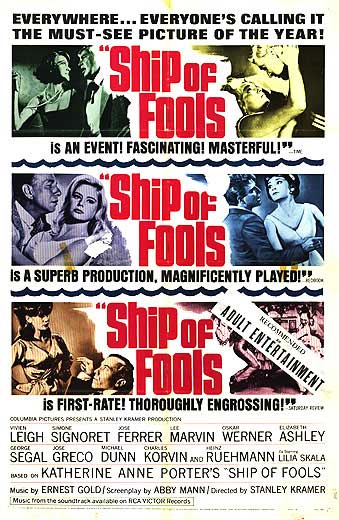
Simone Signoret, Ship of Fools
★ ★ ★ ★ ★
(lost the 1965 Best Actress Oscar to Julie Christie for Darling)

Why I Waited: Has anyone ever hustled to see Ship of Fools? 150 minutes of Stanley Kramer mixing and matching thinly archetypal characters with all of his typical subtlety?

The Performance: Voters handed eight nominations and two wins to Ship of Fools in 1965, so clearly they found something to like. Those dual wins, for Ernest Laszlo's sleek black & white photography and for Robert Clatworthy and Joseph Kish's luxe but elegant design of the cruise ship, even pass muster by Oscar's standards, which means having to accept the fact that, despite the splendid Best Director nod for Hiroshi Teshigahara's Woman in the Dunes, it's too much to ask for that film's indelible visuals to snag the trophies they merited. But Ship of Fools, despite the famous Kramer imprimatur, arrived in port as one of those Best Picture contenders with no corresponding nod in Best Director, implying attenuated enthusiasm among the more sophisticated nominators. The actors were more generous with their balloting. Given their proclivities, I suppose there's no way they could overlook the twee stylings of 3'11" Michael Dunn, breaking the fourth wall with discomfiting, barker-ish merriment at the beginning of the movie—"My name is Karl Glocken," he avers directly to the camera, "and this is a ship of fools!"—and venturing a hollow, ironical knowingness in a bookending coda. Dunn predictably placed and justifiably lost the Best Supporting Actor Oscar, but setting him aside, in the leading categories, the Acting Branch sent a strong message that for all the interlocking vignettes linking Vivien Leigh's caustic spinster to Lee Marvin's bellyaching bully to José Ferrer's hambone Nazi to Heinz Rühmann's optimistic Jewish salesman to Elizabeth Ashley and George Segal's amorous young bickerers, etc., etc., the rueful romance between Simone Signoret's condemned countess and Oskar Werner's stoical shipboard doctor was the obvious diamond in this pail of ice.

As a framing aside, I found Elizabeth Ashley lively and naughty, confiding about Segal's handsome, self-pitying boor that "David's an artist, a wonderful one... He's all caught up with social consciousness right now, but he'll get over it." Would that Kramer had ever done the same, though I'm impressed he would tolerate a line that inevitably sounds like a crack on his own sensibilities. The film moves briskly enough and there are some pert moments, as though enough of the actors see how badly Ship of Fools could use some humor and verve. When things did feel dull, I thought about poor Irwin Allen, who must have labored to survive this movie at some point in his career and thought, If only they'd collide with a tidal wave or an iceberg! Ship of Fools has the starrily-cast but perfunctory patchiness of a disaster movie without the disaster. Then again, for many viewers, all of these earnest declamations and ham-handed, heavy-hearted ironies are disastrous enough, thank you very much. My point is, though, that the actors were onto something in singling out Signoret and Werner for real praise. It's one thing to sidestep the crude literalisms of the script with tart bitchiness, as Vivien Leigh does. "Maybe you were too busy lynching Negroes to take time out for the Jews!" she slings at an American who fumes hypocritically about Ferrer's blunt anti-Semitism. Leigh must have figured this cruise-ship was the closest she'd ever get to doing Tallulah in Lifeboat, and why deny her her fun?

Signoret and Werner, though, opt for a more difficult course than leavening solemnity with tart flippancy. They find a way to play Ship of Fools in a key barely distinguishable, if at all, from the doleful one in which it's been written, but they find real aches and nerve-endings where one would forgive them for finding nothing but contrivances and canned tears. Signoret has been sentenced to die for aiding working-class insurrections in Cuba, offering shelter to revolutionary leaders on her colonial estate. When the ship picks her up from the arresting authorities, she is escorted up a gangplank after filing through a mob of cheering Cuban peasants. Their joy was so pronounced and her own demeanor so sober that, while my brain may already have been narcotized by other dimensions of Ship of Fools, I initially mistook her as someone that the Cubans were thrilled to behold in handcuffs, taking her public lumps. I wouldn't necessarily confide an error like that except that it gives you an idea how austere Signoret is in refusing to play the sanctified martyr. She wears her righteousness and her fate with the neutral formality of a guilty convict of the higher caste, determined not to disclose her emotions or give her arraigners any pleasure.

That's an extremely refreshing approach to screen heroism, particularly in a vehicle this earmarked for liberal self-recognition, even maudlin complacency that Now We Know Better. I probably run the risk in lots of these profiles of crediting entirely to the actress what is in fact a blend of the director's, the writer's and the performer's inspirations; since Kramer can be a difficult filmmaker to praise, I should admit that Signoret would never get away with the implacable humility of this performance if Kramer weren't allowing or even encouraging that take on the character. Yet there is something truly wise and rigorously un-narcissistic in the ways Signoret handles these dimensions of the character, which feel personal to her, exemplary of her acting style and her politics. (Just like yesterday, we're dealing here with a nationally iconic performer who was equally lionized for her outspoken efforts against dominant ideology.) After gently but firmly rebuffing that quandrant of the audience who might desire to behold a damp-eyed Joan of Arc or an indignant firebrand shaking her own chains, Signoret maintains her tight leash on any form of sentimental self-congratulation, even as her character divulges the motives and details of her radical sympathies to Werner's admiring doctor. In a key monologue, she recalls visiting a Cuban worker on the estate that fed her own fortune. "'Pardon me for my house, pardon me for the way it looks, pardon me for ...everything. Most of this place is a garbage dump and I'm just a piece of garbage,'" she quotes or maybe paraphrases the woman as saying, but Signoret doesn't pour unneeded bathos or pregnant pauses into the line. She preserves a downcast but determinedly cool, candid monotone, revealing the Countess to be a kind of chagrined, familiar journalist of the facts of poverty, not a sensationalizing vendor of the exploitable details of suffering. She exudes a heavy though not an exhausted fatigue in the face of the sheer pervasiveness of inequality—matter-of-factly plumping her pillows and angling away from the camera's gaze or from Werner's as she describes how she secreted key agitators in her private chapel, and providing them with arms.

You won't know if you haven't seen the movie, but simultaneously to all this, Signoret is powerfully, poignantly attracted to Werner's blond, clear-eyed doctor, and she has flirted with him repeatedly in advance of this scene—with dignity but still very openly. Obviously mindful of her death sentence, and eventually informed that he, in his own way, faces one as well, Signoret's middle-aged Countess doesn't seem especially embarrassed at trying to lure the doctor into a short-lived, middle-aged romance, even after he admits to being married, albeit dispassionately. Concisely signaling with her eyes the sad, self-conscious ridiculousness of her situation, the condamnée à mort seeking eleventh-hour succor, the handsome but (let's admit it) froggy-looking woman who can't help wanting to kiss this Aryan prince, Signoret's Countess is more than willing to play some well-worn roles: the woman who's seen it all, the addict in need of saving, the lonely diva imploring a lover's embrace with no strings. She says things that one of Tennessee Williams' fading, deluded flowers would say: "My darling, Love, for once let's kiss in broad daylight." Signoret is already smart casting, since there's a certain armature of reserve, lucidity, and integrity she seems incapable of relinquishing even in a dubious part like this one. Still, her avoidance of mawkishness is obviously the product not just of who and how she is, but of deliberate choices and vigilant self-monitoring. Humorous interludes help, as when she pretends to read Lady Chatterley's Lover to Werner as a sleep aid, only to reveal that she's making it all up, and the volume she's actually holding is a textbook called Natural Resistance and Clinical Medicine. But even amidst this campaign to endear herself to a handsome, only somewhat reluctant admirer, who even seems to find her political principles a major turn-on ("I haven't met many people in my life who have committed themselves to anything," he confesses), she still won't short-change a serious gesture she made in the name of social justice as a manipulable tool to entice an escort. I did wonder, though, through the retrospective lens of the Countess's overt yearning for human connection, whether her self-endangering commitment to the revolutionaries was at all motivated—not instead but maybe alongside the unequivocal rightness of the cause—by its promise of camaraderie. Was her valiant collusion one more way not to be so devastatingly lonely?

Signoret's performance raises interesting conundrums for this star-rating system, because I found it to be an impeccably judged approach to a role that scores of other actresses would have fumbled, lacking the tonal control or the palpable moral intelligence through which Signoret movingly humanizes and redeems it. Even her final "Bye" to Werner, at the end of a highly-charged scene, is piquantly quick and quiet. That said, the limitations of the role are such that it essentially prohibits a truly great performance. I can't imagine the wizardry that would be required to divest it of all traces of cliché, which Signoret hasn't done, and her admirable choice for deft, cool underplaying admittedly has the effect of keeping her within a limited stylistic and emotional range—one which so many of her other performances imply is close to a default alternative for her. If she had won the Oscar, I am sure I'd feel cranky that such a flawed part with relatively little screen-time in such a bulging, often listless picture had copped her the statue.

A winless nomination, though, seems like a fitting way to commend Signoret for actually thriving with an assignment that almost begs for failure. I wouldn't want to put the performance in a time capsule, but I would want to show it to any number of actors who think that stock, sentimental, or politically signboarded roles can't be rendered in a way that is smart and moving, and through congenital understatement, no less. Sometimes Signoret is an ace deflector of bathos, as when she receives the information about the Werner character's lethal heart condition by futzing with a stray thread in the tablecloth: who among us, much less in Hollywood, would have resisted this call for moist horror, the frozen, welling close-up that screams, Pity him! Pity me! Sometimes, too, she plays right into the contrived emotionalism of the part, combing her fingers through Werner's hair or firing a deep, searching look into his eyes—and in these moments, her success involves modulating the degrees of sentimentality, not substituting a less expected affect or a bit of actorly business in its place. I'm guessing the Countess would have disliked the film's glossy, melodramatized version of political messaging, and for all I know, Signoret did, too, even though she's humane enough not to judge the Countess for her own moments of grandiloquent feeling. It's an ersatz film, but a very good performance, and in its dignified resourcefulness, an even better acting lesson.

The Best Actress Project: 1 More Down, 22 to Go

Labels: , , , , , ,

Wednesday, October 14, 2009

CIFF 09: Give Me Your Hand, plus an Extra Helping of Gay

Sticking more or less to my sequence of screenings means my next review is for the movie that has so far made the vaguest impression on me, good or bad, through the festival so far, give or take Mexico's Academy entrant Backyard. I'm talking about the French drama Give Me Your Hand, starring two twin brothers who are easy to look at but harder to feel much about. I don't know if my pulse exceeded 100/60 at any point while I watched the movie or wrote this review, but I hope you'll enjoy it anyway.

Particularly now that Give Me Your Hand has fulfilled its cycle of CIFF screenings, and if you're hankering for some gay cinema that better earns that designation, I hope you'll consider the documentary Quearborn & Perversion: An Early History of Lesbian & Gay Chicago, programmed for just two bookings at the luminously old-fashioned Music Box Theatre on Sunday, October 18, and Tuesday, October 20. The filmmaker, Ron Pajak, developed the project with funding from the Chicago History Museum, which continues to be a tremendous benefactor to our city's LGBT community. I am experiencing a rare bout of regret for pouncing on CIFF like a jacked-up kangaroo from the instant the Festival tickets went on sale last month, since I'm obligated to an unmissable life event on Tuesday night and a scarcely less missable film on Sunday. Happily, I'm lucky enough to have one more chance to see this fantastic-looking, eye-opening, richly researched documentary, but that's only because of Ron's generosity with screeners. You, on the other hand, should file out to the Music Box to find out how much more there is to Queer Chicago than singing at Sidetrack and breakfast at Big Chicks, not that I'm knocking 'em. But let's learn a little, shall we, and let's give Ron a hand.

Give Me Your Hand ended its three-screening run at CIFF on Tuesday 10/13. It recently played the Quad Cinema in New York City and may crop up at similarly esoteric and gay-friendly arthouses near you—even if it requires a real gusto for quick-trigger labeling to read this film as "gay."

Labels: , , , , , ,

Monday, October 12, 2009

CIFF 09: Partners

As the Festival continues, it will get harder to review films such that you'll still have time to catch them if my write-up prompts you to be interested. For instance, I wish to God—or perhaps, following the film's brazen idioms, I pray to an Aztec priestess—that I had time to assemble a full review of the three-hour, Teddy-winning, shape-shifting, humidly surreal Mexican drama Raging Sun, Raging Sky in order to convince even one extra person to catch tonight's screening. That one is neck and neck at the moment with My Neighbor, My Killer and with one other title I haven't yet divulged for my favorite of the fest so far, but it's also as mad as a hatter, prompting several walkouts over the course of its 191 grotty, gropey, robustly homoerotic, unabashedly apocalyptic minutes. I'm dying for people to see it. As Aaliyah memorably posed, are you that somebody?

Keep an eye out for that film and for my further thoughts about it, but for now, my first "lame duck" review of the fest is for Frédéric Mermoud's erotically charged Swiss/French detective thriller Partners (or Complices, in French). Spoiler warning: I really liked it, and I imagine lots of other people would also. Even the couple who couldn't stop talking and whingeing as Raging Sun, Raging Sky barreled onward expressed great enthusiasm for Partners, which is much less of a backhanded compliment than it might sound. Here's the beginning of that review:

"Thank goodness someone invented television, or the Earth would never have had the chance to pose itself such trenchant questions as, What do we as a planet most deeply prefer: quasi-democratic contests among amateur singers, or tense four-way standoffs among forensic analysts, the suspected culprits in their cases, the mauled and blue-lipped victims, and their own upsurges of "humanizing" emotion and bias? Put a microphone or a pair of sterilized tweezers in someone's hand, and the whole world thrills. Eventually, someone will figure out a way to blend these two indefatigable premises, somewhere in the vicinity of So You Think You Can Autopsy?.

Meanwhile, thank goodness, too, that someone invented movies, so that scenarios that could easily boil down to an extended episode of CSI: Lyon actually pop on the big screen, taking advantage of unexceptional but unimpeachably sturdy craftsmanship to tell a two-pronged story about two risk-taking teenagers, at least one of whom is doomed to wash ashore on some brackish French riverbank, and about the two police investigators who keep learning things, and rarely the things they expect to learn, by burrowing further into the case..."
(Keep reading)

Partners completed its three-screening run at the festival on Sunday 10/11. Here's hoping you caught it, since I have not discovered any current plans for a U.S. release—though eventually, one seems likely, since Americans will go to French-language movies even when they won't go to any other international films, and Partners has going for it four sexy actors in various states of déshabillé.

Labels: , , , ,

Wednesday, February 04, 2009

Love in Any Language


Still plowing through my personal awards categories. Wherever you're reading from, I hope you have access to these movies, and I hope you'll file some recommendations for other movies we should all be hunting down from around the world.

Labels: , , , , , , , , , ,

Wednesday, October 22, 2008

London Film Festival: Genova, The Possibility of an Island, and Let's Talk About the Rain

The festival experience is starting out beautifully, with oodles on offer and efficient organization and careful projection and big, appreciative crowds. I've never seen so many people in a theater for a James Gray or a Michael Winterbottom film. There were more paying customers at a weekday afternoon screening of The Possibility of an Island, Michel Houellebecq's fantastical, philosophical, theoretical smorgasbord of hogwash, than there were at my evening showing of Tropic Thunder last month in Chicago. I wish the actual movies had been better so far: in addition to Island, which I lay into here, I had a disappointing experience with what I hoped was a sure thing, Michael Winterbottom's grieving-family drama Genova. Winterbottom and regular producer even popped up like gophers after the screening to answer the questions of an almost all-student audience, which would have been a transporting experience for a fan like me if Genova had anything to say or if Winterbottom even now seemed sincerely invested in what he'd created.

Ah, well. The beginnings of festivals are the easiest parts, because the general excitement level is still so high that you can stomach your share of mediocrities. And truth be told, lesser works by Gray or Winterbottom are still illuminating about the medium and dotted with memorable grace notes. And blazing, idioglossic trash like The Possibility of an Island is impossible to conceive under almost any other circumstances, unless Ursula K. Le Guin and Slavoj Žižek dropped a little acid and made a filmed homage to an Iron Maiden album cover. Who would want to miss that?

P.S. Another esteemed director, another subpar product. Is it turning into a curse? Agnès Jaoui puts a foot wrong, for me, by putting her feet so safely and modestly right for a lot of other people. This screening of Let's Talk About the Rain at least drummed up some laughter and warm applause of a kind I hadn't heard in the last 36 hours, but it's the definition of a movie that you wouldn't want to write home about. Next up at bat: Oliver Stone.

Labels: , , , , , ,