Friday, July 03, 2015

The Fifties for 2015


I'm back with one of my most popular features: The Fifties, honoring the year's best filmmaking achievements among the first 50 U.S. releases I saw in 2015.  I think this is the earliest I've ever hit this numerical milestone; it's nice to be drafting this post on July 2, at the exact midpoint of the year.  Many of the films I'm honoring are either still in theaters or newly available on DVD and streaming services, so I hope you'll investigate any titles you've missed.  And, as ever, please suggest your own favorites in the comments, especially if you suspect I've missed the film.

I've gobbled up so many movies post-graduation—ten features in five days, after seeing only three in theaters during the previous two months—that I hustled all the way to a tally of 56 before I could catch my breath. Amy, The Look of Silence, Phoenix, and Tom at the Farm have not technically opened yet, and I'll only believe the last one's planned release when I see it. I'll sideline these for now, which means Tom's Lise Roy, Amy's impressive sound mix, Phoenix's mishandled but interesting script, and just about every stunning aspect of The Look of Silence (easily one of the year's best films, towering over all of the other documentaries I've seen) won't get recognized below.

Otherwise, the eligible movies were '71, About Elly, Amour fou, Blackbird, Blackhat, Boy Meets Girl, Clouds of Sils Maria, Dope, The Duke of Burgundy, Eastern Boys, Eden, Ex Machina, Far from Men, Far from the Madding Crowd, Fifty Shades of Grey, Futuro Beach, Gerontophilia, Gett: The Trial of Viviane Amsalem, Girlhood, Heaven Knows What, The Hunting Ground, Inside Out, Insidious: Chapter 3, It Follows, It's All So Quiet, Jauja, Joy of Man's Desiring, Jurassic World, The Last Five Years, Li'l Quinquin, Love & Mercy, Mad Max: Fury Road, Madame Bovary, Magic Mike XXL, Maps to the Stars, Me and Earl and the Dying Girl, Of Horses and Men, The Overnight, Paddington, A Pigeon Sat on a Branch Reflecting on Existence, Play, The Princess of France, Serena, Spy, Testament of Youth, Timbuktu, The Tribe, When Evening Falls on Bucharest, While We're Young, White God, Wild Tales, and The Wolfpack.  And the nominees are...


BEST PICTURE
Girlhood (rent it!), tough-minded but affecting coming-of-age ensemble drama
It Follows (DVD in July), an ingenious and brilliantly executed horror yarn
Li'l Quinquin (rent it!), Bruno Dumont's amazingly effective foray into comedy
Mad Max: Fury Road (in theaters), tense, implacable, and baroquely conceived
Timbuktu (rent it!), a quietly confident and increasingly tense social document
The Tribe (in theaters), come for all-signing conceit, stay for potent storytelling

Also: I followed Oscar's lead and drew a contour line around the choices that most excite me, though the wonderful Eastern Boys, Pigeon Sat on a Branch..., Eden, Princess of France, and Jauja are all closely clustered just beneath this sextet, and The Look of Silence would unquestionably appear if it had opened yet.


Read more »

Labels: , , , , , , , , , , , , , , , ,

Friday, August 01, 2014

The Fifties 2014: Supporting Actress, Cinematography, Original Screenplay, Art Direction


SUPPORTING ACTRESS

JOE'S PICKS:

Patricia Arquette, Boyhood: Because shouldering an entire alternate perspective isn't easy, and she sells her big moments.

Jillian Bell, 22 Jump Street: For going all Rebel Wilson on this shit, stealing the entire movie, and probably booking herself about six further gigs.

Emily Blunt, Edge of Tomorrow: For handling the tricky balance of both subject and object at once. Parcels herself out incredibly smartly.

Gaby Hoffmann, Obvious Child: For continuing the Hoffmannassaince with a whole bunch of new colors and a quiet confidence of someone who can steal scenes without really trying to steal scenes.

Tilda Swinton, Snowpiercer: For getting on a tricky wavelength and going for it, like she always does, and succeeding, like she pretty much always does. And some spillover goodwill for Only Lovers Left Alive, sure, yes.

Runners Up: Krysten Ritter, Veronica Mars; Mia Wasikowska, Only Lovers Left Alive; Melanie Lynskey, Happy Christmas; Kathy Bates, Tammy

Read more »

Labels: , , , , , , , , , , , ,

Saturday, March 01, 2014

Oscar 2013: Predictions, Preferences


All feature-film categories now complete!

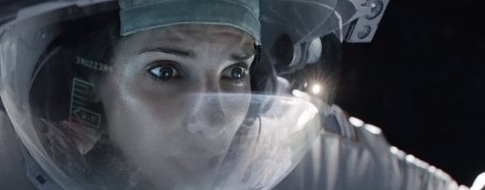
Look how distressed Sandra Bullock is, trying to glance into her crystal ball, straining to quantify how many Oscars her movie Gravity will win tomorrow.  I'm sporting the same look on my face as I publicly prognosticate winners for the first time since Jennifer Lawrence was in the Brownies.  But why not take a stab at it?  I've been spouting off on every other angle of the Academy Awards this year: diagnosing the narrowing field of "top" competitors for The Advocate; debunking popular myths about the Oscars and their biases in The Washington Post; and discussing some favorites among this year's nominees and some formative Oscar moments with Der Spiegel, though if Sie kein Deutsche sprechen, you won't be able to read it.  What I have not done anywhere, in any language, is forecast who is winning or fess up to my own choices.  So many of my favorite people are sticking their necks out.  So, as Charles Busch belts out in Die, Mommie, Die! - widely regarded as a near-miss for a Best Picture nod in 2003 - "Why not me?"

Best Visual Effects
Gravity will stomp all over its competitors, making it the sixth Best Picture nominee in a row to cop the prize (after Benjamin Button, Avatar, Inception, Hugo, and Life of Pi, just so you don't have to look it up).  You may take this streak as proof of the Academy's growth over the years—since even within my lifetime as an Oscar queen "effects movies" were often persona non grata in Best Picture—or all you may see is an industry increasingly compelled toward digital extravaganzas. Either way, Gravity would probably mop the floor even with the five past winners I just named, much less with the competitors it has to vanquish here... which in a way is too bad, because there's a lot to say for the invigorating spectacles and sleek execution of several sequences in Star Trek and Iron Man 3.  I was less taken with the effects work in The Lone Ranger (yes, even as regards that train crash), and The Hobbit: The Desolation of Smaug was one of a handful of Oscar nominees I missed in theaters. Will: Gravity  Should: Gravity  Hey, Where's The Great Gatsby, which owes the bulk of its locations, color schemes, camera movements, and memorably debauched extras to digital intervention

Best Makeup and Hairstyling
From an impressively strong field we slide over to an annoyingly weak one. Dallas Buyers Club will probably win on default, since voters tend to gravitate to Best Picture nominees unless there's a stirring reason not to.  Jackass Presents: Bad Grandpa is many things, but not that.  (Actually, Bad Grandpa on its best day is only a couple of things, which disappointed me, since I thought the first Jackass movie was a hoot.  Especially seeing it in a Detroit shopping mall, with people flashing laser sights on the screen midfilm.)  The Lone Ranger has the more-is-more thing nailed down, and a lot of graphically arresting cosmetics have been lovingly applied to actors like Barry Pepper and Helena Bonham Carter.  Still, AMPAS has recently rejected some ostentatious contenders who would have been shoo-ins in the Rick Baker era (The Time Machine, Norbit, Hellboy II) when a more broadly admired film presents itself as an option (Frida, La Vie en rose, and Benjamin Button in those cases).  I think it might have been nice if more of the Buyers Club's subscribers had looked visibly ill.  I would love to see a bruising throwdown between those who insist that Johnny Depp's bird-stapled-to-his-head "Native American" is the year's most horrifying faux-archetype and those who proffer Jared Leto's eyebrowless transwoman for the same distinction.  But failing that battle, and following the canny publicizing of Dallas's breathtakingly low budget, Adruitha Lee and Robin Mathews ought to get own their chance to say "All right, all right, all right!" or possibly even speak about Neptune. Will: Dallas Buyers Club  Should: Lone Ranger  Hey, Where's American Hustle, obviously, but also the lightly greyed hair of Llewyn Davis and the wax-museum quality of so many of his acquaintances.  Also, Cate Blanchett's Park Avenue blonde tresses in Blue Jasmine, which are turning into dark roots before her eyes, or ours at least.

Best Supporting Actor
On the subject of Dallas Buyers Club, I thought the movie was fantastic and Jared Leto pretty good the first time I saw them.  Upon revisiting a week or so ago, Dallas betrayed more stress marks, and Leto—by now vaulted from Casting Stunt That Paid Off to Prohibitive Favorite for the Oscar—still seems ...pretty good, without quite explaining what Rayon's doing in this script.  There are some pearl-clutching gestures and other frou-fra in the performance that make it seem stale, conceived more for an audience than from a character who's been built feet up, as they say in American Hustle.  And speaking of Hustle, Bradley Cooper has a large enough part in that movie that he's drawn fire for being a lead falsely slumming in this category.  Yet there are lots of ways to confront the question of who's really "supporting" in a film.  Leto's scenes are more limited, but every single one is handed to the character to be charismatic, or tragic, or funny, or all three, just like Angelina Jolie's and Jennifer Hudson's scenes were in their Oscar-winning vehicles. The movie arguably supports him more than the reverse. Cooper is on screen bunches but, like most of his Hustle castmates, acts an over-the-top character in a strong way and still doesn't seem like he's showboating, or depriving his co-stars of the cues they need to enrich their work.  He and Abdi are the Bests in Show in their movies without ever looking like they realize it.  Fassbender, like Leto, is cleverly playing a thesis that's been posited in the script in place of a real character: in one case, the AIDS patient with a wavering commitment to living, in the other, a slave-owner as one-man multiplex of grimy perversions.  Hill is ...uh, very good in 21 Jump Street and Moneyball.  I have no idea who he's playing in Wolf of Wall Street, no matter how hard he's working to keep the badminton birdie from landing. Will: Leto  Should: Cooper  Hey, Where's James Gandolfini, who didn't need an iota of gratuitous sentiment to merit a nod for his middle-aged romantic, so tentative yet brave, so relaxed yet staunchly principled.  Plus the usual surfeit of guys who got no promotion (Ben Mendelsohn in Place Beyond the Pines, David Oyelowo in The Butler) or who indulged in the sin of acting in non-American films (Yiftach Klein in Fill the Void, Peter Kazungu in Paradise: Love).

Read more »

Labels: , , , , , , , , , , , , , , ,

Saturday, October 06, 2012

The Fifties for 2012: Cinematography

This was by far the easiest lineup to assemble, rising like cream even above the worthy runner-ups:


Best Cinematography
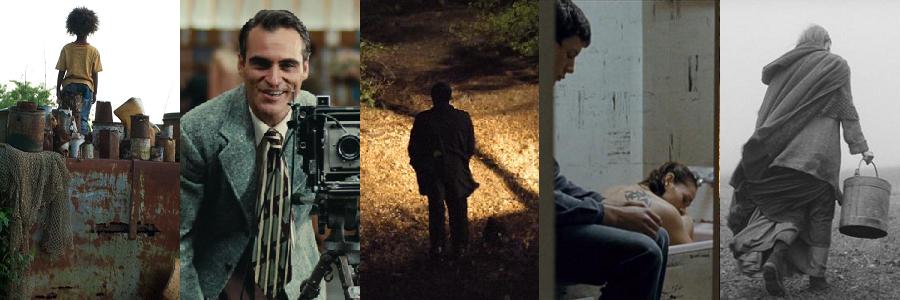
Ben Richardson for Beasts of the Southern Wild, for seamlessly blending natural lighting and fantastical accents, pulling out detail even in quick-moving shots, making FX-heavy images work;

Mihai Malaimare, Jr., for The Master, for making 65mm more than a talking point, using it to galvanize the movie's preoccupations with captivating surfaces that feel impenetrable;

Gökhan Tiryaki, for Once Upon a Time in Anatolia, for fields of deep black streaked by dazzling pools of headlamp or flashlight illumination, and for granular detail in close-up or long shot;

Adam Arkapaw, for The Snowtown Murders, for injecting such Polaroid seediness into his typically vivid compositions and sharp edge-lighting, and using fluorescents to such advantage; and

Fred Kelemen for The Turin Horse, for the lithographic beauty of its silvers, greys, and blacks, for making air palpable, and for the impact of quotidian objects and textures.

Honorable mentions, as I say, trailed these field-leaders, but that's no discredit to work as good as Jakob Ihre's fluid camera movements and remarkable sensitivity to faces and social dynamics in Oslo, August 31st; Mátyás Erdély's muscular sequence shots and stomach-tightening play with depth of field and off-screen space in Miss Bala; Florian Hoffmeister's amber, ink, and indigo variations on Terence Davies's delicate house style in The Deep Blue Sea; Robert Yeoman's artfully two-dimensional, broad-palette storybook aesthetics in Moonrise Kingdom, with more warmth and subtle human detail than Anderson has attained since Tenenbaums; and Robert Elswit's characteristic elegance with color and composition, even amid frenzied sequences, in The Bourne Legacy.

Labels: ,

Wednesday, December 07, 2011

Eyes on the Critics' Prize: Safe

During the latter half of the 1990s, when my movie habit was really entering its mainlining stage, the Boston Society of Film Critics was the most excitingly off-consensus of the major American critics' groups, which was a particular pleasure to me because Boston is where I was living at the time. I have written before about my love for this group and their invigorating choices during this period, made all the more interesting by the lists of people who almost won during those years (like Katrin Cartlidge and Tilda Swinton in 1997, running close behind Helena Bonham Carter for very offbeat projects, and way out in front of Judi Dench, Kate Winslet, and Julie Christie).

The first Boston citation that really made me sit up and take notice of the group, during the first year I was attending school and absorbing cinema in that city, was the Best Cinematography prize for Alex Nepomniaschy's lensing of Safe in 1995. That season, the bulk of the prizes were being posted to Shanghai Triad, a typically dazzling light-show from the Zhang Yimou factory. The Oscar eventually went to the emerald greens, flying dirtclots, and battlefield immersions of Braveheart. At a stage in my movie education where "best cinematography" still meant "prettiest pictures," the Boston crowd's recognition of Safe's intimidating symmetries, its freezing pastels, and its wide-angle hyperbolizing of banal Valley interiors was a real wake-up call. Clearly, I would need to rent the movie as soon as the VHS bowed (!), motivated not just by a plotline that sounded so nervy and elliptical but by a panel-certified promise of visual imagination.

Granted, the indelible visuals of Safe have a great deal to do with the director's labors of framing the shot and placing the camera. How much this prize ought to have been shared between Nepomniaschy and Haynes is up for debate, yet it's notable that no other Haynes film has really looked like Safe, not even in the moments of Velvet Goldmine (shot by Maryse Alberti) or of Far from Heaven, I'm Not There, or Mildred Pierce (all shot by Ed Lachman) that evoke the antiseptic domesticities or the deoxygenated atmospheres that are so crucial to the earlier film. Those tropes get a very particular and brilliantly effective workout in Safe, and all the more so since the film was made for almost nothing, inside relatives' houses and a lot of other existing, creatively marshaled locations. Beyond the 2001/Clockwork Orange-style vertical lines, flat planes, and rectilinear severity of so many shots, and beyond the Fassbinder-ish way that Nepomiaschy and Haynes frame characters within nested boxes and under flat light (such that even casual encounters feel depersonalized and stagy), look how often the air just hangs there in Safe. Julianne Moore's line readings constantly suggest that Carol is being asphyxiated, but for reasons that make sense if you've seen the film, we have to feel that Carol is definitely getting air, and that something weird might be in that air.

There's a subtly frizzy quality to the light in Safe—making sunrays and pools of color diffuse a bit even in brightly lit rooms and sharply lensed shots. This lighting casts a slight blur in the women's locker room, the hair salon, the living room with the wrong-color couch, the sitting room with its DNA-shaped staircase, and even the "restorative" ceramic igloo where Carol eventually winds up. This quality of the light, not dry but not damp, not gaseous so much as atomically dense, makes the airspace in Safe matter in an almost literal sense, holding its own against the man-made structures and objects that are made so conspicuous in Haynes's shots. Carol moves through a vacuous, plastic universe, and later proceeds to an ostensibly cleansing, fresh-air retreat, but in all of them, she is constantly and unnervingly touched by vaguely visible, vaguely palpable molecules. What are those molecules? What do they bear within them or convey between them? Is there something inside them that makes Carol sick? (All the white noise in the sound design immeasurably assists this quietly creepy dimension of the lighting schemes.)

Nepomniaschy frequently has to help us locate Carol within very long and wide-angled shots, particularly by the standard of most interior shooting. Yet at the same time, Carol White is the last person in the world who should attract a spotlight, or a key light, or a backlit halo, which would feel all wrong for this profoundly recessive woman. Nepomniaschy is really ingenious, then, at helping us pinpoint Carol without violating the invisibility and insubstantiality that are fundamental to Haynes's and Moore's conception of her, using geometries within the frame or the softest caress of color or glow to highlight her when necessary, just the littlest bit. In other scenes where the camera is closer, as when Carol attends the allergist's office, the ugly, fluorescent lighting of the space is somehow just soft enough around Carol that we feel some compassion for her, some human weight and latent loveliness in her body. In this way, lighting itself extends an invitation to empathize, counteracting the institutional chill that encases her (including, for some viewers, the chill of the script itself, though Haynes's writing doesn't register that way with me). Something impalpable in these shots provokes us to worry and hurt for Carol, not mock her as a Barbie doll, or reject her as a zombie, or think of her only as a rhetorical stand-in for ourselves. Nor do we just sit there, helplessly perplexed as we might well have been by this soft-spoken San Fernando cypher. The light warms Carol as much as possible, even as it refrigerates her. I love, by the way, how Nepomniaschy allows Moore her freckles in scenes like these, more so than a lot of D.P.'s have done, and he doesn't adopt the easy strategy of making Moore's natural pallor register melodramatically as a signal of dangerous anemia.

Equally marvelous are Safe's shots in daringly low light: the overhead sex scene between Carol and her husband, the late-night prowl in the garden, the testy marital exchange across a mile-wide bed, the final straight-to-camera shot. In these moments, little except the crest of a cheekbone, the angle of a brow, or the copper sheen of her badly permed curls stands between Carol and a kind of Stygian oblivion. That such details communicate from within such broad, wide, grayed-out canvases, and that Carol's last, indelible lines ("I love you... I love you...") resonate as both encouraging and harrowing from within this world of shadow, have a lot to do with Moore's and Haynes's genius. But again, some of the credit is due to the precise calibrations of pessimism and hopeful sympathy that the cinematography invests in Carol's anxious days and in her waning, bruise-colored nights.

Safe's micro-budget miracles and nifty visual tricks don't stop here. Maybe that disastrous baby shower gets a little too pink/orange toward the end of the sequence, but there's a nice against-the-grain kick to any LA sunset that's allowed to look like lox that's been sitting too long at the buffet. I also love how the potted palms in the corners of those baby-shower shots don't remotely suggest a cute, predictable oasis of greenery and fresh air. If anything, they look brackish and black-leafed, as though the plants have got environmental illness, too, but like so much else in Nepomniaschy's shots, the effect isn't so strong that you notice right away. In general, Nepomniaschy cooperates well with the movie's smart production design, delicately highlighting props, shapes, and other visual triggers that make a suburban kitchen look subliminally close to a therapeutic center, or that foster a rhyme between a living room and a hospital room. The images guide our eyes in these and other ways, despite an overall aesthetic and a thematic framework that absolutely require the austere dehumanization of the film. The camera can't look like it's guiding us, or gratifying us at all, or even speaking our language.

Nepomniaschy hasn't had nearly the career one would project for the guy who made Safe look like a million bucks, despite having nothing but nickels to work with. He gave Joe Carnahan's Narc a nicely enervated texture and tint, but there's not much in it you haven't seen in other policiers. He filmed Julia Stiles falling in love with a prince, Drew Barrymore with a teacher, and a multi-culti group of high-school students with Antonio Banderas's dancing. He was the second-unit photographer on Country Strong and on most of D.J. Caruso's movies. I have no idea what to make of this successful but undistinguished résumé, but clearly, the most important signs of Safe's legacy fall elsewhere than the D.P.'s own filmography. I have thought a lot about Nepomniaschy's work in Safe while noting the rise of recent indie phenom Jody Lee Lipes, whose lensing of the apartment in Tiny Furniture recalled the deadening homespaces of Safe, but just a bit more preciously. His low-lighting of Martha Marcy May Marlene is often clever or evocative, and a few times, as in the swimming/diving scene, extremely resourceful, yet his images don't "stick" with me in the same way, and his visual strategies for coaxing inchoate, internalized trouble out of Elizabeth Olsen's remarkable face seem just a shade coarser and more obvious than how Nepomniaschy's camera interacts with Moore's equally remarkable face. Even the images I think I know best in Safe continue to pay new dividends the longer I dwell on them. I'll never know why Nepomniaschy doesn't have more filmmakers begging to work with him, but I'm glad he has one critics' prize to call his own, in recognition of one of the best and best-lensed American movies of its decade.

Previously in this series: Dead Ringers ('88)

Labels: , , , , , ,

Sunday, September 18, 2011

The Fifties for 2011: Images and Words

Here I continue my yearly enterprise of isolating the achievements I admire most from amidst the first 50 films I viewed from this calendar year of U.S. releases.

Please be advised, by the way, that Tim Robey and Joe Reid have both gifted us their parallel lists, Joe conveniently at the 50-mark as well, and Tim so far past it I wonder if he can remember it. Also, several commenters have got enticing lists to share. Keep reading around!


Best Cinematography
Stéphanie Weber-Biron for Heartbeats, because even if Dolan borrows most of his ideas, his films move gorgeously between swoony, heightened sensuality and deftly deoxygenated dolors;

Pavel Kostomarov for How I Ended This Summer, because faces and framings evince mystery, tension, and texture, landscape evades cheap pathetic fallacies, and Arctic glow is soft but spooky;

Adriano Goldman for Jane Eyre, because all the bounced light sources serve key themes, and moody lensing has a metaphysical severity that echoes Jane's tough, devout outlook;

Chris Blauvelt for Meek's Cutoff, because the palette's dusty austerity and the inspired boxiness of the Academy framing make these dioramas both antique and transcendent of era; and

Emmanuel Lubezki for The Tree of Life, because as in operatic music, Malick's camera is characterization and worldview, a free-indirect means for exploring souls without being of them.

Honorable mentions in alphabetical order by film title to Peter Zeitlinger for Cave of Forgotten Dreams, an atypically uneven but still exciting Alwin Küchler for Hanna, Kim Hyun Seok for Poetry, Reinhold Vorschneider for The Robber, who would have shared the citation with his hard-working camera operators, and the team of Yukontorn Mingmongkon and Sayombhu Mukdeeprom for Uncle Boonmee Who Can Recall His Past Lives. Maybe Boonmee should be in for Heartbeats? I'll live with it.


Best Screenplay
Mike Mills for Beginners, because a long chain of short, taciturn, yet revealing scenes can be harder to write but richer to discover than three acts of heavy dialogue;

Abbas Kiarostami for Certified Copy, because Kiarostami has not previously disclosed a knack for probing reality and illusion with such finesse or such stirring emotional depths;

Moira Buffini for Jane Eyre, because not since the mid-90s glories of Hossein Amini has anyone stayed so true to a landmark novel while so aptly condensing and taking risks;

Lee Chang-dong for Poetry, because a few stock scenes and meandering passages are a worthy tariff for such probing and delicate characterization, such breadth of mystery; and

Alexandru Baciu, Răzvan Rădulescu, and Radu Muntean for Tuesday, After Christmas, because to hold shots so rewardingly and lift performances to such heights, you need to start from an acute anatomy of intimacy and its failures.

Honorable mentions to John Logan, Gore Verbinski, and James Ward Byrkit for Rango. The year's funniest movie so far, The Trip, is too heavily improvised to count here, and apparently too much so to even credit a screenplay.

Labels: , , , ,

Thursday, October 28, 2010

Hit Me With Your Best Shot: The Night of the Hunter

Not only am I apparently over-challenged to join Nathaniel's Hit Me With Your Best Shot series by the posted deadlines, but most of us who participate continually moan about how hard it is to winnow down to just one shot, even though this is the whole point of the exercise. At least with Showgirls I knew right where to go, but I kept sneaking in runners-up for Angels in America and Requiem for a Dream. At least I committed to a favorite in each case.

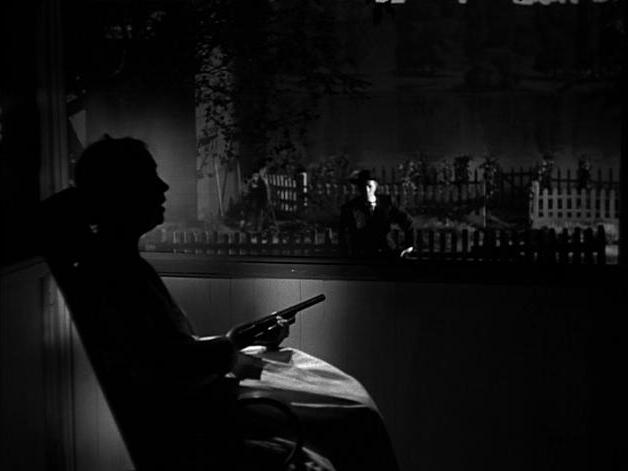
This time I'm cheating a little more, because the more deadline-savvy participants have already revealed their choices, and I couldn't help looking at their entries before I skimmed back through the movie. I love the peekaboo lighting trick that director Charles Laughton and legendary d.p. Stanley Cortez pull off with the candle and the window screen, while feisty Lillian Gish is keeping vigil with her shotgun, guarding her new wards from burly, devilish, implacable Robert Mitchum:


Jose likes this shot, too, so even if I would have picked it as my favorite (and I might have), I'll leave it aside for now.

I'm pretty sure my choice would actually have been "Not Quite Still Life, With Frog," one of several storybook tableaux featuring uncanny animal bystanders, during the kids' spooky flight down the river:


I just adore the cryptic, animist flavor of this sequence, which is shimmery and beautiful, but with the lenses pushing the frogs and the bunnies and the spiderwebs so insistently into the foreground that the overall effect is not entirely reassuring. Laughton and Cortez avoid telegraphing in any obvious way that the kids are absconding to a safer haven, or that having (barely) evaded the mad preacher's grasp has necessarily made life easy. To confess fully, however, I partly love the image because without it, and without the whole river-flight sequence, I don't know if Michel Gondry and Björk would have dreamt up her "Human Behaviour" video, and that would have been a great loss to humanity.


I also don't see how Martin Scorsese would have arrived at many of the images he burned into my brain in Cape Fear without Harry Powell to serve as Max Cady's stauncher, more barrel-chested grandpappy, always surreally lurking around the perimeter of the house he is haunting:


And I'm grateful for so many images that other Hit Me With Your Best Shot commentators singled out:


I'm especially fond of the top left image because I find it so breathtaking that Laughton and Cortez can orchestrate such an unbelievably strong, remarkably sustained, concertedly unrealistic look for their movie, and still accommodate so complete a departure from their template as these quick inserts of the (perpetually) drowned Shelley Winters. The light gray palette and minimal chromatic contrast, the diagonal angles, the unsettling motion of the formidably static camera, the flowing undulations of the seaweeds: Shelley hasn't just died, she's sunk to the bottom of a completely different filmic universe. From whose perspective—psychic or imaginative, rather than literal—could this shot possibly derive? I can't imagine the kids having this particular vision of their late Mom, though I'm not sure the rest of the movie exemplifies the kids' vision, either. Of all the times Shelley obligingly drowned on screen, this one's my favorite.

I also love the top-right image because even though the house towers over Mitchum's Harry, a fact that is only accentuated by the low angle of the camera, and even though the domicile all but crowds the human menace out of the frame, the compressed depth of field and the minimal shadowing everywhere except the front door area makes that house look awfully flimsy. Whereas, introducing a man-shaped black hole into the shot, resting with arrogant, Hud-like indolence against that crooked little tree, Harry seems as though he could raze the whole edifice in the time it takes to say "Leaning on the everlasting arms."

A few more favorites, since this is the end of the series' first season, and it's such a visually rich film:


Adore this opening aerial shot. Nothing's even happened yet, and already the kids of the world are sprinting for cover as though this is Cloverfield.


Like a re-write of the final shot of Shane, except this isn't about watching a boy's hero riding off toward the horizon, but watching a boy watch his father be apprehended by police, as though he's witnessing this awful trauma but also experiencing it as a sort of out-of-body experience. Again, the lensing and the bare minimum of shadow make it look as though Billy is standing before a screen painting of his father's arrest rather than implicating him spatially in the scene, though the advance of all those cops is undisguisably harrowing, and the implied sightline is devastatingly direct. Poor kid. His dad already feels so close and yet so far away.


Bless Laughton and Mitchum for allowing Harry some wit, and the film its own occasional, obsidian sense of humor. The actor popping his head down from the top bunk when we aren't necessarily expecting him to be a presence in the scene is even more chuckle-worthy as a graphic impression than it is unsettling as a certain pretext for nefarious behavior. This shot, too, gets a pointed reprise in Scorsese's Cape Fear. (Remember that Mitchum played the original Max Cady, too.)


One of the few close-ups I've ever seen of Mitchum where he almost looks conventionally handsome, and frankly pretty sexy. Screening Out of the Past and Crossfire yesterday, I was thinking of how carnally charismatic Mitchum succeeds in being without quite qualifying as handsome. He's shaped like a keg of ale, with an inverted pyramid or a funnel for a head, his brow much wider in circumference than his jaw, and his facial features stretched in a strange, triangular way like a drawing on a balloon, cinched with a knot at the bottom. It's a great face for movies, but an odd one, and only great because Mitchum makes it work as brilliantly as he does. But in this shot, he's much more straightforwardly attractive, and it makes Shelley Winters's Willa Harper make a little more sense in the way she breathlessly flings herself at him. Which, speaking of...


...is there a more devastating shot of spousal alienation in movies, especially on a wedding night, especially when we're expecting, as Willa obviously is, that Harry will be a force to be reckoned with in bed? Poor gal, even before she winds up in the drink, having handed her kids over to the monster.


And is there a more pitiable irony in movies than the fact that Billy can't help but react to the pitiful spectacle of terrible, terrorizing Harry being taken down like some petty vagrant, as though it's a replay of his Dad's demise—that he instinctively reaches out to his most fiendishly devoted antagonist, even permitting himself the emotional release that he did not allow at the moment of the initial wound?


How dear and how insightful, then, of Lillian Gish's Rachel to help Billy get over his father by allowing him to feel just a little bit like the man of her house, afforded the privilege of sleeping at her feet while the rest of the kids are locked up behind them. Is there a bit of the overzealous warden, though, in the way Rachel "protects" her charges? Is it odd that she sometimes looks more like ranch-hand of the kids than their den-mother caretaker, with her chickens penned inside her little coop, and with her trusty dog, subservient and silent, sleeping at her feet? She's a more than obvious Force of Good, but even Good can look a little strange, especially when you're dreaming. Sort of. Maybe.

(Note that all of these shots will luster even more once the Criterion DVD bows in the U.S. on November 16, in the 1.66:1 aspect that Laughton intended, and which the MGM disc compresses into Academy ratio.)

Labels: , , , , ,

Saturday, August 28, 2010

The Fifties for 2010: Best Cinematography

Following my picks for the best directors and screenplays. And no, despite costume and hair, Ben Stiller and Tahar Rahim were not separated at birth, though I'd love to see Rahim's take on Roger Greenberg.


Robbie Ryan for Fish Tank, for the intimacy and the claustrophobia in his 4:3 framings, achieving crackling color, light, and composition within social-realist bounds;

Harris Savides for Greenberg, for making Angeleno sunrays bland, merciless, and offhandedly enchanting in different scenes, and signaling unspoken affects so eloquently;

Yorick Le Saux for I Am Love, for unbombastic floridity, tweaking old styles with modern agitations and candor, and proving as chameleonic as Tilda in their two collabos;

Martin Gschlacht for Lourdes, whose crisp lenses and chipper colors evoke banal artifice, yet he coaxes uncanny depths from slow movements, patience, and eerie closeups; and

Stéphane Fontaine for A Prophet, who traverses a wild array of palettes and visual environments, grotty to sun-drenched, but coheres them through sustained visual energy.

Extremely honorable mentions to five runners-up who offered such strong work I'd consider them an above-average field in and of themselves: Michael McDonough's cold, steely, location-specific lensing of Winter's Bone, with some exciting departures from realism; Pawel Edelman's deliciously sinister handling of depth, framing, and geometrically blocked spaces in The Ghost Writer; Thimios Bakatatakis's tense, unsettling synthesis of Buñuel, Arbus, and Haneke in Dogtooth; Bernhard Keller's subtlety with flesh tones and bodily movements under the Italian sun in Everyone Else; and Adam Arkapaw's hot white silhouettes and precise framing in Animal Kingdom, which also handles close-ups very well as long as they're not gratuitously heavy on the zoom.

Further honorable mentions to Hong Pyung-kyo's vivid lingering on faces and colors, such that Mother seems controlled but ever-ready to go berserk; Barry Ackroyd's dependably active camerawork and deft nighttime shooting in Green Zone; and Eric Gautier's atypically pop-brite but characteristically shrewd lighting of Wild Grass, a fruitful matching of his sensibilities with Resnais's.

Labels: , ,

Sunday, August 22, 2010

2009 Honorees: Cinematography

In a perpetually competitive category, though this year wasn't as tough as some, my favorites of 2009 were...


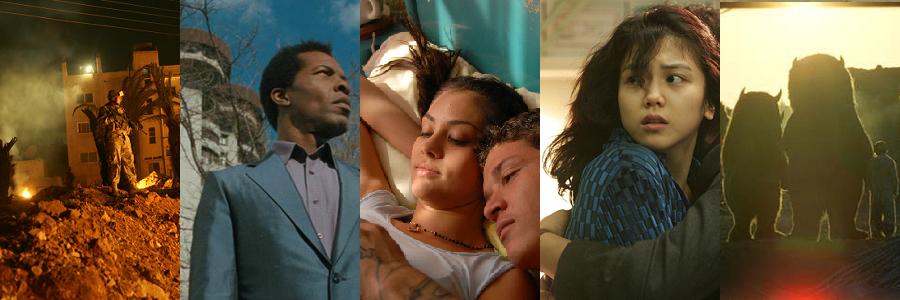
Barry Ackroyd for The Hurt Locker, whose ace kineticism no longer surprises but still invigorates, especially when blending the furtive, the laser-sighted, and the panoramic;

Christopher Doyle for The Limits of Control, because even beyond his delectation in bright, unusual hues, there'd be no movie without his managing of visual tension and geometric motifs;

Adriano Goldman for Sin Nombre, because what he lacked in novelty he more than compensates in striking, dramatic, rich-toned lensing, distilling place as well as edgy mood;

Jeong Jeong-hun for Thirst, who can go anywhere Park wants to go, from epic grandeur to woozy delirium to febrile abstraction, even in a film where light is the enemy; and

Lance Acord for Where the Wild Things Are, who fuses generational reverbs by braiding 60s lens flares, 70s dolor, and modern ironies, and relishes the woolly materiality of the Things.

Extremely honorable mentions to Yorick Le Saux for the lurid dynamism of Julia's camera movement and its natural and artificial lighting and to Gustav Danielsson for finding just the right lenses, palettes, and frames for Roy Andersson's ingenious tableaux mordants in You, the Living.

Further honorable mentions to Greig Fraser for Bright Star, Alain Marcoen for Lorna's Silence, the unbelievably named Martin Gschlacht for Revanche, and Alexis Zabe for Silent Light.

Labels: , ,

Wednesday, March 30, 2005

Man with a Movie Camera

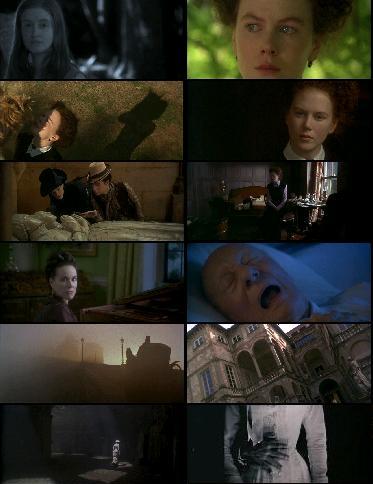
As in, does anybody put one to better use than Stuart Dryburgh, the English cinematographer who celebrates his 53rd year today? At least in his two collaborations with director Jane Campion, Dryburgh managed to create startlingly modern images that nonetheless hearkened back to the earliest days of photography—not just in the stop-motion trick shots in The Portrait of a Lady or the wedding-picture scene in my all-time favorite movie, The Piano, but in all of the tight close-ups, gleaming skin tones, aquefarious blues, sepia mists, and daguerreotype purples. These are easily two of the most gorgeous English-language movies of the 1990s, and aside from a weakness for wild angles and a few self-quotations (like Barbara Hershey framed at her piano in Portrait), their styles are admirably distinctive. Don't tell me you can look at these images...


...and not want to see the movie that they are from. In fact, don't admit to me that you haven't seen the movie that they're from. Don't even live like this. LOG. OFF. and go rent it. Really, you should be renting out the 35mm reels and projecting those babies on the side of your house, because the available DVDs for both Piano and Portrait are hair-risingly careless in their transfer quality and packaging materials. But that's a fight for another day. Just savor these images. Look at that closeup of Holly Hunter's hand caressing her piano keys through a crack in the packing-crate. Tell me that isn't from a silent movie.

Meanwhile, my man Stuart has not exactly had the career I would have expected since the two-shot with Campion. The same year as Portrait, he lent some nice photography to John Sayles' sprawling and subversive Lone Star (another great rental), but for some reason, he's been dicking around ever since in a bunch of romantic comedies, whether agreeable (Bridget Jones's Diary), forgettable (Kate & Leopold), or downright execrable (Runaway Bride, whose look was as garish as the writing, the performances, and the premise). The forthcoming Aeon Flux may or may not inspire confidence.

Come back to the 5 and Dime, Stuart D, Stuart D.! Obviously, this dude works well with women directors and he's a genius at the 19th century, so I'm hanging my hopes on Liv Ullmann's forthcoming adaptation of A Doll's House, starring Kate Winslet (!), John Cusack (?), and Tim Roth (mmmm...). Meanwhile, I can't be playing favorites, so here's some luscious Portraiture to look at on your way out, including the most remarkable dying scene in recent memory, when John Gielgud's character yawns himself into permanent sleep. Happy birthday, Stu. You changed my life, man.


Photo of Dryburgh © 1996 by Samuel Goldwyn Film. Photos from The Piano © 1993 by Miramax Films/Artisan Home Entertainment. Photos from The Portrait of a Lady © 1996 by Gramercy Pictures/Polygram Filmed Entertainment.

Labels: , ,