Wednesday, August 26, 2009

Films of the 00s: Spirited Away

A shame about Ponyo, which is often (surprise!) a kick to look at but is so lacking in narrative cohesion or persuasive emotion, and is so dully voiced by the dubbed cast of Anglo celebrities and, in two instances, their squealy younger siblings. Miyazaki really misses on this one, I think, even if my expectations were inevitably raised by the preceding weekend's return to Spirited Away. I have only seen Miyazaki's last three films, but isn't there a pretty general consensus that this is his masterpiece? It's not without its tiny flaws, but it's such a sumptuous work of imagination. Where you can see the demographic that he's trying to please with Ponyo, there's no way he made Spirited Away for anyone but himself, with all the weirdness and ambiguity that implies. From my new review:

"Chihiro's tasks are trickily superimposed: finding her parents and changing them back into humans, finding their way home, learning a new job, making sense of her companions and fairweather friends, assuaging the fiery Yubaba, working through a proto-attraction to the mysterious and changeable Haku. Because Miyazaki entitles each of these figures and plotlines to their own healthy measure of non-transparency, young Chihiro has an exaggerated but nonetheless a fully persuasive experience of adolescent confusion on multiple fronts. She herself is more rounded than the petulant but slightly blank and compulsory Ofelia of Pan's Labyrinth, and I appreciate that Miyazaki insists for so long and in such detail on the ornate workings of the bathhouse—has a center of relaxation ever demanded so much dizzying organization and helter-skelter commotion?—that it has a freestanding and magisterial integrity beyond its contingent role as a test of Chihiro's mettle. You have a sense that she has truly entered a perplexing, maddening, and magical world, rather than a hunch that an inventive filmmaker has devised some fancy tableaux for her to fumble through on her way to certain triumph. (keep reading...)

Labels: , , , , ,

Monday, August 24, 2009

Films of the 00s: Ali

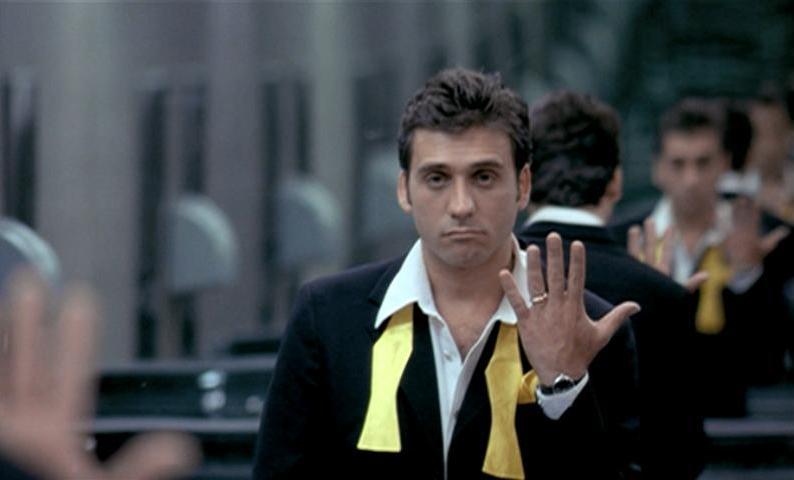
My first retrospective trip back to the movies of 2001 is another conversation review with Mainly Movies, this time devoted to Michael Mann's idiosyncratic and commercially underperforming bio-epic Ali. No question the movie is internally inconsistent in style, rhythm, and emphasis, but I couldn't help noticing that Ali was often invoked with embarrassment if not outright derogation in recent reviews of Public Enemies, and having admired the movie tremendously during its commercial run even as I struggled a bit to grasp what Mann was up to, I've been eager for a long while to revisit the movie and stick up for its intelligence and its unusual ambitions. I can see why Tim feels that the movie "has more flow than shape," and I have a few misgivings of my own (and a few more that, as ever, I didn't find time to err in this space), but we both still respect the movie tremendously, with perhaps a bit more visceral enthusiasm on my part. Have a look, and tell us what you think.
Labels: , ,

Friday, August 14, 2009

Films of the 00s: Late Marriage

If you were bummed that I ended the 2000 retrospective (at least for now!) with such a lukewarm review, I can doubly make it up to you. My first trip back to 2001 is not only an unqualified rave, it doubles as the next entry up, aka #27, on the Favorites countdown, which has been dormant ever since we checked in on Howards End last December; no question those Wilcoxes have got a splendid cottage there, but I didn't mean to slumber there for quite so long. Here, then, is a peek at what I have to say about another family's crisis of social conventions, class prejudices, and sexual mores in Dover Kosashvili's stark, punchy, funny, and humbling Georgian-Israeli dramedy Late Marriage:

"Even given its stripped-down style, the simply but sharply drawn characters, the bluntness of its sexual scenes and of its dramatic narrative turns, Late Marriage is apparently much more than meets the eye, or the English-speaking ear. I love knowing that even a familiar object contains so many unaccessed depths and complexities, but you have to hand it to writer-director Dover Kosashvili that his peculiar naturalism never pretends to be spelling out all of the meanings in the story or the currents between the characters.... Dramaturgy alternates, sometimes on a dime, from the casual ease of Zaza's scenes with Judith and her daughter to the sinister ritualism with which Zaza's extended family intrude into the apartment to the grippingly dilated reality of Zaza and Judith's love-making, amidst which Judith reveals a secret that ironically invites comparison to the character who is her most formidable antagonist." (keep reading...)

Because Sandra Bernhard's "smash hit one-woman show" Without You I'm Nothing rocketed up the chart after last winter's revised rankings, we're just now catching up to it at #26. Which means we've only got the very best quarter of my stable of prize pets to explore, plus, back on the 00s track, a handful of beloved films I haven't looked at in a while, some mixed bags that I've never stopped arguing about (think eyeliner and Izod dresses), and a sampler of titles I've never seen, ranging from boisterous epics to silly shenanigans to coolly received products from some of the world's most legendary auteurs. 2001: A Blog Odyssey.

Labels: , , , ,

Wednesday, August 12, 2009

Films of the 00s: Two Family House

After Timecode, I was both eager and nervous about checking in with its polar opposite, a determinedly modest dramedy called Two Family House that reaped some genuinely warm word-of-mouth during its brief commercial run. I can't say I was a fan, but I concede that for certain viewers, Two Family House will be eminently embraceable as "the kind of movie they just don't make anymore." To wit:

"It's obviously snobby to hold one's preferences above others', confusing any line between judgment and personal taste, and I don't want to do that. Besides, Two Family House was as beloved by most critics as it was by its tiny but devoted audiences, so I stand to learn something from its fans. I just couldn't convince myself to join them, despite the movie's occasional pleasures and admirably atypical environment. Unfortunately, the look, pace, and structure of the film stop feeling elegantly restrained and pass into something like boilerplate mediocrity." (keep reading...)

If an ardent fan of Two Family House can talk me up, I'd be delighted to hear the pitch. Otherwise, we'll soon be moving on in the interest of time from 2000 to 2001, even though it will mean short-shrifting several titles from the turn of the millennium that I recently caught and wanted to trumpet: the monumental but poignant Werckmeister Harmonies, the spirited Faat Kiné, the lengthy but transfixing Eureka, the austere but profoundly moving A Time for Drunken Horses, the sweet romance Big Eden, and the wonderfully amiable Snatch. Hopefully, I'll squeeze out a word or two about these at some point, and I had more titles from 2000 that really cried out for a first acquaintance or a second look, but that's just as true of 2001...

Labels:

Thursday, August 06, 2009

Films of the 00s: Timecode


Far be it from us to disappoint two of my loveliest and most loyal readers, Catherine and Glenn, who specifically asked for this conversation. And far be it from Tim or me to treat Timecode as any run-of-the-mill picture. I don't just mean that we managed a greater-than-usual difference of opinion, though I hope that's a welcome splash of novelty, and an incentive for lots of you to chime in and take some sides, or pick your own battles. Even beyond that, we had a lot of fun with this piece. One might say, four times as much fun as usual. Choose your own path! It's that kind of conversation, because it's that kind of movie.

Labels: ,

Thursday, July 23, 2009

Films of the 00s: O Brother, Where Art Thou?

Well, some things never change, and I guess the conversation-killing power of Up at the Villa is one of those things. I didn't pick this as my next post on purpose to attract more comments, but I suspect you all will have more to say. O brothers and sisters and everyone in between, what think thou?:

"The Coens are not always as smart as they pretend to be, even when they admit that they are pretending, and even when they use their own dramatis personae to set an ostentatiously low bar for their own comparative wit and urbanity. Normally, I'd be only too happy to snuggle up to a movie with lines of dialogue like 'She's at the 5 & Dime, buying nickels' or, with great consternation, 'These boys desecrated a fiery cross!' But the Coens are like party acquaintances who keep changing the subject and then staring at you quizzically when you can't follow the thread, or when you stop wanting to follow it, but who then block all your exit routes from their obnoxious conversation. They make it damned hard to pan one of their technically prepossessing, unimpeachably distinctive films without collapsing into standby allegations about their coldness and their cruelty." (keep reading...)

I've done more '00 viewing in the mornings before work than I'm letting on in the sidebar. Possible future topics of conversation: hijacked buses, split screens, Iranian smugglers, Staten Island, Pikey boxers, African feminism, dead whales at midnight, gays of the past, and gays out West. What sounds good?

Earlier in this series: Up at the Villa, Bamboozled (with Tim), Mission to Mars, The Beach (with Tim), Dôlè, La Captive, American Psycho, and Wonder Boys

Labels: ,

Monday, July 20, 2009

Films of the 00s: Up at the Villa

Having favorably invoked it amidst my rather vehement slagging of Chéri, I thought this might be an opportune moment to check back on things Up at the Villa, and to see whether Kristin, Sean, Anne, Jeremy, Derek, and those nutty Haases were indeed as deserving of my counter-consensus affection as I remembered. The answer is a newly qualified yes:

"I still agree with the spirit and drift of this review, even if a second viewing and nine years' accumulated experiences makes me a tad less sanguine about the filmmaking and a bit blanched about a few of my earlier overstatements. My frequent recourse to the language of 'satire' and phrases like 'whale of a good time' are likely to oversell the verve and implied joie de vivre.... And yet, in its wittiest moments, the film deliciously restores me to my initial plane of enthusiasm, no less so for operating more subtly than I communicate in this write-up." (keep reading...)

As you'll gather from this excerpt, I've eschewed a full reappraisal in favor of a codicil added to original write-up. Since almost no one ever talks about the movie, and even fewer seem to give it a fair shake, I hope you'll consider both the original piece and the amendments as encouragements to rent. Who doesn't want to go to Italy with Kristin Scott Thomas, Sean Penn, and a pair of smart, subtly cheeky auteurs?

Labels: , , ,

Friday, July 17, 2009

Films of the 00s: Bamboozled

Delivered with admiration in this centennial year of the NAACP!

"Four score and seven years ago... they was kickin' our black asses!" So begins one of Honeycutt's embarrassing but inspired comic riffs as the host of Man-Tan: The New Millennium Minstrel Show, the ghastly revue at the center of Bamboozled's estimable storm. I wish that my returning buddy Tim and I had found room to pay more tribute to how funny Bamboozled can be when it wants to be, how the Man-Tan show actually operates, and what tertiary figures like Honeycutt or his near-doppelganger, the protagonist's wreck of a father, bring to the proceedings. But there's only so long that we can bend your ear, and almost everything in the dizzying, maddening, electrifying Bamboozled invites heaps of conflicted commentary. I tried my best in my initial review, written nine years ago in graduate school, but I got more out of my new confab with Tim. We start with our memories of seeing the film for the first time:

TR: "Bamboozled...was one of the first films I reviewed for the Telegraph where I really wanted a lot more space. It was released in the UK in April 2001, a few months after I started the job, and I remember coming out of the screening buzzing, and with my thoughts pulling in all sorts of different directions. Because the movie already had the whiff of commercial pariah about it, this wasn't to be a lead review, and I knew I had a tough job on my hands communicating how this fascinating mess was actually to be recommended in fewer than 300 words: the flaws were manifest, the underlying intelligence, scalding and confrontational as it is, needed some careful argument to disinter...."

ND: "As far as I'm concerned, in the year 2000, I saw Bamboozled in a racially segregated, semi-concealed theater, and it only showed once per night, and I was the only patron there. Hence my sharp and bitter sense, during that first screening, that Lee was shooting grenades at vicious, longstanding American problems that powerfully persist, albeit under different guises...."

From there, we have plenty to say about the film's ceaseless self-divisions, the wavering targets and cogencies of its satire, the parts that work best, the parts that don't work at all, what do with the ending, and what is finally most important to emphasize about such a confoundingly sloppy-smart film. Again, there are entire shelves, whole aisles of cans of worms that we couldn't open. But the conversation isn't over yet! - as always, we hope you'll enjoy the whole piece and share your thoughts in the Comments field.

(By the way, as any Chicagoan who keeps track of how AMC plays the downtown 600 Michigan Ave complex against the nearby and much more deluxe Rivers East multiplex can tell you, the practices of quietly segregated booking are not gone, and not absent even in major cities. Look, too, at this article, linked yesterday by Nathaniel, about current distribution problems facing the Sophie Okonedo vehicle Skin in the UK and certainly, though the article doesn't reach this far, in the US.)

Earlier in this series: Mission to Mars, The Beach (with Tim), Dôlè, La Captive, American Psycho, and Wonder Boys

Labels: , ,

Wednesday, July 15, 2009

Films of the 00s: Mission to Mars

Most people hated it. Its supporters not only lionized it, they openly disdained the people who hated it, including their own colleagues. Had I followed these kinds of turf wars more closely in 2000, I would have made a point of seeing Brian De Palma's Mission to Mars and having something to say for myself. Certainly post-Black Dahlia, a fascinatingly mixed bag that prompted one of my favorites of my own reviews, I'm intent on catching all De Palma movies when they open, and on exploring more of his back catalog. So, to that end, better late than never:

"Call me craven, but I feel sure that Mission to Mars isn't nearly as bad or nearly as accomplished as its detractors or champions espoused amid their memorable slugfest. Say this for the movie: almost every memorable bit plays to the film's advantage, and certainly to De Palma's, even if the general fabric from which they emerge is more than a little frayed.

The opening sequence blends technical virtuosity with a kind of warm and personal storytelling modesty that's rare for De Palma: Stephen H. Burum's graceful, almost zero-gravity camera executes a miraculous sequence shot that evokes the breezy domesticity of a backyard barbeque, while staying just shy of being too smug or showy about its own formal accomplishment. No slam intended on Boogie Nights, but I'm more impressed when a sustained shot like this culminates in a textured evocation of an almost quotidian event than when filmmakers drop one in for obvious razzle-dazzle...."
(keep reading...)

After this film and The Beach back-to-back, I'll follow up shortly with something more esoteric for all you high-art types, though Armond White, Charles Taylor, and Pauline Kael (as if the first and second didn't already imply the third) would stress to us that Mission to Mars is high art. Meanwhile, my partner in crime Tim Robey will join me for another conversation about a film that I suspect we both admire at about the same level, but it's such a bold, fractious, complicated case that no two opinions are likely to be quite the same.

Labels:

Saturday, July 11, 2009

Films of the 00s: The Beach

As if sitting at my laptop writing, reading, and taking notes weren't social enough—on really exciting days, I swivel in the same chair to face the TV and DVD player—I decided to bring another voice into some of these retrospective reviews of Films of the 00s. And who better to invite than my favorite print critic, Tim Robey of Mainly Movies and the Daily Telegraph. Reading Tim's reviews or, better, chatting with him after a movie always clarifies my thinking about it. Since this series purposefully orbits around movies that I'm internally split about, either because I'm just now seeing them or because I have lingering uncertainties dating back to their initial release, I'm especially eager to talk some of them out and so, so excited that he's volunteered to dish.

Given his day job, which he conveniently started right at the top of the decade, Tim sees many more movies than even I do. Thus, finding movies that neither of us has already seen has proved a challenge, especially with the added hurdle of looking for offbeat titles that are easily available on both sides of the Big Pond. But speaking of pond-hopping, Tim was eager for a second trip back to The Beach, a post-Titanic, post-"P***y Posse" vanity/comeback vehicle for Leonardo DiCaprio, and probably Danny Boyle's most aggressive bid for a studio-funded mainstream Hollywood hit. Despite the marquee presence of Tilda Swinton, I had somehow never seen it. Here are some excerpts of our review:

ND: "Maybe since Boyle had so recently been so adept at making the drug-trips in Trainspotting so truly frightening and off-putting but simultaneously kicky and engaging, I was hoping he'd find a way to hyperrealize the sensual pull, the literal dangers, and the ethical quandaries of this scenario a little more. At the very least, don't you think it's a mistake of the script to partition the survey of life among the commune so fully away from the dangerous, glancing engagements with the gun-toting, pot-planting Thai mercenaries? For Richard and the Frenchies to commit so fully to beachy 'happiness' while knowing it involves regular, entrenched exposure to violence and brute corruption would be more interesting than compartmentalizing those looming threats only toward the beginning and end of the movie. Though the risk of racist iconography would have shot pretty high, this approach to structure might have furnished an effective decoy by which the corruption inside the compound would have emerged more surreptitiously, and as a more interesting test of the audience..."

TR: "By the time Richard is running around in the jungle like Martin Sheen meets Rambo, Boyle has inelegantly retreated into his default final-act mode of Trippy Psycho Overkill—cf. Eccleston in Shallow Grave, Renton vs. Begbie in Trainspotting, Murphy's bloody woodland spree in 28 Days Later, the Sun-God killer/whatever in Sunshine. It's not enough. I like the hints of Richard's moral alienation right at the start, particularly the way he closes the door behind him while regarding Daffy's corpse (though that's another good scene half-ruined by "this-was-some-crazy-shit!" voiceover). But this idea isn't followed through properly in the paradise sequences, and Leo, who is very uneven, can't do much to make Richard's bandanna psychosis actually work as a dramatic device. Still, I do appreciate the way his lie about copying the map comes back to haunt him—the way reducing it to a half-lie ("I only showed it to them!") actually makes the situation worse, the way Tilda turns on him, the dumb obliviousness of the new visitors, which sends a chill...."

Lots more where that came from. And how about you: do you remember the film? Did you read the book? Do you have Leo's back a bit more than we do? If this were 1998, I'd be a dead man by now. Can you settle this whole did-they-or-didn't-they dispute? Chime in with a comment.

Earlier in this series: Wonder Boys, American Psycho, La Captive, and Dôlè

Labels: ,

Thursday, July 09, 2009

Films of the 00s: Dôlè

Judging from the comments (what comments?), this retrospective series about buried gems and split decisions from the last ten years is more fun for me to write than for you to read, but what can I tell you. I like it, and I'm learning a lot, as I certainly did in my first encounter with Dôlè, a Gabonese film from 2000 that had been pitched to me in the past, somewhat maladroitly it turns out, as a West African Boyz N the Hood. That's tall praise and there's a nugget of merit behind it even if I don't think the comparison really holds. Still, while Dôlè isn't a slam-dunk, it's an engaging and a visually accomplished 79 minutes, which certainly eclipses lots of better-marketed movies that have some comparable inspirations at heart. To wit:

"A Slumdog Millionaire nearly ten years avant la Boyle, this shortish Gabonese feature has the good sense to avoid either the chirpy fructification of poverty as entertainment or the sensationalizing of grisly violence as an entrée into the life of some dream-deferred youths. School kid Mougler (David Nguema Nkoghe) wants to get in on the hip-hop game with his pals, especially lead emcee Baby Lee (Emile Mepango Matala), who sports a Fugees T-shirt while he rehearses the French-language lyrics of his favorite artists and chastises his buddies for mucking up their parts. It would be easier to hold the rhythm and master the words if these kids had a radio, which they still refer to as a 'ghetto blaster,' a few years after you stopped hearing that term quite so much in the American streets. Despite the likelihood that huge swaths of Dôlè's audience won't ever have seen a Gabonese film, or perhaps any West African film or any images of Gabon or Libreville at all, writer-director Imunga Ivanga isn't interested in the kind of social cross-section that would contextualize where and how and in relation to whom these kids live, to include whether they have their own 'ghetto' to blast. It doesn't quite look it, but unlike Boyle, Ivanga associates the frustration of have-nots with a series of sharply coded rules, fantasies, and assumptions, not with grabby emblems of abjection or televised deliverance..." (keep reading...)

Like a lot of African films, especially those without the auteurist pull of a Sembene or a Mambéty imprimatur, Dôlè is distributed in rentable, projectable, and purchasable formats by California Newsreel, which deserves all the thanks and the dollars it can get. Encourage your local or university library to buy it and then check it out.

Labels: , , ,

Tuesday, July 07, 2009

Films of the 00s: La Captive

I always enjoy when filmmakers betray their fascination with work by their peers, even when the lines of influence are as evident as they are from Kubrick to Akerman. It's a kick on a DVD supplement to hear this under-appreciated Belgian master compare her film La Captive, loosely adapted from Proustian example, to the widely rejected Eyes Wide Shut, and not principally because both movies rework early 20th-century literary conceits into the social and sexual idioms of nearly 100 years later. This La Captive certainly does, with just as much affinity for ironic anachronism as Kubrick betrays, and with a similar, powerful emphasis on the ways in which even shallow, diminished men control women, imagining they have absorbed them and known them fully. As in Eyes, which Akerman deliciously misremembers as a Richard Gere vehicle, the male lead in La Captive understands more and more that he has precious little hold on what the woman in his life thinks or does or feels, and if Akerman's film is a good bit slower and less baroquely daring than Kubrick's, fans of his film (and I know that a few haunt this site) may well be intrigued by hers. As added incentive, here's the start of my new review:

"Chantal Akerman's elegant and admirably committed updating of Proust disentangles the notion of the controlling, possessive lover from the commercially overworked figures of either the brutish Svengali, throwing his weight around along with his fists, or the imperious hedonist of either gender, wielding a charismatic erotic arrogance that pitifully abjects the lover who just can't seem to say no or cry foul. By contrast to these enduring types, the sexual captor in Akerman's movie is a pale, ageless, rabbit-eyed, neurasthenic male of the Ian Bostridge stripe, whose physical frailty ironically contrasts but hardly neutralizes the vigor of his proprietary impulses. His name is Simon Levy (Stanislas Merhar), and though he's too restless, mobile, attentive, and jealous to be a simp, he often makes comments despite his cream-complexioned youth that call to mind those aging, terminally incommoded women who nonetheless rule their respects roosts with barely contested authority in any number of 19th-century English novels. Bathing before a pane of frosted and beveled glass, on the other side of which his coveted lover Ariane (Sylvie Testud) also languishes in a tub, Simon rhapsodizes in his peculiar, semi-detached way about the visual, textural, and aromatic wonders of Ariane's body, her skin, her vagina—while nonetheless imploring her to give herself a good scrub. 'If it weren't for my allergy and all the pollen you bring in,' he says, 'I almost wish you'd never wash,' a line that would work as either a wry or a broad comic indictment of brattish, whey-livered romantics who guard, relish, but find themselves intimidated by the robust materiality of the women they idolize and thereby objectify..."

I hope you'll keep reading and at least consider renting!

Labels: , , , , ,

Saturday, July 04, 2009

Films of the 00s: American Psycho

This post was not intended as a flip rejoinder to Independence Day, though when I realized it had that potential implication, I can't say I rushed to defuse it. Make of this what you will!

I was initially mixed about Mary Harron's American Psycho, but it's a hard movie to forget or to shrug off. Ten years later, that much further into Harron's unusual career and well past Bale's arrival as a major star (though who knows if he'll stay that way, given his recent string of vehicles and performances), I am still mixed on Psycho in a way that's hard to parse. What's forceful and confident and strong in the movie is clenched so tightly to what's clichéd and imprecise and chaotic in it—at some moments more than others, but especially towards the end. Still, I'm more inclined now than I apparently was in 2000 to accentuate the positive in this strange and striking movie. Here's how my new review starts...

"As early as Little Women and The Portrait of a Lady, maybe even earlier, Christian Bale's face has always been a kind of parodistic exemplar of the word 'chiseled.' As Patrick Bateman in American Psycho, Bale famously mapped that adjective onto his whole body. If his sharp brow, ever-enviable cheekbones, and suddenly statuary muscles seem preternaturally planed and hewn, via a regimen of exercise and cosmetics to which an early sequence memorably introduces us, there is also an aspect of the severe, maybe even the fascistic about this Wall Street pirate's pursuit of his inner and outer Superman. Chiseling isn't just a metaphorical or an autoerotic activity for Patrick, who also likes to slice and carve people up, although the Guignol assaults and starkly photographed red-on-white bloodbaths in Mary Harron's movie were never its most interesting element..."

What is its most interesting element, at least according to me? I'll tell you if you keep reading...

But by the way, does anyone remember that Lions Gate promotional stunt where you could sign up to receive daily e-mails from "Patrick Bateman" leading up to the film's commercial release? File that under creepy oddities in the annals of film advertising...

Labels: , , ,

Thursday, July 02, 2009

Films of the 00s: Wonder Boys

At noon today, July 2, we will officially hit the midpoint of 2009. As is true for a lot of you, I'm sure, there are contexts in my professional and personal life in which I can barely handle the fact that half of the calendar year has already passed. The prospect of So Much To Get Done, shot through with the horror of Where Does All The Time Go?, can be quite debilitating, so I choose to redirect that energy into a sort of New Year's Eve-ish posture of wistful serenity: Remember This? How About That? Look At Everything We've Done.
Getting closer not just to the end of the year but to the end of a decade—I know, I know, not in mathematical point of fact, but by cultural consensus—means that the retrospective mood is setting in strong and early, and it's here to stay for at least six more months. I've been thinking about all the movies I've seen that came out since all of our computerized infrastructures didn't crash at Y2K. Though I often feel compelled to revisit durable favorites, my stronger desires of late have been to catch films that sailed past me in their commercial runs, or to take a second or third spin with titles from the 00s that I worry I might have under- or over-rated, or cases where I flatly can't predict how I'll feel about a given film now that more years have passed. So, unlike that "Plays of the 00s" series that's unfolding on my miniature theater blog, which revolves around annual prize-winners and word-of-mouth hits, my "Films of the 00s" series, inaugurated as 2009 has officially begun winding down instead of up, has broader and weirder goals: taking stock of films I missed, films where I didn't match the critical consensus, films that I felt mixed about at the time and still do, films I've caught myself flashing back to when I never thought I would, films that were personal pets at the time but that I haven't thought about a lick since, films that in one way or another say, "Give me one more chance!" Stay tuned through the rest of the year.... among other things, this project oughta help me craft some Best of the Decade lists that I can really strongly get behind.

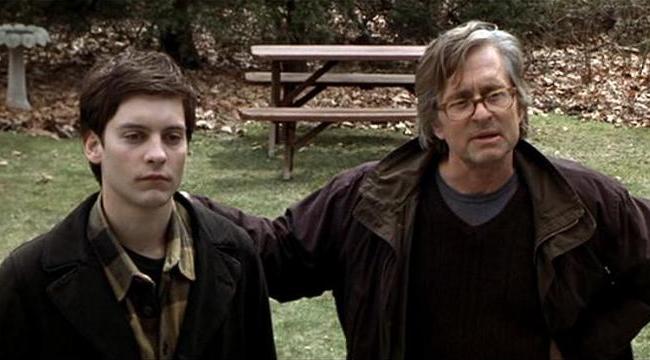
To kick things off, I took a third spin with Wonder Boys, a film I loved enough in 2000 to see it twice, even though Paramount had a hell of a time selling even one ticket to almost anyone except delighted critics and devoted cinephiles. They even released it twice, to no commercial avail. I was an ardent fan at the time. Suddenly, in 2009, I find that I'm... just a fan. The problem, it turns out, is its star performance, one of the very elements that drew the most hosannas at the time, including from me. From my new review:

"What Wonder Boys has in spades, beyond the heroic self-confidence to make a dramedy with so many non-cartoonish adult and semi-adult characters (and academics at that!), is a terrific sense of economy: you don't, for example, need to see much of the Grady/Sara relationship to glean a strong sense of its moods and backstories, just like you don't need more than one vertiginously high-angled shot of a wet slice of pizza, drooping over a porch railing in the rainy dawn, to 'get' everything about the previous night's wild party. But Douglas's self-regarding persona and, I dare add, the story's and the script's own notions of Grady seem much less contiguous than I remembered them being with that air of crystallized understatement. The movie pushes him at us, almost as much as that infamously awful poster did...."

Read the rest here, and enjoy the series as it progresses, doubtless in fits and starts (doesn't everything around here?). I won't always have quite this much to say, or quite this much time to say it in, but hopefully I'll take occasions to jot at least something about films like Wonder Boys that I barely spoke about at the time, despite having lots of thoughts about them.

Labels: , ,