Sunday, January 31, 2016

Supporting Actress: Jan's Out, Feb's In

We've reached the end of our first month of the yearlong Supporting Actress retrospective, honoring the 365 movies that have yielded nominations in that category's first 80 years. (This year's AMPAS voters, whatever their other foibles, at least complied with my schema and furnished nominees from five separate films, which keeps my math on track.) I hope you've had fun reading along, if you have been.  You can click the image to the left and visit the Calendar for more on each nominated movie, plus a few individual performance reviews.

So, who are your five favorite nominees from this early batch? And, separate question, what are your five favorites among the films? My own all-star team of performances from this batch probably entails Judith Anderson for Rebecca, Fay Bainter for Jezebel, Jane Darwell for The Grapes of Wrath, Agnes Moorehead for The Magnificent Ambersons, and Barbara O'Neil for All This, and Heaven Too, with apologies to close runner-up Patricia Collinge for The Little Foxes. If we're talking actual movies, my cream of the crop encompasses Dead End, Dodsworth, Gone with the Wind, The Magnificent Ambersons, and The Philadelphia Story, though it stings to leave out Grapes, Rebecca, and Stage Door, especially.

What are your thoughts, dear reader? And—one more question—are there supporting performances by women from 1936-1942 that you especially wish had appeared on Oscar's ballot?

Lastly, do consider following along with the Supporting Actress films for February, already posted. The beauty of this feature is that you can already see what film will be up for review on the site and on Twitter for any given day. I'd love to hear other voices on the same movies. I know you're out there, you opinionated queens. Four of February's performances are first-time viewings for me: Paulette Goddard in So Proudly We Hail (1943), Lucile Watson in Watch on the Rhine (1943), and two winners, Ethel Barrymore in None But the Lonely Heart (1944) and Anne Baxter in The Razor's Edge (1946). Beyond my curiosity about these four, I'm especially keen to revisit The Song of Bernadette (1943), which I saw once, ages ago. I wish I remembered Crossfire (1947) more clearly. Two famous films that I didn't love the first and only times I saw them, Mildred Pierce (1945) and Key Largo (1948), are also ripe for reassessment.  And somehow, we'll all get through the mid-40s fad for nominating ethnically inappropriate performances: Aline MacMahon's "Chinese" peasant in Dragon Seed (1944), though she at least applies a soft touch; Gale Sondergaard's member of the palace in Anna and the King of Siam (1946); and, easily worst of all, Flora Robson's blackface part in Saratoga Trunk (1945, but nominated in 1946). Jesus, keep me close to the cross.

Labels: , , , , , ,

Sunday, January 09, 2011

Everybody Goes to Mike's, and Nathaniel's


Slow going on this blog lately; ironically, I've been quite active on other people's. Last week, Mike's site served as the headquarters for our latest entry of the Best Pictures from the Outside In series, where he, Nathaniel, and I chatted up Gentleman's Agreement, 1947's earnest exposé of anti-Semitism, and Rain Man, 1988's innovative fusion of mushy drama, luxury car ad, autism-themed PSA, leaked actor's-rehearsal footage, odd comedy, incipient Reagan-era self-critique, and inexplicably didgeridoo'd kitsch object. Please read the transcript and leave your comments at Mike's place, but come back here to vote in our Reader's Poll of your favorite Oscar champs from 1943-47 and from 1988-92.

As you already know, I tend to exploit the typically long hiatuses between Best Pictures... installments as a reason to investigate other titles from the same years as our current headliners. I made a huge dent in 1947 when all was said and done, though I still have some luscious-sounding reader recommendations like Nora Prentiss, Daisy Kenyon, and The Unsuspected to hunt down. I opted to fill out a year where I hadn't seen much, rather than round out my bulkier albeit U.S.-centric viewing history in 1988, so that remains a bit of a loose end, with the Angelopoulos, Eastwood, Kusturica, Kieślowski, and Menges titles remaining especially enticing. Also, now that Pete Postlethwaite has passed, I'm all the more eager to at least take another trip to the sad but incandescent Distant Voices, Still Lives.

Meanwhile, over at Nathaniel's recently spiffed-up site, I added my voice to the semi-regular Oscar podcasts that he convenes with Joe Reid and Katey Rich. As is true of his apartment, Nathaniel's blog remains a host-space par excellence, and it's sweet of him to keep inviting me over. In the latest conversation, divided into a Part One and a Part Two, we pore over the tea leaves of what films and performers do and don't seem bound toward Oscar nominations on January 25th. We also gloss a few favorite semi-candidates (or, in my case, a non-candidate) who ought to have been walking in the front-runners' shoes.

The onetime front-runner that Nathaniel, Katey, Joe, and I all wonder (and maybe hope?) will find itself locked out of the Best Picture race is Danny Boyle's 127 Hours—which, in a fortuitous coincidence, will also be the title of my next Best Pictures... chat with Nathaniel and Mike, given how long it will take to re-screen Laurence Olivier's Hamlet and Bernardo Bertolucci's The Last Emperor. Stay tuned, and in the meantime, a Top Ten of 2010 should follow in the next week or so, and maybe another special feature to keep things going at a steady hum in the new year....

Labels: , , , , , , ,

Wednesday, November 03, 2010

Voting Like It's 1947

After all this 1947 viewing I've been doing, considerably aided by your suggestions, I've hit the quotient of 30 U.S. release-year contenders that makes me feel justified in posting a personal Oscar ballot for the year. Which is the only framework in which I can really summon the will to discuss "ballots" and "voting" today. My only misgiving is that I've seen so many great performances, especially given the vivid and large ensembles of so many of the noirs and pseudo-noirs, that I wish the list hadn't just wound up looking like I did what Oscar voters so often appear to do: start with their five favorite movies and just keep ticking them off through every category. Lots of very close calls in arriving at these groups of five, and almost always at the expense of candidates whose films would have thrown more variety into the list.

So, by way of honorable mention, and since the main page for 1947 already clarifies my next stable of candidates for Best Picture...

Best Director: Alf Sjöberg, Torment; Jean Renoir, The Woman on the Beach; Carol Reed, Odd Man Out; Robert Rossen, Body and Soul; Robert Montgomery, Ride the Pink Horse or Lady in the Lake; Vittorio de Sica, The Children Are Watching Us

Best Actress: Joan Crawford, my beloved Possessed; Shirley Temple and Myrna Loy, The Bachelor and the Bobby-Soxer

Best Actor: Roger Livesey, I Know Where I'm Going!; Cary Grant, The Bachelor and the Bobby-Soxer; Victor Mature, Kiss of Death; Robert Ryan, The Woman on the Beach; Ronald Colman, A Double Life; Edmund Gwenn, Miracle on 34th Street; Dana Andrews, Boomerang!; Nikolai Cherkasov, Ivan the Terrible, Part 1

Best Supporting Actress: Elsa Lanchester, The Bishop's Wife; Celeste Holm, Gentleman's Agreement; Marilyn Nash, Monsieur Verdoux; Gloria Grahame, Crossfire

Best Supporting Actor: Robert Alda, The Man I Love; Thomas Gomez, Ride the Pink Horse; Lloyd Gough, Joseph Pevney, and Canada Lee, Body and Soul; Lloyd Nolan, Lady in the Lake

Two bonuses: one is that Oscar's Best Supporting Actor lineup from 1947 turns out to be a really high-grade lineup, to include very solid work from Robert Ryan and Charles Bickford, though I preferred them both in other movies; the other is that, while I can't make up my mind about hypothetical Cinematography nods, I cannot see how the Academy omitted Body and Soul and Nightmare Alley. The Ghost and Mrs. Muir is very, very pretty but not quite in the same league, and I can't speak from Green Dolphin Street, but as ever, I think I smell a rat.

Not done with '47 till the next Best Pictures installment goes up, so I may still sneak in a few more titles. Recommend away if you've got performances to stump for, in addition to the films you might have pointed me toward in the previous entry.

Labels: , , , , , ,

Friday, October 29, 2010

Further into 1947

I loved having the Chicago Film Festival to break up my days of book writing and revising, and now that it's concluded, I've been running an unofficial festival of my own of the movies of 1947. I tend to do this when I've finished re-screening the Best Picture victors that Nathaniel, Mike, and I will be discussing in our approaching installment of the ...Outside In series, and I'm curious to flesh out my sense of the annual crops from which Oscar anointed his favorite. I've changed my ideas about Gentleman's Agreement in certain ways since the last time I saw it, so I'm not spoiling the conversation we three musketeers will eventually have when I say that, all the same, it's an uninspiring winner. And already I've made thrilling dates with much-loved or at least widely admired classics that I'd never seen (Out of the Past, Kiss of Death, The Ghost and Mrs. Muir, Best Picture nominee Crossfire), exciting short films from the comically animated to the darkly lyric (Tweetie Pie, Le tempestaire), and less familiar outings from renowned directors (Hitchcock's The Paradine Case, Kazan's Boomerang!). I've also revisited some movies I saw so far back in my TCM-watching and VHS-renting days that they were in many ways new to me, and almost always delightful larks: The Bishop's Wife, The Farmer's Daughter, and especially the delicious if stylistically rudimentary The Bachelor and the Bobby-Soxer, the year's second-biggest commercial blockbuster, starring Cary Grant, Myrna Loy, and Shirley Temple on lustrous comic form and derived from an Oscar-winning script by Sidney Sheldon.

What I have not done is revisit the two huge auteurist touchstones from 1947, Orson Welles's deeply disorienting Lady from Shanghai and Charlie Chaplin's rather broad and scabrously off-putting Monsieur Verdoux, which sprang from an idea by Welles and many, many people regard as a masterwork. I've screened them both in big-screen restored prints, recently enough to at least trust my basic distaste for both, and though I probably owe it to the geniuses behind each of them to take another stab at some point, I am so not up for it right now.

But what should I be up for? I love reader recommendations in cases like these, either because you've already seen some of the films I'm still anticipating or because something jumps off my pre-selected docket that sounds as tantalizing to you, sight unseen, as it does to me. Major actorly showcases with durable fan bases, like Carol Reed's Odd Man Out with James Mason, or Robert Rossen's Body and Soul with John Garfield? Anthony Mann double-feature Railroaded! and T-Men? Relative obscurities by Ozu (Record of a Tenement Gentleman) and Kurosawa (One Wonderful Sunday), and better-known but seemingly minor work by Sirk (Lured), Leisen (Golden Earrings), and Renoir (The Woman on the Beach - check!)? Black-cast musicals Juke Joint, New Orleans, with its much-touted Billie Holliday cameo, and the enticingly named Boy! What a Girl!? The brooding darkness of Brute Force, Nightmare Alley, or Quai des Orfèvres? Actressy vehicles for Joan Crawford (Daisy Kenyon) and, in a rare leading role, Teresa Wright (Pursued)? Actor-director Robert Montgomery's Lady in the Lake, a longtime pet of film theorists? (His Mexican noir Ride the Pink Horse is an under-heralded gem of the same year.) British cult favorite Brighton Rock, apparently ruined by the Rowan Joffe remake now completing its global festival tour? Box-office bonanzas Forever Amber, Welcome Stranger, Unconquered, Life with Father, and The Egg and I, the latter two with Oscar nods for acting? Notorious MGM boondoggle Desire Me, the Greer Garson vehicle from which George Cukor fought to efface his name? The movie Cukor made that year that he actually liked, as did AMPAS, was the Othello-obsessed thriller A Double Life, probably due for a rewatch. And speaking one last time of the Academy, what about inaugural Academy anointee for Best Foreign Language Film Monsieur Vincent? The Katharine Hepburn twofer of Sea of Grass (another Elia Kazan project) and Song of Love (a dread composer biopic), which even I, as a lifelong devotée, have thus far stayed away from? What other titles am I not clocking at all, though I should?

I probably have room between now and November to absorb three or four more of the above. If you were setting my agenda, what would you pick? Fire away in the comments, and we'll see if we can reach a gentle(wo)man's agreement, or whether we get stuck in a crossfire.

Labels: , ,

Saturday, October 09, 2010

Best Pictures: The Best Years of Our Lives and Driving Miss Daisy

No time to write a snappy post, not when I've got a highly divisive movie about a belligerent, misogynist multiple amputee to head off to, and then thoughts to share with strangers, in a bowling alley, with a bar, about "Sex on Screen." As I annually repeat, it's so lovely of Chicago to throw me this festival as a birthday present every year, but this really is a new way to party.

Meanwhile, my present back to you, in cahoots with Nathaniel and that recently reactivated review-writing supermachine Mike, aka Goatdog, is our latest installment of the popular Best Pictures from the Outside In series. We love having these conversations, and we especially love that the comments are always so engaging and detailed and rich and on-point. Jump on in! Especially because the Wyler, at least, is one of the greatest movies Oscar ever rewarded. And 1 out of 2 ain't bad. Pretend it's baseball.

Labels: , , , , , , , , , , ,

Tuesday, June 29, 2010

DTs With Bats, Dances With Wolves


NICK: As I write this, I'm sorry to say it's been exactly five months since the last installment of Best Pictures from the Outside In, my regular series of rotating conversations with Mike and Nathaniel. The Lost Weekend turned into The Lost Winter and The Lost Spring. How did this happen? Well, I'll tell you. We each popped the full Director's Cut of Dances With Wolves into our respective DVD players on January 16, the morning after we published the last episode, and the movie wasn't over until yesterday. But we kid, Kevin, we kid, and if you really do have the technology that might help to clean up the Gulf, I'll never make a joke about you again. Anyway, if you're looking for the real culprits, check out this film festival, these 408 women, and the most joyous, indefatigably creative film blog on the web.

You need surfeits of joy to deal with The Lost Weekend, Billy Wilder's lugubrious drama about a writer's-blocked alcoholic named Don Birnam (Best Actor winner Ray Milland). You need just as many to hold up through Dances With Wolves, Kevin Costner's long, sobering chronicle of how the Lakota Sioux—depicted at first as the heirs of a hardy, reverent, and gallant way of life—are catastrophically displaced by the encroachments of post-bellum White America. Neither movie was a project that Hollywood studios were dying to make. In the final months of World War II, The Lost Weekend was trying to hawk a horrific story about an unsympathetic drunk that almost every major actor had declined to play. Dances With Wolves dropped the sexy, rising star of Bull Durham and No Way Out into an expensive three-hour epic that isolates him on an open plain for most of the first hour, then renders itself in large part in subtitled Lakota Sioux. And it sends people from the theater feeling sad and guilty. And did we mention the matinée idol in question had decided to direct it himself, despite no previous experience?

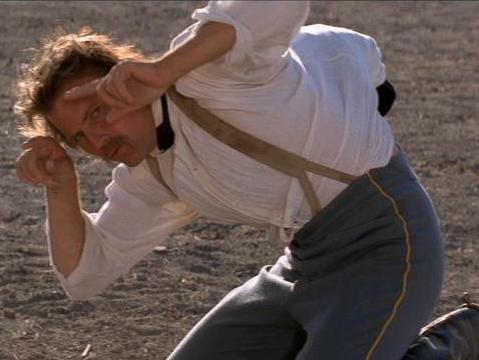
Milland's Don is a raving drunk. Costner's Dunbar is just... different.

With a lot of the movies we cover in this series, especially among the recent entries, I have a fairly strong idea of whether we'll gravitate toward enthusiasm or dismissal. Excitingly, though, I actually have no idea what either of you guys thinks about either film. Most reviewers at the time and more recent critics have identified some mixture of strong and weak elements in both movies, so before we each tip our hands as to our overall admiration for Weekend and Wolves, I want to ask: what, for both of you, is the single strongest element of each film? I'll answer, too, but it's my party to host this time, so I get to go last. And if only to teach Kevin a lesson about brevity, let's prove how much we can express in just a handful of sentences, maybe two or three per movie. Go!

NATHANIEL: We're rusty at this and you'd like us to start on a positive note and you'd like it to be brief? Quite the taskmaster! I'm afraid that when it comes to dishing out compliments to one Mister Costner the first description that came to mind was "neat." That's his own shallow compliment of choice to Madonna in Truth Or Dare, a compliment which she instantly gags on despite proving the lack of gag reflex later in her film.

You don't want me to start with the gagging so I'll say that I like that the look of the film isn't overly "neat". Despite the kind of duly saturated sunsets that win cinematography Oscars sometimes the film is content to look dusty and humble, particularly in regards to Costner's Little Hut on the Prairie. And I dig the wolf, an exquisite animal actor. I'd dance with it, too.

←BOTTLE: They like me, they really like me!

As for The Lost Weekend, I keep thinking about that hidden bottle, hanging outside Don Birnam's (Ray Milland) window by a string. Few movies offer up an early image that beautifully concise and versatile: it's a plot device, it's a literal representation of alcoholism, and it's a visual metaphor for Don himself, hiding away in shame and hanging by a thread.

NICK: A haiku: Taskmaster I am, / But those are gorgeous answers. / Mike, your turn to Dance.

MIKE: Brief I can do. Positive... we'll see.

I'm going to Stand with a Fist and name Mr. Costner the Actor as the best thing about Dances With Wolves. His complete ordinariness fit the character perfectly, not adding much nuance but serving as a representation of an average but smart Indiana boy stuck by himself in a mud hut. It's not a great compliment that his artless "acting" won the prize here, but a compliment nonetheless.

For The Lost Weekend, Nathaniel already nailed the best single element of the film—that bottle on the string is such a perfect encapsulation. So I'll expand by praising its attention to Don's obsession with acquiring and concealing bottles, the hyper-detailed strategy of which ones to leave for his brother to find and how to use his good nature against him, the increasing lengths he'll go to get them. It's a nice, small attention to detail in a film that tends toward big speeches and arm-waving.

NICK: Big speeches and arm-waving indeed, which is why my favorite moment in The Lost Weekend is easily the most comical, when Don Birnam gets caught attempting to rob the woman next to him in a fine restaurant, and the whole place erupts into a loud chorus of "Somebody stole a purse, somebody stole a purse!" I love how they all know the song, and they sing it with such merry, mocking gusto.

My Wolves answer is also musical: I completely adore the score. I realize John Barry pilfers a bit from his own Out of Africa compositions, but I think the music has a genuine, dark majesty to it, and an epic scale of feeling that helps the film earn its sense of scope and energize its runtime.

Honestly, I think Dances With Wolves is, all in all, a pretty strong film: flawed in all kinds of moments, but technically very accomplished and engaging at the level of story. But am I sensing I'm alone in this?

← Costner entices Oscar by stealing his favorite ensemble. Give or take the hair.

NATHANIEL: Well, I can't back you up there. I remember liking it well enough in 1990, though I never wanted it in the Best Picture race, and being vaguely irritated that Kevin Costner wasn't nominated for Best Actor. Twenty years later, I can't imagine what I was thinking in terms of the latter. Apologies to Mike but I think Costner is nearly disastrous in the lead role, especially in regards to the ever-present journal narration. We should be experiencing someone opening their soul up: new experiences, new cultures, new land, new language. That's a lot to take in. Dances needs a Lt. Dunbar with really expressive eyes and voice, capable of conveying inquisitive feeling and depth of conviction (though depth of intellect or feeling are not required). But there Kevin Costner always is, looking like he just stepped out of a late 80s hair salon and loosing all those flat bored Californian vowels on us. If the film hadn't been so famously his, I would have to assume it was a paycheck gig based on the evidence. Where is the passion? He's much better in the physical sequences, whether it's comedy (the naked discovery, his problems with low ceilings, or riding a horse in general) but for facility with a character arc this was a huge step down for him from Bull Durham and No Way Out.

It's the voice that I hate most. The hair is runner up. It only gets worse with the running time when he loses the only thing keeping him in period—the mustache—and meets that kindred spirit salon aficionado Stands With a Fist. I know this sounds incredibly facile but it's just so distracting to me... especially because the aesthetics of costume, set, and camerawork otherwise seem committed to time and place. The bored voice and the 80s hair just remind me that this was always a vanity project for a star at the peak of fame.

NICK: You might hate the performance so much, Nathaniel, that you're repressing the info that Kevin actually was nominated for Best Actor for this... though he was a sort of pioneer of the Blanchett-Tucci School of grimacing at one's own performance during the nomination reel. I like Mike's point about Costner's "average" quality desisting from making Lt. Dunbar some kind of saint or prodigy, but otherwise, I have to admit to subscribing to everything Nathaniel just said. His voice is the single thing I cannot stand about the movie, with or without a fist.

But the movie overall? Has it declined in other respects for you, Nathaniel? Mike, I take it you're also a detractor?

MIKE: I Stand With a Fist against the two of you. (How many times can we make that joke? as many times as we want to!) Maybe I'm letting my opinions about the film color my reception of Costner's performance, but pretty much everything Nathaniel said about him (aside from the 80s hair salon stuff—you got me there) makes me more convinced that he's perfect. The film is a fumbling, well-meaning attempt to show us Native American culture and the effects that whites had on it. It gets so much wrong, but its heart is in the right place, even if it is a little stupid sometimes. Costner's shallowness fits into that perfectly. And even though I, too, hate those godawful journal readings, his complete lack of inflection fits his very gradual change from his weird devotion to duty in the face of its pointlessness to his devotion to the culture that accepted him. If Hare Krishnas instead of Lakota Sioux had moved in next door, I think he would have joined them with just as much fervor.

As for the rest of the movie, I loved a lot of the acting around the edges, especially Graham Greene's befuddled nobility and Tantoo Cardinal's watchfulness. It tries mighty hard to avoid exoticizing the Lakota, which I appreciate, even though it's at heart about how much better the Exotic Other is than mainstream white culture. I'm torn. I genuinely liked it, but it's an embarrassed liking.

NATHANIEL: Allow me to elaborate on the nuances of my position—nuances, while discussing Dances With Wolves. I actually agree that the shallowness is not a problem. I like that he has such a facile understanding of the culture and that he's not a deep thinker. My problem with the film, I suppose, is that I don't really believe that it's aware of its shallowness. I think it believes in itself as a great social message movie and Dunbar as some great martyr/savior. Note that strange crucifixion pose in that early scene where he rides his horse into that sea of guns, certain of death but willing to sacrifice himself for the greater good. But what is he saving? The whole movie is a delay of the sad, inevitable crushing of the Native Americans.

I guess the self-importance and the obviousness of its message rub me the wrong way. Which is why I like it best when it's a little bit uncomfortable with itself. Like when Dunbar gets squeamish about the Sioux killing his fellow frontiersmen or when it allows you to sit in on the tribe meetings and everyone's opposing points seem valid in some way. I admire that the ending accepts defeat, even if it only does so in that familiar epilogue text-based way: "This is what happens after the movie ends," it says, in order to edify you. "In case you get your history from the movies!"

I'm feeling churlish now, because the movie does mean well. That's a prerequisite for winning Oscars, yes? If I rode into that village they'd rename me Bitches About Movie.

NICK: Agreed that the movie's heart is in the right place, but I also think it has enough strong scenes and a solid enough technical bedrock—sound, lighting, score, editing—that it roundly eclipses a lot movies with "heart in the right place." The heart is worn so close to Costner's own sleeve that I believe this film more than I do a lot of other movies with similarly naïve and exoticizing tendencies, whose politics often seem worked out by committee.


I do think Dunbar matures a bit over the course of the film. His early attempt at a cruciform suicide, brave but grandiloquent, doesn't seem to me to typify his more humble self-conception in the prairie scenes. Not that the earlier scene makes much sense, anyway. But I loved the shots of all the other soldiers' boots in that scene, so soon after we'd just gotten so down and dirty into the nasty truth of Dunbar's own injured foot. Little accents of montage and visual emphasis like that are gratifyingly frequent within the filmmaking; Costner seems legitimately to have thought in cinematic, image-based terms, even if they're awfully old-fashioned and sometimes ham-handed.

Are we required to address the buffalo hunt before getting drunk with Ray Milland? Mike, does the movie snag your attention in other respects than Costner's performance or its wobbly attempts at PC sincerity? Signed, Manages the Discussion.


And we'll be back, after this 60-hour buffalo hunt!

MIKE: I wish we could get drunk with Milland before addressing that buffalo hunt, which is, I think, the only time I was absolutely sure I was seeing footage from the extended edition. It went on FOR.EVER. And so extendedly brutal, too—even with the special film versions of arrows that drop buffalo instantly, instead of helping them bleed to death slowly. I don't know what the point was, actually, to how godawful long that sequence was. It reminded me of the five-minute "Yee-hah, get 'em going!" scene from the beginning of the cattle drive in Red River. OK, I get the point.

That said, you guys have covered most of what I like about DWW—the score, its willingness to be both gorgeous and ugly, the tribal meetings. I liked its only attempt to tie the first half of the film in with the ending, when Wind In His Hair reprises his "Can you see that I am not afraid of you?" in the shape of the more distant but more heartfelt "Can you see that I am your friend?" Actually, with a film that runs over three hours, I'm surprised there's not more back-and-forth referencing to create some kind of continuity. Aside from beautiful shots of waving grass, that is.

OK, I'm buying the first round, and it's good stuff, too: someone has to talk about Ray Milland. My mouth is full of whiskey and grandiloquence, so it's gotta be one of you two.


And we'll be back, after this 60-hour buzz hunt!

NICK: I sort of can't deal with Ray Milland in this movie. He has his moments, but the teeth-baring, wild-eyed approach to drunkenness feels more Reefer Madness to me than Academy Award. He does not seem comfortable conveying any emotional or psychological complexity, much less any charm or appeal to offset his obvious disastrousness as a romantic partner for the Jane Wyman character.

But then, I think Wyman and Phillip Terry are pretty woeful in the other lead roles, and the film keeps waffling between looking cheap and under-produced and looking gimmicky and over-worked. Wilder throws almost anything he can think of at this script, and some of it clicks okay, but a lot of it doesn't. The movie, like the lead performance, just seems so hysterical and cooked-up to me.

NATHANIEL: Hysterical and cooked-up? You mean you haven't hallucinated small animals devouring each other after a bender?

I can't really argue with this assessment—any of it—but in a way I liked the hysterical bits most. I know you're not exactly a fan of Requiem for a Dream, either, so maybe this is a personal thing? For myself, addiction stories work best onscreen when they're operating at opposite poles of stylization. They can be incredibly moving when they're dour and naturalistic (I think immediately of that 'let's get high one last time together' scene in High Art) but if I can't have them that way, I need them to be elaborately stylized like Requiem. I think that's the best way to get at the headspace of addiction, which isn't exactly rational or sane.


So, for me, the film worked best when it went a little off the rails. I'm not talking about the rather elaborate strategies for hidden bottles and cash grabs. Those scenes offered more rococo-cuckoo detailing than mere stylization. But I definitely liked the DT hospital trip and that overly sweaty walking tour of the city... on account of, 'What the hell?'

I hope I'm making sense. Basically I enjoyed the things that distracted or interrupted all the speechifying the most.

NICK: Requiem is an interesting comparison, and probably more apt than my own unexpected free-associations over to Precious. That movie's flourishes of fantasy and pure directorial conceit sometimes work and sometimes don't, and I can sympathize with the filmmakers' attempts to get "cinematic" mileage out of downward-spiral narratives (addiction, poverty, disease, what have you), which are so frequently inert on screen. But the reason I thought of Precious is that its swerves into fantasy almost always feel related in some way to the headspace of the character. Whereas, for example, the Dance of the Trenchcoats that suddenly overtakes the scene at the opera in The Lost Weekend just feels so arbitrary, and utterly unconnected to Don—although the initial conceit, that he's watching La Traviata and all he can "see" is the stage-drinking, plays pretty well. More importantly, where Precious, for me, earns its leaps into exaggeration or abstraction by handling the "straight" scenes and the performances with such force and insight, The Lost Weekend feels like it's on wobbly legs even when it's trying to be spare and candid, or to handle pretty basic three-character dialogue scenes.

I do agree, though, about the scenes in the DT ward, filmed in Bellevue Hospital. Those are pretty harrowing, and I like that Frank Faylen, as blond Nurse Bim, is the only actor who slyly insists on the homo-panic subtext that the screenplay basically excises from the novel, with its new emphasis on "writer's block."


MIKE: Weird, Nick, because I, too, thought of Precious during Milland's freakouts, but it was not a good thing. The flourishes in both films seem like just that—directorial flourishes, and completely unearned. The dead-serious straight scenes in Precious make the jumps to fantasy even more jarring (again, in a bad way), but oddly enough I don't think I minded the ones here as much because the general tone of The Lost Weekend is one of arm-waving and hand-wringing.

I, three, liked the DT ward scene in Weekend, and now that I think of it again, I think there's an interesting parallel between that scene and the one in DWW where the US Cavalry is holding Lt. Dumb-Bear in his mud hut, surrounded by grinning toothless chaps with southern accents (why, if they're Union troops? oh, never mind...) who are taking turns beating him. This is one spot where DWW veers a little away from realism, I think to emphasize the shock that Costner's feeling: "Is this what I was supposed to be loyal to?" And over in The Lost Weekend, Milland gets his strongest taste of the downside of binge drinking. Although, could this really have been his first case of the DTs?

That's all for me this round—I'm off to become Hobbles on One Leg—but I just noticed that you two actressexuals have neglected to mention Mary McDonnell (aside from her hair). What's up with that?

NICK: I can see that argument that The Lost Weekend's more florid conceits meld better in a movie that's generally pretty florid, whereas they stand at greater odds with a movie that elsewhere aspires to a kind of realism. Then again, The Lost Weekend was praised more than anything in 1945 for its gut-wrenching, unvarnished realism—it's all over the reviews of the time—so it just goes to show that one generation's "realism" is another's bag of splashy directorial flourishes. (Unsurprisingly, one of my favorite reviews from the film's initial release was this one by James Agee, who was unusually skeptical among his peer group in 1945.)


Jane Wyman co-stars as Accessorizes With Leopard.
Mary McDonnell co-stars as Stands With a What the F**k?

As for Mary McDonnell, she's at least a better target for idolators of actresses in Dances With Wolves than Jane Wyman or Doris Dowling is in The Lost Weekend, and I find her thoughtful and technically skilled, particularly with the Lakota Sioux dialogue. Still, it's clearly apprentice work from an actress who really started hitting her cinematic stride two years later in Passion Fish (a full generation, in entertainment years, before she assumed presidency of the galaxy, brilliantly). Still, the fact that neither author Michael Blake nor Costner could conceive of a Sioux love interest for Dunbar signals one of those important limits in Dances With Wolves's extravagant liberal piety.

Nathaniel, what are your closing thoughts?

NATHANIEL: I've liked Mary McDonnell better in just about everything else, which is why I was avoiding the topic. Even the following year in Grand Canyon, I was onboard. "What if these are miracles?" she asked her husband in that We're All Connected movie (speaking of liberal piety...). And she did so with all the directness and full-spectrum humanity I came to love so much in her work in Passion Fish and Donnie Darko and beyond.

If there's a miracle occurring anywhere in Dances With Wolves, it's that she's able to keep a straight face while trying to sell that character. I'd say it's a thankless role but an Oscar nomination is quite a lot of thanks for playing Stands With a Fist Token White Woman. She can bring all the technique she likes to it; I did like watching her struggling to make English words. It's very actorly but totally watchable. Still, it's just an impossible task. Especially since, as you insightfully note, the very presence of Stands With a Fist is a textbook example of the embedded racism in White Guilt movies.

I feel like I Lost a Weekend (hardy-har-har) watching Dances With Wolves, and what did I have to show for it? Epilogue text to tell me that the Native Americans were going to have it real hard after the movie? Thanks, Professor Costner. One sign of a movie's strength is how far it extends in your imagination beyond the last scene, or before the first. Do the characters live outside the frame? In that respect, I'm not sure I can fully get behind either film. The Lost Weekend doesn't offer much closure unless you buy Don Birnam's renewed "I'll beat it this time" vow. I'm not sure Billy Wilder is asking you to, given the final shot. So it's easy to feel those characters living on, but in a nightmare loop of the same movie you've just watched, complete with DTs, pawn shops, and broken promises. But I find it impossible to imagine a life for Stands With a Fist and Dances With Wolves beyond that slow ride into winter. Maybe that's the (elegiac) point... but I needed to feel something more than a history lesson as they faded out.


Tags:
This Week: Nathaniel's post on the other Best Picture nominees from 1945 and 1990 and Mike's post at his newly reactivated blog!

Previously: ep.1: Wings & No Country; ep.2: Broadway Melody & Departed; ep.3: All Quiet & Crash; ep.4: Cimarron & Million Dollar Baby; ep.5: Grand Hotel & LOTR:ROTK; ep.6: Cavalcade & Chicago; ep.7: It Happened One Night & A Beautiful Mind; ep.8: Mutiny on the Bounty & Gladiator; ep.9: Ziegfeld & American Beauty; ep.10: Zola & Shakespeare; ep.11: You Can't Take It with You & Titanic; ep.12: Gone with the Wind & The English Patient; ep.13: Rebecca & Braveheart; ep.14: How Green Was My Valley & Forrest Gump; ep.15: Mrs. Miniver & Schindler's List; ep.16: Casablanca & Unforgiven; ep.17: Going My Way & The Silence of the Lambs

Compendium: My ongoing "Best Pictures" Special Section, with reviews, rankings, polls, and links to all of our discussions

Labels: , , , , , , ,

Wednesday, June 02, 2010

Actress Files: Barbara Stanwyck

Barbara Stanwyck, Sorry, Wrong Number
★ ★ ★ ★ ★
(lost the 1948 Best Actress Oscar to Jane Wyman for Johnny Belinda)

Why I Waited: I took a lengthy tour of early Stanwyck about a year ago but stalled out around Double Indemnity. Her post-Phyllis period is much less familiar to me and, I must admit, more uneven based on what I have seen. Still, who doesn't look forward to 90 minutes in bed with a freaked-out Babs? By all rights, she ought to have reaped twice as many nominations as she did, and I wanted her counted among my final group.

The Performance: All of my last three profile subjects, Ingrid Bergman, Olivia de Havilland, and Irene Dunne, were contenders again in the 1948 Best Actress race. Most people today and a sizable ratio of them at the time thought de Havilland's asylum patient in The Snake Pit was the most deserving nominee, give or take that her even more deserving sister, Joan Fontaine, was inexplicably missing from the list for Letter from an Unknown Woman. All of these ladies were bested by second-time nominee Jane Wyman, for not speaking a word as the mute rape victim of Johnny Belinda, defending her unhappily begotten baby with a double-barrel shotgun. The fifth nominee, effectively treated as such in contemporary journalism, was Barbara Stanwyck in Sorry, Wrong Number, giving a virtual inverse of the Wyman performance. Bedridden and reliant on the telephone, Stanwyck's performance is extravagantly concentrated on her voice. Wyman was backed into a corner, killing in self-defense; Stanwyck starts out in a corner, trying to stave off her own murder, the plotting of which she horrifyingly overhears when the operator misdirects one of her calls. But what if this isn't a misdirection? What if her husband Henry (Burt Lancaster), whom she intended to ring, is one of her would-be assassins?

A lot of lurid stuff goes on in Johnny Belinda and in Sorry, Wrong Number, which might sounds like a point of connection except that Johnny has the romantic luster and the improbable optimism of a prestige project. Along with The Snake Pit, it was the lead nomination-earner in its year. (How often could you say that about any two recent vehicles made as showpieces for their headlining actresses?) Sorry, Wrong Number, though, is one of the few and one of the first shabby shockers to make its way into the Best Actress derby. Paramount treated the film with some care, given its established commodity value as a celebrated radio play starring Agnes Moorehead. They made plenty of money from it, too, and Anatole Litvak, the same director who later helmed the tonily dressed but visually inert Anastasia, fills the movie with the kinds of ornate sequence shots and camera movements that prove the technical ambitions of the filmmakers. Still, Sorry, Wrong Number feels akin to subsequent Best Actress vehicles like Sudden Fear and The Star: snapshots of major stars flirting with B-grade disreputability, demonstrating the abilities and the magnetism that have made them superstars, but also disclosing some untidy, serrated edges in those moments of extreme emotion toward which the films keep pushing them. You can't always differentiate whether these ladies are enjoying their strolls down darker, rougher avenues or whether an odor of desperation, maybe even exhaustion, is wafting into their careers.

I don't mean this as strict criticism, but if anything, Stanwyck's performance is one of the elements that make Sorry, Wrong Number seem like dubious exploitation, particularly if we compare it to all that fancy camera choreography. Let's be clear: you do have to know what you're doing to inhabit such an aggravated, ultimately hysterical pitch for 90 minutes without stalling the film or fatiguing the audience. Stanwyck's stamina helps to make Sorry, Wrong Number feel like a persuasively real-time suspenser, and though it's hard to imagine showing up to set for so many days in a row, instantly ready to leap these scales of intensity, she pulled it off. In individual moments, you see her wit and her resourcefulness in bright lights. Her varsity letter in cigarette-wielding is all she needs in the early scenes to establish that Leona Stevenson, incapacitated though she is, is no helpless victim by temperament, even if the screenplay does toss her into the deep waters of panic fairly early. Leona even finds time for a few puffs as she re-cradles the phone following that overheard confab about snuffing her out, before she moves ahead with a call to the authorities. Sometimes, Stanwyck's gifts serve primarily to help her past some flaw in Lucille Fletcher's plotting, as when she has to achieve such levels of terror that Leona actually hangs up on an operator whose help she badly needs, but without making the audience retract our sympathies in the way we usually do when the marked victims in horror movies start behaving like ignoramuses. My favorite moment in the performance is probably her disbelieving reaction shot during a flashback scene to her first date with Lancaster, a low-rung employee in her father's pharmaceutical empire who can't figure out what she stands to gain from taking up with him. Stanwyck doesn't need a word to telegraph the answer, just a wickedly lascivious stare, curled into a smile at his virility and also his obliviousness. Especially in a film that tends to hamper her distinctive but formidable carnality, it's a great moment, also providing a rare flicker of humor in this character.

All the same, too many of these compliments conjure the reverse specters of what is too limited in the part, or too coarsely unexplored in the performance, or both. Lancaster creates some trouble by keeping Henry from looking remotely interested in his courtship with Leona; he's still a new enough actor that he hasn't learned to employ that Mount Rushmore face with more subtlety, and he's too quick to give Henry a motive. Still, his dollar-chasing selfishness should never have been a surprise to Leona, even if this particularly lethal scheme isn't something you'd automatically see coming, and Stanwyck's omission of any signs of how Leona responds to or rationalizes Henry's manifest reluctance about their marriage leaves the character looking a little dim. Maybe she feels she's lucky to snare any husband, much less such a hunky one, but Leona shares so much of Stanwyck's typical, brazen self-confidence that this explanation doesn't scan, either. Maybe all Leona wants is a sex object or a pet, given her fierce individualism or her insuperable bond with her rich daddy, with whom she still lives, even after she marries Henry. But then, the character's "cardiac neurosis," the very premise for her spells of bed-rest, is a psychosomatic illness triggered by wild tantrums based in insecurity, so that rules out the thesis of Leona being a stalwart pillar on her own. And the casting of Ed Begley fairly well pulverizes any possibility of being in love with Papa.

So, why does Leona marry Henry, and why is she so taken aback by his own duplicities, even the smaller, earlier, more reasonable ones? Why does she get sick with these quasi-paralyzing spells—apart from their seeming like an immature writer's stringy compromise-device for avoiding full-on disability, which would impose tighter restrictions on character and incident than Fletcher seems willing to entertain? And, as much as I hate to ask this: who is Leona, anyway, except a vessel of enraged, effective, but rather clockwork stages of fear? Her tearful collapse upon hearing from an unexpected party in the final sequence, plus the river of apologies that start pouring from her mouth, seem out of keeping with the tougher broad Stanwyck has implied at other moments, not least in her harshly expressed impatience with anything that the secondary characters attempt to tell her. Leona only allows the most direct answers to her fairly limited questions. Again, the writing is not Stanwyck's ally in this project. She's stuck with a lot of radio-potboiler language that's meant to hook the casual listener or orient the confused auditor: e.g., "But where is my husband, Mr. Stevenson?" or "Don't you know, I'm a very sick woman!" Allow me to grossly project: it's quite possible that, as a characterization, Leona Stevenson seemed so scattershot to Stanwyck, so obviously a necessary crux for this thrill-ride premise but not a coherent individual in her own right, that she simply gave up trying to make her anything but scared, then outraged, then scared and outraged, and finally scared.

Stanwyck's professionalism and inveterate hardiness serve the material just fine. She might err too far on the side of making Leona hard to like, but she is constitutionally unable to make the easy choice of inviting pity, which would undoubtedly lure so many other interpreters. Still, for an actor who applied such an inimitable stamp of personality to virtually every performance she gave for an extraordinary fifteen years—such distinctive blends of sauciness, complexity, and intelligence, across a huge range of genres and parts—I admit to being chagrined by the sourness and rather flat severity that start stalking her work in the late 40s. In Sorry, Wrong Number, in The Two Mrs. Carrolls, in Crime of Passion, even in Robert Wise's Executive Suite, where everybody except Stanwyck seems to be firing on all the right pistons from the word "Go," she comes across as having been barely convinced to take the part, as though she materialized on the set while still working out some fierce aggression against the role or the script, maybe even the medium. She holds back from connecting all the notes that are supplied to her (such as they are), and still more from adding her own chords, which is the crowning glory of so many of her 30s and early 40s turns. Douglas Sirk still found an eager, sympathetic, gorgeously disciplined actress in Stanwyck for 1953's All I Desire, and I'm sure there are other examples of late-career glories. She fully accedes to the high-style tackiness of Walk on the Wild Side without skimping on backstory or nuance. Still, it's notable how many roles after Double Indemnity recruited this incredibly versatile performer to play harsh, off-putting, sometimes malignant women, and she tends to make them even more so—including when, as in Sorry, Wrong Number, she might have justified this approach a little better by digging more deeply for rationales, signaling more strongly that her movies were worth her effort.

It's impossible for me, I think, I hope, to dislike a Stanwyck performance, and in the case of Sorry, Wrong Number, there is no reason to. She's not at all bad in it. I just don't see her taking the kinds of initiatives that might have allowed her to be good. That creeping edge in the already-flinty voice of hers registers not just as panic but as a kind of frustrated fatigue. More than soliciting the other characters' assistance, Leona seems to want them to talk faster, say less, just get the fuck on with it. She has good reasons: the clock is ticking, and as far as she can tell, she has a date with the Reaper at 11:15. But I almost laughed during a few of the scenes when Leona barks so loudly into her interlocutor's receiver that there's no need for a cross-cut to Leona herself in order for us to hear her: "IS THERE ANYTHING WRONG? YOU'RE NOT KEEPING SOMETHING FROM ME, ARE YOU?" "ARE YOU TRYING TO MAKE FUN OF ME?" "JUST IN CASE YOU DON'T KNOW, I'M A HELPLESS INVALID!" "WHAT ARE YOU TALKING ABOUT, I CAN'T TAKE ANY MESSAGES NOW!" ""DON'T YOU REALIZE I'M A TERRIBLY SICK WOMAN?" "LIARS, LIARS, LIARS, LIARS, LIARS, LIARS!"

I confess, my notes are incomplete: a few of these lines may have been spoken over direct shots of Stanwyck on the horn. In any case, she's awfully shouty. Granted, in her circumstances, you would be, too, but you might not want to be such a screeching harpy that no one wanted to help you, nor could anyone get a word in edgewise. And you might not signal, as Stanwyck often does, that she's not just yelling at Sally Lord or Waldo Evans or Dr. Alexander—respectively, her romantic rival, her shadowy informant, and the writer of her prescriptions—but that she's yelling at Paramount, at Lucille Fletcher, at an industry that's starting to take a narrower view of her, and of which she's starting to take an embittered, unimpressed view herself. None of this may have any connection to biographical reality. Maybe Stanwyck loved Sorry, Wrong Number, meditated deeply on the enigmas of Leona Stevenson, and could think of nothing better in 1948 than to continue playing a long train of perturbed, erratically sympathetic women. But for me, watching this performance, listening to that voice, I heard a different message coming over the line.

The Best Actress Project: 1 More Down, 7 to Go

Labels: , ,

Sunday, May 30, 2010

Actress Files: Olivia de Havilland

Olivia de Havilland, To Each His Own
★ ★ ★ ★ ★
(won the 1946 Best Actress Oscar)

Why I Waited: Two and a half years ago, after screening Kitty Foyle, I realized I had 65 more nominated performances to go (not counting, of course, the 15 new nominees that have been anointed since then). Only four of those were winners, and I've enjoyed saving them up. Surely, though, after I wrote up Joan yesterday, you didn't think her sister-rival could be far behind?

The Performance: "The most mysterious mysteries are people, and usually people who don't seem mysterious at all," states the onscreen epigraph for the 1946 Paramount weepie To Each His Own. "Take Miss Norris, for instance. Here she is, a middle-aged American woman, walking down a London street on a blacked-out New Year's Eve." Olivia de Havilland "takes" Judy Norris to the tune of her first Best Actress Oscar, approaching her with the studied élan of an efficiency expert, devising clear physical and vocal correlatives for every adjective or information-point the screenplay offers about her. Right off, she adopts the harsh, snooty accent of a moneyed, standoffish American expatriate as she haggles over a cab on her way to her fire-watching duties on the roof of a London church. (Fire-watch, v., to keep a nighttime eye on the city, calling in any bomb-related blazes before they can spread too far). After some bickering and some light-comic mishaps with her fellow cyclops, a George Sanders type called Lord Desham (Roland Culver), the two repair to a café where he describes coming home from World War I to find his wife and child dead of the so-called Spanish flu. Full stop on Lord Desham: the movie only includes this dolorous tale as a generic prompt to goad Judy into her own reminiscences of hardship. Or rather, to allow de Havilland the kinds of close-up reactions that leave no doubt she's holding back her inward laments. As the actress takes pains to show us—her vowels aggressively arch, her clothes and hat completely concealing, her fine jaw warily pulled back toward her neck in instantaneous response to Desham's compliment, her dark eyes guarded and transparently preoccupied—Judy isn't giving up her ghosts to a total stranger. She prefers to unspool them in voiceover, and then in fully re-enacted flashback, so that de Havilland can start off with a new assemblage of character traits: the smart but modest makeup, the open manner, the "nice" but ardent romantic daydreams of an early-century upstate New Yorker, the ice-cream scooper and checkout girl in her father's smalltown pharmacy and convenience store.

De Havilland is by no means a bad actress, and in fact, she has the serious commitment to detail, the curiosity about character, the self-confidence, and the susceptibility to various passions that often a distinguish a really strong one. She's impressively go-for-broke in The Snake Pit, intriguingly devious in My Cousin Rachel, and, for all the divided opinions about her gleaming saintliness in Gone with the Wind, able to sustain subtle fluctuations and nuances of an essentially good person. But the first thing To Each His Own tells us is that Judy is "mysterious," and this de Havilland isn't. If anything, she translates in many of her performances as rather proud of herself, though without the panache or the illuminated complexities of headstrong goddesses like Davis, Hepburn, Crawford, or Bankhead. Particularly after the famous early-40s case in which she won freer rein to choose her own projects (and thereby rendered a magnificent service to a legion of fellow actors), de Havilland gravitates to pictures and directors that radiate a Hollywood studio's idea of "prestige," and there's something of the docent's look in her eye: Note the fineness of this film. Allow me the honor of starring in it for you. By all means, let me take you on a tour of this interesting woman.

Considered a bit differently, in movies like To Each His Own or her other Oscar-winning performance in The Heiress, de Havilland seems like a self-consciously strong student who is eager to get herself into the honors courses and impress teachers and fellows alike with her diligent, well-expressed variations on the lock-and-load research project, the correct geometric proof, the five-paragraph essay. There's ability but not a surfeit of fire, and even less of mystery: her eagerness to show you some good acting involves disclosing how scrupulously she takes her work, how thoughtfully she has searched for just the right techniques and gestures to demystify anything uncertain in the script. She submits her notes as well as her finished compositions for the audience's approval, and she waits for the day the Dean's List is posted. Admittedly, I respond in some of the same ways to the screenplays of Charles Brackett, which are almost always as sturdily constructed and arc-defined as everyone says, with dollops of comic incident and "character moments" thrown in for extra delight, but often with the same effect of broadcasting his processes of plotting and outlining. In mid-quality scripts like the one for To Each His Own, which are still much stronger than a lot of other writers' mid-grade scripts, I don't observe the jokes, the flashbacks, the interruptions, or the climaxes without hearing Brackett's conscience saying, "Let's lighten things up here to keep the film from getting soggy," or "Here's the instant they should reach for the Kleenex," or "Here I tarted up the structure a bit, to keep the audience from getting bored, and to show off the contrasts in Olivia's performance."

You can easily see why these caliber and species of talents would gravitate to each other, and why de Havilland, in the immediate wake of her judicial campaign for better roles, would leap at a story that gives her so many guises to inhabit: the fluttering innocent, the girl crushed by a necessary secret, the self-made Mildred Pierce, the blackmailer whom the audience can't begrudge, the Stella Dallas who'd rather ache in silence than crash her kid's good time. She isn't always tepid or fully safe in her approach. The whole premise requires that young Judy draw certain lines beyond which she's no longer willing to be the paradigmatically good girl, and though de Havilland misses a dozen opportunities for added depth during her whirlwind courtship with cynical aviator Bart Cosgrove (John Lund, not appealing), she melts pretty well when the time comes. Sure, she makes up for it by acting disappointingly prim even when she's by herself—ladling herself a symbolically significant glass of milk with finishing-school decorum, when there's so much else she could articulate in this moment—but she's convincingly antsy while dancing the steps of a tense social fandango that's meant to preserve her happiness and her good name, and convincingly devastated when the Fates capriciously intervene. Even in the best of times, then, the successes of the performances maintain a steady embrace with its limitations. De Havilland has focused too much, perhaps, on staving off the harpies of propriety who would slag off Judy Norris as a "bad girl," but she has sunk to the unimaginative level of these hypothetical tsk-tskers by preemptively countering with a cautious, fatally unmysterious blandness. She's much too flat and procedural with lines that could have carried delicious weight: "This is what I hoped flying would be like," "They talk about him as if he were dead, just dead," "I'm a traitor to everything you stand for," et al. Her Judy, to my mind, is more relentlessly "decent" than her roseate Melanie, because the gradations of the later performance are actually much blunter, and she has conceded in advance to the logic that stronger signals of pleasure, ambivalence, eroticism, pragmatism, or cruelty would be the marks of a bad person.

To Each His Own unfolds not unlike one of those early-30s, Sin of Madelon Claudet-style numbers where the unwed mother, having lost or renounced or sacrificed her child, undergoes a kind of picaresque of good and bad fortunes while trying to recover her life—with the obvious corollary agenda of accumulating untouchable credentials as a parent who warrants the restoration of her child. Sure, she becomes a cold-creme magnate instead of a trod-upon prostitute like Helen Hayes did, but you know the template. De Havilland gets a couple of scenes to flaunt her nouveau wealth and strategically wheedle her boy away from the couple who has raised him, by holding their financial fortunes in her immaculately gloved hand. The film hedges its bets by contriving to have the husband in this adoptive couple be a lifelong admirer of Judy, in fact a previously rejected and still-simmering suitor, but the actress sends no signals of thinking one way or another about him while she makes her big, remorseless play with only little Gregsy in mind. (Yes, "Gregsy.") She gets a luxe, dark, end-of-Blonde Venus ensemble in which to conduct this plaintive but mercenary errand; why Mary Anderson's Corinne is suddenly dressed as Dolly Madison is less clear. Anyway, de Havilland doesn't foreclose all sense that Judy isn't entirely on the up-and-up here, or that she might even enjoy pinning the possessive Other Mother to the wall. But here again, she softens and beams a bit too much just as the standoff is coming to a head, one of too many moments in To Each His Own when de Havilland elects to play "love" or "motherhood" or "what's best for the child" as spotless, burnished, uninterrogated ideals. She pitches right into the expectations of a dully conceived audience, rather than reflecting any of the character's own truths and striated experiences, starting with the fact that for Judy to remember herself as having been sublimely in "love" with Capt. Cosgrove is at best a self-protective delusion.

The final sequences of To Each His Own complete the actress's cosmetic tour of age brackets, and I certainly grant her the technical execution of her late-middle-age posture and voice, though the shoe polish under her eyes was a bit much, and she gives the strange effect of having aged remarkably between leaving for a train station and arriving there, and again during the car-trip from the station to her house. At last, she offers some of her most complicated, conflicted acting during these last-act scenes, as she wrestles with the decision of revealing her true identity to her now-grown boy or whether to stay mum, and questions whether her silence has more to do with insulating his contentment or with placating her own sense of shame. In a few of her close-ups, you can even see some doubt passing over her eyes about whether Gregory's genial but peremptory behavior has only to do with his incomplete information about what's going on or if he's just, you know, insensitive and a little rude.

De Havilland still might have done more with these scenes, but by the same token, I don't mean to imply that she's so completely on-the-nose in the preceding 100 minutes that there's no excitement in watching her, no possibility of the character's feelings having a claim on the audience. There's just too little sense of those feelings having deepened, shifted, or grown more complex in passing from the script to the screen, through the creative medium of the actress. An even more docile actress like Jane Wyman proves in films like All That Heaven Allows, albeit in tandem with a more ambitious and skeptical director, that you don't have to play a "bad girl" to communicate the labors and ironies of trying to do what's right and yet always finding yourself holding the short straw, or of being prone to sexual arousal despite an onscreen persona that's hardly designed to set the reels on fire. Frankly, the script for To Each His Own and the brusque performances of the other actors give de Havilland many more opportunities than Wyman, or other actresses in similar parts have had, to explore her character's discontents, and to violate her personal standards for propriety without losing the empathy of the audience. The film was nonetheless a hit and a key step, maybe the key step, in de Havilland's sudden ascendancy to the top spot among Hollywood's dramatic actresses. Oscar was obviously impressed, though de Havilland's legal victory against Warners surely gave her a huge boost in the voting, as, I expect, did her showy dual role during the same year as a murder suspect and her twin sister in Robert Siodmak's The Dark Mirror. I haven't seen that one, but I suspect it offers de Havilland another chance to impress us by differentiating separate guises of herself in the same movie. I still wish she showed a defter hand at finer nuances, and that she'd have worked more often and more mysteriously to find the fissures and ambiguities within a single guise of herself, without a decades-spanning plot or a double role or a flash-forward epilogue like the one in The Heiress to help her along. But as they say—even though I'm not sure what else it's intended to mean in this particular movie—to each his own.

The Best Actress Project: 1 More Down, 10 to Go

Labels: , , ,

Saturday, May 29, 2010

Actress Files: Joan Fontaine

Joan Fontaine, The Constant Nymph
★ ★ ★ ★ ★
(lost the 1943 Best Actress Oscar to Jennifer Jones for The Song of Bernadette)

Why I Waited: This title is quite a rarity, so even getting to see it feels like accomplishment enough to wait until the near-end of the project.

The Performance: A star-rating conundrum, because the performance poses strange problems, and so does my past history with Fontaine. Probably like a lot of people, my first exposure to her work arrived through her knockout turn in Rebecca, where she's romantic, and quite convincingly desperate. She only struggles, as everyone does, with the transition into the talkier second hour and, more individually, with a tendency to evoke the character's fragility by telescoping her own evident nerves. I saw her next in The Women, though I frankly don't remember her at all, and in a small part in the under-heralded Quality Street that I recall clearly and fondly. Then, the huge disappointment of Suspicion, relying on all the same tricks as her Rebecca role but diluting its strengths and intensifying all of her weaknesses: a tendency to whinge and plead rather than act, a worrisome lack of personality, long ruts of playing the scenes in the same, vague way. She seems only fitfully able to grasp the character as more than an enfeebled victim and conspicuously begs the audience to pity her, despite how much else there is to play in this script. It's called Suspicion, Joan, not Blessed Are the Meek. Spin some wheels! Think through your problems! Give us some fiber, some feistiness, some exasperation, some sense of why you stay even when everything augurs so badly. Pick up the pace! As the "Win, Lose, or Draw" contestants in When Harry Met Sally... urge, "Draw something, resembling anything!"

Suspicion so got under my skin (in a bad way) that I underestimated the toughness and spirit in Fontaine's Jane Eyre; I kind of clocked out whenever she started going Trembling Flower on me again, which is less often than I had recalled, though she does do it. But then she connects in Letter from an Unknown Woman with a precision and maturity I'd never seen before in her acting, ironically enough by playing her most yearning, self-effacing, and passionately suffering character, who ought to have been too young for her. How to explain that, and why doesn't it bring me around to feeling more confident when I approach one of her performances? Poking around the 40s, I'm impressed by some of the weight and bite she puts into early scenes in This Above All, which is eventually too treacly to be believed, and by her screwball exuberance in The Affairs of Susan, which is an unexpected and imperfect fit for this actress, but it placates me to feel that she, too, wanted a break from playing human water lilies, with knitted brows and bitten lips. She's someone I'd love to see in a strong performance one more time, to feel more able to extend the credit she deserves for her peaks. I'm thrown off, though, and a little freaked out by her apparent fetishization of weakness and mistiness, marring her best work and prompting me toward an undue focus on her limitations. For a long time the "Mama always liked Olivia best" meme from her real life didn't help, since it sounds like more whingeing. Frankly, though, as the years pass, Olivia's work has started to look a bit more smug and safe, while I notice it's Joan who seeks out the Ophülses, the Welleses, the Hitchcocks, the Lupinos, the Manns, the Langs. I'm a mess of preoccupations: I can't tell whether she's an eager student of masters or a disciple of passivity, a woman who ought to cut it out already with the schoolgirls or a vessel of unusual compassion, gravitating toward stymied women but not exclusively so, and capable of a real, moving connection with their first flushes of longing.

The Constant Nymph, for me, doesn't settle the question of how "good" an actress Fontaine finally is. I still credit an exceptional combination of ingredients for managing to extract precisely what is most special about her in Rebecca and Letter from an Unknown Woman. What The Constant Nymph does, though, is bring me palpably 'round to Fontaine's side, feeling well-disposed toward the performance even in its shakier angles and passages, and deciding once and for all that 40s cinema would lose something without her missionary work on behalf of girlish dreamers and piners. Nymph plays a bit like a rough draft for Unknown Woman. Here again, Fontaine is in pigtails, acting less than her real age while she rhapsodizes about a Francophone pianist-composer, even if Charles Boyer passes under the memorably non-Gallic name of Lewis Dodd. We first meet Fontaine's Tessa Sanger dashing all over the rural cottage where she lives with her father and sisters, astir at the news that Lewis is paying the Sangers one of his occasional visits. Upon his arrival, she beams at him with a desire that she either doesn't yet understand as romantic love or just doesn't want to recognize as such. She is, after all, a schoolgirl, so the intergenerational dynamics of The Constant Nymph can be disconcerting, well beyond seeing 26-year-old Fontaine dashing about in pigtails and braids. But at least it's energetic dashing, with some Jo March flavor—though closer, for sure, to Ryder than to Hepburn.

In truth, these scenes could be insufferable: Fontaine's every other line contains her breathlessly sighing out the name "Lewis!", often to the exclusion of any other words. She fails to convince when "singing" high soprano while Lewis works out some bars of a new, swooning symphony. From here, she runs helter-skelter out of the music room, clambering into the woods and atop a rock where Tessa likes to do her best thinking and compose exuberant iambic pentameter in tribute to sublime expiration: "I have tonight a quiet desire to die," etc. It starts to feel as though Hollywood, not just Fontaine, ought to have outgrown these templates of rustic but high-minded sentimentality. Deaths in the family loom on the horizon, as do chillier and more age-appropriate rivals for Lewis's heart, even if Tessa still doesn't think of herself as campaigning for that prize. Lewis starts to recognize his own conjugal longing for Tessa around the time he has become her legal guardian, which will feel a bit too Soon-Yi for a lot of viewers. The film detours around these and other sticky issues by opting for the simultaneously damp but airy cliché of Art über Alles, though one wishes its view of art weren't so laughably parochial. The whole script turns on Tessa's being—despite her avowals that she hasn't any talent or vocation whatsoever—the only soul around who possesses the aesthetic sensibility and the exquisite intuition to realize that Boyer's Lewis ought to hang up his stentorian, crash-banging modern music and write something "real," in the form of Erich Wolfgang Korngold's gushing tap of unprocessed syrup. Actually, everyone seems to agree that Lewis ought to renounce "uncomfortable dissonance" for mawkish melodiousness, but somehow Tessa gets all the credit, perhaps because she's the only one who gazes off plaintively in the distance during those furious chords, rather than looking as though she's just witnessed a murder, or at least sucked a lime.

I should mention, Tessa also experiences regular fainting spells due to the "valvular lesions" in her heart. Lewis, for this reason and for others, makes earnest appeals that she protect her heart as she moves into the world. "But my heart's a very simple heart," she gently responds. "Isn't that some protection?"

Why isn't this catastrophic, or at least irretrievably precious? Who could expect anyone, but especially Fontaine, to get away with whispering beatifically about her simple heart, sporting plaits and a retro D.W. Griffith housedress in the era of Eleanor Roosevelt, Ingrid Bergman, the WACs, and Rosie the Riveter? Part of what saves Fontaine is that she's able to play young, innocent excitability without being fussy about it and relating to the feelings more than the external surfaces. Occasionally the performance feels a little bit busy with all the impassioned racing around. But in the crucial scenes where Lewis plays his music, she captures the timid reverence of youthful awe, stripped often enough of those antic, broad gestures by which most performers attempt to play beneath their own age. She doesn't seem constitutively placid so much as rendered speechless by beauty, and there's nothing else in The Constant Nymph's script that she short-changes by emphasizing Tessa's sublime, even thoughtful immobilization in these moments. As an actor, Fontaine keeps the focus on what inspires the character to such raptures, rather than selling us too hard on the idea of the character herself being deep or exquisite. When she gets that speech on the rock about the "poetic" feelings that overtake her in her private woodland enclave, she rattles off the dialogue very quickly, as she nearly always does in the purplest passages of the script. She therefore conveys a young girl being inarticulately overrun by strong feelings, rather than paying maudlin tribute to each and everyone of them, or indulging herself with slowed-down, self-conscious displays of how uniquely introspective Tessa is (despite Lewis's regular reiterations that she is "the pick of the bunch"). She feels most of the time like a credible girl, not an angelic savant. The script seems eager to settle for the latter, so Fontaine's avoidance of that more treacly route earned my admiration.

I also loved the moments when Boyer and Fontaine got to detach from the plot and show the audience their fond comfort and ease with each other: sinking into conversational rather than dramatic rhythms, clearly improvising with physical gestures, managing to be convincingly low-key while preserving an intense, motivated focus on each other. These interludes remind me very little of typical 40s acting, although it's not the first time Edmund Goulding has led ensembles into such charming, unrushed, convincingly intimate offhandedness (see, for example, the persuasive small-town family in White Banners). For all her coltish energy as Tessa, and sometimes it is too generically expressed, Fontaine is able to relax inside the character in a fetching way, renouncing any style of acting that would redirect The Constant Nymph's empathy toward so many characters into a vehicle for her own focus-pulling pixieness. Don't you walk into a movie called The Constant Nymph expecting to be bonked over the head with gamine adorability? Fontaine's Tessa looks too caught up in everything and everyone she's reacting to to seem nearly as invested as I'd predicted in yanking the audience's heart-strings. She could certainly take the character deeper, or shed even more affectations, or steer even clearer of her standby expressions of wistfulness. But I believed that she believed in the part, and I appreciated that she wanted us to like Tessa for her thoughtfulness, her modesty in the face of beauty, and the woman she seems on the verge of becoming, not for an overly glossed-up or time-stopped portrait of the girl she already is, or because we sense danger from her heart ailments (which, by the way, she plays very well). I might re-watch the movie and wish I'd been a little tougher on her, but I've confessed my biases and how pleased I am that they didn't kick in. And in many ways, the measure of a performance like this may inhere in how well it induces the viewer's feelings of tenderness toward the character, without feeling manhandled into it. Fontaine makes clear and disciplined choices (enough of them, anyway), she demonstrates fine interactions with her director and her co-star, and she doesn't make me feel like a simp or a dupe for finding Tessa Sanger nearly as dear as she obviously does. That's good enough for me.

The Best Actress Project: 1 More Down, 11 to Go

Labels: , ,

Tuesday, April 27, 2010

Actress Files: Jane Wyman

Jane Wyman, The Yearling
★ ★ ★ ★ ★
(lost the 1946 Best Actress Oscar to Olivia de Havilland for To Each His Own)

Why I Waited: No strong reason, except I was worried about pap, as though the movie would be two hours of two comely adults beaming at their sun-dappled son and his little deer (even though, honestly, I can imagine worse things to behold). But I recently re-watched National Velvet by the same director and saw more in it than I had before. Then, too, I got more interested in Gregory Peck after seeing The Keys of the Kingdom. So the timing turned out right on this one.

The Performance: Jane Wyman goes honey blonde! I wasn't expecting that. I also wasn't expecting her to be the bad cop. While Peck, the handsomest man in 1940s movies, hugs his son and invites him places and dotingly talks him to sleep, Wyman makes a thick, doughy mask out of her saucer face and seems barely susceptible to the claims of her child. She's stern—not quite disapproving but more than aloof. I don't like the word "literally," but in a film whose first image of shimmering Florida wetlands made me literally catch my breath, even on DVD, Wyman's log-brown eyes are where all that light goes to die. Her skin has a pinkish glow, and every now and then you catch her smiling: there is vitality here, so its habitual suppression feels like a willful act, not a fundamental absence or a natural state. She's not an essentialized archetype: the Bitter Pill, the Cold Mother. She's an internal manager, thinking, always, about what to disclose, what to retain, and yet her surface barely ripples. She belies this inward activity with an impressive mirage of outward tranquility, however downcast. In other words, she doesn't betray a more vivid exasperation like that of Dorothy McGuire in A Tree Grows in Brooklyn, who's tough and confusing to her kids, too, and shows all the eddies of disappointment, preoccupation, and nursed anger in her body and her face. Wyman's Orry Baxter is more still than that, less easily arousable. Whatever drives her discontent or her remoteness lies deeper in the groundwater of who she is, even though it hasn't always been endemic to who she is, and it still isn't. When she gets mad, which is more than once during The Yearling, because of bad luck or short-sightedness or because of her husband's encouragement of unaffordable sentiment in their son, the flares of temper soon seep back into that more mysterious state, that flat, grim calm.

That you have to say all of that, and you can't just boil it all down to "Orry Baxter is a hard, quiet mother," distills the virtues of Wyman's steady, smart, and nuanced playing of the character. It isn't as subtly victorious a performance as Anne Revere contributed to National Velvet, as the stoically affectionate mother who has clearly been many other women in her life on her way to her current persona, and whose steadfast support of her daughter is both engine and byproduct of so much else in her personality and history. The Yearling is a less exultant, perhaps more technically accomplished movie than National Velvet, but none of its characterizations are as offhandedly skilled and rounded as the parents' in the earlier film. But actually, working within a constrained range and palette pushes Wyman down a productive road as an actress. Only the year before, she wore her thespian strategies and her up-and-down feelings rather too obviously as Ray Milland's frustrated but loyal girlfriend in The Lost Weekend. She plainly thought it was an "important" movie, and comes across as intrigued by the tunneling psychological bent of the story and of Wilder's filmmaking. This piquing of her interest, though, results in the only performance I've ever seen Wyman give that seems too worked over, like an over-eager rehearsal, full of ideas but lacking cohesion and credibility.

By contrast, and even allowing for the sizable disparities between these two characters, The Yearling's Orry Baxter spends a lot of scenes in mild perturbation or just lost in herself, and Wyman doesn't make a big show of it. Even in the scene that "explains" her temperament, at exactly the moment and through precisely the backstory that I suspected, she doesn't indulge herself. In a Hollywood decade that seems especially filled with vengeful or idealized or punchliney mothers, it's compelling in and of itself to see a mother so simply played—not because she lacks complexity but because she doesn't theatricalize her complications. Moreover, she presents them as a thinking person's storehouse of ambivalence, not as traces of any romantic, "timeless" qualities of her heart or mind (see: Irene Dunne in I Remember Mama), or as symptoms of intricate, transcoded psychological complexes (see: Joan Crawford in Mildred Pierce). I can't help wondering if what Wyman learned here about projecting a recessive maternity—about filling her warm face with something like coldness, or sometimes with the semblance of feeling nothing at all—marked a crucial step toward achieving that muffling of personality in her famous films with Sirk. In those movies, she somehow remains appealing as a lead character while staying consistent with Sirk's fundamental skepticism about how deep people really run, and to what extent our affects are really "our" own. To the extent that The Yearling finds Wyman doing more with less and, in some scenes, quite contentedly doing less with less, I'm pleased to see some interesting facets of her persona taking shape—and also a bit surprised, however pleasantly, that Oscar paid attention.

In that respect, it can't have hurt that the finale of The Yearling comes outfitted with one of those scenes that pour out all of the saline emotionalism that has hitherto been absent in the character, reassuring the audience that she does have "maternal" feelings, in the way we prefer to see them. She's good, but not more than that, at handling this turn into pathos. I was more impressed, though, by the peremptory, fists-on-hips way she calls her fellas to dinner yet seems a little bored by them and their cliffhanger stories about their day's adventures: "Are you gonna tell me, or maun I live in ignorance?" She chides her son a little for being twelve years old and "still lookin' for a play-dolly," just as she admonishes her husband after a destructive storm for preaching optimism. "Yes, find the good in it," she spits as Peck's Ezra Baxter rummages for silver linings in their cottage full of rotting food. Because Wyman plays the whole part with such a weighty taciturnity, these digs are more cushioned than they'd be in a more openly acrid take on the character. By the same token, though, they entail a heavier sense of reproach, because they seem to arise not from a momentary outburst but from Orry's dense, private, and sedimented way of thinking. She doesn't say anything she doesn't mean, and little she'd like to take back. She's a solid, unexpectedly formidable person, but not invulnerable: look how she double-takes when Ezra, in an uncharacteristic pre-emptive strike, says from his sickbed that Jody will be allowed to keep his fawn and to feed it real milk, and (I'm paraphrasing) she'd better not be such a bitch about it. Orry's ashamed to be so scolded in front of her son, and before she's done or said anything, but stunned, too, just to see such fire in her husband; possibly she is brought up short by being so evidently predictable in her own lack of warmth. Wyman shows you enough of this that you catch Orry's momentary hurt; she keeps you and the film from turning her into a foil, set up to fail against a paragon and a towhead who are so easy to like. But then she sponges the insult back wherever she sponges everything else, keeping you waiting every 10 minutes or so for a glance of surprise, an unsolicited story or memory, a grin, a blush, or a gunshot that reminds us that there's a great deal more to her than meets the eye, and she's not to be dismissed.

The Best Actress Project: 1 More Down, 36 to Go

Labels: , , ,