NICK:
NICK: As I write this, I'm sorry to say it's been exactly five months since the
last installment of
Best Pictures from the Outside In, my regular series of rotating conversations with
Mike and
Nathaniel.
The Lost Weekend turned into The Lost Winter and The Lost Spring. How did this happen? Well, I'll tell you. We each popped the full Director's Cut of
Dances With Wolves into our respective DVD players on January 16, the morning after we published the last episode, and the movie wasn't over until yesterday. But we kid, Kevin, we kid, and if you
really do have the technology that might help to clean up the Gulf, I'll never make a joke about you again. Anyway, if you're looking for the real culprits, check out this
film festival, these
408 women, and the most joyous, indefatigably creative
film blog on the web.
You need surfeits of joy to deal with
The Lost Weekend, Billy Wilder's lugubrious drama about a writer's-blocked alcoholic named Don Birnam (Best Actor winner Ray Milland). You need just as many to hold up through
Dances With Wolves, Kevin Costner's long, sobering chronicle of how the Lakota Sioux—depicted at first as the heirs of a hardy, reverent, and gallant way of life—are catastrophically displaced by the encroachments of post-bellum White America. Neither movie was a project that Hollywood studios were dying to make. In the final months of World War II,
The Lost Weekend was trying to hawk a horrific story about an unsympathetic drunk that almost every major actor had declined to play.
Dances With Wolves dropped the sexy, rising star of
Bull Durham and
No Way Out into an expensive three-hour epic that isolates him on an open plain for most of the first hour, then renders itself in large part in subtitled Lakota Sioux. And it sends people from the theater feeling sad
and guilty. And did we mention the matinée idol in question had decided to direct it himself, despite no previous experience?

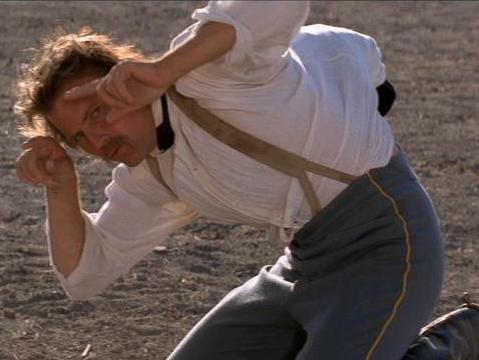
Milland's Don is a raving drunk. Costner's Dunbar is just... different.With a lot of the movies we cover in this series, especially among the
recent entries, I have a fairly strong idea of whether we'll gravitate toward enthusiasm or dismissal. Excitingly, though, I actually have no idea what either of you guys thinks about either film. Most reviewers at the time and more recent critics have identified some mixture of strong and weak elements in both movies, so before we each tip our hands as to our overall admiration for
Weekend and
Wolves, I want to ask: what, for both of you, is the single strongest element of each film? I'll answer, too, but it's my party to host this time, so I get to go last. And if only to teach Kevin a lesson about brevity, let's prove how much we can express in just a handful of sentences, maybe two or three per movie. Go!
NATHANIEL: We're rusty at this
and you'd like us to start on a positive note
and you'd like it to be brief? Quite the taskmaster! I'm afraid that when it comes to dishing out compliments to one Mister Costner the first description that came to mind was "neat." That's his own shallow compliment of choice to Madonna in
Truth Or Dare, a compliment which she instantly gags on despite proving the lack of gag reflex later in her film.
You don't want me to start with the gagging so I'll say that I like that the look of the film isn't overly "neat". Despite the kind of duly saturated sunsets that win cinematography Oscars sometimes the film is content to look dusty and humble, particularly in regards to Costner's Little Hut on the Prairie. And I dig the wolf, an exquisite animal actor. I'd dance with it, too.
 ←BOTTLE: They like me, they really like me!
As for
The Lost Weekend, I keep thinking about that hidden bottle, hanging outside Don Birnam's (Ray Milland) window by a string. Few movies offer up an early image that beautifully concise and versatile: it's a plot device, it's a literal representation of alcoholism, and it's a visual metaphor for Don himself, hiding away in shame and hanging by a thread.
NICK: A haiku: Taskmaster I am, / But those are gorgeous answers. / Mike, your turn to Dance.
MIKE: Brief I can do. Positive... we'll see.
I'm going to Stand with a Fist and name Mr. Costner the Actor as the best thing about
Dances With Wolves. His complete ordinariness fit the character perfectly, not adding much nuance but serving as a representation of an average but smart Indiana boy stuck by himself in a mud hut. It's not a great compliment that his artless "acting" won the prize here, but a compliment nonetheless.
For
The Lost Weekend, Nathaniel already nailed the best single element of the film—that bottle on the string is such a perfect encapsulation. So I'll expand by praising its attention to Don's obsession with acquiring and concealing bottles, the hyper-detailed strategy of which ones to leave for his brother to find and how to use his good nature against him, the increasing lengths he'll go to get them. It's a nice, small attention to detail in a film that tends toward big speeches and arm-waving.
 NICK:
NICK: Big speeches and arm-waving indeed, which is why my favorite moment in
The Lost Weekend is easily the most comical, when Don Birnam gets caught attempting to rob the woman next to him in a fine restaurant, and the whole place erupts into a loud chorus of "Somebody stole a purse, somebody stole a purse!" I love how they all know the song, and they sing it with such merry, mocking gusto.
My
Wolves answer is also musical: I completely adore the score. I realize John Barry pilfers a bit from his own
Out of Africa compositions, but I think the music has a genuine, dark majesty to it, and an epic scale of feeling that helps the film earn its sense of scope and energize its runtime.
Honestly, I think
Dances With Wolves is, all in all, a pretty strong film: flawed in all kinds of moments, but technically very accomplished and engaging at the level of story. But am I sensing I'm alone in this?
 ← Costner entices Oscar by stealing his favorite ensemble. Give or take the hair.NATHANIEL:
 Well, I can't back you up there. I remember liking it well enough in 1990, though I never wanted it in the Best Picture race, and being vaguely irritated that Kevin Costner wasn't nominated for Best Actor. Twenty years later, I can't imagine what I was thinking in terms of the latter. Apologies to Mike but I think Costner is nearly disastrous in the lead role, especially in regards to the ever-present journal narration. We should be experiencing someone opening their soul up: new experiences, new cultures, new land, new language. That's a lot to take in.
Dances needs a Lt. Dunbar with really expressive eyes and voice, capable of conveying inquisitive feeling and depth of conviction (though depth of intellect or feeling are not required). But there Kevin Costner always is, looking like he just stepped out of a late 80s hair salon and loosing all those flat bored Californian vowels on us. If the film hadn't been so famously his, I would have to assume it was a paycheck gig based on the evidence. Where is the passion? He's much better in the physical sequences, whether it's comedy (the naked discovery, his problems with low ceilings, or riding a horse in general) but for facility with a character arc this was a huge step down for him from
Bull Durham and
No Way Out.
It's the voice that I hate most. The hair is runner up. It only gets worse with the running time when he loses the only thing keeping him in period—the mustache—and meets that kindred spirit salon aficionado Stands With a Fist. I know this sounds incredibly facile but it's just so distracting to me... especially because the aesthetics of costume, set, and camerawork otherwise seem committed to time and place. The bored voice and the 80s hair just remind me that this was always a vanity project for a star at the peak of fame.
 NICK:
NICK: You might hate the performance so much, Nathaniel, that you're repressing the info that Kevin actually
was nominated for Best Actor for this... though he was a sort of pioneer of the Blanchett-Tucci School of grimacing at one's own performance during the nomination reel. I like Mike's point about Costner's "average" quality desisting from making Lt. Dunbar some kind of saint or prodigy, but otherwise, I have to admit to subscribing to everything Nathaniel just said. His voice is the single thing I cannot stand about the movie, with or without a fist.
But the movie overall? Has it declined in other respects for you, Nathaniel? Mike, I take it you're also a detractor?
MIKE: I Stand With a Fist against the two of you. (How many times can we make that joke? as many times as we want to!) Maybe I'm letting my opinions about the film color my reception of Costner's performance, but pretty much everything Nathaniel said about him (aside from the 80s hair salon stuff—you got me there) makes me more convinced that he's perfect. The film is a fumbling, well-meaning attempt to show us Native American culture and the effects that whites had on it. It gets so much wrong, but its heart is in the right place, even if it is a little stupid sometimes. Costner's shallowness fits into that perfectly. And even though I, too, hate those godawful journal readings, his complete lack of inflection fits his very gradual change from his weird devotion to duty in the face of its pointlessness to his devotion to the culture that accepted him. If Hare Krishnas instead of Lakota Sioux had moved in next door, I think he would have joined them with just as much fervor.
As for the rest of the movie, I loved a lot of the acting around the edges, especially Graham Greene's befuddled nobility and Tantoo Cardinal's watchfulness. It tries mighty hard to avoid exoticizing the Lakota, which I appreciate, even though it's at heart about how much better the Exotic Other is than mainstream white culture. I'm torn. I genuinely liked it, but it's an embarrassed liking.
 NATHANIEL:
 Allow me to elaborate on the nuances of my position—nuances, while discussing
Dances With Wolves. I actually agree that the shallowness is not a problem. I like that he has such a facile understanding of the culture and that he's not a deep thinker. My problem with the film, I suppose, is that I don't really believe that it's aware of its shallowness. I think it believes in itself as a great social message movie and Dunbar as some great martyr/savior. Note that strange crucifixion pose in that early scene where he rides his horse into that sea of guns, certain of death but willing to sacrifice himself for the greater good. But what is he saving? The whole movie is a delay of the sad, inevitable crushing of the Native Americans.
I guess the self-importance and the obviousness of its message rub me the wrong way. Which is why I like it best when it's a little bit uncomfortable with itself. Like when Dunbar gets squeamish about the Sioux killing his fellow frontiersmen or when it allows you to sit in on the tribe meetings and everyone's opposing points seem valid in some way. I admire that the ending accepts defeat, even if it only does so in that familiar epilogue text-based way: "This is what happens after the movie ends," it says, in order to edify you. "In case you get your history from the movies!"
I'm feeling churlish now, because the movie does mean well. That's a prerequisite for winning Oscars, yes? If I rode into that village they'd rename me Bitches About Movie.
NICK: Agreed that the movie's heart is in the right place, but I also think it has enough strong scenes and a solid enough technical bedrock—sound, lighting, score, editing—that it roundly eclipses a lot movies with "heart in the right place." The heart is worn so close to Costner's own sleeve that I
believe this film more than I do a lot of other movies with similarly naïve and exoticizing tendencies, whose politics often seem worked out by committee.


I do think Dunbar matures a bit over the course of the film. His early attempt at a cruciform suicide, brave but grandiloquent, doesn't seem to me to typify his more humble self-conception in the prairie scenes. Not that the earlier scene makes much sense, anyway. But I loved the shots of all the other soldiers' boots in that scene, so soon after we'd just gotten so down and dirty into the nasty truth of Dunbar's own injured foot. Little accents of montage and visual emphasis like that are gratifyingly frequent within the filmmaking; Costner seems legitimately to have thought in cinematic, image-based terms, even if they're awfully old-fashioned and sometimes ham-handed.
Are we required to address the buffalo hunt before getting drunk with Ray Milland? Mike, does the movie snag your attention in other respects than Costner's performance or its wobbly attempts at PC sincerity? Signed, Manages the Discussion.

And we'll be back, after this 60-hour buffalo hunt!MIKE: I wish we could get drunk with Milland before addressing that buffalo hunt, which is, I think, the only time I was absolutely sure I was seeing footage from the extended edition. It went on FOR.EVER. And so extendedly brutal, too—even with the special film versions of arrows that drop buffalo instantly, instead of helping them bleed to death slowly. I don't know what the point was, actually, to how godawful long that sequence was. It reminded me of the five-minute "Yee-hah, get 'em going!" scene from the beginning of the cattle drive in
Red River. OK, I get the point.
That said, you guys have covered most of what I like about
DWW—the score, its willingness to be both gorgeous and ugly, the tribal meetings. I liked its only attempt to tie the first half of the film in with the ending, when Wind In His Hair reprises his "Can you see that I am not afraid of you?" in the shape of the more distant but more heartfelt "Can you see that I am your friend?" Actually, with a film that runs over three hours, I'm surprised there's not more back-and-forth referencing to create some kind of continuity. Aside from beautiful shots of waving grass, that is.
OK, I'm buying the first round, and it's good stuff, too: someone has to talk about Ray Milland. My mouth is full of whiskey and grandiloquence, so it's gotta be one of you two.

And we'll be back, after this 60-hour buzz hunt!NICK: I sort of can't deal with Ray Milland in this movie. He has his moments, but the teeth-baring, wild-eyed approach to drunkenness feels more
Reefer Madness to me than Academy Award. He does not seem comfortable conveying any emotional or psychological complexity, much less any charm or appeal to offset his obvious disastrousness as a romantic partner for the Jane Wyman character.
But then, I think Wyman and Phillip Terry are pretty woeful in the other lead roles, and the film keeps waffling between looking cheap and under-produced and looking gimmicky and over-worked. Wilder throws almost anything he can think of at this script, and some of it clicks okay, but a lot of it doesn't. The movie, like the lead performance, just seems so hysterical and cooked-up to me.
NATHANIEL: Hysterical and cooked-up? You mean you haven't hallucinated small animals devouring each other after a bender?
I can't really argue with this assessment—any of it—but in a way I liked the hysterical bits most. I know you're not exactly a fan of
Requiem for a Dream, either, so maybe this is a personal thing? For myself, addiction stories work best onscreen when they're operating at opposite poles of stylization. They can be incredibly moving when they're dour and naturalistic (I think immediately of that 'let's get high one last time together' scene in
High Art) but if I can't have them that way, I need them to be elaborately stylized like
Requiem. I think that's the best way to get at the headspace of addiction, which isn't exactly rational or sane.


So, for me, the film worked best when it went a little off the rails. I'm not talking about the rather elaborate strategies for hidden bottles and cash grabs. Those scenes offered more rococo-cuckoo detailing than mere stylization. But I definitely liked the DT hospital trip and that overly sweaty walking tour of the city... on account of, 'What the hell?'
I hope I'm making sense. Basically I enjoyed the things that distracted or interrupted all the speechifying the most.
NICK: Requiem is an interesting comparison, and probably more apt than my own unexpected free-associations over to
Precious. That movie's flourishes of fantasy and pure directorial conceit sometimes work and sometimes don't, and I can sympathize with the filmmakers' attempts to get "cinematic" mileage out of downward-spiral narratives (addiction, poverty, disease, what have you), which are so frequently inert on screen. But the reason I thought of
Precious is that its swerves into fantasy almost always feel related in some way to the headspace of the character. Whereas, for example, the Dance of the Trenchcoats that suddenly overtakes the scene at the opera in
The Lost Weekend just feels so arbitrary, and utterly unconnected to Don—although the initial conceit, that he's watching
La Traviata and all he can "see" is the stage-drinking, plays pretty well. More importantly, where
Precious, for me, earns its leaps into exaggeration or abstraction by handling the "straight" scenes and the performances with such force and insight,
The Lost Weekend feels like it's on wobbly legs even when it's trying to be spare and candid, or to handle pretty basic three-character dialogue scenes.
I do agree, though, about the scenes in the DT ward, filmed in Bellevue Hospital. Those are pretty harrowing, and I like that Frank Faylen, as blond Nurse Bim, is the only actor who slyly insists on the homo-panic subtext that the screenplay basically excises from the novel, with its new emphasis on "writer's block."

 MIKE:
MIKE: Weird, Nick, because I, too, thought of
Precious during Milland's freakouts, but it was
not a good thing. The flourishes in both films seem like just that—directorial flourishes, and completely unearned. The dead-serious straight scenes in
Precious make the jumps to fantasy even more jarring (again, in a bad way), but oddly enough I don't think I minded the ones here as much because the general tone of
The Lost Weekend is one of arm-waving and hand-wringing.
I, three, liked the DT ward scene in
Weekend, and now that I think of it again, I think there's an interesting parallel between that scene and the one in
DWW where the US Cavalry is holding Lt. Dumb-Bear in his mud hut, surrounded by grinning toothless chaps with southern accents (why, if they're Union troops? oh, never mind...) who are taking turns beating him. This is one spot where
DWW veers a little away from realism, I think to emphasize the shock that Costner's feeling: "Is
this what I was supposed to be loyal to?" And over in
The Lost Weekend, Milland gets his strongest taste of the downside of binge drinking. Although, could this
really have been his first case of the DTs?
That's all for me this round—I'm off to become Hobbles on One Leg—but I just noticed that you two actressexuals have neglected to mention Mary McDonnell (aside from her hair). What's up with that?
NICK: I can see that argument that
The Lost Weekend's more florid conceits meld better in a movie that's generally pretty florid, whereas they stand at greater odds with a movie that elsewhere aspires to a kind of realism. Then again,
The Lost Weekend was praised more than anything in 1945 for its gut-wrenching, unvarnished realism—it's all over the reviews of the time—so it just goes to show that one generation's "realism" is another's bag of splashy directorial flourishes. (Unsurprisingly, one of my favorite reviews from the film's initial release was
this one by James Agee, who was unusually skeptical among his peer group in 1945.)


Jane Wyman co-stars as Accessorizes With Leopard.
Mary McDonnell co-stars as Stands With a What the F**k?As for Mary McDonnell, she's at least a better target for idolators of actresses in
Dances With Wolves than Jane Wyman or Doris Dowling is in
The Lost Weekend, and I find her thoughtful and technically skilled, particularly with the Lakota Sioux dialogue. Still, it's clearly apprentice work from an actress who really started hitting her cinematic stride two years later in
Passion Fish (a full generation, in entertainment years, before she assumed
presidency of the galaxy, brilliantly). Still, the fact that neither author Michael Blake nor Costner could conceive of a Sioux love interest for Dunbar signals one of those important limits in
Dances With Wolves's extravagant liberal piety.
Nathaniel, what are your closing thoughts?
NATHANIEL: I've liked Mary McDonnell better in just about everything else, which is why I was avoiding the topic. Even the following year in
Grand Canyon, I was onboard. "What if these are miracles?" she asked her husband in that We're All Connected movie (speaking of liberal piety...). And she did so with all the directness and full-spectrum humanity I came to love so much in her work in
Passion Fish and
Donnie Darko and beyond.
If there's a miracle occurring anywhere in
Dances With Wolves, it's that she's able to keep a straight face while trying to sell that character. I'd say it's a thankless role but an Oscar nomination is quite a lot of thanks for playing
Stands With a Fist Token White Woman. She can bring all the technique she likes to it; I did like watching her struggling to make English words. It's very actorly but totally watchable. Still, it's just an impossible task. Especially since, as you insightfully note, the very presence of Stands With a Fist is a textbook example of the embedded racism in White Guilt movies.
I feel like I Lost a Weekend (hardy-har-har) watching
Dances With Wolves, and what did I have to show for it? Epilogue text to tell me that the Native Americans were going to have it real hard after the movie? Thanks, Professor Costner. One sign of a movie's strength is how far it extends in your imagination beyond the last scene, or before the first. Do the characters live outside the frame? In that respect, I'm not sure I can fully get behind either film.
The Lost Weekend doesn't offer much closure unless you buy Don Birnam's renewed "I'll beat it this time" vow. I'm not sure Billy Wilder is asking you to, given the final shot. So it's easy to feel those characters living on, but in a nightmare loop of the same movie you've just watched, complete with DTs, pawn shops, and broken promises. But I find it impossible to imagine a life for Stands With a Fist and Dances With Wolves beyond that slow ride into winter. Maybe that's the (elegiac) point... but I needed to feel something more than a history lesson as they faded out.

 Tags:This Week:
 Nathaniel's
post on the other Best Picture nominees from 1945 and 1990 and Mike's
post at his newly reactivated blog!
Previously: ep.1:
Wings & No Country; ep.2:
Broadway Melody & Departed; ep.3:
All Quiet & Crash; ep.4:
Cimarron & Million Dollar Baby; ep.5:
Grand Hotel & LOTR:ROTK; ep.6:
Cavalcade & Chicago; ep.7:
It Happened One Night & A Beautiful Mind; ep.8:
Mutiny on the Bounty & Gladiator; ep.9:
Ziegfeld & American Beauty; ep.10:
Zola & Shakespeare; ep.11:
You Can't Take It with You & Titanic; ep.12:
Gone with the Wind & The English Patient; ep.13:
Rebecca & Braveheart; ep.14:
How Green Was My Valley & Forrest Gump; ep.15:
Mrs. Miniver & Schindler's List; ep.16:
Casablanca & Unforgiven; ep.17:
Going My Way & The Silence of the LambsCompendium: My ongoing
"Best Pictures" Special Section, with reviews, rankings, polls, and links to all of our discussions

Labels: 1940s, 1990s, Best Picture, Billy Wilder, Blog Buddies, Jane Wyman, Kevin Costner, Mary McDonnell
 Nick's Flick Picks: The Blog


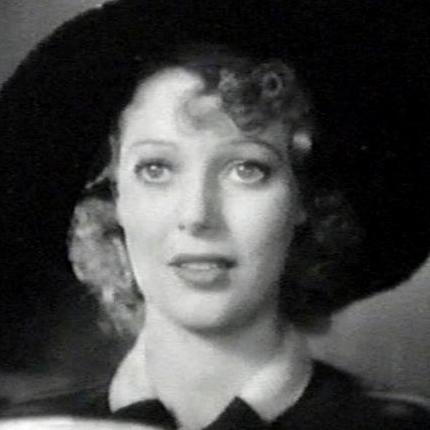


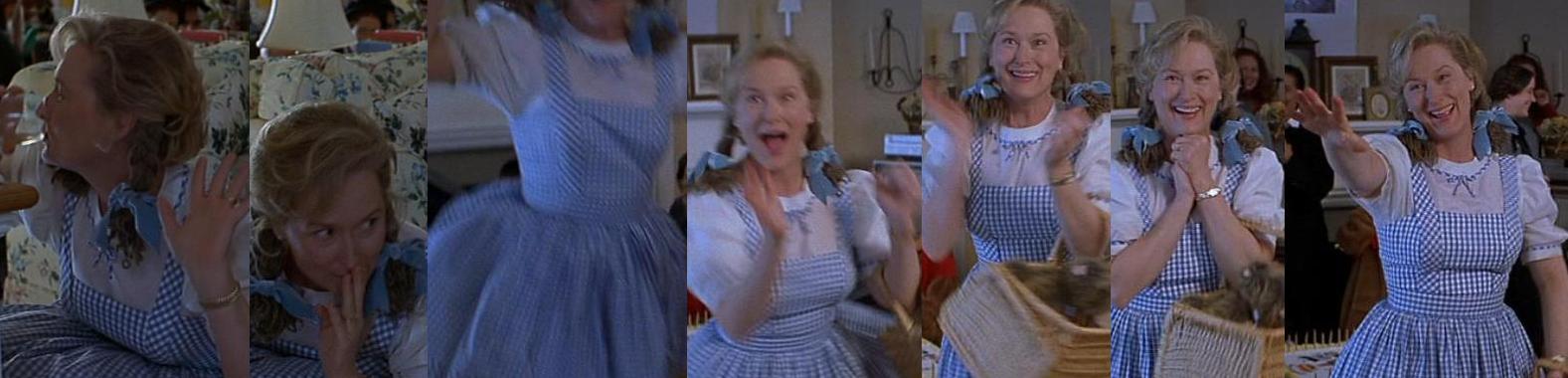

 That you have to say all of that, and you can't just boil it all down to "Orry Baxter is a hard, quiet mother," distills the virtues of Wyman's steady, smart, and nuanced playing of the character. It isn't as subtly victorious a performance as Anne Revere contributed to National Velvet, as the stoically affectionate mother who has clearly been many other women in her life on her way to her current persona, and whose steadfast support of her daughter is both engine and byproduct of so much else in her personality and history. The Yearling is a less exultant, perhaps more technically accomplished movie than National Velvet, but none of its characterizations are as offhandedly skilled and rounded as the parents' in the earlier film. But actually, working within a constrained range and palette pushes Wyman down a productive road as an actress. Only the year before, she wore her thespian strategies and her up-and-down feelings rather too obviously as Ray Milland's frustrated but loyal girlfriend in The Lost Weekend. She plainly thought it was an "important" movie, and comes across as intrigued by the tunneling psychological bent of the story and of Wilder's filmmaking. This piquing of her interest, though, results in the only performance I've ever seen Wyman give that seems too worked over, like an over-eager rehearsal, full of ideas but lacking cohesion and credibility.