The writing categories almost always seem weakest to me at the 50 mark, and this year's no real exception. Don't get me wrong: lots of really good work here. But maybe not enough
great work. Bring it on, fall season!
 Best Original Screenplay
Whit Stillman
Best Original Screenplay
Whit Stillman for
Damsels in Distress,
for wit, for giving arcs to the few characters who need them without short-sheeting others, and for making every scene equally major or minor;
Patrick Wang for
In the Family, for supplying backstory in deliberate steps, intriguing but just shy of coy, and for scripting big drama at modest volume, at Southern speed;
Reid Carolin for
Magic Mike, for flexibility, spryness, and tone, putting solid muscle on the bones of that old cliché, "It's messy and multi-sided, just like real life";
Wes Anderson and Roman Coppola for
Moonrise Kingdom,
for setting up two molecules, one with kids who seem eager to be adults, one with adults who seem like kids, and figuring out how to bond them; and
Ercan Kesal, Ebru Ceylan, and Nuri Bilge Ceylan for
Once Upon a Time in Anatolia, for a patient structure that slips inside many heads, working as a tense procedural and a study of the motives and mechanics of storytelling.
Honorable mentions to
Alice Rohrwacher for the unusual and incisive coming-of-age in
Corpo Celeste; and to
Seth MacFarlane for the potty-mouth of a million funny colors in
Ted, but also for a take on perpetual male adolescence that really works. Honorable mentions
to the honorable mentions include
Athina Rachel Tsangari for trusting her odd instincts and generating unforeseen payoffs in
Attenberg; Paul Thomas Anderson for his bold experimenting with unfilled mosaic in
The Master, Jennifer Westfeldt for conceiving a great premise and good lines in
Friends with Kids, even if her sense of an ending is still pretty off; and
Vanessa Taylor for the bracing honesty of the best scenes in
Hope Springs, shining through a directing job that I suspect flatters and short-sells her script in different ways.
 Best Adapted Screenplay
Michael Bacall and Jonah Hill
Best Adapted Screenplay
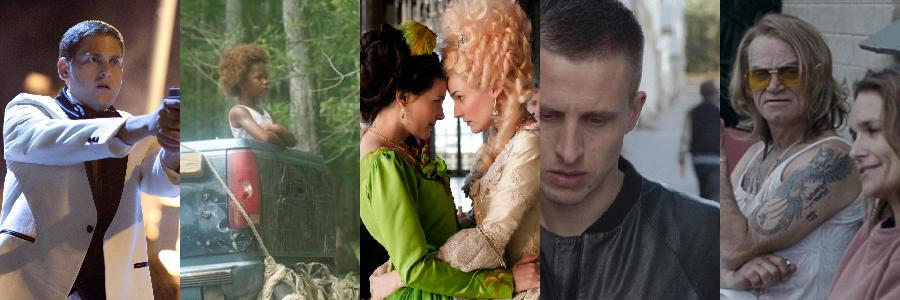
Michael Bacall and Jonah Hill for
21 Jump Street,
for its almost unnerving ability to clear four hurdles that fell almost everyone: Action-Comedy, High School, Dubious Remake, Bro-y Dick Jokes;
Lucy Alibar and Benh Zeitlin for
Beasts of the Southern Wild, for vast, oracular ambition that still feels rooted in a six-year-old's mindset, and for avoiding the arc into disaster we've come to expect;
Benoît Jacquot and Gilles Taurand for
Farewell, My Queen,
for all the trigonometry of who's obsessed with what or with whom, for keeping the queen at bay, and for apt semi-veiling of palace protocol;
Joachim Trier and Eskil Vogt for
Oslo, August 31st,
for its most detailed and most even-handed scenes, like the addict's confession of suicidal thoughts and his meeting with his sister's partner; and
Shaun Grant and Justin Kurzel for
The Snowtown Murders,
for handling half-hour arcs in mere minutes, snaring us in the winch of missing what's happening, and in the trap of thinking we could escape.
Honorable mentions in this division are limited to
Tracy Letts's adroit refitting of his own play
Killer Joe, which just passes the smell test of is-this-art-or-is-this-sleaze, and keeps adding layers literally till the last edit; and
Nick Cave's script for
The Blandest Title in the World, which tries too hard with some characters (Pearce) and too little with others (Wasikowska, Chastain), but even in its substantially re-edited form works as a good evening yarn.
Labels: Fifties, International, Screenplays, Steven Soderbergh, Wes Anderson
 Nick's Flick Picks: The Blog