 Corinne Griffith
,
The Divine Lady★ ★ ★ ★ ★(lost the 1928-29 Best Actress Oscar to Mary Pickford for Coquette
)Why I Waited: Unavailable for a long time, especially since I can't cotton to watching movies on YouTube. My brother was nice enough to tape a rare broadcasting on Turner Classic Movies, but I wound up deferring anyway till the Warner Archive Collection produced this
DVD.
The Performance: So, here she is, the shadowy question mark, the nebulous presence. I had never seen anyone list Griffith as one of the runners-up for the second Best Actress Oscar until suddenly, there she was, interpolated as a highly anomalous sixth nominee in Robert Osborne's
60 Years of the Oscar. Does she "count"? Oscar queens, when they aren't banging their heads against the problem of world hunger, sometimes debate this. Granted, the question is almost entirely obviated by the Academy's oft-repeated insistence that there were no official "nominees" for this second ceremony, and that the listings now commonly reproduced for those years were really just retroactive write-ups of films and performances that were bandied about by the very small voting body, before consensus finally swung around to the announced winners. If that's how things went down, Griffith's inclusion, however belatedly instated, makes good sense.
The Divine Lady won the Best Director Oscar for Frank Lloyd and earned a cinematography nod, too, so her vehicle was obviously on the voters' collective radar. Plus she was a high-echelon star at that time, having appeared in nearly 70 features by 1929.
Even more than having the riddle of this nomination solved, though, I would like to know what particular depressants the AMPAS College of Cardinals were hooked on when they had these discussions. Prohibition was on, but it must have been
something, since Falconetti in
Joan of Arc, Marion Davies in
Show People, and Lillian Gish in
The Wind are just three examples of landmark performances from this eligibility period that got passed over for subpar work by important talents (Chatterton, Compson) and light, limited turns at the center of films that Oscar obviously fancied (Love, Griffith). We know how I feel about the
ghastly winner, and I'm still holding out hope that the late, legendary Jeanne Eagels will redeem the category as fully as she's reputed to. Otherwise, it's a foursquare gaggle of essentially two-star performances that, on days when the sun's shining and the coffee is good, I'm willing to grant a third. After all, Chatterton was probably doomed to overdoing her Madame X by her famously hambone director,
Compson gets better when the script gives her more to work with, and Love compensates in some late scenes for what is plainly mediocre in the rest of her performance.
Griffith, meanwhile, is a fine, energetic, but dispiritingly superficial vessel for
The Divine Lady's rather chintzy retelling of the fable of Admiral Lord Nelson and Emma, Lady Hamilton, revisited
more famously by Vivien Leigh in 1941. Lloyd mounts the heck out of the very exciting sea battles, setting himself up for
Mutiny on the Bounty six years later, but his visual and narrative approach to the expository scenes and to the political
and romantic buildup is stagebound and thoroughly antique. Eventually, this means lots of broad emoting in proscenium frames with forty-foot ceilings and theatrical light, which clearly encourage Griffith and the other actors back into an already-anachronistic style of Nickelodeon-style poses and overstatement. But this isn't how things start, and in fact Griffith gets an initial entrance we might all envy, popping brightly out of a late-18th century hackney coach just moments after hefty, scowling Marie Dressler, playing her mother, has gotten wedged in the doorway while trying to do the same. Emma sports the world's floppiest, widest-brimmed hat, and she can barely stop chuckling and clapping at how lovely and youthful she is. You'd be hard-pressed to see the kernel of what the opening titles refer to as "England's greatest beauty" inside this coltish little sylph, but Lloyd and cinematographer John F. Seitz at least help her turn on a little heat. Fifteen years before Seitz followed Stanwyck's glittering anklet down the stairs of
Double Indemnity, he adopts the point of view of rakish aristocrat Charles Greville as Emma climbs into his house—first as an ivory foot peeking unexpectedly from behind a first-floor curtain, then as a long pair of bare legs sliding all the way through the window.

You can see why Greville is briefly moved, but even setting aside his cynical preoccupations—all he cares about is his precarious position as the likely heir to his unwed uncle, the famous Lord Hamilton—it's equally easy for the audience to relate to his rapid cooling of affection. Griffith is bubbly but rather free of personality, as though her top billing and the well-known real-life tale guarantee that anything she does will be received as impossibly enticing. I find her a bit fidgety, like Clara Bow having a go at one of Lillian Gish's true-heart Susies. When this mostly silent picture requires that she sing, Griffith is too stiff and arbitrary in her movements to communicate any musicality at all, much less any relation to the song we actually hear (even if, as is quite possible, this track was selected later). You'd have to be stonier than I am not to take pity on her as Greville sends her packing to Naples, especially since that's not the worst of it. He's assuming that her sparkling youth, matched with her social impossibility in every other respect (she's the cook's daughter!), will be enough to prompt his elderly uncle's infatuation while standing in the way of an actual marriage, thus preventing any biological sons from dislodging Greville's claim to Lord Hamilton's fortune and influence. We know all of this, while Emma knows none of it. What she renders, as a result, is a simple but plaintive impression of a broken-hearted teenager. I do wish, though, that Griffith had struggled a bit more with her feelings, or with such an open disclosure of them, and maybe that she ahd showed more of an intuitive hunch that Greville's motives are stained with greater sins than fickleness.
Without implying a categorical improvement, Griffith hits several of her peaks in the passage between Emma's arrival in Naples through Lord Hamilton's surprise proposal. She is desperate but also a bit funny as she busily "improves herself" by learning the harp and, you know, changing some of her outfits—prepping to dazzle Greville completely when, as he has promised, he appears in Naples to collect her. I remember her very clearly in a series of shots in which she's trying to adopt precisely the right pose for receiving her erstwhile lover, as he at long last arrives: seated at her harp? before an arras? lounging suggestively in a high-backed chair, hugging a bouquet of flowers? For an actress who gets stuck for longish passages of
The Divine Lady in one basic guise (the Flitting Imp, the Tearful Castoff, the Ardent Pleader, the Weepy Adorer), it's pleasing to see Griffith playing around with so many personas, and showing us an Emma so self-conscious of how she comes across. Her vindictive blast of anger when she realizes Greville never meant to rejoin her is something to behold, and portends exciting changes in psychological texture for the second half of the film (though unfortunately, these promises are barely remembered, much less kept, in the rest of the performance). And in two very memorable close-ups—a Sternberg-style glimpse through the glistening strings of her harp, around the time she first meets Nelson, and then a later image, well into the heart of their affair, of her carnally stroking her cheek with the blooming head of a rose—she cuts through all the
Cavalcade-ish rubbish in the script ("Those Frenchmen, with their infernal Revolution, are upsetting all of Europe!") and strikes some real sparks. Griffith reveals in moments like these that she is capable of playing Lady Hamilton as an aroused, headstrong, and risk-taking woman. Her extra-marital and politically inflammatory acts on Nelson's behalf, whether bringing provisions to his starving sailors or imploring the Queen of Naples to offer safe harbor to their fleet, are temporarily credible as the behavior of a woman who is smart enough to think strategically and far-sighted enough to think outside the confines of her own immediate experience, even as they are also heedless gestures in the name of a selfish love, itself laying a certain path to spousal reprimand and social ostracism.
Given all that, it's disappointing that Griffith doesn't stand up more often for any sense of Emma's intelligence, of her knowing that she's plunging ahead into dangerous waters and maybe even enjoying it. Her clinches with the utterly unenchanting Victor Varconi as Lord Nelson are washouts more often than not, partly because she plays so many of them in a register of teary, brow-knitting, frankly pathetic passion. This wet-tissue approach would make as much sense for some farmgirl's crush, nursed for a local boy whom her family doesn't like, as it does for a high-flying and knowingly controversial historical actor. "I am the one thing England will never let you have!" she sighs to Lord Nelson, who is raising British hackles for taking so suspiciously long to come home for his hero's welcome. So she understands, surely, how many stakes are attached to their illicit bond, and how many sentiments (despair, anger, arrogance, wistfulness) are merged in such an utterance. She's too broadly melodramatic, though, playing Forbidden Love in too lachrymose a fashion, without implying a more detailed sense of this formidable woman and her particular, extraordinary dilemma. Non-fans of silent cinema sometimes assume there was no room for subtlety or layering in the heightened style of performers working without dialogue. It's hard, though, to imagine even as lunar a presence as Janet Gaynor or as fine-boned a creature as Lillian Gish, much less a tougher customer like Betty Compson or Gloria Swanson, playing so close to such a dewy surface, and letting sentimentality overwhelm so many other traces of the pragmatism, insolence, and introspection that are pivotal to this character.
Griffith pours a lot of herself into her bustling approximation of youth and then into the passionate commitments and quivering lips of her adult years. I expect she viewed this ability to age the character as one of the major tasks of her characterization, since she seems to underestimate so many of its other demands. She isn't an unaffecting actress, and I didn't experience her as a blemish on her movie so much as an impediment to it cutting deeper and communicating more than it ultimately does. Emma, after all, doesn't just get older, or happen to pass from a preening village beauty to a fabled personage. She
has to grow more complex to make the choices that she does, putting herself right in the line of social fire and inviting the man she clings to as a soul mate to do the same, in the name of their own addictive longing for each other as well as professed political convictions—and with the people of at least three nations watching closely. To fill out that drama of strong but irreconcilable allegiances takes more than a solid, steady cryer, an amiable but hardly extraordinary beauty, or an ability to look shocked at the worm-infested food being served to the navy of Europe's mightiest empire.
The Divine Lady aspires to grand historical fiction, which it only achieves in the thundering naval standoffs. Griffith, meanwhile, gives a performance better-suited to paperback romance, with engaging but infrequent flashes of something more. The touch of the divine is nowhere apparent.
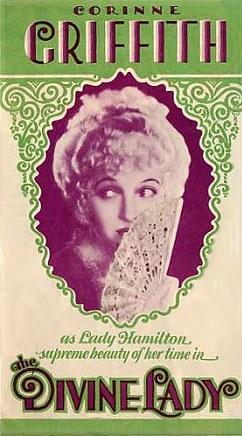
The Best Actress Project: 1 More Down, 14 to Go(More info about Griffith, plus the poster I swiped above, can be found
here.)
Labels: 1920s, Best Actress, Corinne Griffith, Early Cinema, Silents
 Nick's Flick Picks: The Blog


 Eagels has an appetite for capital-A Acting, then, in ways that align her performance closely with t hat of fellow nominee Ruth Chatterton in Madame X, equally intent on leaving us breathless with her slideshow of the penitent, the zombie, the harlot, the lioness, the mother, the screamer, the martyr. If you're looking for subtlety, shop somewhere else. Beyond her proudly high-pitched approach to Leslie Crosbie and her desires, Eagels is manifestly caught in that collective Hollywood moment of learning to calibrate a performance register appropriate to the talking screen. She plows ahead with a haughty but unplaceable accent, bobbing somewhere in the sea between British upper-class snobbery, New England nouveau riche, Midwestern bitchiness (Eagels was born in Kansas), and pure Broadway affectation, rooted in no zip code or line of longitude I could pinpoint on this planet. Her name is bigger than that of the film in the opening title card, and she appears to have scaled her performance with that sense of proportion very much in mind. Just as the shrill vocal mannerisms belong indistinguishably to the actress and the character—the generous assessment would affix Eagels as an inspiring forebear for Davis's later, much-admired ethos of being as ugly or unpleasant as a role demanded—it's impossible to draw a line between Leslie's disingenuous prevarications on the witness stand and Eagels's insolent tests of the audience, plying us with see-through layers of actorly self-indulgence. She dares us to question her shameless chutzpah as anything but a perfectly apropos character choice, though it's plain as day how she enjoys sailing over the top of her own role.