Nick's Flick Picks: The Blog

Actress Files: Jeanne Eagels
 Jeanne Eagels, The Letter
★ ★ ★ ★ ★
(lost the 1928-29 Best Actress Oscar to Mary Pickford for Coquette)
Why I Waited: For a long while, I had no choice, but thank God for eBay. By the time that transaction came through, I'd become a big fan of The Letter in its later incarnation, and Eagels's tawdry but glorious reputation had excitingly preceded her. Plus, the rest of her category had really struggled to yield a front-runner, even after my recent viewings of Betty Compson and Corinne Griffith, so my hopes were somewhat nervously pinned here.
The Performance: For the 1940 version of The Letter, Bette Davis gets one of the best entrances in movies, striding out of her Malaysian rubber-plantation bungalow in chic blouse and long skirt and emptying a pistol into the back of a doomed, staggering man. As a first impression, it would intimidate anyone, possibly excluding Chicago's Velma Kelly, who'd make a great cellmate for Leslie Crosbie, the cartridge-emptying diva and manipulative plaintiff-adulteress of W. Somerset Maugham's renowned story. Indeed, Davis's entrance is so instantly galvanizing that some viewers may be surprised by the deliberate, psychologically nuanced route that she and William Wyler pursue into the material. It's a very tense and engaging film, but defined more by the parsing of criminal perversity, by moral quandary, and by threatening characters slowly skulking around the sidelines than by electric action. By contrast, 11 years earlier, when Jean de Limur directed and co-adapted the previous screen version of The Letter, he in some ways reversed this relation between first impressions and follow-up. At 61 minutes, de Limur's version is exceedingly brisk even by the economical standards of late-20s Hollywood, mounted as the cinematic equivalent of a short story, tracing a clear arc of beginning, middle, and end. The staging is not particularly varied or inspired, and certainly attempts none of the surgical dissection of Leslie's mental state that Davis, Wyler, and cinematographer Tony Gaudio achieve. De Limur intends to move us through a juicy narrative at a steady, unembellished clip, notwithstanding his few cuts and static frames. Yet, for all this, the film starts slowly, cutting and tracking through three minutes of quiet establishing shots of Singapore Harbor and the inland community before finding the Crosbies at home together. Jeanne Eagels's Leslie is settled into a rattan chair, sewing some lace.
Not until 15 minutes into this hour-long film does Eagels's Leslie even get around to Davis's opening gambit, grabbing her handgun and firing her six shots. Eagels does this with a slow, heavier cadence, and with an almost pugilistic fury to contrast Davis's murderous sangfroid. Eagels, her loose and damaged blonde hair waving in frazzled tufts around her face, thrusts her arm forward with each separate shot, as if she's sawing a log, or as if she's trying to propel each bullet even more lethally into Geoffrey Hammond's body. The actress transfixingly overwhelms the left side of the frame, admittedly looking more like what she was—a notorious drug addict barely hanging on at the end of New York's roaring 20s—than she does like a voluptuary stewing in the tropical swelter. As such, though, she nonetheless cuts the kind of disturbing figure that The Letter needs, particularly since de Limur's prosaic use of the medium requires that Leslie unsettle us in fairly outward ways, not through the kinds of subtle, affective insinuations on which Davis & Co. thrive. Frankly, it could hardly be more obvious that de Limur has shaped The Letter as a vehicle for Eagels more than as an inquiry into Leslie. He and Eagels come across as bigger fans of flashy transformation than of gradual evolution and enigmatic tensions. They evidently enjoy taking Leslie from a calm-looking housewife with a secret to a shamelessly cynical courtroom witness to a repulsed and absurd target of blackmail to a woman who seems beaten at her own game, until she finally lets loose with a howl of erotic satiation and wifely contempt that literally brings things to a halt.
 Eagels has an appetite for capital-A Acting, then, in ways that align her performance closely with t hat of fellow nominee Ruth Chatterton in Madame X, equally intent on leaving us breathless with her slideshow of the penitent, the zombie, the harlot, the lioness, the mother, the screamer, the martyr. If you're looking for subtlety, shop somewhere else. Beyond her proudly high-pitched approach to Leslie Crosbie and her desires, Eagels is manifestly caught in that collective Hollywood moment of learning to calibrate a performance register appropriate to the talking screen. She plows ahead with a haughty but unplaceable accent, bobbing somewhere in the sea between British upper-class snobbery, New England nouveau riche, Midwestern bitchiness (Eagels was born in Kansas), and pure Broadway affectation, rooted in no zip code or line of longitude I could pinpoint on this planet. Her name is bigger than that of the film in the opening title card, and she appears to have scaled her performance with that sense of proportion very much in mind. Just as the shrill vocal mannerisms belong indistinguishably to the actress and the character—the generous assessment would affix Eagels as an inspiring forebear for Davis's later, much-admired ethos of being as ugly or unpleasant as a role demanded—it's impossible to draw a line between Leslie's disingenuous prevarications on the witness stand and Eagels's insolent tests of the audience, plying us with see-through layers of actorly self-indulgence. She dares us to question her shameless chutzpah as anything but a perfectly apropos character choice, though it's plain as day how she enjoys sailing over the top of her own role.
I was happy to let her have her day in court, and happy to clear her of all charges, even where I knew she was guilty. The courtroom encompasses just too delicious a scene of who-me? self-theatricalization, for Eagels as for Leslie. I was frankly in her grip even when the performance was more obviously flawed, as in her fidgety, awkward physical carriage during her scene of furtive negotiation with Lady Tsen Mei, playing Geoffrey's Asian mistress. Even if it's a blight on de Limur's gifts as a filmmaker, it's worth underscoring how many of Eagels's scenes she plays in long, uncut master shots, during many of which she is allowed no more mobility than the camera. In noteworthy contrast to the heavy reliance on close-ups we see in the performances of her fellow nominees, in line with the relative aptitudes or at least the relative attempts of their movies to generate feeling through editing, Eagels is the show for the bulk of The Letter. Her lust, her bigoted disgust, her lack of compunction, notwithstanding her pretenses of being saturated with compunction, her boredom with the tropics, her sense of having triumphed, her dawning recognition that punishment has not been avoided, and has only just begun: they all feed and swim off of Eagels's body, her significant poses, her unpredictable rhythms, her weird energy. Even her aura of working hard in some scenes and of somewhat lazily coasting by in a few others, which should baldly hamper the work, actually articulates something credible, even entertaining, about Leslie's own blended propensities toward trying to get away with murder while nonetheless seeming to flaunt the artificiality of her own good-wife façade.
Chatterton, Swanson, Crawford, Bankhead: who knows how many of their opportunities they might have lost to Eagels, had she not manifested such a chronic unreliability in life, and then taken herself out of the game with her final, possibly suicidal overdose—an event that interceded between the wrapping of The Letter and her reaping of this unofficial Oscar nomination. Anyone who can hold the screen this vibrantly would have been a major force in Hollywood, especially as she got better at scaling her voice and her other effects. Look how arrogant but also weirdly poignant she is, blatantly culpable but newly vulnerable, as she explores with her lawyer the dangers posed by the titular, incriminating letter. She may resort a bit too often to the tic of gagging, momentarily, on an admission or an utterance for which she feels revulsion, but I appreciated her refusal to disguise Leslie's racism ("some sort of scandal with a ...half-caste Chinese woman!"). I relished even more how she chokes on the phrase "planter's wives," as though belonging to or even being associated with such a soul-killing species gives her physical and spiritual acid reflux.
And, showboater though she clearly is, Eagels does not always opt for the brashest possible gesture. One of the quietest scenes in the performance could easily have been one of the loudest, as she puts down her lace and heads to her writing desk in that first long sequence, penning the missive that will eventually cause her such trouble. At the end, she dispatches it to Herbert Marshall's Geoffrey via one of her errand boys, and then settles back in her favorite chair. The vamping possibilities seem endless here—she might easily have slunk around her suddenly-empty bungalow, writing the letter in a furious pantomime of lurid passion, simmering with a gustatory smugness in her own treachery, her wantonness, her power, after sending off such a carnal plea for attention and relying on an unpaid servant to deliver it. But Eagels stays quiet, glum, and restrained in this scene, as though Leslie really despairs of losing Geoffrey. She cuts off any assumption that the character enjoys betrayal for its own sake or that she can't get enough of her own amorality.
It's a canny snapshot of vulnerability to plant near the outset of such a tough and daringly embroidered performance, and it allows more meaning in her final, famous, high-pitched indictments. "With all my heart and soul, I still love the man I killed," she repeats. The first time she says it, she is obviously firing a crossbow of withering, undisguised faithlessness right into the heart of her husband. The second time, though, because Eagels has earlier revealed a woman who really did love this bored and rebarbative rake, she seems only to be lacerating herself. Once more, with subtly different feeling: "With all my heart and soul, I still love the man I killed!" Who knows how long that despondent, raging thought will echo in Leslie Crosbie's mind? Since this version of The Letter ends right there, who knows who long it will echo in mine, too?
The Best Actress Project: 1 More Down, 5 to Go
Labels: 1920s, Best Actress, Early Cinema, Jeanne Eagels
posted by NicksFlickPicks at 2:00 AM
8 comments


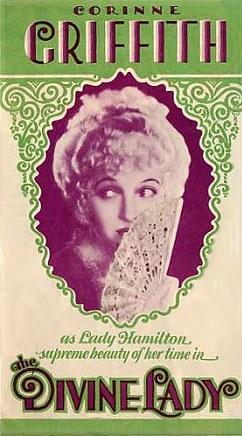
 You can see why Greville is briefly moved, but even setting aside his cynical preoccupations—all he cares about is his precarious position as the likely heir to his unwed uncle, the famous Lord Hamilton—it's equally easy for the audience to relate to his rapid cooling of affection. Griffith is bubbly but rather free of personality, as though her top billing and the well-known real-life tale guarantee that anything she does will be received as impossibly enticing. I find her a bit fidgety, like Clara Bow having a go at one of Lillian Gish's true-heart Susies. When this mostly silent picture requires that she sing, Griffith is too stiff and arbitrary in her movements to communicate any musicality at all, much less any relation to the song we actually hear (even if, as is quite possible, this track was selected later). You'd have to be stonier than I am not to take pity on her as Greville sends her packing to Naples, especially since that's not the worst of it. He's assuming that her sparkling youth, matched with her social impossibility in every other respect (she's the cook's daughter!), will be enough to prompt his elderly uncle's infatuation while standing in the way of an actual marriage, thus preventing any biological sons from dislodging Greville's claim to Lord Hamilton's fortune and influence. We know all of this, while Emma knows none of it. What she renders, as a result, is a simple but plaintive impression of a broken-hearted teenager. I do wish, though, that Griffith had struggled a bit more with her feelings, or with such an open disclosure of them, and maybe that she ahd showed more of an intuitive hunch that Greville's motives are stained with greater sins than fickleness.
 Four reasons for this entry:

 But let's not dodge the issue: Coquette is a dog, and Pickford is barely tolerable in it. She handily gives one of the worst performances ever nominated for the Best Actress Oscar, and she won for it, almost certainly because of her stratospheric celebrity and her crucial role in founding United Artists as well as the Academy itself, only two years prior to her copping this trophy. Awfully cheeky to be 36 years old and playing an airheaded chit who can't help flirting with every man in the room, from her father's peers to the local bad boy. Pickford looks suspiciously dowdy, and not just because her infamous haircut has her looking so matronly, or because she's so perpetually clad in distressed housedresses and nightmarish effulgences of figure-killing tulle. Even amidst such intense internal competition, the most antique thing about Pickford's Norma is the actress's creaky performance style, yet this isn't an "old" style so much as a frantic, immature feint at what grand acting by established masters might look like. Dabblers in early cinema might assume that Pickford hasn't yet recalibrated her gestures or mannerisms to suit the new sonic capabilities of the medium, but you could watch silent films for days without seeing anything this garish. Pickford has no one to blame but herself for her insistence upon buttoning and almost corkscrewing her thin lips until her mouth looks like the knotted end of a balloon, and then calling greater attention to this bizarre mannerism by repeatedly pointing an index finger, inexplicably, to her face. She's a fright of uncontained energy, and not in that Clara Bow way that can be infectious in spite of itself; she looks harried and taxed, like she's somehow overthinking the part without actually thinking at all. She whinges, she scowls, she bends over backward as her boyfriend of ill repute whispers sweet pledges to her in a forest glade. She flails her arms in the air when she races across Southern streams to find him, and sinks like an eight-year-old into the lap of Louise Beavers, humming away as her loyal mammy (!). The close-ups are impossible to parse: if you didn't know that Johnny Mack Brown was playing the object of her adoring ardor, you'd wonder why she's sniffing and glowering at this fellow who has come to surprise her at a dance. Her odd vocalisms ("Ooh yoo doon't knoow my deddy!") make Singin' in the Rain's Lina Lamont seem like a creature drawn from life, and when her character gets dragooned into one of those fifth-act court-trial sequences that have felled many a better movie than Coquette, she quakes in her chair and whips her head about, letting her voice go so high and shrill that you worry she might be tearing it.
 While I collect my thoughts about the best of last year's performances by leading actresses, while I try to figure out why I was so stultified and put off by the

 Finally, apologies for burying the lead, but if you've got a multiregion player—or even if you don't, because here's a reason to buy one—Chantal Akerman's legendary feminist opus
  This post is a strange non-sequitur after nearly a month of silence, especially with so many threads dangling and so many novelties (like a redesigned website!) looming on the horizon... but this is the weekend of
  The implication behind this widely accepted Academy lore is that the third entrant in this race, Merian C. Cooper and Ernest B. Schoedsack's
  As with Nanook, most of the humble "life" and domestic rituals we observe in Chang are recreations of already-outmoded or fanciful practices, enacted by a locally selected cast who were very conscious of performing for the camera. Kru really was married to Chantui, and their onscreen children really were their children, which is more than you can say for Nanook, and as the senior location scout and interpreter for the film crew, Kru himself enjoyed more of the creative process and was perhaps more creatively involved in the staging of his own (mis)representation than was Allakariallak, the Itinivuit man who played Flaherty's "Nanook."* In these ways, Chang captures a family group and a setting that are slightly more "real" than Nanook's, and yet the film flaunts its artificiality much more obviously. Some well-shot and extremely exciting sequences of "spontaneous" leopard attacks are nonetheless blocked suspiciously well toward the sightlines and placements of the cameras; the interior shots of the treehouse, in at least some instances, don't match the exterior perspectives of what is supposed to be the same structure.
 Whatever its political implications, Chang (the Thai word for "elephant") is a remarkably efficient entertainment, packing more visual punch and pulse-quickening spectacle into 69 minutes than
  I haven't tried watching Chang in a zoo, but I have screened it for an auditorium full of restless, pent-up college undergraduates, and their reactions—excited, skeptical, nostalgic, ironic, but universally intrigued—were thrilling to gauge, and Chang's aspirations to "reality," even as it serially undercut its own pretenses in that direction, make it a fascinating time capsule of popular cinema at a moment where talkies were just arriving and the drift toward theatrical, narrative- and human-centered comedies and dramas was not yet graven in stone. Sunrise, in its more delicate and elegiac way, is just as commemorative of cinema's moment of reckoning, after thirty years of evolving traditions and on the cusp of seismic revolutions, ascendant studios, and much more standardized production. Cinema, up to that point, subsisted on a recipe of short "actualities" (acrobats flexing, boats docking, fires, kisses, rescues), nature photography, slapstick humor, formal experiments with light and continuity, and literary narratives. Chang gives you a little of all of this at once, and it's built, shot, and scripted to entertain literally anyone, from a 4-year-old to a nonagenarian member of its own original audience. Give it a whirl, tell your friends, and if you're drafting a film-studies syllabus pretty soon, consider giving the admittedly wondrous Nanook a rest.
 Precious few actresses of the early sound era were as blithely comfortable before the camera as Claudette Colbert, especially while radiating such innate intelligence and good humor. Her consummate, seemingly unflappable professionalism makes her a smooth match for her role in Private Worlds as a gifted psychiatrist, winning the confidence of patients and colleagues as well as the audience, even as Charles Boyer's chauvinist hospital director can't quite adjust to the notion of a female doctor. The script sputters a little among its various tones and subplots, and one has the feeling that major moments in Colbert's characterization have been dropped, either in the writing or editing stages. Still, she keeps every scene believable, and like supporting players Joan Bennett and Helen Vinson, she thrives under the directorial hand of Gregory La Cava, whose later success with 1937's Stage Door proved how gifted he was at balancing a wide range of fully plausible women within the same film.
 The good news first: Page's wild mannerisms and almost feral conviction perfectly suited her for her next Tennessee Williams project, the 1962 adaptation of Sweet Bird of Youth, where she duly plays a wild and feral exhibitionist who only thinks she's a recluse. Unfortunately, everything that clicked for Page as Sweet Bird's Alexandra Del Lago makes her grotesquely wrong for Summer and Smoke's epicene Alma Winemiller, who is scripted as a much more delicate creature, even in her most id-driven moments. Instead, Page fusses and snorts through a grandiloquent version of "repression" that is very much the conceit of a struggling actress and a flawed, tricky script—but not at all the stuff of life. Blythe Danner came much closer to the mark in a televised 1976 version of The Eccentricities of a Nightingale, Williams' apt revision of the almost self-parodic Summer and Smoke. Evidently, Danner recognized that misplaced softness and measured affectation can be plenty abrasive, as the story insists, without veering anywhere near a caricature. By contrast, Page strangles every line and moment, finally tarnishing Williams' reputation as well as her own.
 A very pleasant surprise—the kind of performance that snaps you back to attention, even after you think you've got a performer and a genre pegged. No one could accuse Shearer of being the most technically skilled actress, and "serious" projects like this one often froze her up a little, even as MGM banked her reputation on them through most of the '30s. Still, she has clearly connected to the role of Elizabeth Barrett Browning, and the basis of her performance is not dull adulation for a great lady and her words, but rather Elizabeth's active skepticism about her controlling, almost lascivious father. More and more aware of how dangerously he hems her in, Shearer's Elizabeth wrestles with the confusing stakes of being caught amongst an illness, a parent, and a lover. She lets Fredric March bounce around as Robert Browning without slackening her own performance, and her climactic flight from the Barrett abode works terrifically, mostly because Shearer has so clearly, gradually telegraphed Elizabeth's rational and emotional divorce from her father's influence. Hardly a turn for the all-time trophy case, but both the performance and the movie are more richly shaded than I expected.
 Why not start a new month, especially May, on a romantic note? Yesterday I enjoyed a rare look at Frank Borzage's
  If you're into a grittier take on street life than Borzage is peddling, or if you're just in the mood for a humdinger of a documentary, Marc Singer's