Nick's Flick Picks: The Blog

Best Actress Update: 5 More Down, 85 to Go
Claudette Colbert in Private Worlds (1935) ★ ★ ★ ★ ★
(Lost to Bette Davis in Dangerous)
 Precious few actresses of the early sound era were as blithely comfortable before the camera as Claudette Colbert, especially while radiating such innate intelligence and good humor. Her consummate, seemingly unflappable professionalism makes her a smooth match for her role in Private Worlds as a gifted psychiatrist, winning the confidence of patients and colleagues as well as the audience, even as Charles Boyer's chauvinist hospital director can't quite adjust to the notion of a female doctor. The script sputters a little among its various tones and subplots, and one has the feeling that major moments in Colbert's characterization have been dropped, either in the writing or editing stages. Still, she keeps every scene believable, and like supporting players Joan Bennett and Helen Vinson, she thrives under the directorial hand of Gregory La Cava, whose later success with 1937's Stage Door proved how gifted he was at balancing a wide range of fully plausible women within the same film.
Bessie Love in The Broadway Melody (1929) ★ ★ ★ ★ ★
(Lost to Mary Pickford in Coquette)
Bessie Love's starring performance in 1929's Best Picture winner gets off to a pretty rough start. Her stiff discomfort as a vaudevillian performer plagues the picture, given that her showstopping "talents" and those of Anita Page as her sister comprise the driving conceit of the story. Their musical numbers never improve, even when the screenplay suggests that they are supposed to, but as the emotional threads of the piece take center stage, Bessie piquantly conveys her distress over Anita's gallavanting, as well as her gradual realization that her lover prefers the other sister. Her best moments verge on the maudlin without quite collapsing into it, and the very idea of a singing-and-dancing backstage musical was so brand spanking new in 1929 that you forgive a few growing pains in the film and the performances.
Geraldine Page in Summer and Smoke (1961) ★ ★ ★ ★ ★
(Lost to Sophia Loren in Two Women)
 The good news first: Page's wild mannerisms and almost feral conviction perfectly suited her for her next Tennessee Williams project, the 1962 adaptation of Sweet Bird of Youth, where she duly plays a wild and feral exhibitionist who only thinks she's a recluse. Unfortunately, everything that clicked for Page as Sweet Bird's Alexandra Del Lago makes her grotesquely wrong for Summer and Smoke's epicene Alma Winemiller, who is scripted as a much more delicate creature, even in her most id-driven moments. Instead, Page fusses and snorts through a grandiloquent version of "repression" that is very much the conceit of a struggling actress and a flawed, tricky script—but not at all the stuff of life. Blythe Danner came much closer to the mark in a televised 1976 version of The Eccentricities of a Nightingale, Williams' apt revision of the almost self-parodic Summer and Smoke. Evidently, Danner recognized that misplaced softness and measured affectation can be plenty abrasive, as the story insists, without veering anywhere near a caricature. By contrast, Page strangles every line and moment, finally tarnishing Williams' reputation as well as her own.
Rosalind Russell in My Sister Eileen (1942) ★ ★ ★ ★ ★
(Lost to Greer Garson in Mrs. Miniver)
Here's another actress who never gets truly comfortable in her role, thus enervating the audience she is supposed to entertain. The trouble is, Russell looks as though she thinks she's nailing it: for someone who balanced star showmanship and ensemble relations so sublimely in His Girl Friday, Russell could be astonishingly callous toward her fellow players in other movies, and My Sister Eileen catches out her arrogance several times too often. She slings out punchlines and waits for the laughs to circulate, usually while shifting her weight distractingly from one foot to another, or rolling her eyes, or tugging repeatedly at her costume. She waits to speak instead of listening, probably failing to notice that young Janet Blair is showing much more finesse in the sillier but trickier part of Eileen. Russell's physical overstatements almost kill the conga scene that would become so central to Wonderful Town, the 1953 musical derived from the same source material. Still, at least Russell can sell a gag when she's under control and staying in the moment, and her reactions to New York City's urban indignities are often charming. She's too funny to be bad, exactly, but she's too haughty in this part to be legimitately good.
Norma Shearer in The Barretts of Wimpole Street (1934) ★ ★ ★ ★ ★
(Lost to Claudette Colbert in It Happened One Night)
 A very pleasant surprise—the kind of performance that snaps you back to attention, even after you think you've got a performer and a genre pegged. No one could accuse Shearer of being the most technically skilled actress, and "serious" projects like this one often froze her up a little, even as MGM banked her reputation on them through most of the '30s. Still, she has clearly connected to the role of Elizabeth Barrett Browning, and the basis of her performance is not dull adulation for a great lady and her words, but rather Elizabeth's active skepticism about her controlling, almost lascivious father. More and more aware of how dangerously he hems her in, Shearer's Elizabeth wrestles with the confusing stakes of being caught amongst an illness, a parent, and a lover. She lets Fredric March bounce around as Robert Browning without slackening her own performance, and her climactic flight from the Barrett abode works terrifically, mostly because Shearer has so clearly, gradually telegraphed Elizabeth's rational and emotional divorce from her father's influence. Hardly a turn for the all-time trophy case, but both the performance and the movie are more richly shaded than I expected.
The Pick of This Litter: Basically, it's between Colbert and Shearer, both of whom had already won by the time they assumed these roles, and both of whom have been better elsewhere. I'll give the slight edge to Norma Shearer since Barretts hinges powerfully on her work, right at the same moment when Private Worlds starts spinning into a handful of opposed directions.
(Images © 1935 Paramount Pictures, reproduced from FilmPosters.com; © 1961 Paramount Pictures, reproduced from the Animation Station; and © 1934 MGM, reproduced from FilmPosters.com.)
(Lost to Bette Davis in Dangerous)
Precious few actresses of the early sound era were as blithely comfortable before the camera as Claudette Colbert, especially while radiating such innate intelligence and good humor. Her consummate, seemingly unflappable professionalism makes her a smooth match for her role in Private Worlds as a gifted psychiatrist, winning the confidence of patients and colleagues as well as the audience, even as Charles Boyer's chauvinist hospital director can't quite adjust to the notion of a female doctor. The script sputters a little among its various tones and subplots, and one has the feeling that major moments in Colbert's characterization have been dropped, either in the writing or editing stages. Still, she keeps every scene believable, and like supporting players Joan Bennett and Helen Vinson, she thrives under the directorial hand of Gregory La Cava, whose later success with 1937's Stage Door proved how gifted he was at balancing a wide range of fully plausible women within the same film.Bessie Love in The Broadway Melody (1929) ★ ★ ★ ★ ★
(Lost to Mary Pickford in Coquette)
Bessie Love's starring performance in 1929's Best Picture winner gets off to a pretty rough start. Her stiff discomfort as a vaudevillian performer plagues the picture, given that her showstopping "talents" and those of Anita Page as her sister comprise the driving conceit of the story. Their musical numbers never improve, even when the screenplay suggests that they are supposed to, but as the emotional threads of the piece take center stage, Bessie piquantly conveys her distress over Anita's gallavanting, as well as her gradual realization that her lover prefers the other sister. Her best moments verge on the maudlin without quite collapsing into it, and the very idea of a singing-and-dancing backstage musical was so brand spanking new in 1929 that you forgive a few growing pains in the film and the performances.
Geraldine Page in Summer and Smoke (1961) ★ ★ ★ ★ ★
(Lost to Sophia Loren in Two Women)
The good news first: Page's wild mannerisms and almost feral conviction perfectly suited her for her next Tennessee Williams project, the 1962 adaptation of Sweet Bird of Youth, where she duly plays a wild and feral exhibitionist who only thinks she's a recluse. Unfortunately, everything that clicked for Page as Sweet Bird's Alexandra Del Lago makes her grotesquely wrong for Summer and Smoke's epicene Alma Winemiller, who is scripted as a much more delicate creature, even in her most id-driven moments. Instead, Page fusses and snorts through a grandiloquent version of "repression" that is very much the conceit of a struggling actress and a flawed, tricky script—but not at all the stuff of life. Blythe Danner came much closer to the mark in a televised 1976 version of The Eccentricities of a Nightingale, Williams' apt revision of the almost self-parodic Summer and Smoke. Evidently, Danner recognized that misplaced softness and measured affectation can be plenty abrasive, as the story insists, without veering anywhere near a caricature. By contrast, Page strangles every line and moment, finally tarnishing Williams' reputation as well as her own.Rosalind Russell in My Sister Eileen (1942) ★ ★ ★ ★ ★
(Lost to Greer Garson in Mrs. Miniver)
Here's another actress who never gets truly comfortable in her role, thus enervating the audience she is supposed to entertain. The trouble is, Russell looks as though she thinks she's nailing it: for someone who balanced star showmanship and ensemble relations so sublimely in His Girl Friday, Russell could be astonishingly callous toward her fellow players in other movies, and My Sister Eileen catches out her arrogance several times too often. She slings out punchlines and waits for the laughs to circulate, usually while shifting her weight distractingly from one foot to another, or rolling her eyes, or tugging repeatedly at her costume. She waits to speak instead of listening, probably failing to notice that young Janet Blair is showing much more finesse in the sillier but trickier part of Eileen. Russell's physical overstatements almost kill the conga scene that would become so central to Wonderful Town, the 1953 musical derived from the same source material. Still, at least Russell can sell a gag when she's under control and staying in the moment, and her reactions to New York City's urban indignities are often charming. She's too funny to be bad, exactly, but she's too haughty in this part to be legimitately good.
Norma Shearer in The Barretts of Wimpole Street (1934) ★ ★ ★ ★ ★
(Lost to Claudette Colbert in It Happened One Night)
A very pleasant surprise—the kind of performance that snaps you back to attention, even after you think you've got a performer and a genre pegged. No one could accuse Shearer of being the most technically skilled actress, and "serious" projects like this one often froze her up a little, even as MGM banked her reputation on them through most of the '30s. Still, she has clearly connected to the role of Elizabeth Barrett Browning, and the basis of her performance is not dull adulation for a great lady and her words, but rather Elizabeth's active skepticism about her controlling, almost lascivious father. More and more aware of how dangerously he hems her in, Shearer's Elizabeth wrestles with the confusing stakes of being caught amongst an illness, a parent, and a lover. She lets Fredric March bounce around as Robert Browning without slackening her own performance, and her climactic flight from the Barrett abode works terrifically, mostly because Shearer has so clearly, gradually telegraphed Elizabeth's rational and emotional divorce from her father's influence. Hardly a turn for the all-time trophy case, but both the performance and the movie are more richly shaded than I expected.The Pick of This Litter: Basically, it's between Colbert and Shearer, both of whom had already won by the time they assumed these roles, and both of whom have been better elsewhere. I'll give the slight edge to Norma Shearer since Barretts hinges powerfully on her work, right at the same moment when Private Worlds starts spinning into a handful of opposed directions.
(Images © 1935 Paramount Pictures, reproduced from FilmPosters.com; © 1961 Paramount Pictures, reproduced from the Animation Station; and © 1934 MGM, reproduced from FilmPosters.com.)
Labels: 1920s, 1930s, 1940s, 1960s, Best Actress, Claudette Colbert, Geraldine Page, Norma Shearer, Oscars, Rosalind Russell
posted by NicksFlickPicks at 9:32 PM
4 comments


 A few months ago, I wrote
  Utterly beguiling. I'd halfway expected to feel like Garbo was being goaded along by Lubitsch and the studio bosses, given how the "Garbo Laughs" premise was such an instant, easy sell. Happily, if anything, she keeps the movie going even when the script and the supporting cast hit a few ruts. Her poker face is somehow a different creation from the familiar, enigmatic mask of her romances and dramas, but her eruption into laughter in the famous café scene with Melvyn Douglas is perfectly timed and pitched. Great line deliveries, too. The movie doesn't allow the performance to grow or deepen as much as it might, but it's still a totally fetching piece of work.
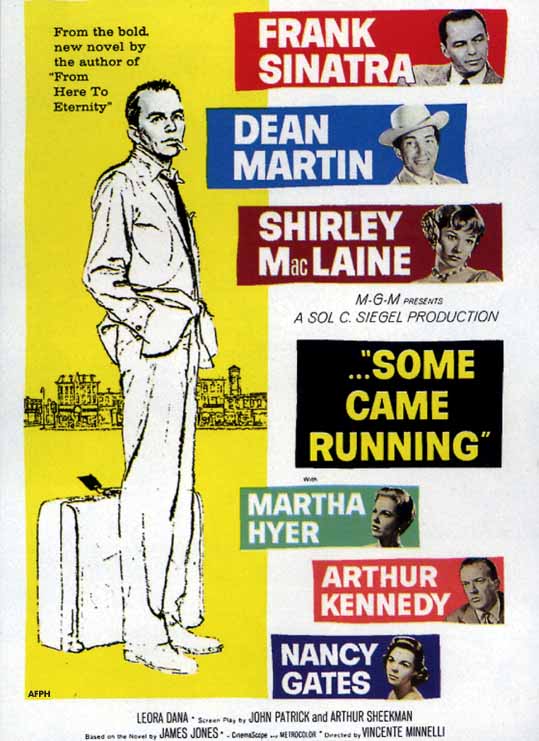
 When we first meet her on a long bus-ride with Frank Sinatra, MacLaine's character comes across as a pretty standard-issue "free spirit," and it's hard to fix exactly why she hops off with him, uninvited, in his home town. From there, this lengthy, deceptively simple drama will keep MacLaine's character waiting in the wings, and she holds out beautifully until her brilliant closing moments: once everyone else has tied their love-lives into intransigent knots, Ginnie figures it might finally be her turn. Actress and character seize their chances in perfect synch. MacLaine's lovely in her frank prostration before Martha Hyer, and she's truly sympathetic in the film's unexpected finale. All in all, she unearths the human being inside a Kooky Sprite.
 I'm all for actresses having stellar breakout years, and Teresa Wright is such an instantly likeable performer—charming and lovable, while always communicating a sincere thoughtfulness—that I hate to begrudge her anything. She even goes far toward redeeming the "meet cute." Still, this is a supporting performance that, like everything else in Pride of the Yankees, is relentlessly keyed to reflect further glory unto Gary Cooper's Lou Gehrig. It goes down easy but lacks weight and insight, virtually by design.
 In yet another winning pick from the
  Elated to see a play that survived to the screen with its essential character intact, I also gave the DVD of